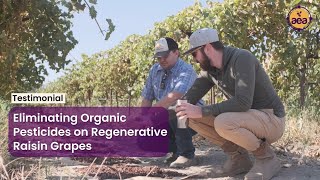
Steve Cardoza, an organic raisin grape grower in Fresno, CA (owner of Cardoza and Cardoza Farming Company), describes transitioning off pesticides since 2018 and running four complete seasons using only nutrition-based controls (AEA foliar program). He shifted to cover-cropping every row and reduced tillage to increase soil organic matter (noting ~0.25% SOM increase in sandy soils), improve water holding capacity, and sustain canopy health. He reports higher yields and quality, reduced severe pest impacts (previous spider mite outbreaks causing 60–80% canopy loss), and growing interest among other growers.
Questions this video answers
2018
300 acres
Four complete growing seasons
About 0.25% (a quarter of a percent)
Upwards of 60% to 80% canopy losses
Chapters
I'm really proud of being able to say that we're not using pesticides anymore. I've not sprayed anything with the word side in it since 2018. So now this is our fourth complete growing season where we've not utilized anything other than nutrition to control of our disease and pest pressure. I get a lot of really positive feedback about that and that tends to drive me further in that direction. Like if I can do it, then I can help other people do it. My name is Steven Cardoza. I'm an organic raisin grape grower out of Fresno, California and I own Cardoza and Cardoza Farming Company, work with my father, Dwayne Cardoza Ranches, and we farm 300 acres of organic raisin grapes. Prior to using AEA, we had obviously Carlos mentioning we were using pesticides and we had a totally different nutritional program and testing program. It was basically a complete upheaval of our old system to what we're doing now. And that entailed our soil management practices shifting a bit. We've always used cover crops, but we used a little bit lesser rate. And we were doing it every other row to leave like a barren row to put all the prunings and shredded and all the off season maintenance. So we've shifted from that to to cover cropping, every single row. So that's really shifted our soil organic matter starting to increase. And the vineyards obviously look a lot differently because there's cover crop in every single row. Then we've also shifted from a really heavy tillage process to a mowing process. So trying to be less like invasive to the soil profile. But that's all with the objective of harnessing our soil in a way that we can be more efficient with water. It can have a greater water holding capacity. And that's working right now. Like the vines that are behind me have not seen water and probably 20, 22 days, I want to say, and they still have a green canopy. There's still little bits of new growth, but you can see and I attribute that to not using like a French plow and really cultivating underneath the vine and letting the middle stay untouched for the entire growing season until we're getting ready to harvest. So I have seen increases in our soil organic matter like a quarter of a percent over the last few years, which sounds like a really minuscule number. But given our extremely sandy conditions, any type of increase in the soil organic matter is really going to have a positive net benefit to your operation and your water use. I'm seeing plant responses like canopy Staying greener, us maintaining that pest resistance even throughout the times we're limiting the irrigation cycles. So yeah, there's been a big shift in the overall health of the plants. As we've done the soil health practices in conjunction with the AEA products, our yields have gone up, our quality has also gone up, which are not those lines usually, you know, are opposite of one another. As the higher yields you get, your quality tends to depreciate. So that was a, you know, surprising benefit and something we're really pleased, pleased about. The, the pest pressure is really the biggest one and the, the canopy vigor, when you deal with severe pest pressure then it usually causes like problems beyond that year. You know, you're not going to just, if you have a canopy loss, it's not like, oh well, it's bad this year. No, it's going to devastate you next year, maybe even two years in the future. So we've had these, you know, highs and lows with our, with our yields and our quality and that's kind of flattened the curve of that. And now we're like, this year is our down year, traditionally would be our down year. So we have a little bit depressed yields from last year, but it's nowhere near what we were experiencing before. And we're still managing like we're still profitable and still doing well with even the diminished yields this year than we had a year prior. We were really having significant, severe challenges with the spider mite and having upwards of 60 to 80% canopy losses on some places where the infestations got really bad and the organic pesticides weren't cutting it. The way that John describes it really resonated with me with like the way that insects attack plants is they look for the weak ones, right? They have like this light that's on us saying come in and feed off of me. And you got to figure out how to turn that light off. And you're doing that through nutrition. We're still not where I'd like to be long term, but massive, massive progress to the degree that we don't use pesticides anymore. So we're just kind of ramping up what we're doing. So where we used to spend, you know, X amount of dollars, we're now doing X + five digit number and then scaling that forward going on. So that's the plan for right now. And then eventually we'll start incorporating the soil primers and whatnot to try to get the full scope of what AEA can offer. We starting primarily with the foliar program to tweak and balance the imbalances that we were experiencing. I'm still a realist, certainly I still see the very real challenges that we're facing. But something that gives me some optimism, I think, is feeling like there is a path to being independent from the sources that are driving the challenges, which is, in my opinion, you know, heavy pesticide use, heavy herbicide use. A lot of these things are driving greater challenges for the grower. And I feel like the regenerative model is going to remove you from that cycle and you can be more dependent upon yourself and you can source your inputs from, you know, sustainable sources such as aea. Utilizing and remove yourself from the treadmill, I think, is something that needs to be a primary objective for all growers. Reception is starting to shift a little bit. Starting. You can see the gears working with some of these growers thinking, I don't like the weeds, I don't like this and that. I don't know how I feel about COVID crops. But it's hard to argue with the way the vines look. And the one thing about the raisin industry that is a bit unique is your yields are undeniable, right? You. You literally take your crop and you put it on the ground. Anybody who grows raising grapes knows when it. What the trailer looks like, your approximation on your tonnage. You can also see by the way that the grapes, when they start to dry, their color will is indicative of how good the quality is. So you get like a bluer, purplish kind of raisin that's a really high sugar, high quality versus like a red raised in is going to be a lesser quality. So you can see these blue trays that are full, that are end to end or doubles or even triples in some places. You can't argue with that result. So that's where you start to see the shift from they farm weeds to what. How's. How is there so much weeds and there's still so much crop, you know, so that's nice and I appreciate that. I try to focus on making what I farm as resilient as possible to be able to thrive in the future and, you know, ride these waves and these challenges that we're going to be experiencing, you know, as a community and be able to withstand those. Those pressures as best as possible. And that's why I feel like going all in with the regenerative model and trying to drive up like my soil organic matter in particular, to be able to hold more water, because that model is going to be really impactful and will drive success for the whole agriculture industry.