Episode 128: Scaling A Regenerative Dairy Farm with Blake and Stephanie Alexandre
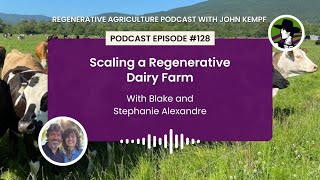
Interview (YouTube) hosted by John Kempf with Blake and Stephanie Alexandre of Alexandre Dairy (Crescent City, CA). They describe their fourth-generation dairy background, starting the current ranch in 1992 (~500 acres), and growing to manage ~9,000 acres across three counties with five milk barns. They run a pasture-based dairy system, a sizable pasture-raised egg business (peaked ~50,000 hens; after 2022 avian influenza now ~20,000 birds producing ~15–18,000 eggs/day), and launched a retail organic A2, grass-fed dairy brand in 2017 (notable attributes: A2/A2-only herd, 6% butterfat whole milk, expanded SKUs including kefir, yogurt, sour cream, butter). They pursued regenerative certification early (participants in pilot programs; among first certified by Regenerative Organic Alliance and Savory/EOV) and use practices to build soil organic matter (reports of fields rising from ~2–3% OM to ~12–15% OM over decades). They emphasize decommoditizing products, direct-to-retail branding, financing challenges (betting the farm on the brand; term sheets that did not close; banking covenant issues), and advice for other farmers (be prepared to invest, seek funding, and 'dare to be different').
Questions this video answers
1992 (bought ~500 acres).
About a little over 9,000 acres across three counties; milk cows at five locations.
Launched in 2017 (brand hit shelves ~2017).
Approximately 6% butterfat whole milk.
Expanded up to ~50,000 hens (peak); experienced avian influenza in September 2022 that wiped flocks and forced composting; current flock ~20,000 birds producing ~15–18,000 eggs/day.
Chapters
Hi, friends, this is John. Welcome to the Regenerative Agriculture podcast where we have all kinds of fun conversations and you know what they're all about. If you don't, you can listen to the history. I'm delighted to have a conversation today with Blake and Stephanie Alexander from Alexandra Dairy in Northern California. They've been good friends. I've known them and known about their operation for quite some time, but I've never had the privilege of visiting. But I keep hearing lots of great things about the work that you're doing and how your operation has evolved. Can you tell us a little bit about the history, the pathway, what has your journey been like and the scope of the work that you're doing today?
Sure, John. First off, thank you so much for having us on. It's an absolute honor to be part of your podcast. I really, really enjoy it and a lot of people do around the world. So we are coming to you from our home here in Crescent City, California, which is the extreme northern part of California, where our ranch is actually just three miles from Oregon. And we're right on the coast. And so we can hear the waves from our back window, our bedroom window, and it's a beautiful setting. We have green grass 12 months out of the year. We do have a dry season right now for about five months, so we irrigate. But we're in a beautiful climate that is absolutely meant for growing cool season grasses and grazing cattle. And we're also right on the edge, the northern edge of the redwood forest. And so. So it's just a wonderful little fog belt right here on the coast.
And Blake and I are fourth generation dairy farmers, both on our mother's side. And our fathers both immigrated from European countries when they were teenagers. So we grew up really with immigrant parents and just a lot of things on the dairy and work ethic. And I grew up with a mom that was always outside with the calves or on the tractor farming and things like that. So we are both passionate. God gave us this passion for dairy and I prayed I'd marry a dairy farmer and found him at Cal Poly San Luis Obispo, where we both attended college.
That's a wonderful story. Did you, did you start your dairy farm on your own? Did you take over one of the family dairies? How did that come about?
A little of both. But where we live now, we started on our own in 1992. We bought like 500 acres. And then it's just been growing and growing here in Del Norte county, which was 100 miles north of Where I grew up down in Ferndale, which is where my great grandfather on mom's side had started farming about 100 years ago. And our oldest son Joseph and his wife run that farm now and oversee that operation. And that's our one of our hundred percent grass fed milk dairies. And anyhow, so yeah, we've done a lot of growing on our own. The farm that I grew up on that my dad had actually leased for 38 years, it's no longer in our family. We never really owned it. And so I had this desire always to own land and I just kind of had a burning passion for that for a long time. And then of course that's now morphed into taking really good care of the land and being a great steward.
We were really fortunate right after we bought this ranch and we got a lucky deal where the owners financed because it was a kind of a bigger dairy. It was milking around 1,000 cows and just really, you know, big for a grazing dairy. It wasn't a grazing dairy at the time. And we befriended a agronomist, John Schneider, and so he is the one that really opened our eyes to organic matter and do everything you do to watch that organic matter and improve the organic matter. And that meant do no harm to the soil. And so we Learned that some 32 years ago.
Bring us flash forward to today. What is the scope of your operation today? And you have some very unique things that you're doing with grass fed production, with a 2 production, so forth. Tell us a little bit about your branding. It's like you have, you have a pretty awesome story of the full scope of everything you have going on.
Yeah, we do. And sometimes just telling it makes me tired. So, yeah, we've always been a bit aggressive in terms of trying new things. I was in a leadership program 33 years ago that California Ag leadership. And it really taught us how to think outside the box and not to be afraid and kind of dare to be different type stuff.
Was that with Tim Lazell?
Yeah, absolutely. Yeah. Yes. And Tim. Tim was Stephanie's college advisor. College advisor, right. And then Tim and I knew each other at college as well, he was teaching there. But we had so much in common, both the SAG backgrounds, FFA stuff. And so, yeah, then I spent two years with Tim traveling literally all over the world. And it was just wonderful because we learned a lot. In fact, I was with Tim LaSalle the day we walked on the beach with Alan Savory back in 1995. And Tim quit his job and Went to work for Alan back then and it was just the three of us walking on the beach in Santa Barbara, drinking wine. It was really an awesome experience. I was happy just to be a fly on the wall in that conversation.
Yeah. Tim has impacted so many people. When I think about the who are the significant movers and shakers, particularly in agriculture in California, the number of people who Tim mentored is remarkable. It's a majority of the people that at least that I'm connected with at a distance.
Yes, absolutely.
Yeah. And it was back in those days in the 90s where we were listening to the Ellen Savory CDs and Blake Read the book and was really getting into desertification and what that was and why it was happening and what we needed to do. Good.
And of course, as I read that holistic management book, it absolutely confused me. I didn't understand anything I was reading. I was a very poor reader. Unlike you, John. I did not grow up reading. My dad didn't read or write and he was my hero and I was totally good with that. So let's go back to the scope of what we do and kind of the big picture. So we are managing about a little over 9,000 acres in three counties. So the two coastal counties is where all the animals are and we've got an inland hay ranch of a couple thousand acres of irrigated alfalfa. And here on the coast, we milk cows at five locations and they're all old milk barns. There's nothing fancy about what we're doing. It's. It's rather scrappy, if you will. Our newest milk Barn is about 45 years old and you know, everything we do is a grazing based operation. My, like I was saying earlier, My grandfather started 100 years ago, but we've always been a grazing dairy. You know, even during all those conventional years, grass fed production has always been what we do with a little bit of grain. When Organic Valley was starting and 100% organic program, we actually went to them and said we wanted to start one and we'd like to. We'd rather do it with them instead of without them.
100% grass fed, hundred percent grass fed.
And we were their very first grass fed program where we had two of our neighbors with 100 cows each. And then we had about 500 cows on the program and started their first route. And that was fun. That was really encouraging because we nutritionally, we knew it was the right direction to go for people and we just had to figure out how to do it for cows. Right. Because we've had these dairy cattle that we bred in the US that really don't like grass fed production. And so they're not adapted to it. Yeah, absolutely not. So we produced milk for them for three years under that program. Then we actually found a much higher priced market for the next six and a half years where we were supplying a Trader Joe's yogurt and getting paid really well for that. And during that time, towards the end of that, we started our own brand. And so our brand hit the shelves about seven years ago, almost eight years ago coming up. And I don't know, Stephanie, why don't you talk about kind of the ag program and what got us off the farm and a little bit into the.
Marketplace when we traveled to Pennsylvania and met up with Hugh Carmen and we'd already been learning from Jerry Bernetti and Getting to know Dr. Paul Dettloff through the years. But anyway, when we traveled to Pennsylvania, we went to Roman Stolfas farm and he was showing us, he was showing Blake and the our boys the egg business. So we right away came home and took an old hay wagon and made a portable chicken coop. And really we were raising kids and we would go to farmers markets. At the time we had a raw milk program at our farm just really passionate about. And I was a Weston A. Price chapter leader. And so just doing it and living it and in the sense of raising kids, it became a full fledged business. Whole Foods found us when somebody's child was graduating from Humboldt State. They saw us in local markets and we laughed and said, no, we're dairy farmers, we're not starting an egg business. And then a year later we're in Whole Foods and the kids were just in junior high. By the time the kids were in college, Costco was calling us and we gave a presentation to Costco's management team of 48 store managers on organic animal husbandry and what it entails. And Costco didn't know their biggest customer was organics at that time when we did that, and I think that was in 2015, 14, I don't. But it was just neat to be a part of the growth of an organic program. And then we would go to the Expo west food shows every year because whether it was Rumiano Cheese, Humboldt Creamy Organic Valley would invite us. We were a dairy farmer that walked the talk about organics in our kitchen. The cows, the grass, everything we were trying to learn and stuff was for real. And they were seeing us seeing that. And while we were there, we ran into two Employees of a big chain. And they said, hey, we want to help some farmers start a brand. We need some innovation in the dairy case, this and that. And they came to work with us full time and helped us. And that was in 2016, when that happened, and we launched in 2017. It was pretty scary, exciting. All of the above.
Yeah. Our goal was really just to bring organic A2 milk to the consumer because nobody else was doing that. We tried hard to get the A2 corporation out of Australia to do it, and they just had no motivation because they were already making a huge margin on conventional milk. So we just decided to do it. And because we had that little bit of a retail experience with the eggs and confidence. Yeah. You know, there's a quick story I'd tell. Probably 12, 14 years ago, we got invited to Stanford Research Institute, or it was actually Stanford it in food program. 400 people. They asked our son Christian, who's kind of always led the chickens to speak, but he was busy at an APPA conference or something, and so I went instead. And the subject was, why $10 eggs back then? So they wanted to know why we're selling, you know, $10 a dozen. E. So I drove the 600 miles thinking, thinking, thinking, what is the answer? So the answer I came up with as I presented to this group was consumers have a right to pay more, to get more. And so out here in California, we've got a lot of large city folks that they want what's best for their family, they want what's best for the planet. And then some of them just absolutely want, nutritionally, the best product. And so we're trying to take the hard road at every turn and work as hard as we can to make sure our chickens are on fresh, green grass 365 days a year, and they're making an egg that has true color and different nutrition pattern. And before we had our own eggs, I used to think an egg was an egg, and now I absolutely understand and can taste the difference. And so that whole experience and that concept is really what motivates what we do.
And you also learned at that point, consumers have a right to pay more to get something better.
You know, I think there's something fundamentally wrong with a worldview that comes up with that type of a question. It seems to me, when we consider the macroeconomics of paying farmers well and what that means for the rest of the economy and what that means for nutrition and human health outcomes, a better question is, why $2 eggs?
Right?
Exactly.
Yeah.
Yeah.
I love that about your thinking, John?
Yeah. And I walk in the grocery store and stuff, and I'm always shocked at what people put in their grocery cart. I'm just shocked. It's like, don't they know that's making them sick? Don't they know that has red dye in it? Don't they know this, this, that? And it makes me sad. I look at the schoolyard and that's, that's where my heart really bleeds for these children that are so unhealthy in the obesity crisis. We live in one of the poorest counties in California. It's number three at the bottom. And you see that in their health. You really do. And that's where we want to make a difference right on the home front, right in our community.
Yeah. Our culture in this country, you know, is not educating people appropriately. You know, we've got media that has an agenda, we've got marketing that has an extreme agenda. And nobody on, you know, mainstream is saying for health and nutritional health, you need to go to the farm and not the pharmacy. And, you know, if we could just get that message across to people, you know, I know our world would change. People could start to think clearer, they'd be healthier and, you know, everything would be in harmony as opposed to what we have now.
And we learned that quote, go to the farm instead of the pharmacy. When we were at an acres conference in 2003, that was when our world just opened up. And Blake bought Gary Zimmer's book the Biological Farmer. I stayed in a whole day class with Sally Fallon and learned about Weston A. Price principles. And we really just core level felt purpose in what our role is for the kingdom on nutrient dense food and where food should come from. And then God took care of the rest. And we just prayed we were following God's will. There were scary decisions about Blake wanting to buy a ranch or something, and I was always scared, but I had to trust him and, and pray about it and just release. So, yeah, doing it, doing it for the food system in our nation.
Yeah. The other awesome mentor that we met at the very first Acres was Jerry Bernetti and became close friends for a lot of years. And, you know, it was just. He was, you know, the, I'd say the one that really opened mind up the most to phytonutrients and everything that's involved and how the soil really works. Yet it was subtle and it was just, it was very good.
Well, you've had a fascinating journey with lots of learning along the way, but you Know, I want to dig into a bit more into the organic A2 milk. But before we go there, you've mentioned the egg business, but you haven't given us any indication of scope or scale. How is that still operational and what does that look like?
So we've got five children, all born in the 90s and we started the egg business. So Roman Stolfas and I were, we Met in Washington D.C. testifying at a congressional hearing on pasture. And then he invited us out and so a few months later we happened to be able to make that trip in early 05. And at that point his second son I believe was running the program and my kids were seeing it and they're gosh, 10, 11 years old, 12 years old. And it was about raising K. We came back to our large scale farm, if you will, and decided that we were going to raise eggs with our kids. We're going to call it Alexander Kids Eggs and no employees are going to be involved. And so it was just kind of a sink or swim project for the kids. And we started with 150 birds and then that kind of grew to 500 birds. And we converted a whole old hay wagon into a mobile coupe. And then we just kept evolving from there. And then we had this idea to do these three sided lean to sheds on skids and park two of them together, call them the building called a chicken coop. And that could house two or around 1500 birds. We built three of those. And so while our kids went through high school, if they were hooked up on that a lot and when other.
Kids are out, that's an interesting verb, hooked up on that. That's much better than some of the things they could have been hooked up to.
Exactly. And that's, and that's why I use that word because they weren't hooked up in town. And we had set a goal when we just with our first two children were born and we bought the ranch. We were gonna raise naive rednecks. That was our goal.
I don't think you qualify as naive redneck parents. I think you've.
Yeah, we're just faking it here, John.
Yeah. And also one time I said, why aren't you guys out on a Friday night? You know, do you go, you know, with your friends and stuff and one of the kids go mom, you don't want us out there.
Wow.
And it was like, wow. That was, you know, gives me the chills. We raised great kids, right?
And so they would literally bring kids out and they'd be at a campfire at the egg ranch or vaccinating chickens till 10 o' clock at night with a bunch of their friends, things like that. And so that was just a really neat experience. And so then our kids start going away to college, which is 600 miles away, and then one's there, then two, then three. And then our oldest stayed to get his MBA. And so then we had four kids at college and all the pressure the chicken coops were was on me and a fellow we had just hired to kind of assist. And so I'm delivering eggs every Tuesday and that's like a hundred and some mile one way trip and then hauling cattle and calves to the market and things like that. But during that time, our son Christian, number two, was writing a plan to expand to 30,000 chickens. And so that was his senior project at Cal Poly. And so when, as soon as they started graduating, three of them came home within a year period. And we really expanded. We went to 30,000 and then we built for 50 or 60,000 hens. And so we got up to that 50,000 mark here about three years ago. Then we got bird flu in September of 22, which was quite the learning experience. So government comes in. By the end of the week, all the birds are dead and we composted them. And then we came back from kind of the ashes of that mess. Over the next probably four or five months we started. We bought four truckloads of spent hens out of Wisconsin and got back on the shelves. And so today we're making about 15, 18,000 eggs a day with 20,000 birds or so. We've got 10,000 young ones in the brooder barn right now, and we have about half the employees we used to. We sell our eggs for about $8 a dozen off the farm instead of six. We decided it was going to be a profitable venture this round. And it's. It is who we are.
Thank you, Blake. That's a very interesting story. When you say we decided that's going to be a profitable venture this round. This is, I think, one of the prevailing themes that I observe over and over is that farmers tend to not value themselves. And I use that phrase very specifically and very deliberately and consciously. I didn't say farmers don't value their product. I said farmers don't value themselves. And that is reflected in how they price their products. And so kudos to you for doing that.
Yeah, thank you, John. It's. Yeah, I get a little tingly inside just hearing you talk about that, because it's so true. A friend here A couple nights ago, his daughter's adopted a calf here and. And working in our bucket calf program. But he was in the house here and we were visiting and he, he runs a little CSA and, you know, market garden. And, you know, he kind of got big and then he's now downsizing. And I'm explaining to him what I'm listening to. And I think some guys that you've interviewed and how they're, you know, super profitable at a smaller scale with less acres. But bottom line is I'm talking to him and he needs to price his product higher. And he's like they're shaking his head and looking down. The typical farmer attitude, like, I don't want to be, you know, aggressive or I don't want the spotlight shining on me or something. And it absolutely is inherent in all farmer operations. And we got to get over that. You know, our products need to be the highest price out there. That's our marketing program. That's our message to consumers, that we're the best. And of course, then we have to back it up with taste and nutrition and the story.
You know, there's. One of the books that I've frequently recommended in presentations to farming audiences is Secrets of the Millionaire Mind by T. Harvaker. And it's fascinating to observe people's reactions. There is a large subset of people in the farming community who have an allergic reaction to the title alone. Yeah, I'm not a Millionaire, I Don't Want to be a millionaire. That they have this aversion to the idea of wealth. And that aversion is associated to self value, the perception of self value. And I've even said the greater your aversion to the title, the more important it is that you read the book.
I totally agree.
So true. And raising our kids here, we knew, you know, cash flow and stuff. Dairyman deal with a lot of money, and then the egg business starts. But we didn't want to be looked at like the rich people in town. We drive old vehicles, old pickups. We're still in the same house. We raised our kids 1800 square feet and used every square inch. You know, that kind of stuff. But to the market, we do have to take care of things financially along.
The line of that book. I don't know why, but this has been in my mind for a long time. Quite a few years ago, Stephanie and I were at a conference and I don't really remember where and when and why it was, you know, it was somewhere, I think in Minnesota or something, and we, we Walked downstairs to a little bit of area there, and these two guys were talking about billionaires, as if one of them, like, knew some billionaires. And a very serious conversation. But the statement was, billionaires don't worry about the little things. Now, this is me paraphrasing, but, you know, I've kind of been obliviously, you know, running through life, not walking, but running and, you know, buying ranches, doing things. And I certainly don't worry about the little things, even though the details are extremely important. I want to maybe just throw this concept in. When I was little, when we had two channels of tv, my favorite channel when I was in the house was our favorite show to watch was Mutual of Omaha's Wild Kingdom. And Merlin was once Merlin Perkins, I think was his name. Call 800228 9800. But Merlin was. Jim went in. We sent him in three days ago. I'm catching up, blah, blah, blah. And he's talking about, you know, leopard eating this animal or something. And he made a comment that said that animals aren't burdened with the knowledge of knowing that they will someday die. And that just hit me so hard. You know, I'm like 10 years old or something. First off, I didn't know if it was true. Right. Because who knows what animals are really thinking? And. And so I've been watching animals ever since, wondering, do they really know? And my answer is, yes, they do, Especially watch a buffalo die. And then the concept was that I just decided I'm not going to burn myself with the knowledge of knowing that I might fail or that my decision might be wrong. And so I literally just focus on positive things and move forward. And then I married Stephanie. So she's got her foot on the brake and I'm on the throttle.
That's right.
Wow. Thank you, Blake. So let's come back to a 2 milk. You drove the. If I understood correctly, either maybe at the beginning of this conversation or at some other point, you were the first to bring organic A2 milk to the market in North America, at least in any significant way. What motivated that? What drove you to go in that direction?
Well, we had been studying A2 ever since the book came out. Read about it in Acres usa.
Bought the book the Devil in the milk.
Yes. By Dr. Keith Woodford. But our motivation was the people encouraging us to be out in the market. We already had been talking to our dairy buyers. You guys should do this. It's real. The science is real. I was researching the studies and this and that. And I know it was all funded by the A2 Corp. But it made sense. If you can drink goat milk and you can't drink cow's milk, there's some truth there, what's going on. And so with that and the experience of having an egg brand in the market, we decided to go for it and do. We also felt like we were young enough to do it ourselves instead of waiting for the kids to do it. We didn't know if they would or not because it is a scary adventure.
And I would try to offer up to your listeners the perspective from a California farmer, a scary farmer, primarily right here in California. We pound our chest louder than the rest sometimes. And we had the California Milk Advisory Board with the Got Milk ad and, you know, happy cows and things like that. And those things kind of always subtly kind of bother me. And you know, I try to look at it from my say, a Wisconsin perspective because we've got a lot of dairy friends in Wisconsin and what they were saying and doing. And once we learned about A one that's in the milk, the devil in the milk, it's like you can't unlearn that. It's like, now what in the heck are we going to do about it? So we're trying to explain it to people. And of course we'd already made a decision to kind of, you know, run upstream, if you will, as an organic farmer. We were the only the ninth dairy in California to go organic back when we did, and there were no markets. And so we helped create this organic market in Northern California, which was successful generally. And then we had this burning desire to get the milk right and to help consumers again. They have a right to pay more, to get more.
Then also in considering, you know, the consumers needed a better product in the a2 organic milk. But also there were many boxes we could check. We have riparian zones. We've fenced off and planted a lot of tree. We have a coho salmon story. We had a bald eagle nest for about 20 years, it seemed like. And it's basically build it and they will come. As we did regenerative practices as we learned what we were learning. More frogs. When you left our ranch, there were no more frogs. It seemed like on a rainy day, crossing the road at night. Just all these stories of our ecology, where we lived. And we thought we had a beautiful story to bring people back to Dairy one. It's digestible to the surrounding what we're taking care of and can tell that story of the Aleutian Canadian yeast that used to be endangered. Now they're 100 species. And they used. They would always graze on our ranch and we were part of their comeback. And then say, and by the way, we're dairy farmers and this is how we do it.
You had your own personal journey. You read the book Devil in the Milk, you started learning about A2 versus A1 proteins as you brought this product to marketplace. What has the market interest or the market appetite been from consumers and from wholesale buyers?
Yeah, it was, you know, it was a big boulder to push up a big hill for a long time. And so we launched in 2017. So those next three, four years, we spent all of our free time as a family with our kids and, and others and their spouses or friends out doing demos in stores because somebody had to tell the story. And that went on and on and on until Covid hit and it was time to go to like phase two of launching a brand.
Yeah. And fortunately there was PPP money from the government and I feel like that kind of saved us a little bit because I think if we would have given up, we would have lost everything, the farm and stuff, because we bet it all to start the brand. And that was scary. So on the. But the A2, the receptive thing, it was really neat as people said, oh, I can't do dairy. And we would give them a free 12 ounce sample and give them our card. You know, call me personally, let us know how you do. And they would. Or they would email. Wow, I couldn't do dairy, but I can drink yours. And that was really exciting. We even ran into somebody who said I was a raw milk drinker and moved to an area where I couldn't get raw milk anymore. So I bought your product and wow, I can digest it like I could the raw milk. But also my autoimmune disease disappeared. She was dealing with eczema and dark circles and, you know, so with that foreign protein even still prevalent in raw milk. So for your listeners who drink raw milk, make sure it's A2. The A2 is a big deal.
Well, the three of us in this conversation have read the book. We're familiar with what we're talking about. But actually, let's go back to the basics a little bit. What is A2 milk and why does it matter?
A2 refers to the digestible protein in milk. It's a. All mammal milk, historically was a 2. Breast milk is a 2. So we're raised on it. If we're breastfed. Goat milk, water buffalo, a lot of the boss Indicus or the Boss Indicus variety of dairy, which is prevalent in India, is all A two, like the Brahmas and stuff. But European breeds had a mutation and somehow it got bred into several breeds. We've raised and tested a lot of Jerseys and people say, oh, Jerseys are A two. They're not. So anyway, it comes back to the digestible protein. We do a DNA test on the cow or the heifer and we find out, is she A2, A2 or is she A1, A1 or A1 A2. So we only milk cows that are A2 A2 DNA. And that's why on our brand we say A2, A2.
Yeah.
So simply put, they inherited the A2 gene from both parents. And the A1 gene, the mutated gene, is a. There's a histidine where there's supposed to be a proline on this 209chain amino acid. And when that histidine is there, this little seven chain thing doesn't break down. They call that beta casein morphine effect. And it bothers people. And so, you know, once you understand that that is simple, that is truth, even though it wasn't scientifically replicated at some university. When we read that and we started to promote that concept by telling people, you know, we got a lot of flak and a lot of arrows in our back because, oh, it's not real, it's not this. And it absolutely, this is truth. And so when you just boil it down to the truth and you understand why people get a tummy ache from drinking dairy or eating dairy, it's like, wow, we could just fix that. Drink this version, not that one.
So we do hear a lot of people say, oh, I can't do dairy, I'm lactose intolerant. We explain it and then they give it a try and they can drink our milk. So it wasn't the lactose at all. What happens when that protein chain sits in your gut? It kind of just sits there and doesn't digest. And then that lactose is still in there, not digesting. It ferments in your belly. And that's where that lactose intolerant symptom comes from.
There's one other piece to launching our brand I think is important for listeners to understand. We had kind of two things that we would really promote and talk about. And we wanted to be a bit of a dairy disruptor. Not, not necessarily with the A2, but with what our offering was. And we went back to an old fashioned looking bottle that we had built it's a plastic bottle, but it kind of looks like an old milk bottle and cream on top and high percent butterfat in all our products. So, so we launched with a 6% butter fat whole milk. And so again we're giving consumers a reason to pay more to get more. And people responded to that. And we're not trying to go out and put a big dent in the market. We were just trying to sell to 1 or 2% of the people. That's all we needed was to bring premium pricing to our farm because we were going the extra distance to grass fed and graze our cattle and breed A2 cattle and all those things. And we needed to find a premium in the marketplace and truly get paid for what we were doing.
How large is your market distribution geographically at this point?
We started for the first three, four years just focused on the west coast, primarily the three western states. And I remember giving a talk to our team that there's guardrails here on these three states and we don't want to jump over the guardrail. We really want to stay in our region. And we did that for, like I said, the first four years. And then we decided to get some production in a ESL facility which is the extended shelf life or uht, the dairy industry. Ultra high temperature milk, which allows about a 90 day shelf life on a carton of milk which then we could couple up with our yogurts that had a 90 day shelf life and kind of reach out over those guardrails. And so we then started to go nationally into Whole Foods and a few other stores with just a handful of SKUs and that has grown and evolved. We came out with kefir two years ago that has done super well. And we've also added sour cream and butter this year. And so we, we now have more SKUs that can travel nationally. And so we're across the country and at about 3,300 stores, the high end natural food stores. So Whole Foods sprouts, natural grocers and all the smaller ones along the way. We're not big in the big retailers because we don't want to be. We don't fit in there as well.
Yeah, you don't have enough volume for that either. I would assume. So I am ignorant of esl. And the moment you say that you can have a bottle of milk that has a 90 day shelf life, that raises all kinds of reservations for me because I don't know. So what do the critiques of ESL have to say about that?
Yeah, so I travel to Washington D.C. a lot with Farm Bureau. And I was literally going every three months there for a lot of years. And I was sitting with our lobbyist who was a young mother in D.C. and she's like, oh, I would love to have your milk here to feed my kids. And we're all sitting out here in the west coast with these guardrails, imaginary guardrails that I drew on a whiteboard one day you know, saying that, you know, we're going to sell our 20 day shelf life or 25 day shelf life version of processed milk. That is what we believe is as close to raw milk as we could get. You know, so minimally processed vat pasteurized is how we primarily do our bottles. And so it's low and slow and it's very old fashioned. But to get across the country, as this young mom's telling me that she would buy my milk in any package. And so I'm not thinking of this boxed milk that's shelf stable. She goes, I would buy that, that's better than all the alternatives. And she's right. So again, consumers have a right to pay more, to get more, whether they live in Florida or New York. And so nobody else was bringing them an A2 organic version. And so we kind of bit the bullet and, and went to esl, extended shelf life, which is kind of a term that's used in the United States to, you know, put milk in cartons. And when you see a carton of milk, you can't tell if that was processed with a, you know, a 25 day shelf life or 80 or 90 day shelf life. And so it used to be a big deal 15 years ago and 10 years ago. And I would say now that less people ask about that because when fairlife came out with their milk that lasted on their shelf and my 70 some year old mom said, I like this one because it lasts, you know. And so I think the convenience of that has now overweighed the nutritional, you know, image that, you know, processed milk has.
Well, are there significant nutritional variations in a 90 day shelf life milk?
I don't believe so. Right. Edacious folks have done a lot of studying on our milk and others and we're still coming out on top. And I know they started in our carton milk and so, you know, yeah, perfectly. People should come out here and drink our milk out of the milk tank. But that's, that's not practical. So we have to find a path to, you know, again to get product to the consumers.
We were watching the shelves and Seeing, you know, all the growth in organic UHT milk and realizing that for a survival mechanism, this was a good move for us. Also knowing families that drank a lot of milk, just my friends and stuff, and I would ask, what milk do you guys drink this before we launched the brand and stuff. And, and they were just using, you know, just whole milk. For my kids, whole milk was their, their priority. They weren't looking was an organic. Was it, you know, uht, Was it fat pasteurized? This is my, you know, realizing consumers were buying UHT milk because it lasted longer.
Stephanie, you made an interesting comment when you were describing the development of the brand that you bet at all, you bet the farm to build a brand. Tell us a bit about what that was like.
Well, the first scary part in our lives is all of our milk went through Humboldt Creamery. It was a co OP. And in 2009, the CO OP went bankrupt and we were the biggest supplier of dairy. And we just lost so much. It took us about five years to get out of special assets. And one of the saving graces was Organic Valley took our milk. We lost our markets during that time. Everybody, all our customers, all ours, like our co op customers ran because there was fraud involved. And here we had started this whole organic market in our region. And even Organic Valley, George Seaman said, this is one of the only organic pockets that was started on its own, which was rightfully so. We have the consumer here in California. So we went through some really scary times where we almost lost it all and really, I mean, do that through that time, got really strong in faith and we were able to persevere. And then we got really healthy organic prices got really, you know, aggressive. In 2014, 15, we were able to catch our breath and stuff. And then when this opportunity came to control our destiny of our milk, and we already had the passion, we thought we could do it. We didn't realize how expensive it would be. We didn't realize we were with an ag production bank and they would get mad that we were involved in a creamery and brand. And then we broke covenants because we weren't cash flowing through it because it was all going to the brand to, you know, selling milk that you weren't getting paid for yet because you were just investing. And so it was quite a deal. We. And we also knew our purpose was, was for a food better food system because we had something more to offer, but also for our community and take care of our employees better and take care of our community. We would love to get our milk in our local schools. And my prayer was that we could be profitable enough to where we can sell our milk so cheap that every kid in our community was drinking our milk. Well, that's not answered yet, but we are sending a lot to the local food banks, and it's happening where a lot of families that wouldn't normally drink our milk are drinking it. So. But the question, you know, betting the farm, we still are, because we've not gotten properly funded, we always thought we could bring in an investor. We were doing the right things. Now with the regenerative story and the organic and nutrition, and a lot of the funders want to fund somebody that wants to start regenerative practices, or they want to fund somebody that wants to sell a brand that has a, you know, a great incline of sales, and we just haven't got that. Yes.
And I would just add to the story. So the Humboldt Creamery Co Op going down was a huge thing. My great grandfather was a charter member there. My grandfather was on the board for 20 some years. My dad was on the board for 30 some years, and I was on the board for two years, and it went bankrupt. And it was a big, big thing in our world. And we were 43% of the total volume at that point at this creamery that had become like the fifth largest organic brand in the US and we were quite proud of the momentum and that movement. And I think God weighed in and said, no, wrong path. And so kind of pulled the rug out from under us there for a while. We took five, six years to catch our breath. And it was really, really painful and hard, but a lot of self reflection and a lot of, okay, are we doing the right thing? And we do pray hard and try to, you know, kind of pick up the signals when we can. And so, you know, launching our brand and stepping out in faith, like Stephanie had mentioned earlier, we thought we'd leave that up to the next generation. And then when some people encouraged us to do it, we're like, what the heck? We're, you know, we're not that old yet. Let's make it happen. And so we kind of drug our kids through the process and they've embraced it. And the oldest three are now married and working with us full time. Number four helps out quite a bit. And number five still hasn't come home yet from college.
Thank you, Blake. You know, it seems to me we now live in a world where regenerative agriculture is kind of having its moment in the sun. There is a fair amount of media attention there's lots of conversations that are happening even within the mainstream agricultural community. And there are many financiers and investors and consumers who are very passionate and are talking a great deal about regenerative agriculture, but particularly on the investment and the financing side. It just seems to me that the actual level of activity is completely dishonest, disproportionate to the amount of noise. There's a lot of talk and not a lot of action. And so I'd love to dig a bit deeper into your experience. It would seem to me that you have an existing enterprise, a successful brand, and that you are the definition of an investable enterprise. If we authentically care about regeneration and regenerating enterprises and regenerating agriculture, then yours would be an outstanding and exceptional case study and an opportunity to actually invest and make a difference. And so I'm really interested in your story. What's the process been like for you to seek to raise investment funding and what has happened? What's been going on in that front?
Sure, it's a big question with a big answer, I guess. As we learned about regenerative, we were excited. We asked our oldest daughter Vanessa, to participate in the pilot program with a couple of groups. Those were three year programs where they had selected a handful of farms around the world, really 22 in one case and then about 12 in the other. And so we were part of these pilots for three years. And then we were launching that ESL Extended Shelf Life Milk into whole foods nationwide. And I told them that, you know, we're regenerative. And they're like, okay, that's great, whatever that means. Do you have a certificate? And no, we didn't, we didn't have a seal or a certificate. Got off the phone, called both of those groups and said, you know, are you guys ready to, you know, make a seal and a certificate? And so this was the Regenerative Organic alliance and the Savory Group, which was EOV Land A Market or, or you know what, EOB Ecologically Outcome Verified. So we became the first number one farm that they either group had ever certified. And so that made us the first regeneratively certified farm in the US and possibly around the world, I guess. And so pretty soon the today shows out here interviewing us and people are talking. And so we became this regenerative kind of example. I remember going to a meeting in San Diego. It was called Sustainable Brands and there's, you know, thousand people there and all these big companies, Shell Oil I think, had about 18 people there. Sustainable Brands. And I'm like, whoa, this is weird. There was one other farmer there, Austin, the fella from up, up north that you've interviewed also on your podcast, Royal Farm. Yeah, I can't think of his last name.
Austin Elred.
Yeah, There you go. So we didn't meet, but we were both, we were the two token farmers at this event. And I had a chance to sit on a panel and, you know, give about three minutes worth of something. But what's bothering me is that it's all these brands that are adopting the concept of regenerative. They don't even understand it. And the movements, like from the top down. And. And that just really bothers me because regenerative can only come from the bottom up. It's got to start in the soil and it's got to come from the farmers and the people that are caretakers for the land. So I've always had that in my mind. And so now we move forward. And now regenerative is really, in our eyes, just a new word to define an old system. And, you know, the first regenerative farmers were Adam and Eve, in my opinion. And we're now just farming in harmony with this system that our creator and God gave us. And so it's not a big deal. It's kind of undoing all this high tech, aggressive attitude that we've had, particularly here in the United States for the last eight decades. And so it resonated first with brands and companies and retailers, and then eventually it's worked its way down to consumers and farmers. And we've had the opportunity to kind of be a spokes outfit or farm for the movement. I find myself on the committee that is now attempting to define regenerative agriculture for policy and protocol here in the State Department in California, Department of Ag. It was really interesting. The last meeting I was going to a couple months ago. I'm driving down there, I'm listening to your podcast. You're talking to the fella in. Is it Pakistan, perhaps started talking about this committee that I'm going to literally be at in two hours. And so I passed that on to the committee. It's like they're talking about us in Pakistan. And a couple hours before that, I'd listened to a regenerative brands podcast and they were talking about this committee. And so this is real work that we're doing. And anyhow, so that's where I'm at today.
So, Blake, I'd like to bring you back to the question that I started this with specifically around you Bet the farm. You've had challenged banking relationships as a result of investing in a brand with an agricultural lender. You've sought to raise investment funding as I understand it, unsuccessfully. And my question is, given the outstanding example and spokes farm that you are, as you described it, why the lack of success is there? What's the reality of the investment world in regenerative agriculture and why is there not more activity there?
Yes, thanks for getting me back on track. Right. And so the funders then jumped in and said, hey, we want to fund that type of agriculture. Right. We're social investors, we're this, we're that. And so yeah, we, we started attending things that again, I got asked to speak at rfsi the it was in Oakland back then and this is probably five years ago. And it was interesting, it was fun, it was exciting. But we had a brand with our name on it. The only purpose that we, from our perspective, why did we start our brand was to bring value to our farm. And so we don't want to build a brand that we would ever sell because it's the purpose of our brand was to offer this premium market pricing back to our farm so that our farm is sustainable and long term into the future. We dairy in an area where it's hard to be a farmer. We're remotely located, surrounded by ocean and not a lot of people. So that was on our mind always. And so we, we had this idea that, you know, the brand is never going to be for sale. However, we thought that, you know, that shouldn't matter to the investors, that, you know, funding should be available. They can buy into our ranch, they can buy into our brand and we just need an exit strategy of some sort that would pay them handsomely. Because they all say up front they're willing. Not all of them, but most of them. Yeah, those are options. We're willing to do that. But then you just keep dancing down the path and pretty soon they're looking behind the curtain and there's a lot more stress financially on us than I guess it appears from the outside. And so we've never been able to strike a deal.
And we've had deals offered to us, we've had term sheets given and then they couldn't come with the money. And that's happened before. And then interest rates went high, so then they back away. Actually that's happened two different times. Where term sheets presented, they already looked behind the curtain. They understand how we did it. I mean we had to make a decision or I was making the decision Feed the cows or pay the payroll taxes. That's how we did it. And now I have a relationship with a Mr. IRS man. We took old used equipment and refinanced it because it was free and clear. And we were able to cash flow that we month and get through payroll. You know, did many of those to make it. You know, how did we do it without the cash flow? Just little things that we could do just to survive because we knew again, if we stop, we would lose it all. It felt like, at least in my mind, that we had to be prudent and resourceful no matter what it took.
There's this recurring conversation in the regenerative space that, of course, if you want to be a truly regenerative farmer, then you have to be financially viable. You have to be financially sustainable. And that means to decommoditize yourself. And decommoditizing yourself can mean a thousand different things to that many different farmers. This is the pathway that you've been on of developing your own brand and going direct to market. What advice would you have for other people who are considering developing their own brand and doing what you have done?
It's an investment. It is an investment way more than we ever expected. But if you're doing the right thing and to tell the story and operate with truth and passion, you know, make sure you're funded somehow, whether it's equity in your land and just there are surprises and maybe go in with open eyes. What did you say?
Yeah, yeah, yeah. It's not for the faint of heart. I do encourage people to ask us. I love giving advice to potential competitors out there. You know, it's kind of us against the big guys. You know, we don't look at another small brand starting up as competition. That's just helping build the momentum of what we're all trying to do.
We're all trying to fix the food system.
And it does bother me that I can think of about 10 friends that have started a little dairy brand that have shut it down. And so, you know, the secret to our success is this unwillingness to stop. And, you know, at one point, we're swimming across this monster, dirty river, and, you know, we're into the brand for $10 million, and the bank's saying, you know, you're now in special assets one more time, new bank, and, you know, pay us off, and we're like, you know, do we give up and, you know, to do this or, you know, or is that bank in front of us now closer than the one behind us? And so we made that decision, and we just kept dumping money and effort into our brand and doubled up. And so Stephanie used the term that we bet the farm on it, and that's absolutely real. And we did that without the bank's permission, apparently. I didn't think we needed to ask them because we always made our payments and did what we were supposed to do, but yet they kind of went woke on us and turned. And anyhow, we've now got a new bank that has given us again, an agreement to move forward. We haven't closed escrow on that, but we expect to next month. And so that'll be the first time since we launched our brand that we will be appropriately funded. And we really look forward to that day.
Really? Yeah.
Yeah. Wonderful. Well, you know, this. This has been a very important conversation, and I'm sure that many people will greatly appreciate it. One of the things that we haven't really gotten into is the farming aspects. The. The farm management, managing livestock, the quality of the nutrition that you're producing and so forth. And I don't know that we need to comprehensively go over everything that you've done, because the information, the things that you've done are also available in other places online. But I suppose I'd like to ask the question of what is it that you are doing, or what are the management aspects that you have learned, that you have developed that are unusual or that are unique, that perhaps are not widely known, that deserve to be more widely known and that would benefit many people.
Great question. It is kind of funny that I'm talking to my. My soil guru God here, and we hadn't even talked about soil yet. And so thank you for that question.
You shouldn't call me those things, by the way.
Yeah, I. I understand. But I do have you. I do have you on this pedestal. Pedestal. And, you know, you. You're the next.
That's going to be hard to fall down from that. You know, it's going to happen sometime.
I know. I. That's. I'm turning the pressure down.
Pedestals are unhealthy places to be.
Yeah. You're the next generation, and you're going to carry this ball for a long, long time. And I remember your very first podcast or two that, you know, your goal was to document this stuff, and so that's what I'm trying to get to here. So the things that make us say different from our neighbors in terms of permanent pastures, grasses, the fact that our soil is, you know, the focus on organic matter that we learned about 30 some years ago, which is truly just building the sponge in the soil and conserving water and extending that wet period for the plant have just served us really, really well. And so, you know, the concept is do no harm. And then eventually this awareness of biology comes along. And once we dug into that and focused on the microbiome of the soil and the bacteria and the fungi and, you know, everything that's involved, it really helped us to manage what we do. And so now we graze taller grass. We don't eat it down as hard. The EOB Land of Market group comes in and evaluates our, our management every year. That's an extremely helpful tool to tell, you know, kind of thumbs up or down whether we're improving year over year. And so we have developed what we call a kind of a field facelift where we pick our 20% of our land. That's the worst. And I do that at about 30 to 40 miles an hour in a pickup. I don't really. So I'm, I'm not tested, I'm not testing, I'm probably guessing and I apologize for that. But you know, we're slowing down to micromanage, to learn. But it's pretty obvious where the lowest 10 or 20% of your land is. And so then we tend to overgraze that down, get it short, apply compost, we call it a 3x treatment compost, airway and harrow. And then broadcast new seed over it using a little four wheeler. And so yeah, we run 6,000 acres and we seed with a four wheeler and a little herdsman electric spin spreader on the back. And we do that. And that has served us well. NRCS has come along with some programs where healthy soils program where then they, they kind of require you to do the same land three years in a row. And that's been a wonderful experience to learn that. Wow. You know, three years of compost and treatment really helps. One makes a big difference, but three really, really sets that. And I'm thinking of a piece of land here right behind me, 100 acres or so that we used to 30 some years ago when we started the ranch, we irrigated it every eight days during the dry season. And that would have been 15 to 20 times passes of irrigation. A lot of labor, a lot of water, a lot of pumping. Now last year we irrigated it three times, saved a bunch of labor, bunch of water. And we didn't sacrifice yield. It's still green all the time and lush and growing and it's just really fun to see that happen over the last three decades.
Wow, that's an impressive. That's a, that's an impressive story.
Yeah. And in fact, when Vanessa got out of college, this is another story. And I don't know what year she graduated about eight or ten years ago, but John Schneider and I took her out on a four wheeler and taught her how to test, you know, do soil sampling. And you know, I use a probe, he uses a shovel. Point is just get some dirt and representative samples and, you know, put it in a bucket, blend it up and then send a sample off. And we were, you know, our goal was to test about every five years. And so she's, we had not done that in a long while. While just kind of got busy and we just keep growing with more land. And so that same land that I just spoke of was 2 to 3% organic matter 30 years ago, and today it's 12 to 15%. So.
Wow.
We are building organic matter through our grazing adjustments, right. Tall grass, you know, growing deep roots, grazing it off quickly, intensely with, with our cattle and polywire. So we run about 30 grazing groups of cattle and that could be a hundred head to up to 500 head. And milk cows get a new set every 12 hours. And, you know, dry cows and heifers get a new set about every two to four days. And we never go over six days as our rule. But we, we have to, you know, we're not moving cows four times a day just because it's physically too much work.
So I want to dig into seeding, your seeding exercise a little bit, because this is actually something I think many farms would benefit from. And I get asked questions all the time about can we feed cows seed and have them drop it? What are effective ways of reseeding pastures, particularly those that are difficult to access with machinery, equipment. So what you're describing, are you doing the seeding before the soil disturbance with the harrow? Is it afterwards words? Is it before rainfall? How are you managing seed to soil contact and germination?
So it's both sometimes before and or after the harrow, but, you know, before is way better. And then as we do that field facelift now, say in August, September, October, we can irrigate it up. But as we get into September, then we start playing with, you know, a rain event coming and it's kind of nice to be able to, to get it established. And then we have 70, 80, 90 inches of rain here a year. So we're pretty darn wet when it does start to get Wet. So, you know, we got to time that we, we don't do these 3x treatments in the spring, you know, because we would be interrupting all that lush spring growth and we're just not willing to sacrifice that. But we haven't played with the, you know, feeding clover seed to cows. I remember my dad talking about that 50 years ago. And I don't know if we actually did it, but we talked about it. I just haven't done that and I probably should or could. To me, that's just spotty. Literally, I'm more of a kind of we're going to slow down and do it right and truly cause a disruption event. And so. No, I don't do that.
I liked the way that you phrased that, Blake, of truly causing a disruption event. Because we speak about using our livestock as tools to cause disruption and to do surface disruption, et cetera. And it's easy to get caught in the dogma of this one way of causing disturbances better than all the other ways and not remain open minded to alternate pathways of achieving the same thing.
Yeah, thank you for that question or comment because I love Gabe Brown and Alan Williams and I learn a lot from them. I actually signed up for their course this year in March and spent three days with those guys just because I, my kids had gone and I had never gone. And so I wanted to learn. Then I came home and we, you know, tried to accomplish a little more disruption with our cattle. And what I know is context is always everything. And in our incredibly gifted permanent pasture growth area climate. Climate. Right. You know, our average temperatures here now in the summer is 57 degrees. And so we're literally under this fog belt all summer long. And our winter temperatures are in the low 50s and occasionally dip into the 40s, 11 degrees difference between winter and summer. And so we are truly in a, an area that God wants grazing cattle. And so to go out and disrupt our high yielding green pasture with cattle is too much of a setback. And I did some of that here in the spring and in March and April and May and I just. Okay, now I get it. All right, so our disruption is truly, with a, an airway machine, we're now grazing some really tall grass with some bread heifers that it's on a ranch that's really hurting, that has had pathetic management for 20 years. And we're trying to rebuild the soil and you know, we're laying down a lot of material, you know, with using these heifers to, you know, to lay down grass that we've rested now for seven months and that feels good on one hand. But as we were doing our first quarter financial statement, I'm realizing that our feed inventory wasn't where it needed to be for the bank. And it's like, what the heck's going on? Well, it's all that damn grass. You know, I left 1,000 acres go for, you know, to rebuild soil, and it was too much financially all at one time. And so we always got to balance everything. And I'm now more into eating the grass off, leaving some of it, and then doing the disruption with the tools.
Yeah.
Not afraid to spend a little bit of diesel doing that because financially that is way cheaper than some of the alternatives.
Well, yeah, it's way cheaper than the loss of value in production that can occur as. As a part of that decision making. So you have an incredibly rich story with decades of experience, and I'm sure we haven't even begun to scratch the surface so far in our conversation, but what other particularly important pieces do you want to bring forward? What else have we missed?
I'm sure your listeners know this, but we are so thankful for the mentors in our life. You know, early on in 2003, we got sent to Acreage USA. You know, who in California knew about that back then and get in their magazine and read it all the time. We love the grazing magazine that we get. Blake's a YouTube education from YouTube kind of guy. So it's the mentors that Dr. Paul Dettloff, Jerry Bernetti, Hugh Caraman, and now our daughter has more. She talks about that. I can't even recite their names that she's learning from. We're always learning. We're open. Opening to learning our binders of health practices for dairy cows is huge. And sometimes we need to open it again and look at something else or try something else. But it's been an amazing journey and we're real thankful for that. But we really, really appreciate the mentors and others.
Great question. I'm here pondering what direction to go in. And for me, it's dare to be different. I was an FFA state officer in 1980, 81. And it was a really big step in my life. I was 17 years old and I got thrown into this world where I traveled for 300 days that year and was speaking to high school ag classes about agriculture and different things. But one of the first deals that Mr. Davis, who was our advisor, leader, mentor, we had to write a speech and give the speech to some elected officials in Sacramento. And so he was helping me and he gave me a poem. And it was. The title was Dare to be Different. And it just really struck me and it stuck with me. Much like, you know, the animals aren't burdened with the knowledge and knowing that they made somebody die. And so. Dare to be different. Strive to win. Live life to its fullest. Christ had no sin. You can be different if you were strong. Live life to its fullest. Not just so it's long. There's a few other deals in there, but it's like, it's just really sound wisdom in that. And so, you know, you don't have to go through life accepting the prices that the conventional system is paying you for your farm products. Dare to be different and step out of the comfort zone and, you know, explore. Because as you charge people more for whatever it is that you're selling, you're literally giving them the opportunity to experience a little philanthropy your way. And that's a gift that you're handing them. And it's not a crime. You're not taking their money, they're giving it to you. And that's what lubricates the processes of these systems that we're talking about about. And so that's what needs to change in the American agriculture scene.
Beautiful notes. Thank you, Stephanie, and thank you, Blake. And what I really appreciate about the work that you're doing in this conversation. Stephanie, you expressed appreciation and gratitude for the mentors that you have had and that you have, and I really appreciate your willingness and enthusiasm for being a mentor to the many other people that are following in your footsteps. So thank you for being here. Thank you for sharing your wisdom and experience.
Thank you for having us. We really appreciate you and what you offer to the world community on regenerative ag and so many facets of just being farmers.
Thank you, John.
The team at AEA and I are dedicated to bringing this show to you because we believe that knowledge and information is the foundation of success. Regenerative systems. At aea, we believe that growing better quality food and making more money from your crops is possible. And since 2006, we've worked with leading professional growers to help them do just that. At aea, we don't guess. We test, we analyze, and we provide recommendations based on scientific data, knowledge, and experience. We've developed products that are uniquely positioned to help growers make more money with regenerative agriculture. If you are a professional grower who believes in testing instead of guessing, someone who believes in a better, more regenerative way to grow visit advancingecoag.com and contact us to see if AEA is right for you. Thank you for listening and we look forward to working with you.
More from John

Episode 186: The Power of Precision Management and Multi-Species Covers with Mike Thompson





Podcast Extra: John Kempf on Soil Biophysics, Plant Immunity & Foliars on the Permaculture...


