Episode 96: Revolutionizing the Chicken Industry with Paul Greive
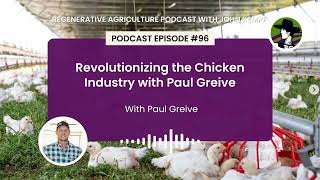
John Kempf talks with Paul Greive of Pasture Bird about raising chickens on pasture at scale. They discuss the challenges of small-scale local food systems, how automation is changing poultry farming, and what regenerative agriculture means for the industry.
Chapters
Hi, friends, this is John, and this is the Regenerative Agriculture Podcast. Welcome back. I should mention that if you haven't listened to some of our earlier episodes, I probably wasn't as good an interviewer then as I am now. I've certainly become a bit more comfortable with practice. But we had some incredible guests early on that have some incredible content. I'd encourage you to go back and listen to those if you haven't. But here in the podcast, we generally focus on agronomy and agronomic science and cultural management practices and those types of related pieces with a specific emphasis on regenerating, soil health and plant health and public health, and all the things that we care about. I'm really excited to have as my guest for this show Paul Grieve from Pasture Bird. If you haven't heard about Paul and his work, where have you been? Hiding under a rock somewhere? Because Paul and his team have been doing some really interesting stuff I've been observing from a distance for the last couple of years. I'm really intrigued and impressed and excited by the potential of what might come in the future. So, Paul, thank you for being here. Thanks for all the work that you do. And why don't you tell us the background, the story a little bit about what you're up to, what you're working on and how you got here.
Yeah, thank you. Thanks for having me, John. Thanks for all the kind words. I'm glad that you said team. This is definitely. I'm the one who goes on the podcast, but there's a large crew all working on these things. As you know, there's a. There's always a lot of people behind the operation, so I'm just one person on the team. But it's been, it's been a journey. God's had me on a ride for about the last 11 years and maybe it goes back even a few years before that. I really came to this unconventional way after college. I was a college athlete, and after college I went into the Marine Corps and I was in sniper school in Quantico, Virginia, where I contracted Lyme disease from a tick from just laying out the woods for too long. And I started to get some really odd adverse health consequences from that. It was the kind of thing where you're feeling great one day and then the next day you've got brain fog and fatigue and you've got achy joints and you've just got all these weird things that you didn't think that would be possible as a 22 year old. Thankfully, the whole paleo and eating like a caveman sort of thing was all happening in the military at that time. And I had a few friends said, you know, if you want to feel better, you should really think about what you're putting into your body. And I'd never thought about that in my whole life, you know, growing up in the 80s and the 90s as a McDonald's kid. And I just had never thought about the idea that food could make you feel any different. But lo and behold, I did clean up my diet started feeling a lot better. And when I came home From Iraq in 2009, my family really on a tear of trying to find local organic produce and vegetables, grass fed, grass finished meat, beef and lamb and pasture raised chicken. And the one thing that we just could not find was pasture raised chicken anywhere. And so that's really where the story begins.
That's a fascinating start to the story. You know, I find it interesting how many of the regenerative agriculture landscape as it exists today. There are many, perhaps early adopters that are now starting to join the innovators and they're starting to see the trend of the future that is coming. But it's an interesting percentage of people, a very high percentage of the people who were the innovators who were early in the space came to it as a result of some type of stress or duress. For some of them it was financial duress and for many of them it was a health challenge exactly as what you described in your experience.
I was listening to Will Harris, who's a guy that we've also modeled a lot of what we do after. And just an interesting, interesting man and a real pioneer in regenerative ag. He had a comment, he said the only way to drive change is through pain. And I was thinking, I don't know if I totally agree with that or not, but man, it sure does seem like oftentimes you have to suffer to really necessitate change. And that's where I think God was doing a work with the sort of health stuff that was going on with my family. My father in law actually lost like 100 pounds. And that, that bit of pain I think drove really where we are today.
Well, I think it's the default setting for most people. Like there there are some special characters who gain energy and thrive from leaning into large challenges. Yeah, but the default for most people is to seek comfort and to be comfortable. And if the status quo is comfortable, change is uncomfortable and so therefore tend not to change. And so it's for that reason that, yeah, I think for many people pain is a prerequisite to considering at least making significant changes. Many people might stumble into incremental change, but making significant change doesn't happen easily for most people.
Yeah, I mean, my wife and I were living this very normal lifestyle. We were living in Newport beach, had a good salary. You know, this is after the military now. I was working as an accountant, she was working as interior designer. Had a nice little cottage close to the beach. And by all accounts, you wouldn't really have a good reason to walk away from that. Move in with your in laws. You know, at one point, nine of us were living in a 1700 square foot house. So just to back up a little bit, the story goes, you know, couldn't find pastured poultry, searched high and low, farmers markets, grocery stores, just struck out everywhere. We got really interested in the work of Joel Salatin out of the Shenandoah Valley in Virginia. And we thought, you know, what, what would it be like to just raise some birds in our backyard? And we ordered 50 chicks on a whim, with no experience and no knowledge of anything. We read about half of pastured poultry Prophets, which is one of our kind of go to references for, for doing pastured poultry. The 50 birds came and we gave it a shot and, and we're really impressed by this idea of moving animals to fresh pasture every day. For me, as a kid growing up in Seattle, I considered myself not a hippie environmentalist, but somebody who cares deeply about the environment. And as a Christian, just stewarding land and trying to steward resources, well, all I ever heard was that the best thing you could do would be to not have animals in the ecosystem. And it just never made that much sense to me because I knew God created animals for a reason. Joel was the first time I thought about this idea that actually animals managed properly or in their wild state are a benefit to the environment. And animals played feed plants and plants feed animals. And it's actually a beautifully designed system. And so that's what really got me intrigued, is this idea that we can produce nutrient dense food, raise high animal welfare, but also be like a benefit to the environment. And that was the trifecta for me that said, I'm going to go for it, get the 50 birds, kind of do the whole thing. As 50 became 100 became 200 became 500. We found ourselves, you know, leaving our Kush day job and moving in with the in laws and just trying to get this little baby farm off of the ground and reinvest all the profits, backyard processing, you know, the whole, the whole story.
I really wonder how many farmers Joel Salatin has launched with that little book, Pasture Poultry profits. I bet it's more than a hundred or two. It's probably more than a couple thousand. In reality, it's. I'm sure it's quite a number.
I bet the number's in the thousands. Yeah.
You touched on an important point of the idea of the environmentalist perspective of livestock and humans in the landscape versus a Christian stewardship perspective. And there are these two kind of diametrically opposed views where one of them holds that the best way to regenerate landscapes is to remove people from the landscape. And the other point of view is that the fastest way to accelerate regeneration of landscapes is, is to have more people who have a caring, loving, stewardship relationship with the land. And that as a hyper keystone species, they can accelerate regeneration faster by far by orders of magnitude than anything else you might do.
I mean, why do we exist? It comes back to a pretty fundamental question, whether you believe in evolution or creation. Why the heck are we here if it's not to be a positive impact on the land and to bring order into chaos? I mean, I think that's a huge part of why we even exist as a species. It's not just to consume resources. There's no creation or evolution. That's just a pure consumer. I mean, we have to have some kind of a beneficial role in our optimal state. I really think that this movement into automation and removing people from the land is really, honestly, it's a sad, sad state of affairs. I don't think it's our optimal well being, that's for sure.
Well, it is resulting indirectly or perhaps directly, you could argue, resulting in the degradation of landscapes.
Agreed.
The fact that you are removing people from the land means that you're removing care and love from the land. And that is just accelerating all of the bad habits or providing a pathway for all the bad habits that lead to degradation to become dominant.
Well, you take a 10,000 head feedlot or you take a 10,000 acre kind of monocrop corn facility. And I always preface all this, this is not a knock against the farmers that are running those systems at all. And I think that there's great people doing lots of different styles and all that stuff, but traditionally, right. We had about three men tending an acre of land. And you walk onto that 10,000 acres of corn where you see massive amounts of runoff and you see lots of leaching and you see lots, you know, chemical fertilizer being applied. And it's like, man, if we had three people, that main part of their life, I mean, eight, eight to 12 hours a day are spent caring for that one acre. If you had three people doing that, what would each of those acres look like? It wouldn't look like that. Definitely wouldn't look like that.
Well, there's this mantra that we need to grow food to feed the world. And at the same time, 40% of all of our corn production is going into ethanol. There's biodiesel production. There's just a really wonky scenario. And like, we need to recognize that there is very little substance and truth in the feeding the world mantra the way it's commonly used here in North America. Because the reality is most of the world doesn't consume primarily corn and soybeans.
And what I've found odd or interesting or whatever with, I feel like the journey that God's really taken me on is I'm a huge, passionate believer in small scale local food systems where you do have three people paying attention to every single acre. And this integration of community and farming and the intersection of these beautiful things that really only happen on a small scale local food sector, but then also straddle this really odd world where we're also working with one of the largest chicken companies in the country to try to improve an authentic model of doing pasture raised at scale, to try to make real pasture raised poultry more accessible and more affordable for people and put it into large scale retail and do it on a scale that can be a fertility program for those corn and soybean fields. So it's, it's this weird dichotomy and it's almost like it could sound like I'm a conflicted person if I don't have the chance to sort of explain the story of how, how we even got there in the first place. But God's really put me in this place where I feel like, yes, small scale local food is really important, but improving the way that big ag and large scale poultry happens, and to see another model pioneered there, I also think is really important if we want to leave it better for the broader next generation that comes behind us.
Totally. The way we should think about it is that if we had those localized regionalized food systems that are the ideal, that people would hold an ideal vision that people hold in front of us. Such a model internalizes many costs that are presently externalized. Agreed. Which means that food produced in those ecosystems is inherently more expensive. Now, arguably, it's more valuable from many different Perspectives. But we, we also have to acknowledge the reality that it costs more in dollars and cents, that many people may not be able to justify or may not be able to afford. And so the value that I see is, as Buckminster Fuller said, you don't change something by fighting against it. You replace it with a better model and a better system. And that is really what I see happening with you and the work that you're doing with Pasture Bird and collaborating with Purdue. So tell us a little bit about that. From the 500 chickens, what was the remainder of the pathway that got you to the work that you're doing today?
Well, we were very. What I would call it not traditional. The right word is probably a classic small scale Salatin inspired direct to consumer farm. We started with all on farm pickups, realized that convenience had to be one of the legs on the stool if we wanted to actually have a regenerative financial situation happening. So we started to really focus on convenience and quality because we knew we couldn't compete on price. And I've always felt like you need two of those three legs kind of for the stool to even be able to have a chance to stand. Right. We realized convenience would be a big spot for us. So we started to offer pickup sites where we would drive around and people would meet us at specific locations around Southern California. I should mention, we've always been in Southern California. That's where we really started, where we've been from. And we've tried to focus on how can we be successful in our context. Because our context is very different than Ohio or Pennsylvania or Florida. We've got 26 million people within an hour and a half of the farm. A lot of those people are interested in health and wellness and connectivity to farm, but they don't have any kind of farming background themselves. So then we offered, started offering home delivery eventually where we'd load up a bunch of cars and we'd drive product directly to people's houses. So we've been on this journey of convenience. But what happened at our very small scale is we started to feel like we're producing food for rich people. And none of us were ever rich growing up. And so it felt like this really weird position to be in where we're raising meat. I mean, we were in chicken, lamb, beef, pork. We even started sourcing some wild fish, you know, aggregating and producing kind of a combination of both. But we were producing and selling food that our parents could have never afforded growing up. And that just started to feel really weird. And so we thought is there a way to pick one of these four or five species and to get really good at it? So instead of being a generalist that's sort of doing everything and it's really expensive. Is there an opportunity for us to get really good at maybe beef cattle or maybe we do dairy or maybe we do poultry? And as we did our, what we call a SWOT analysis, strengths, weaknesses, opportunities and threats. We had really expensive land. We didn't have a lot of water being in Southern California. But we did have a year round growing season. And we had a USDA certified processing only an hour from the farm that we had access to. And after talking to a lot of poultry farmers, they didn't have that. It was one of the biggest hold ups for people was that they didn't have USDA certified processing which is what would allow us to kind of scale. So we made essentially family meeting. We made this decision that we're going to try to get really good at poultry and see if we can impact the broader poultry industry and bring some scale into it to make things more accessible and more affordable. And that's really what sent us on the journey of going from Primal Pastures, which was the mixed livestock family business doing home delivery, to focusing on Pastured, which is the largest pastured poultry producer in the world. And we've pioneered these 7,000 square foot fully autonomous solar powered mobile chicken coops that drive birds to fresh pastures. So I can tell more about the story in between, but that's really the genesis of what we're doing.
7,000 square foot autonomous robots moving birds to fresh pasture every day. Sounds like a pretty interesting story. Let's hear a bit more about that.
When we're thinking about how to scale and to bring costs down for pasture poultry. We'd already had about five years of experience moving mobile coops to fresh grass all the time. It started with the Salatin system of like a 10 foot by 12 foot, 2 foot high mobile coupe where the birds are living on the ground all the time. And your listeners are likely familiar with the Salatin style. Next we moved up to a tractor pull system which is a greenhouse on skids. 600 bird, about a 720 square foot. It's like a 26, I think it's like a 26 by 30 or 36 or 40 something in there. But it worked out to 720 square feet. Move those every 24 hours. In our climate we can do that year round. Huge advantage to be in poultry and to be able to go year round. That's really what we needed to start working with the chefs and to start thinking about retail sales into grocery. But it's extremely labor intensive. So even with the tractor pull 600 bird system, we had about a dollar per bird just in labor, just from moving the coops around, the industry has five, three to five cents in labor, right. So it was like this doesn't increase the welfare of the bird, it doesn't increase the nutrient density of the product. It does nothing really beneficial. It just costs us more to do it this way. So we started thinking, is there a way to streamline? And as much as we were, I would say we hated Big Ag. Like it was fundamentally antithetical to what we were trying to build and what we were trying to pioneer. But as we started to focus on scale, it's like as much as we dislike and we have a distaste for all these things, are there things that we could learn, efficiencies that they've picked up over 50, 60 years of industrializing the food system, is there something that we can glean to incorporate in our system to make it better? You know. And so we started to look at, well, why are they so effective? Look at the poultry barn that the classic western kind of 60 year poultry barn is about a 600 foot by 40 foot wide. So about 24,000 birds inside of each one. Everything's automated. From the climate control to the fans, to the curtains, to the feed delivery and the water delivery, it's all 100% automated. The only thing that a human needs to go in and do is they walk through the house and they find dead birds and they pull them out, you know, so everything else is automated and they're even talking about automating that eventually. And so we started thinking, how do we take the best of the best from that, but put it into a mobile system that would move birds to fresh pasture every 24 hours at the stocking density that we like to get the manure impact that we really want. And it came back to size. You can't justify investing in automated feed and automated water and automated curtain climate technology on 600 birds. It never pencils out. But if you can 10x that and you and you amortize that over 6,000 birds, well now a lot more possibility opens up for automation. So that was really the why, the reason why we went to 6,000.
More from John

Episode 186: The Power of Precision Management and Multi-Species Covers with Mike Thompson





Podcast Extra: John Kempf on Soil Biophysics, Plant Immunity & Foliars on the Permaculture...


