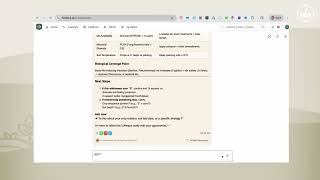
John Kempf demonstrates FieldLark AI, an AI agronomist released in public beta (access via advancingecoag.com) that integrates nutrient, microbial, and environmental interactions to generate regenerative agriculture recommendations. The walkthrough covers accessing the tool, the per-chat memory model and sidebar history, an example query on managing Rhizoctonia in potatoes (with specific recommendation categories), the Explore Further numbered follow-ups, and a "describe in detail" function that compiles more thorough, lower-variability responses to support decision-making.
Chapters
Hi friends. I'm quite excited to tell you about the FieldArc AI that we have been working on. The AEA team has been working on it for months. I've had this vision for a decade of an AI agronomist that takes this very multidimensional information that we use in making regenerative ag recommendations and we've released it. So it's FieldArc AI. You can find it in the menu bar@the advancingecoag.com website. And at the moment we've released it for public beta access. You can apply for access and you'll be given access. We're metering it out. It's usually within one or two days you have access to it. And Fieldwork AI is an AI in the, in the image of, let's say ChatGPT or Grok or Gemini, where you can ask it all types of different questions. And what makes fieldlark unique is it has been trained to take all the various nutrient interactions and microbial interactions into consideration. So it'll make a set of recommendations that may not be immediately obvious if you just do a literature review, for example. So it'll take redox dynamics and so forth into consideration. So you could ask in any types of questions. Let's ask it about, let me see, what do I want to ask it about? I'm going to ask it how can I manage rhizoctonia on potatoes? And there's some additional functionality when we think about how to use these chatbots. You can think of each chat thread as Field ARC will remember each chat thread so you can go back in history, you can look at your various threads, you can add in additional information, add in additional context and it will remember all that information. So you could come back here and say thanks for the recommendations you've made. I need, here's my environmental context, here's what my soil looks like, here's my soil analysis, here are my weather conditions, these varieties that I have. How does that change the recommendations? And you'll get an updated set of recommendations. The more information you feed it, the more fine tuned the recommendations are that you get back. And fieldlark will remember all the information that you put into a particular chat thread. But then when you go to start a new chat thread on a different topic, it won't. That information doesn't carry over to the new chat thread. But it is valuable to change threads and have different threads for different topics. So you might have one on a particular insect, another particular disease. So you look at the output Here the results how I can manage Rhizoctonia on potatoes. And it will give you a framework of biocontrol seed treatments with microbial inoculants, planting applications, foliar applications cover crop strategies that can be used for the long term, different types of soil amendments that can be effective in changing Rhizoctona virulence in the long term and the outcomes that you should be able to expect. And then we have this very interesting Explore Further section which has. There's some functionality here that is non obvious that I wanted to point out. So you have these five different questions. How do Brassica cover crops, specifically ultramicrobial communities to suppress Rhizoctonia? That one looks quite interesting if I scan these quickly. Let's bounce down. There's some interesting questions here, but let's bounce down to question number five. What are the root causes and contributing factors that lead to Rhizoctonia outbreaks in potatoes? I want to follow up on that question. So rather than doing a copy and paste, which is more difficult on a phone than it would be here on a computer screen, but instead of that I can just. That's question number five. I can just put in number five and enter it and automatically recognizes that I'm asking about that particular question and I will answer that question. What are the root causes and contributing factors that lead to Rhizoctonia? So that's some pretty cool functionality. On the upper right part of your screen you have a new chat button if you want to start a new thread. And right beside that in the hamburger menu bar you have pulls up a sidebar that you can access all of your chat history. So it can be very valuable to go into each of these individual threads and just update them and constantly feed them more information about the challenges and problems that you're working on. So referencing the fifth question and it describes root causes of Rhizoctonia, primary root causes, actionable insights, leverage points, next steps, etc. All right, so now there is another feature of Field Lark and that is Field Lark is, is trained to respond to a particular prompt called describe in detail. So if you ask it to describe in detail how I can manage prize Octonia, I can get this correct here. There is an inherent feature within these chatbots that it's not a. It's a feature, not a bug. If you ask the same question six different times, you will get six slightly different answers. There will be a fair degree of overlap as well, perhaps 60 or 80% overlap. There also be some slight variation and that variation can be very interesting and valuable if you want to look at all the various edge cases and edge information. If you really want to do a deep dive. And we've made an attempt within the constraints of the technology, we've made an attempt to try to pull all of those together using this describe in detail function. So you can pull together a very thorough description of how to manage or of any particular challenge by using that particular feature. So you start off with a summary, gives you a summary, gives you a problem analysis of the root causes and the mechanisms, what's happening going on, microbial dysbiosis, manganese deficiency, excess of potassium, environmental triggers. Then it looks at short term treatments, looks at long term preventions to develop multi year resilience, looking at disease suppressive cover crops. So you get the analysis. There is this particular phrase of describe in detail will give you a fairly thorough overview. But again it's there's this inherent feature of these large language models to produce variable answers. So I would bet a nickel or a stack of nickels that if you ask the exact same question with the exact same scenario, describe in detail, you'll have less variability, maybe 5% or 10%, but you'll still discover new information. So that's it, that's Fieldlark. I'm quite excited about the information that it's bringing back and please let us know what you think, give us feedback and if you like it, like the results you're getting from it, please share it with others. Thank you all.