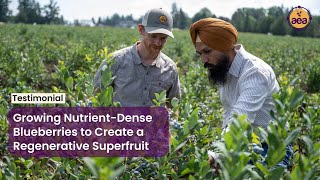
Gurpreet Singh grows blueberries at Bhar Farm in Langley, British Columbia using regenerative methods since 2018, skipping pesticides and synthetic fertilizers. He uses sap analysis to track nutrient density and focuses on soil biology and pollinators to grow varieties like Calypso and Aurora with better bud set and fruit quality.
Questions this video answers
60 acres
2018
Langley, British Columbia, Canada
Calypso, Aurora, Liberty
They report not using any pesticides or insecticides
Chapters
This approach is 100% more enjoyable than the conventional farming. Like the whole mindset of not just scouting for pests and flying some insecticides and killing that, killing that, killing that insect, killing that thing. And so that's no longer the thing. It's like encouraging the beneficials and then let the nature take other things. Usually everybody is on a spray schedule for one or the other pests or fungicides or this and that. We are not using any of those because we don't need to. My name is Gurpreet Singh Bhar Farm in Langley, British Columbia in Canada and we grow blueberries. We primarily grow three varieties. It's Calypsos, Auroras and Liberties. So this farm that we are standing on is 60 acres and we started planting this in 2018. We are six and we basically are from Punjab, it's northwestern part of India. We are stewards of land. Farming is what we do. And this is the profession that we like because it resonates with our culture. We think it's a noble work, it's a noble profession. Farming is the basics where we actually generate things. You kind of get to feed people and to nourish people. And you know, I would say that's where healthy mind comes from.
We've been working with Kuprit for the, our fourth season. The berries and the bushes are beautiful. It's really a pleasure to see plants that look like this and a crop that looks like this. Gurpreet has been a joy to work with because he's taken the program and the mindset to be his own. And that's where we really seek success, is when people embody the principles of regenerative agriculture. The enjoyable thing about consulting is when farmers are happy to be doing what they're doing and excited to be seeing what they're seeing. And that's the case here.
What I'm trying to achieve is to grow nutrient dense berries. They are a superfruit and a superfruit should be a superfruit. So the consumers, those who are buying these berries to get health benefits like they, they should get those health benefits. And that's, that's my goal from the beginning. I wanted to grow nutrient dense berries. And you know, that took me to this world conferences that, you know, intern kind of opened the whole chain. And the biggest, you know, compliment that I received was one lady like, she came and she said that, oh, these actually taste like blueberries. So that was a huge compliment. We can say that by the looks of the plants and everything, but until we Measure it and we have some concrete data about it. It's hard to say what is working and what's not. So in order to confirm that SAP analysis is a go to tool and that has helped us a great way to manage the excesses as well. There are some excesses sometimes in the front of the field. We had a history of the land usage history prior to we buying this property. This was a mushroom barn and then it has lots of mushroom compost sitting over there. That's lots of nitrates and lots of other nutrients that was, that was actually hampering the growth. And we were thinking of it as a deficiency. But once we got into SAP analysis things start falling with foliage we can correct it easily on the growth of the plants. So what we have seen is like the internodal distance has decreased since we the plants of synthetic nitrogen and the leaf size has improved and overall we see a little bit of waxy sheen over the, on the leaves with the fruit size and overall quality markers have all gone up. We follow the post harvest program, the aea and the reason we do is because blueberries set the buds for next year's season in the fall. So we would sure that the plants have all the nutrients and energy to do that for an optimum bud set for the coming year. We also like to feed the microbes in the soil. We do cover cropping, we do mow and blow where we mow the COVID crops from the bare middles, from the alleys and throw it onto the berms. And we haven't used any pesticides or insecticides and we don't disturb the soil. We kind of, you know, right now we are working on towards integrating some animals. We'll see how successful we get into that one. But that's just on the trial. But you know, we do soil primers kind of, you know, feeding the soil. The whole approach is towards like that and no synthetic, you know, fertilizers that damage the soil biology. The whole approach is towards getting the soil biology and you know, the plants healthy soil. So you know that approach and then it's, it's a mind shift we rely much more on now we are taking care of the pollinators and in turn the whole biodiversity or the ecosystem around the farm, you know, that is, that is improving and in turn is like, it's more like working with nature kind of thing.
Right now we at aea we love working on blueberries because they respond very quickly. Some of the differences we see right away are increasing the leaf size and thickness and sheen, as well as improving growth and decreasing dead tips that you can get from calcium boron deficiencies. We meet farmers where they're at. We have no judgments around conventional growing, and we can make a big difference and improve things. Whether you're a conventional or an organic system.