How regenerative agriculture is changing lives and conventional farming | John Kempf and AEA Growers
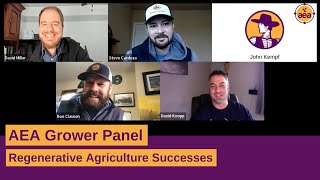
Transcript of a webinar (John Kempf with David Miller and three growers: Steve, Bo Crossing, and David) discussing motivations, experiences, and outcomes from adopting regenerative agriculture. Participants describe transitions from conventional practices, on‑farm trials (reduced inputs, foliar nutrition), observed improvements in pest resistance (spotted wing drosophila, spider mites, mealybugs), and preliminary economic and soil‑health observations (reduced input costs, stable yields, organic matter challenges). The conversation mixes personal motivations (human health, legacy, economic survival) with practical anecdotes and emerging data from one to a few seasons of changes.
Chapters
Welcome, everyone. Thanks for joining us for this webinar today. We've invited a really great group of people to join us. David Miller is here, which I think many of you know or have met on webinars in the past. David has really helped to step in in the last year to help guide our information that we've been sharing and putting out there. So thank you, David, for that. I think many of you know him, or if you haven't gotten to know him, you'll be enjoying this conversation. And then we have three of the growers that we've had the privilege of working with for the last couple of years. And our reason for having conversations like this is because it's very clear that while we as a team have tried to, we do our best to stay really well informed and to be constantly learning about agronomy and how to develop the best agronomic management systems that really deliver profits very quickly. This different type of management system. Just knowing agronomy doesn't mean that you know farming. And many of us are also farmers, many of us are also homesteaders and so forth. But it's very valuable to hear from growers directly in the field. And that's why we have invited Steve and Bo and David to join us here. So I want to say thank you to all of you for joining us, and I'll love to have you share just a bit about your background, your farming context, tell us a bit about your operation, the transitions you've made, and what it is that you'd like to share with your audience. Now, we're just going to have a fun conversation here and you can type in for our audience listening in. You can type in any questions that you have into the Q and A, and we're going to try to bring those up in the course of conversation as well. So thanks everyone for being here. David Miller, I'm going to turn it to you for a quick intro if you have anything to add, and then we'll just go around the circle.
Excellent. Thank you, John and I don't have anything to add to the intro except it's wonderful to be with a group of people again and sharing the experiences we've had. Just always inspired when I consider the effort and the energy that gets put into producing food. And I want to take this moment to thank the three growers that we have here on the call, as well as all of you growers who might be listening in for producing food. And I hope that in this conversation today you will be encouraged, inspired, and continue to continue in this career of producing food. We need food if we're going to be healthy. So we're going to start out by just having a quick intro, intro of each of the farms here. So Steve, you're the first on my left here. Maybe you want to go first and just share a bit about your operation and yourself. Hello everyone.
I am an organic raisin grape grower out of the Central Valley of California, the Fresno area. I've taken over the business for my father about seven years ago. Last year was 300 acres, now we're up to 350. Got some more land this year. So excited about that. And I began my journey through regenerative agriculture five or so years ago once I learned of John at the privilege of meeting him at an event out here. And I've gone down the rabbit hole of sorts of regenerative agriculture and it's got me where we're at today, which is going quite well and I'm very pleased with my experiences so far.
Great, thank you, Steve. And we'll, we'll look forward to hearing some more details about that. Beau, we'll have you go next.
Hey everybody. Yeah, Bo Crossing. I'm out in Washington State. I farm in the Columbia Basin project. Irrigated ag, mostly hay grains and cattle. And yeah, I started down this kind of a path a couple years ago when I kind of ran across a friend, shared a link of John's podcast and got me thinking totally different than what I've been doing in the past. So I was definitely going to say a conventional farmer raising the normal crops. We do have a feed yard and manure has always been my base of my fertility program and then call it nitrogen, sulfur, whatever I needed commercially to take care of everything else from there. So last year or two I started working with some of the AEA staff and doing a lot of analysis and kind of flipped my whole program around on what I believe what was possible to do with our farm. So only years in on this, one full year of confidence this last year on changing my perspective on how I look at farming. So that's kind of a quick background on myself.
Excellent, very interesting. Thank you, Bo. David, we'll go to you next and I'm going to ask you a follow up question. You can just kind of merge right into this of what was your biggest motivator in adopting regenerative agriculture. So if you want to share a bit about yourself and then just go right into this story of, of what got you started and your journey in this, this new model of agriculture thus far.
Sure. My father passed away about four years ago and I was, I took over the farm and we were heavy synthetic inputs, heavy tillage and I just kind of didn't quite agree with that. And I started investigating on YouTube where everybody goes. And my biggest motivator was human health. And then one, you know, one video led to another and then that started to get me down the path of regenerative agriculture. And to me it's a no brainer that, you know, that we need to start implementing these practices. I'm in southern Illinois, corn and beans mainly and then cover crop. And I also have a 14 acre BlackBerry farm that I started about four years ago. And so I've got a lot on my plate and everything but the, the salt based fertilizers and all that and the pesticides, I just, I knew that that wasn't right. I knew there had to be a different answer. And so. But what got me started was the human health aspect of it. I had a younger brother who passed away from leukemia about 10 or 11 years ago. And you know, there's kind of a direct correlation with glyphosate and you know, and non Hodgkin's and leukemia and all those illnesses. And so that's what really got me motivated to start on this. Because the way I look at it, if I'm going to help feed the world, I'm not going to do it with poison.
Thank you.
And yes, go ahead, John.
Feeding the world and poisoning the world are kind of oxymoronic. So.
Thank you. Thank you and David, and.
Looking forward.
To continuing that journey and what a noble cost and reason. Let's go to Bo. Why, what motivated you to get started and tell us a bit about the journey and, and the story of, of how you started on this journey.
My journey started from manure. Manure is my base, my fertility. About 30 years having a local feed yard and supplying my needs with manure. And then manganese was my Achilles heel. When I look at all the manure I put on my fields, when I test manure, I see what the amount of manganese that I'm putting on my fields. And then I test my crops in my soil and it's not there. And all of a sudden five years, I asked my local agronomist, where is it? Why can't I find it? I test my manure and I'm applying twice as much manganese as any crop would ever remove. And when you look at 30 years, my soils are still deficient in manganese. And I could not get any local person to answer that question. I talked to the local lab and the soils lab and he explained, yeah, it's mineralized and that's it. He had no other ideas on where to go from there. And so then a couple years ago we had used to at least out our ground for potatoes and they would come in and fumigate for potatoes. You know, once every five years our grounds get rotated potatoes and parting with and anyways that actually led me to John Camp where the local potato farmer sent me a link on one of his podcasts because I think we had the conversation about it. And so I went down that road and actually got answers on the interactions of manganese and why it's being mineralized or where it's at. And then so at least I didn't have answers how to fix my problem. But I knew where to start looking and I needed an education on myself on what to do. And so that led me down that path of looking at things totally different. So I went down the path of trying to capitalize on my manure, my fertility, to make the best of what I have. And the deeper I dig into it and with the soil, health, manures and everything, the more it all aligns to what I'm doing. I'm a hay, grain and cattle. We do a lot of cattle because trying to maximize our area. Also when you look at the regenerative ag, I have all the facets to do it. I have the manure based, I have the cattle, I have the land, I have the irrigation. I have everything in my hands to do it. To be self sustaining and not rely on somebody else to. For my outside inputs. And, and so that, that's the deciding factor for me. I, I did not want to have to be relying on purchasing commercial fertilizer from somebody else. So, so it, that was like I say that was where it started for me. And it's still basically the. It's a paradigm where I don't know where to end. I still have more unanswered questions, you know, going down this road. But, but anyways, enough go on or let somebody else explain a little bit.
That's great, that's great. Thank you Bo. And exciting that it's a journey and it's like you're seeing so much already from it and learning so much, but where's it going to end? Like what are the possibilities? What are the opportunities? It's really, is really an exciting journey that I don't, I don't know that we have a destination for it. I don't think we're going to arrive at some point and be there.
It's great.
Thank you. Steve, what, what cost you to even consider regenerative agriculture?
For me, I think taking over the operation from my father has given me like this like rude awakening of the threats that we're all facing. And particularly in my area with water and labor prices. There's just a lot of things driving us out of business and not a lot of things that are like amplifying or augmenting our business. So the prospect of regenerative agriculture making things easier on yourself each year after the next, that was probably the initial appeal. Like if I can start building soil health and get the system running in a more holistic manner, that nature is going to help me out and I'm not going to be fighting it as much. So that was the initial appeal. I would, I would say also the, I'm kind of a skeptic by nature. So the fact that people think that they have, you know, agriculture wrapped up and in my area there's lots of very large, very successful farmers that are very confident in their abilities and have done well. But I've always thought maybe there's another way to do it, especially a way that's more in line with nature, that's not as heavy handed with the harsh chemistries and, and things that are commonplace around here. So that's what got me, got me going.
Great, great.
That's excellent. This wasn't on the list, but I'd be awesome to John, tell us just briefly what motivated him. John, what motivated you to start regenerative agriculture?
David, A bazillion people have heard my story. I've repeated it about a bazillion times too. So I think the, I'm really. Obviously there were the significant changes that we had on the farm, but you know, there is this mantra that was really a marketing slogan by big Agribusiness that we have to feed the world. And that's the people who repeat that mantra the most are the people who are growing corn and soybeans and commodity crops, many of which don't go to feed the world. But that's a different conversation. But you know, we have this epidemic of degenerative illnesses here in North America and to some degree around the world, but particularly in North America and where we have. I saw the data actually just this morning. I was looking at some of the updated data. 43% of the people in the US are obese right now. It's like 43%. Why would we consider that to be acceptable? Yeah, it's common, it's normal. But why is that acceptable? And so that is not just an agricultural problem by any means. It's also a dysfunction of food processing and the ingredients that are permitted to be put into processed food. So that's, that's a contributing factor as well. There's environmental factors, but there is also the fact that agriculture and food production contributes a lot of endocrine disruptors. We call them pesticides, but these pesticides are endocrine disruptors and they screw up our hormonal systems in ways that we're just beginning to understand. And that can contribute to making people obese and all types of degenerative illnesses like stroke and diabetes and heart disease. And of course it really messes up with all of our collective reproductive systems as well. I mean that is the foundation of our endocrine system after all. So when you think about all of the cancers that are related to reproductive systems all the way from prostate cancer to breast cancer to ovarian cancer and uterine cancer, and the list just kind of goes on and on. That's a significant proportion. And so I'm really inspired by the potential that we have to eliminate and remove those toxins from our food supply or greatly reduce them simply by producing crops that don't require them.
Great, thank you, John. I remember when you first started describing that and what that meant to me. That's great. Steve, Bo, David, do you all have any questions for each other in what was shared about the journey you've been on?
Not necessarily.
Not sure.
Okay, that's not fine. No problem. There is going to go to the next question.
There is a question in the chat for Bo and Bo. The question is where did the manganese go?
Good question. It's still there. I just gotta get it released. So that. That's basically what I do is. And basically I told it's biology, you know, I need better biology and. And change my practices. So I'm conventional farmer, I love the plow for many years got my best crops following the plow and so but I. I believe doing that excessive tillage as mineralized it so. So no it is still there. It's in a bank. It's in my solar bank. And so I look at, I got 30 years build up a manganese and someday it's going to pay off. So it might that are going to get the biggest benefit from our misapplications or tillage what we've done in the past. But I Believe my soils are going to provide for the next generation. As long as we treat it better, I think it's going to be there and improved. This year I did a corn crop where I followed first cutting alfalfa and then come back with corn and I have the least amount of inputs I've ever put into a corn crop yet my and my soil samples before going in were lower than all of my farm. It had been five years previous since I applied manure in front of alfalfa hay previous I did a wrinkle CP. It's a manure wrinkle CPS. 3 years of alfalfa hay production. I removed probably 35 ton of alfalfa hay dry matter and then in this last year I took an early first cutting and then followed it with corn and I did foliars only and direct seeded into the alfalfa and I got an average yield as my whole farm planted a month later than everything else on the farm and I got gonna say the whole farm was 250 bushel average. There's areas up to 300 bushel in there though. In it 18 pounds of applied nitrogen foliar, only 4 pounds of phosphorus, 7 pounds of potassium plus micros really small amount of micros. I mean so I would have never believed it could be done and I could do it until and say listen to John's podcast and enough other people call it preaching and say it can be so with the high price of fertilizer and knowing that alfalfa is a resilient crop to follow I said this is a good years to gamble as any with the corn crop price and the price out there. I said I'm going to gamble, I'm going to try. I did a third of my acres that way or a little over with reduced inputs and my yields did not change and in my soil samples were virtually identical on composite samples before and after. So I have more questions again now on.
That'S a pretty incredible story. What did you do with the alfalfa planting? Was that terminated?
Yes, it was okay. And yeah yeah we of course we use glyphosate. Yeah. Pre harvest and one application post. So I'm going to say a few of your other friends call it. Yeah, I'm glyphosate addict. Whatever.
I have not figured out how to.
Win myself off of that. It's, it's. Everything's a slow process and you do a little bit at a time and slowly change but, but I'm getting a lot of confidence really quick and fast. Here that I can change my methods and, and without fear of going broke because most of it we don't want to go broke. That's everything. We got one, one bad year or two bad years. Yeah, I can almost take you out. So we're always very cautious about what we're doing financially. But I have less inputs in this field and I got the same return and if not some of them higher yield. My conventional program planted a month earlier and full inputs of pre plant commercial fertilizer, anhydrous side dress and fertigating and I have as good or better yields with the foliars. And so it's changed my whole perspective.
Of how I'm farming.
You know, one of the things that David talks about is how important it is to run trials at a safe level so that if things don't go well and you do have a failure, you're not at financial risk. So I'm curious about how do the economics turn out for you on the areas with the foliar only versus the full inputs?
Honestly, my total inputs were everything were with applications. I did three foliars with a helicopter. I got $130 worth of fertility applied, call it $39 for the flights of helicopters, $13 an acre application. So I'm less than half of my inputs with application than my conventional. And yeah, and the tough part to explain is there's not the, the pounds of nutrients applied. So you don't, it's mental, don't feel like you're getting that value that, that pound for pound, dollar for dollar, whatever. It's, it's. I mean I'm using micro rates but, but some other friends work with that. Talk about the efficiencies of foliar scale. So I was using a 7x on nitrogen and finding a nitrogen that had multiple sources in it and, and it correlated. So when I look at what my soils had and what I applied and use some of these scales that I could find, a few people have it correlated. It matched up where I got 250 bushels of corn harvested. When I looked, my soils had potentially 115, £120 total available nitrogen. Before and afterwards the same. And then I applied 18 pounds of nitrogen and 7x. You know, I'm going to say that's rounded up to 140lbs equivalent. So that was giving me the old rule of thumb for one pound of nitrogen per bushel, it works out on that way. I mean you can sell it however you want, but it works out that way that okay, there Was one pound of nitrogen totally available between soil applied with efficiency scale. But when I took my soil sample afterwards it was all still there. And I think I did have one field portioned out. I did the soil primer on and there was no yield difference but my soil levels were higher there. Not a lot, but a little bit in the micros too. Some of the micros were coming around and so my soil fertility was actually higher. When you use a nitrogen scale of. For how many pounds of nitrogen per Bushel. I was 0.02 on the soil primer field. My whole other field was 0.12 pounds of nitrogen per bushel. You know Matt, what it would have cost me. So that is phenomenal. I have been doing 250 to 350 plus pounds of nitrogen available to a corn crop and trying to average 300 bushel corn in the past with my conventional program. And so yeah, so taking. I should have been doing things on a small scale and changing. No, no, I didn't do it on a small scale. In my mind I took a big percentage of my acres, but they work and, and I think I, there's enough, enough people helping me out here that, that I felt confident and actually SAP analysis was a huge part of it. So following the staff because nitrogen was what I was tracking and following, I did tissues and SAP side by side because I don't understand the SAP. And I had my Jim Dunlop working with helping me read the staff through the season and track it. And honestly that was the confidence booster to let me do it. The old and the new leaves and see when that plant truly needed more. And, and when you, when you listen and hear an AEA agronomist tell you go ahead and put a little bit of nitrogen on, then it feels good. And a little bit is four pounds, six pounds of nitrogen. Oh, and put a little bit on. And I was used to putting on 25 pounds of shot if I'm going to put nitrogen on make it worthwhile. No, it's totally different. Totally different and it works.
So thank you both come through for you on chat regarding your experience. What is your organic, what is your solar organic matter?
Oh, 1.6 to 2% organic matter. And that's the other.
No.
So I had been doing mostly alfalfa hay corn manure program for let's say 30 years. My organic matter gone up a half a percent and it's not moving and I've been trying to get it up higher and it does not move. And so that's kind of led me down the path that it's probably tillage. I'm going to say oxidizers, but too much nitrogen, a lot of other deals. So I, I am on par with or a little bit higher than maybe some of my neighbors, but, but not when you look at a, call it alfalfa hay, corn rotation. I thought I should have been building and with the manure program that I thought I should be building more high organic matters.
And I'm not.
And so, so now it's on trying to figure out how to still change my methods on tillage.
Yeah, lots to figure out there. Bo, there's, there's another interesting follow up conversation we can have when we get there, but there's a chance that some types of manure will actually deplete organic matter. I know that sounds oxymoronic, but the way that it affects soil biology can actually have a negative effect on soil organic matter, which is something that we don't often think about. So. Bo, thanks for sharing that story and that context. I'd like to go to David. I had the privilege of meeting David last week at the Acres USA conference for the very first time. And he. David, you shared a story one evening about the success that you had this last year with spotted wing drosophila on your blackberries, which really got my attention. Can you tell us a little bit about that?
Yeah, I think you actually did a fist pump whenever I told you that.
It's pretty incredible.
Yeah. This next year, next spring, next summer will be my fifth harvest year with the blackberries. And every year we've had the SWD issue. Every year we have one year we lost almost the whole crop, at least half of it to the swd. And we didn't do a fall primer last year this time or you know, in the fall last year. But Rochelle did have us on a seven to ten day foliar throughout the spring and summer, you know, going throughout the season. And some things that we noticed were the fruit was very firm. It didn't fall off of the, it didn't fall off the vine as easy as it had in the past. I mean, you actually had to pull it when it was even, right? And so that was one good issue. It all came into harvest. The harvest time was all within a week or so. It wasn't spread out real long, but we, we even have catch cans and stuff out for the SWD and we didn't find. And so the only thing, that's the only thing that we had changed from the previous year minus we did put a cover crop of, I believe it was radishes out, you know, in between the rows. So that's the only change that we made. So, you know, that's what I think it was due to. And SWD is a major, major issue with the berry farmers and everything. It's. It's a big issue. And David.
Yeah, there's probably many growers listening to us who are not familiar with SWD and berry crops. Can you tell us a little bit about what it is and why it's a problem and how difficult. Why it's a difficult problem?
Well, it's. You're probably more qualified to, to talk than I am, but it's basically, it's a family of the fruit fly. And the female has a saw like apparatus on her back end and she will saw into ripe or overripe fruit and layer eggs in there. And then of course, that ruins the fruit. And then you get like, you'll get like a fermenting smell out in your, in your field and the stuff will start, start dropping and it basically ruins your crop. I don't know if you want to add anything to that, but it's, it's just a pest that is. It came over from what, China or somewhere not too long ago, invaded. Started in California, I believe, worked its way this way. And I think it's been around the Midwest for what, a decade, maybe a few, little bit longer than that. But moral of the story is we didn't have any. None at all. We didn't have any in our catch cans or anything.
And that's a significant story because SWD is not one of those things that just quietly fades into the night. It's not an easy pest to get rid of. So. So that's pretty remarkable.
Well, evidently it's still around, if I'm not mistaken. Correct. They kind of live in the woods, wooded area and everything. But do you want to add to that as far as, as far as your definition of them or.
Well, what I get really excited about the, the example that you shared is we have any number of historical examples of working with berry growers and a number of different berry crops ranging blueberries, raspberries, blackberries, and so forth, where they were able to grow a berry crop that had no SWD in the crop. And perhaps the most remarkable example of this was when there was an organic BlackBerry field across a farm roadway probably 30ft apart from a conventionally farmed BlackBerry field that was under different management. And the BlackBerry crop was completely destroyed and the organic crop that was being managed with nutrition. You couldn't find any SWD in the crop. So that's pretty powerful. But all of those historical examples that we've had, or shouldn't say all of them, but many of them have been a result of an extended time period on a nutritional program. A year and a half, two years. And what I got excited about from your example was you went from basically from 0 to 60 in a single growing season. You didn't do a fall application.
Yeah, we were doing pesticide applications every seven to ten days previous. In the previous years. The thing that really caught my attention is I came across a YouTube video that you had and I watched that. I'm like, well, that makes sense, you know. And so like I said, that's the only thing we changed. We gave it the nutrition that was, that was recommended. No pesticide applications at all. So basically we were organic last year, this year, because we didn't do any synthetic fertilizers either. And my buyer, it's a pretty big buyer, I don't want to say who it is, but whatever. I told him we were going to do this. He said, what are you going to do about swd? And so there's a lot of, there's a lot of people that are either misinformed or, or don't know exactly this crazy path that we're taking. And I said, well, I'm going to do this. I said, I'm going to make a healthy plant. I said, insects don't attack healthy plants. And he basically hung up on me. So that's what we did. And it worked out. The yield two years ago wasn't that great, but the yield did go up 100% this year. And we need to talk more on how to get that bumped up even some more. But yeah, like you said, it was zero to 60 in a year, a season.
That's impressive. That's just really impressive. To go. No historical fall applications of biology, just starting this spring with nutrition and in the first year getting resistant. The reason I'm impressed by that is the, the fruit are usually the last location on the plant to become resistant to insects. It's, it's not that difficult to achieve insect resistance on leaves, but the fruit have such higher nutritional requirements that those will often be the last location to be resistant. And yet you got that in the, in the fruit first year. So that's really impressive.
Yeah. And one thing I didn't mention is in the previous years we had, we had a Japanese beetle problem, really bad. And they, you know, they feed on the foliar and all that. And we didn't have the jap beetles hardly at all either.
That's awesome.
There's another bonus for you, Stephen.
How are you going to top those two stories?
I have a couple good ones, actually. I would say like the, the biggest, like aha moment I want to call it that was we used to have really significant challenges with spider mites. 2018 in particular was a terrible year. The block that I'm sitting right now is 150 acres and we probably had 90 or so acres that were completely defoliated in August, like brown dead leaves, when it shouldn't be looking like that to the. The following year. And up until now, we, we are experiencing zero spider mite pressure, which I attribute to the nutritional program. Like David was mentioning, insects don't attack healthy plants. So since we've adjusted our management practices, reducing our tillage was big. Getting our irrigation situated was, was critical as well. But I think the nutritional shift that we made and using SAP analysis and revamping our entire nutrition program, that's what's the driving force behind the plant's resistance to spider mite. So now I no longer spend time, money, resources, spraying pesticides. We're completely off. We're using nutrition as our pesticide program. And then a side effect to that was there's another pest that's a lot more difficult for a lot of grape growers and that's mealybug vine mealybug. We didn't have terrible pressure from the vinyl, but there were hot spots. There were little locations where you'd see, you know, a lot more prevalent. And since we started utilizing these nutritional programs, it's been completely eradicated. I can't even find the black sticky vines that I used to find in the growing season. It's. They just have gone away, which that was a very strong indicator that things are, are going, going right. And then 2021, we actually had our, our record yields and fantastic quality as well, which in the raisin industry, those things are kind of like mutually exclusive. When your yields go way up, your quality is going to go down. And we are improving our quality and our yield simultaneously. So that just really hammered home that this is the way that we're going to do things in the future.
Wow, that's impressive. So Steve, what, given the pattern that you've observed so far, what do you expect to happen in the future with, with your grape production? I mean, as you just described with grapes you typically expect to see. If you see yields go up, you see quality go down and you're not observing that. So where, where's the, where are the goal posts now?
Well it's not perfect. We're still, you know the, the numbers and raisins is your, Your maturity is 50 is the mark where you're not losing money. We're not taking money from you. So I'm just now getting my grades from this last year from 2022 and my lowest grades are mid-50s and my highest are pushing 70. So that's fantastic but it can still go higher which I'm hoping to accomplish but that those numbers are particularly interesting for me because we experienced record heat this year. There were eight straight days over 110 and five straight days 115. So the quality like the industry has had terrible quality this, this past year and I'm not seeing that saying I'm less than the year before.
Yes.
But I'm still well above where I need to be in in terms of not having a financial, you know, detriment because of the.
More from John

Episode 186: The Power of Precision Management and Multi-Species Covers with Mike Thompson





Podcast Extra: John Kempf on Soil Biophysics, Plant Immunity & Foliars on the Permaculture...


