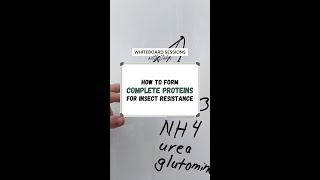
John Kempf explains how Fotomag, a plant nutritional formulation, shifts nitrogen from soluble compounds into complete proteins, making plants less attractive to insects. The effect works systemically across leaves, roots, and fruit, but only if chloride levels stay low relative to total nitrogen.
Chapters
Fotomag is not labeled as an insecticide because it isn't one. It just happens to be a plant nutritional package that changes plant physiology in some interesting ways and changes the internal environment within the plant to such degree that it's no longer a susceptible host for a broad range of different insects. So it's not an insecticide, but it does change plant physiology in some very important ways. And those ways foundationally. This is a bit of an oversimplification, but you have these very soluble nitrogen compounds within the plant. I could scribble these out here, such as nitrate. You can have ammonium as well. You can have various form of urea and ure eyes. And you can have, of course, glutamine. So you have some of these relatively soluble amino acids. And the effect that Fotomag can have, this is not universal because there is some environmental and nutritional context that is required here. But the effect that Fotamag can have if the plant is in the proper environment, proper context, it will convert these mineral forms of nitrogen and even these amino acids in it. It accelerates the conversion to peptides into complete proteins. You end up with a plant that has abundant levels of protein, has abundant levels of total nitrogen, but very small percentage of it shows up in these forms, which changes the susceptibility pattern to a variety, a broad range of different insect pests. Now, the context, of course, this only happens when the plant has a proper mineral nutritional support. Otherwise, one of the common challenges that can prevent this from being effective is if the plant has elevated levels of chloride. If you have chloride levels on SAP analysis showing up higher than total nitrogen, then Fotamag and this whole nutrient interaction that I described in the second level of the plant health pyramid does not have the same degree of effectiveness or it can even be completely ineffective. So there is some nutritional context that is required in order for this to work well. But when the plant has the appropriate nutritional foundation, you can achieve resistance to a broad range of different insect pests with this application. And it's not limited to just application or to just effectiveness on the leaves. You can also put on a foliar application and it will change susceptibility to rootworm larvae or wireworm in the root system. So it doesn't just produce a physiological effect in the upper parts of the plant. It also produces a physiological change in the root system. And usually the last location on the plant to change will be the fruit. So you'll have continued susceptibility. If you have fruit or nuts that are susceptible to insect damage, the change occurs there last simply because those often have the highest nutritional requirements. And any imbalances that show up within the plant show up within the fruits or the nuts to the highest degree. So this is the overall pattern that we see with fotomeg applications. When we put on applications with the specific intent of changing the plant's internal physiological condition to reduce insect susceptibility.