John Kempf leads discussion with 6 Regenerative Agriculture Consultants
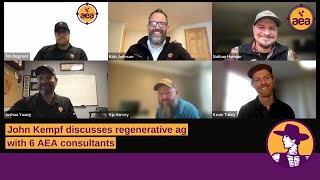
John Kempf moderates a discussion with six regenerative agriculture consultants: Tim DeGroote, Kish Johnson, Nathan Harmon, Kevin Tully, Josh Young, and Kip Harvey. They cover regenerative practices, the challenges farmers face adopting them, and what actually works in the field.
Chapters
Good afternoon, friends, or good morning if you're on the West Coast. Welcome to this webinar by aea, where you really get to experience the full presence and brain power and capacity of the AEA consulting team. We have an absolutely incredible team who is very passionate about the work that we do in regenerative agriculture and bring a lot of knowledge and experience and the capacity. I think the phrase that was at the tip of my tongue was the capacity to produce miracles. And on the surface, that may seem a bit pretentious, but it's not if it's true. And the reality is that getting to having the privilege of working with growing systems and ecosystems is, in some ways it's very similar parallel to working in human medicine, where we do have the capacity to produce miracles. I think the same is true in our ecosystems as well. It's very rewarding, a lot of fun, and we have a really great team that works with some of the leading growers in this space. The conversation for today. You have an opportunity to ask questions directly of our consulting team. I'm here as a moderator to guide the conversation, but I would ask you to ask the questions of the consultants here in our panel that have always bugged you or that have challenged you. What are the questions that you haven't been able to get answers to? Or perhaps saying it a different way is what are the reservations that you have about possibly working with aea? Here's your opportunity to ask those questions and get direct answers direct from the consulting team. So we're going to kick off the conversation. I have a few opening questions for the team, but then this is really intended to be your opportunity to ask questions of the team. So with that, I'm taking entirely too long for an introduction, but here I'll do a quick round of introductions just in the order that they appear on my screen. We have Tim DeGroote, who is an AEA. Hi, Tim. Thanks for being here. Tim is an AEA staff consultant from California, working with all the diverse crops that you can imagine being present in the Central Valley. Then we have Kish Johnson from Virginia and Nathan Harmon from Indiana. And Nathan, yeah, this is a great public setting, but I can't avoid it. Some years ago, one of my mentors, Michael McNeil, gave me the dubious honor of being called a kook. He said a kook is a keeper of odd knowledge. And I recently passed on that nomination to Nathan as well, because Nathan is one of these great people who.
He.
Goes down lots of earthworm holes and he connects these Intriguing dots that you would never expect to be connected and is passionate about growing okra on a commercial scale. Then we have Kevin Tully, who is a consultant from the Pacific Northwest, working with lots of tree fruit and potatoes and hops and lots of interesting crops in that region. Josh Young from Florida, working with strawberries and citrus and working in an environment where it would be great to have some soil instead of beach sand. And then Kip Harvey from Blank. You call Texas home, right, Kip?
Yeah.
Yeah. So we've got very broad geographic distribution from all over the country. And yeah, now is your opportunity to ask great questions. So I'll the, the we want to have this conversation, be very practical and be very real. How do you implement and how do you execute on agronomic management systems that produce significant results? What's the practical application? What's the execution? How do you make it all happen? How do you make it all work? And so I'll kick things off with a question and we'll just go around the circle because I'd love to get all of your perspective on this is what have you observed? We know that we have all experienced giving different growers a different set of recommendations that might be very similar, very similar conditions, similar context. And we make a similar set of recommendations and with one grower there is exceptional success and perhaps with another grower not the same degree of success. There can be any broad array of reasons for why this might be the case. We know that agriculture includes lots of facets and lots of variability. Sometimes that variability is also due to cultural management practices or just capacity to execute. My question for each of you is what have you observed when you're working with growers that really have a significant impact on the outcomes that growers experience with their crops? And this, it's a wide open question. It could be anything related to agronomy or management practices and so forth. So Kish, I think I'm going to begin with you. How would you answer that question? What are the keys to success and practical execution that you've observed?
Yeah, thanks, John. I think twofold for me as we look across our grower base across the country. I think the first one is a little bit of a no brainer in the sense of growers that are invested in being diligent and aware of what's going on on their operations on their farms and that have also a clear path to, to their long term goals and how those challenges that come up, you know, cyclically, annually may impact those long term goals, but that they have a plan in place to not just address the short term goals and challenges as they come up year after year, but rather, you know, are factoring in some of the long term goals and challenges that have and have a continued vision to be able to stay on the course, stay on path to those things. You know, from a very practical perspective. You know, we, we obviously as a company talk a lot about the, our soil health program and the long term ROI and impact that that can have on any growing operation and you know, understanding that part in its context, along with all the actual crop applications that are being made throughout the year and being able to have honest conversations here about what's working and how best to adjust to keep the grower on course, I think are some of the key elements for success coming out of the gate, at least.
Thank you, Kish. Taking the long view instead of the short view generally pays lots of dividends in the long term.
Slow and steady wins the race.
Yes.
Josh, what are your thoughts?
Well, I, I see that not asking questions, being afraid to get help when needed is a very good old boy thing to do and trusting the wrong source of information. We've been, we don't know, we don't know. We've been taught by the best and yet we have. The results are saying otherwise that this is the best program to call. So ask the right questions, you'll get it. Ask and you shall receive. The Bible says.
Thanks, Josh. Nathan.
Yeah, I mean I think that, you know, one of the biggest, in addition to what you guys both said, the, you know, the six principles of soil health, right, of keeping covered and keeping root in the field and you know, integrating animal disturbance to the degree you can and soil armor all that any one of those employed for any amount of time is a step forward. Right. I think that that kind of background can't be, can't be lost. Those things are all very true and layering on every higher order management practice or using multiple of those techniques at the same time and they do have a lot of overlaps. You know, I think that's, that's one thing that really, yeah. Is a difference between things working and moving in the right direction without just being another input, replacement, you know, kind of system. And you know, the other is creativity just to try something new, just to experiment and be willing to, you know, always be running a trial or two or 10 and you know, really, really following up with those things and making yourself accountable. Often growers who, who don't just do the trial on their own but publicize it and say they're going to be, you know, let people know that they can expect some, some data back on this or working with Sare or, you know, the network of sharing that information and committing to, to being part of it, those, those growers always have some form of success to report back on.
Yeah. I think building on what you just said, Nathan, it's in many cases it's. It's not where you have your biggest successes that you learn the most from. It's where you make mistakes and things don't go as you expected that are significant learning opportunities. Tim, I'll go to you next. How would you answer the question of what are foundational pieces that really result in growers excelling?
Yeah, so when you think about foundational stuff and critical factors for grower success, right. As Kish and Josh and Nathan all described, right. Their ideas and then ways of doing things and thinking about stuff that have adverse effects that trickle down the line of success. Right. So I guess I would say, you know, getting a little bit more in the specificity, right. Of talking about, like our programs and stuff like that. You know, one of the biggest things and the main thing that we, you know, believe in is, you know, soil health and, you know, that type of thing. Right. So introduction of biology, our soil primers, stuff like that, that just, that's truly the foundation of what we, how we approach our programs, right. We, we've seen it, you know, work miracles in soil with nutrient availability, uptake, water holding capacity. Right. There's all those factors that go in, right. You know, they talk about the big picture, the mentality, the thinking stuff. You get to the actual physical stuff in the field like that, and then it. That trickles into more and more things that are going to be continued success for a grower. Right. In a program, right. You're continually, you know, taking SAP analysis and, you know, assessing a crop and where it's at on its health spectrum. But, you know, if you can better utilize what's in the ground, you know, to get that regenerative cycle started, you know, that's kind of square one in our type program. So. Yeah.
Nice.
Thank you, Tim. Josh, I see you're nodding your head. We've got a few more guys. Is there something you wanted to add to that?
I just was agreeing with him.
Yeah.
And I think the point that several of you have made now is not losing sight of the basics. There's conversations that I participate in regularly where people get really excited about using microbes and using microbial inoculants and so forth and to the point that Nathan made. We can't lose sight of using cover crops and taking care of those basics so that we provide the environment for all the rest of the system to work. So anyway, you're not here to hear from me today, Kevin, I'm going to go over to you. How would you respond to the question?
Yeah, I have a couple things. One another basic that's very practical, nitty gritty thing is water quality. It can be a big factor in how well we can succeed as a on a farm. If you know water, water is your number one input. And if you have a water quality issue that has been not been addressed, it can make our program much less effective. So that's something we always try to look at when we start with a farm is look at your water quality and make sure that we've got that covered before we try to adjust the, the finer details. And a broader, broader thing is a factor for success for growers is how much people understand the science in order to really believe in the principles of regenerative agriculture enough to be able to see through the challenging things and the many variables and factors. Like you mentioned, there's so many factors and variables that can cause roadblocks and bumps in the road in our path to success. And if you have a good foundational understanding of the science, then you can have the tools to be able to look through those barriers and make it through them into, you know, the next level of success. But if you're really on the fence and kind of think, ah, maybe, maybe not this is, and not really sure about this whole concept of regenerative agriculture or how micronutrients and biology and sea products all work together, then I've seen people get turned away because they encounter a roadblock like water quality. And that comes down on this whole system is baloney. And going back to something else.
More from John

Episode 186: The Power of Precision Management and Multi-Species Covers with Mike Thompson





Podcast Extra: John Kempf on Soil Biophysics, Plant Immunity & Foliars on the Permaculture...


