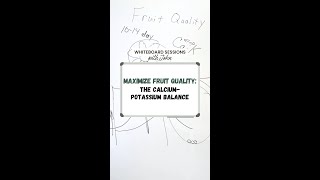
John Kempf explains how excess potassium blocks calcium uptake in the 10-14 days after pollination, when fruit cells divide. This reduces quality and storage life. Growers should use slow-release potassium or wait until cell expansion to apply it, avoiding fast-release potash at planting.
Chapters
So the next component of managing fruit quality is recognizing and understanding that there is this antagonistic relationship between calcium and potassium. Let's focus on potassium for the moment. When you have excess of potassium supply in the embryo or in the plant tissue, it will prevent calcium from moving into the developing embryo in adequate amounts. One of the most challenging things you can do from a fruit quality perspective is make is having a potassium curve where you have a surplus of available potassium here during this cell division window. And remember this, I'm using this boundary line right here to mark this is pollination. So we have a 10 to 14 day window immediately after this. If you have a peak of available potassium or an abundance of available potassium at this point, it will prevent adequate levels of calcium from moving into the developing fruit. Even when you have managed calcium well, you've put on proper calcium applications. So one of the pieces, and this has been one of the foundational challenges is we see growers over applying potassium at the wrong time. So one of the most effective strategies for improving fruit quality and harvest quality is to apply any if there are potassium needs, if there's need for potassium applications, we select a product that has a slower release curve or we apply it later so that our potassium release curve, let's just say here's pollination, let's say we have a 10 day window, 14 day window here. We want a potassium application to look like this. We want peak potassium released during the cell expansion stage that happens after the cell division stage rather than this initial 10 to 14 day window. So for this reason, and again, this is different for different crops, the window on, let's say on a grain crop from planting until pollination, on some crops might be a few weeks, on other crops it might be a few months. So understanding the release curve of our potassium fertilizers is extremely important. And in many crops it may not be appropriate to apply at planting, but instead to delay until after planting. Particularly if we're using a very soluble rapid release potash fertilizer such as potassium chloride, we get this strong flush. The release curve on potassium chloride is a matter of days to weeks, depending on moisture level. So within a few weeks you can get this tremendous release curve of potassium. You do not want that to happen here. It will cost you a great deal of fruit quality and storability problems.