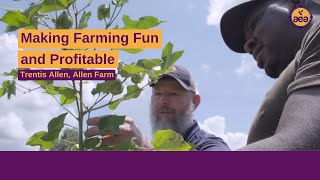
A short interview with Mississippi farmer Trent Allen describing his family's 600-acre diversified farm and their transition to regenerative agriculture for cotton. He discusses collaboration with AEA and Citizens of Humanity, changes in nutrient-focused practices (primers and SAP-guided applications), observed improvements in plant greenness, soil health, reduced insect pressure, and challenges balancing yield with cost. The content highlights farmer attitudes toward innovation and measuring success via soil testing and yields.
Chapters
My name is Trent Allen. We run about 600 acres of farmland. We grow wheat, sorghum, soybeans, cotton and corn. My grandfather, Herbert Allen Sr, started this legacy in the 60s, passed it down to my father, Herbert Allen Jr. And now it's passed down to Trent's island as me and myself. Like working with Trennis. I mean, starting off the first year working with him, he's really enthusiastic about working with us and starting to raise cotton and doing it in a different way. The citizens contacted AEA and wanted to work with cotton growers that were growing regeneratively. They had already met Trentis and so they were the in between with Trentis and aea and that's how the relationship between Citizens of Humanity and AEA and Trentis came about. We are trying to grow better cotton, better clothing and better for the environment. We started off the year using a primer right before planting and then made a couple of different applications after that. Two of the applications based off of SAP analysis from switching our method of treating the plant and this is a better method from my first year of using it. I see the photosynthesis of the plant more greener, the soil health is more better and you have less vegetation than normal if the soil is healthy. By focusing on nutrition, we have noticed that it seems to be less insect pressure in the field. After looking at the crop today, the eye opener for me was seeing the unique about the cotton, how it's performing with the condition that it was in, starting late and the way it's producing right now, using the nutrients that we're putting on it and the yield and the bulbs on it, showing it to reflect that the soil is healthy, being able to talk to them and then giving them a different option than what's been the norm for farming for generations and then letting them eagerness for them to learn something new and then to work and try it out. My biggest challenge right now is understanding more and understanding the soil practice that we can do and to get that high yield, but then at the same time keeping that cost share down to a minimum, that farming is fun and as profitable as it should be as a business. So you never know walking in a door, shaking a man's hand, how they're going to take you and your ideas, your beliefs. I think it's key to understand what they're going through, what their needs are and to work around their challenges to make it easier for them. What helped measure the success of using AEA was the soil testing the regeneration of nutrients that we're putting out and the results you're seeing in a timely fashion versus seeing multiple times. We had to use two applications right now and we're seeing good yield on the cotton as it stands today. I think that the methods and the strategies that we have in place using AEA is for the future.