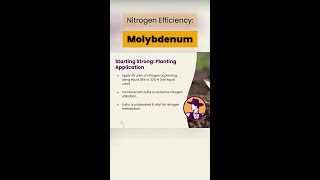
Agronomist John Kempf explains how molybdenum enables soil microbes to convert nitrate back into organic nitrogen. When applied with a carbon source at one pint per acre, molybdenum cuts nitrate leaching to near-zero and improves how plants absorb nitrogen.
Chapters
Molybdenum is the critical enzyme for the nitrate reductase enzyme that is used by both biology and by plants. And every time we add molybdenum and carbon in this combination into this mix, we see the nitrogen leaching goes to practically zero. And even in high moisture conditions. And the reason for that is because if you have adequate molybdenum levels, even when the soil biology nitrifies back— excuse me, nitrifies nitrogen from the various forms, urea and ammonium, into nitrate and builds up nitrate levels. Adequate levels of molybdenum allow other soil biology to convert that nitrate back into organic nitrogen. And so you actually moderate and modulate the nitrate levels in the soil to not become excessive simply by having adequate levels of molybdenum. That means a lot for leachability. It reduces your leachability, but also it increases your plant's energy response because it's now absorbing less nitrate. It has some, but it's not absorbing 80% nitrate instead of 20%. I have a very strong recommendation for also mixing molybdenum with this application. Takes about a pint per acre of a 3 to 4% molybdenum product.