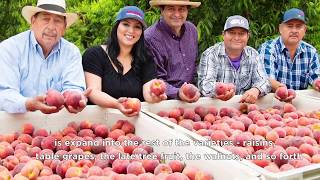
Jason Hobson of Advancing Eco Agriculture describes how regenerative fertility programs increased nectarine yields 25% on a California farm starting in late 2016. Z Fire nectarines sold for $26.82 per unit this season versus $19 last year, adding roughly $1,300 per acre in revenue.
Questions this video answers
December 2016.
About 12% increase in fruit size across varieties.
At least 2 points higher compared to last year.
This season averaged $26.82; last year a little over $19.
Approximately $1,300 per acre more this year.
Chapters
My name is Jason Hobson and I'm the CEO of Advancing Eco Agriculture. Our company is an agricultural products and services company that works with farmers all over the world. And we use regenerative agriculture to bring a new level of performance and health to all kinds of crops and plants. We're taking the best of the science that's coming from scientists around the world, from Europe, from the United States, and being able to bring that down to earth and create fertility programs for farmers that can create bigger fruit size, better fruit quality, better tree performance, and enhance the natural resistance of a plant to insects and disease.
Today, the middle of July, we are packing Elegant Lady Peaches. So far this year, compared to last year, we have really seen an improvement in the quality. The brix level has gone up. The peaches seem to be lasting on the tree fruit a little longer, and they're able to withstand the heat despite the previous years of drought that we've had.
Advancing Eco Agriculture was started in 2006 by a man named John Kemp as a consulting company. Around 2011, John started to make products because he couldn't find the products he wanted to use as a consultant on the marketplace. And we came up with a new way of making products that not only makes them very available and very effective for the plants, but also makes them very safe and very healthy for the soil. What we see as far as fruit quality and fruit size is sometimes in the first year, like here at Jimmy's, a very big increase in the size of the fruit. We usually see better coloration of the fruit and then also usually a higher sugar content.
We have seen a remarkable difference in the crops after beginning with this AEA system. For the past six months, it has been. The fruit is much different. Our brix have been at least two points higher compared to last year as far as our, you know, sampling bricks in the packing house. Not to mention the fruit size has been larger. And in addition to that, we've had a very nice harvest so far. And people are excited in our company about the fruit that's coming off. And it's actually beginning to change our culture, which. That was my. What I really wanted to do was bring in, make grow beautiful fruit and change the culture and get people excited about working towards the vision of just growing some grapefruit.
So since we started working with Jimmy In December of 2016, we've seen a marked change in both the performance of the tree. So you can see here, on these trees, the leaves are very large. There's a very large amount of shoot extension. So the trees have a lot of energy, and that's something that was uncommon here before. And so that's translating into. Because when you have large leaves and you have a lot of leaves, that makes more sugar because they're all solar panels collecting sunlight, and that translocates the fruit. And so you see a bigger increase in fruit size. And we're seeing here what Jimmy was saying, about a 12% increase in fruit size across all the varieties they picked so far. And that's translating into a very big economic difference for them as well. So some of the things we're seeing here on the farm is a very different appearance of the leaf structure. And this is a very large leaf for a peach tree. It's also very flat. So a lot of times you'll see peach leaves and they're curled, they're cupped, and they're kind of curled and twisted. But the majority of these leaves in these trees are very flat, which is an indication of a high level of nutrition in the tree, especially calcium and micronutrients. And so when you have a lot of leaves on the tree that are of this size, then it basically gives the tree a bigger solar panel. So all these trees are solar panels collecting sunlight to turn that sunlight into energy, into sugar for the tree. And when you have this high quality leaf, you have a much greater capacity to build sugar, which then translates into fruit size and also fruit color and quality. There's been a very strong economic benefit so far here on Jimmy's farm. And the increase in fruit size has been able to get them a much higher dollar per box price. And that's translated to a lot of money, a lot of net profit coming back to the farm. More so in years past.
Our first variety, the Z Fire nectarines, we started off the season and we averaged. We finished the variety here just a few a week ago, and we averaged $26.82. Last year we had a little over. Last year, our average was a little over $19. So it's been a significant increase in the amount of money per acre. $1,300 an acre more this year on the Z Fire nectarines than last year. I'm overjoyed. It's a great start.
So Advancing Eco Agriculture is a small company that has a team of consultants that works all over the country. And we have consultants from New York to Washington and California. And we get to work with some of the best farms in the country in high quality fruits and vegetables. And the thing that we're able to do is to help the Farmer figure out what are the economic drivers for their farm, what makes them more money, and focus their entire fertility program around those goals. So if a farm wants bigger fruit size, if they want better fruit color, if they want more fruit, we can design a fertility program to meet those goals.
Actually, we packed 7,000 boxes of Z fires this year. Last year we packed 8,000 boxes. So with 7,000 boxes, we made more money per acre. With larger size, better quality, better fruit, we got a better price. And in our business, size matters. The thing about the advanced and eco ag program was I wanted to do everything. The entire 1500 acres of raisins, table grapes, tree fruit, the walnuts we have, the almonds. I wanted to do it all, but unfortunately I was a little short on money. So what I had to do was I had to narrow that vision down to something we could actually accomplish. So we identified 335 acres of the of early tree fruit varieties starting in May and finishing and just getting into the first week of July. And so the idea was do really well with those varieties and then with the cash flow that we get from that, continue with the others. And so the plan is working. We began harvesting the 335 acres that, like I say, that'll finish about the first or second week of July. But as money comes in from the crop, then my goal is, and what we're trying to do is expand into the rest of the varieties. Raisins, table grapes, the late tree fruit, the walnuts and so forth. And that is our goal. That's our vision. Now next year, we're going to do it all right away, all up front. We're going to get going, be aggressive up front with it. There's nothing like this that exists. This is a team advance. And Eco ag is a team of people. It's not your local chemical guy who's coming out here and, and giving you his best shot. This is a team of advisors that are focused on plant health and soil health. And it makes a big difference. These trees behind me were struggling last year. These trees behind me weren't feeling well last year. So they've been a little slower to come. But yet you can see the new growth, the color in the tree. So next year it's going to be even better when we harvest these peaches. I'm looking forward to. We're not done yet here. There's more to come. The best is yet to come. You know, we're always looking for something and something new to make it better. And we have. It's often times we leave very disappointed. We leave lacking, you know, wanting because we can't find it. This is something where we're very excited about. This is different, what we're doing here in this. In this. On our ranches. This year, Advanced Necoag brings us something very, very different, Very new and very exciting.