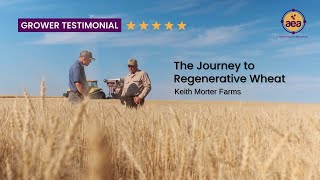
This is a YouTube interview (John Kempf channel) featuring farmer Keith Mortar describing a ~15-year journey toward regenerative agriculture on his 3,900 acres of no-till dryland wheat. Mortar outlines changes: moving from anhydrous to liquid fertilizer (~6–7 years ago), adopting split fertilizer applications, and trialing AEA biological/micronutrient products (including a product referred to as 'bachoul gold'). He reports rapid seed sprouting (12–14 hours), a roughly 50% increase in root mass with AEA-treated plots versus controls, hopes to reduce overall synthetic N use and herbicide spraying over time, and plans further soil sampling and targeted biology applications.
Questions this video answers
About 3,900 acres.
About 15 years.
About 6–7 years ago (took the anhydrous tank off the drill about seven years ago).
Hard red winter, soft white, and DNS (dark northern spring).
Approximately 12–14 hours.
Chapters
I enjoy farming, I love it as much as I love my family. So I want to hand it to the next generation in better shape than what I received it in. And the goal is to get away from these fertilizers. That's what the ultimate goal is. And I think this goes for any regenerative system. It's all about the roots. It's all about how many roots you can get off the plant. The root growth and the root mass was unbelievable in the AEA products. My name is Keith Mortar. My son Austin and I, we own and operate Keith Mortar Farms. We, we currently have about 3,900 acres of tillable land here in a winter wheat spring wheat summer fall rotation. Currently we raise about equal number of acres of hard red winter soft white and DNS dark northern spring. That is my journey to regenetive ag. It's been a long one. It's probably been 15 years. Never been a big fertilizer user. When we got into direct seed 15 years ago, we were putting anhydrous down like everybody else was. And as time went by, I kept hearing about biology getting worse, biology getting worse, and anhydrous might, might be the cause of it. Well, we took the anhydrous tank off the drill about seven years ago now, six years ago, and we put a liquid tank on and we went with liquid fertilizer. The journey basically led from early on a variable rate in our seed and our fertilizer to doing all the split application of fertilizer, only giving the crop what it needed. And then this year, listening to John Kemp at a seminar, they convinced me that this was the way to go, that we were headed down the right road without knowing we were headed down the right road. We found through a lot of the podcasts that John has done over the years about oxidized soil and wheat is one of the worst oxidizers out there. And so how do we reverse that oxidization to get our crops to produce at its maximum level? And a lot of our disease issues. Listening to these people that he has on his podcast, it convinced me that our diseases have more to do with our soils than the genetic of the crop. A lot of university professors would tell you different, but that's kind of the way I feel about it anyhow.
Well, what a lot of other people are doing is they're relying on a synthetic to do the job of mother Nature. And AEA is relying on mother nature to do the job that it's been doing for, well, long before they ever decided to plow this ground. So this step we're taking is not only hopefully going to be a step to make it better generation to farm, but hopefully the generation after me as well. It's a regenerative rollover that you like to see continue for a long time to come.
We are going to get more free time the longer we are in this. When my kid was young, my boy was younger and my daughter were younger, I couldn't go and do because I spent more time on the tractor. And I think long term, if we get everything working right with aea, we might not have to be spraying this crop for weeds. That the biology, the change in the soil will keep the biology will keep those weeds from coming here. And that's huge and that's cost savings to me. Now, do I think it's going to happen overnight? No, it's not going to happen overnight, but in 10 years we might get to that point. When I was a kid, my dad sat on the tractor all the time. My dad never went to hardly any baseball games when I was a kid. You know, he'd go to one once in a while, but it was so rare that it was like a surprise to see him there. The hours we spend out here in the field I think are going to be less. But the hours we do spend out here in the field are going to be more productive because we're going to be doing these things like we did today. You're going to be digging up a plant and looking at the roots. You're going to be pulling the SAP analysis. The hours you spend out here are going to be different than the hours that we used to spend. We're just going to have more time. We're going to be able to go camping, do the things we want to do, enjoy it and actually enjoy farming. The reason kids don't come back is maybe their dad worked them to death when they were younger and they just don't have any interest in it because they always saw it as hard work. Well, I'd like to see it to where kids get excited about it. And it is hard work at times. There's no doubt about it. When you're cutting a crop out here and you got problems going on, it can be hard for us. Regenerative Ag, I think it's only going to become a bigger part of our program nationwide. It's already gotten bigger this year alone. And Regenerative Ag, I think it's actually going to gain more traction than organics are in this county of Morrill county that we're standing in right now. There's only one other person that I know that's buying any product at all from AEA. Maybe in five years we're going to see, you know, 10 people buying product. And so I think it's going to get bigger. I really do.
So we started working with Keith this spring, working on a spring wheat crop, and we started talking about it. The biggest thing we try to get people to do in wheat and most conventional crops is just use less nitrogen. It's already getting really hard to get nitrogen and it's expensive. And, you know, going forward, there's just not going to be that availability of nitrogen or it's just going to be too cost prohibitive to use. So we're able to use way less nitrogen and then use soil biology and micronutrients along with that to get the most out of the nitrogen that we use. Typically, people are putting on enough nitrogen to cause them all kinds of grief. And that's why we see a lot of rust and aphids and all the sucking insects come in. It's because of too much nitrogen. Same with verticillium and any kind of mildew.
What we're hoping for is we're hoping for a better root structure and plant because we can dry out and dryness is what gets our crops. We're hoping to get a crop that's more resilient to our heat issues that we run into at the end of May 1st of June, when we need that plant to be the strongest that we can get. And the AEA products were sprouted in, I would say, 12 to 14 hours. It was sprouted. It was shocking. The root growth and the root mass was unbelievable in the AEA products. And I think this goes for any regenerative system. It's all about the roots. It's all about how many roots you can get off the plant. And what we saw was at least a few 50% increase in root mass with the AEA products versus the non AEA products. A person's looking at the product and you don't want to do what I did and go full tilt on it. You just need to try 100 acres. Because if you're already going broke, you're going to go broke. But if you're wondering, can I save some money? I think you're going to find out there's plenty of nutrients in your soil that are tied up. And that's what we're finding out through AEA's products. We've got nutrients here that are Tied up because of our conventional ag. The trick is getting those nutrients in our soil broke apart so that they're available to your growing plant. The only way you can get that is through the biology. And you can put all the biology. These companies are all about biology right now. But the step that they're missing that John has brought along with his product is you got to feed that biology to get the biology to reproduce itself. And if you're not feeding it while it's trying to make that conversion in the soils, then you're not going to be successful with your biology. As input, costs go up and farmers start looking at this more. Is this going to be a cost savings? I think you're going to find it's a cost savings. I look back when I was younger, in my mid-50s, now in the 90s, we had some tremendous crop years here when I was in my 20s, but we didn't get any more rain then than what we got this year. What is really the difference? And I think our soils have deteriorated that much in the last 30 years to where we have to make a change if we're going to improve our yield. Zinc. We've hit a roadblock on our yields. We can't seem to go. All the new varieties come out. We've hit a roadblock. And so I want to take a 10 year sine wave. You want to use a sine wave because you're going to have good years and bad years and I want to limit that bad. And maybe you're not going to get the very top of the thing, but you'll never have it very bad. Your mean is always right here and try to improve that level of mean that you always have out here. And everybody needs a soil health coach and you got to have a. And I call them the soil health coach because that's really what they are. You got to have somebody that can help you out. And without those people to help you out, you're going to be lost. My plan this fall is to put some more product down. Figuring out the bacteria that we need, figuring out the biology we need. I think the bachoul gold that they have is tremendous product. It gave it a leg up. It was out of the ground three to five days quicker than the rest of the wheat around it. So we're definitely going to put some more bakou gold on. We're going to have to pull some soil samples still and see where we're at as far as nitrogen levels and then match our biology to our nitrogen come this fall. And continue to pursue that. I think the biology is the key to what we're doing here. If you don't have the healthy biology, we can't move forward.