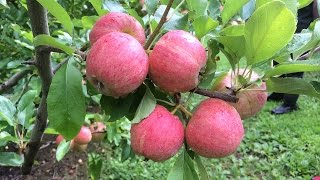
John Kempf explains how cobalt and molybdenum cofactors can starve apple scab fungus by boosting arginine metabolism in trees. An orchard that was heavily infected produced scab-free fruit the next season without fungicides after repeated cobalt applications raised tissue levels to a critical threshold.
Chapters
The essential premise of epigenetics is that environment determines genetic expression. This obviously holds true for animals and people and plants where it's commonly applied, but it also holds true for the organisms that we term diseases. In the late 1950s, when some of the original research work was done on apple scab, they discovered that apple scab is completely dependent on the amino acid arginine as an energy source. Many of the early bactericides that were used for apple scab treatment and prevention in orchards were simply arginine inhibitors, and they proved to be quite effective. When I started looking at. When I understood for the first time that this organism is completely dependent on arginine, I asked. The question is why, instead of trying to prevent arginine synthesis, why are these plants accumulating arginine? And can we speed up the arginine metabolism so that the plant rapidly metabolizes it and converts it to peptides and complete proteins? When we look at the arginine metabolic pathway, there are several enzyme key enzyme cofactors that are required for that metabolic pathway to function with optimum efficiency. In particular, two that show up are molybdenum and cobalt, which are not historically addressed in apple tree nutrition and horticulture. When apple trees have adequate levels of cobalt cobalt, they rapidly metabolize arginine and process it further into peptides and proteins. And the result is that the leaves have very low levels of arginine and no longer provide a food source for the scab organism. We applied this theory to a number of orchards, apple orchards that we've worked with in the Midwest and in the eastern United States, and have learned that with repeated cobalt applications, once the cobalt levels in the plant tissue reach a critical point and those plants have the nutritional integrity they need, they become completely resistant to apple scab. So this picture is a picture taken of a farm that we have worked with for two years. The first year we started working with them in June, and that first year, their Nayla apples had an incredible infection of apple scab. In fact, they produce no fresh market quality fruit. All the fruit went to processing because of the severe scab infections. One year later, in the 2014 growing season, there was no visual scab evident on the trees of any kind, with absolutely no fungicide applications or no bactericide applications to keep the scab under control. So there was a radical turnaround in that orchard in a single growing season. Interestingly enough, for the last two years, we have been using a lot of SAP analysis on the orchards that we have been working with. And we have observed a distinctive difference between those varieties of apples which are susceptible to scab and those which are more resistant on the SAP analysis reports. Those varieties which are more susceptible have greatly reduced cobalt concentrations on the SAP analysis. The varieties which have a greater resistance to apple scab also are much more effective at picking up cobalt from the soil profile and seem to have inherently higher cobalt levels in the leaves than those plants which are susceptible to apple scabbard. Do you want to be the first to learn about new ideas? Subscribe to our blog@advancingecoag.com and connect on social media. Click the button below to subscribe and to learn more about cutting edge ag technologies.