Regenerative agriculture in action at AEA's Texas Field Day | Part 3 of 5
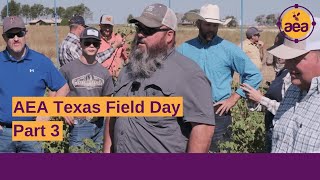
Video transcript of a field discussion (AEA Texas Field Day) led by John Kempf and others about regenerative agriculture practices in Texas. Speakers compare traditional vs AEA treatments across corn and cotton, discuss nitrogen application (50 units applied on corn one year vs zero another), crop color differences due to lower N (lighter green), SAP analysis suggesting crops may not need added N, and alternative causes for greening (Mg/Fe). Other topics include cover crops, grazing, irrigation/water applied (~6 inches on one pivot), timing of planting/termination, foliar and in-furrow biological treatments, and effects of long-term rest vs continuous production on soil biology.
Questions this video answers
50 units.
About 6 inches (six passes, ~1 inch each).
April 20th.
Chapters
Last year this field was in corn. We did the full AEA program. I told you on that little pivot over there, I did 192 bushels, 50 units in. This was identical application, except this only did about 75 bushels. Tell you, the difference in the water had six and a half gallons on that pivot. I've got three and a half on this. So last year was a horrible year for corn unless you had the water to make up for it.
And if your pollination timing just happened to be wrong, it was real bad.
Yeah. Pollination was about 107 degrees, 30 mile an hour west wind. How it survived, I don't know. But anyway, year, huh?
When did you plant the corn?
April 20th. Yep. But it was a foil. AEA followed it up with cotton. It's been a full AEA this year with primer and infuro. At planting, we've done two or maybe three foliars. Two, I think, going along with the saps and, you know, putting what's needed. One thing I've kind of noticed this year is this field is different color than all the other cotton fields I have or anybody else's cotton fields. And I get tons of questions. How come, how come that's a different color?
So is it lighter?
It's lighter green.
Just, you know, off 84, you can see it in the distance. They think something else is growing here than cotton. Then you come up here and it's cotton. It's just a different.
That's just because it doesn't have too.
Much units of N. They don't have.
Any zero applied nitrogen.
Delta Pine. 18, 22.
Well, so, so that brings up what we're going to see. And obviously we're talking about it here. We'll see it in the next couple of fields also where we have traditional and AEA treatment side by side. Color is the thing that most people bring up. And it's. And it's very disturbing to people as they're trying to understand what they're seeing. Because the, the old farmer rule of thumb is that doesn't look quite as green as it should. Let's put some more nitrogen on. Nitrogen is cheap. Let's just add another 10 gallons. And so what we're actually validating with SAP analysis again is that it doesn't need nitrogen. And so at the very least we should consider if we don't like the color, maybe that's not a problem. But even if it is a problem and the plant's saying it doesn't need any more nitrogen Adding more nitrogen is only going to be utilizing a resource, number one, that we don't need, and number two, that's contributing to many more problems that we're trying to avoid. So why would we want to do that? And so that, that leads right into where we started the conversation this morning of understanding that oftentimes we're our own worst enemy. So we need to learn how to do the things that are contributing to our success and the success of our soil rather than doing what we think or what we have been taught or what our eyes are telling us, rather than what the crop is really telling us.
Mike, I just want to make sure I got this straight. You applied 50 units of nitrogen on the corn last year and no nitrogen this year?
Correct.
And how does the crop look compared to other crops in the area other than the color?
It's not as loaded as some of the, I guess, seems like the traditional crops that always are high yielding in this area don't seem to be doing as well. But some of that aren't usually yielding. They're fantastic. So a lot of those crops is missed out, especially some of the dry land. It's loaded up more than what this is. But, you know, nitrogen applied compared, you know, don't know if that's the only factor.
Well, and the other question there also is, I think what a lot of people on the high plains are seeing that I hope causes them to question a little bit, is that our organic fields and our non irrigated fields look better and potentially have more yield potential than our traditionally treated irrigated fields. So what have we been doing under extensive irrigation that is contributing to the lack of performance in the season that we've had, that's allowing these lower input or virtually no input crops to be performing much better. And so all of that to say, you know, we've got to be able to, to understand what we're witnessing and be willing to maybe change our mind about something that we have believed to be true. That's not based on what our fields are actually showing us and telling us. And so that, you know, again, these fields have traditionally had the same kind of things that other fields have had historically. But we're beginning to see that even in shifting the system, we're not really having big problems and we know that the future is much brighter, whereas those other systems seem to be, you know, they've had their heyday, if you will, and now things are getting worse and worse and worse.
And.
And then even when you do get the exceptional weather year that you've been waiting for why is it not producing what you thought it should and what's standing in the way of that? And so that's, again, we've not been. We've not been what I would consider really aggressive on this field with our treatments. You know, Mike has done a great job with primer and the inferrow treatment. And so when we talk in furrow treatment, what we're really looking for there is biological stimulation, small amount of micronutrients to make sure that plant is getting as a seedling, what it really needs. And then we're going to come back and see what the plant's telling us 20, 30, 40 days down the road and then evaluate from there based on what our weather is, what the crop is doing, and what the saps are telling us, how are we going to manage from there? It's not a. It's not a typical program of we've got $80 to spend or we've got $150 to spend. And here's what we're going to do. We're going to do this at this time, and this at this time, and this at this time. Instead of no, we're going to let the crop and the conditions tell us what it needs, and we're going to manage according to a budget that we're going to utilize based on when and how the crop needs it. Instead of let's throw it all out there and hope that it works.
If you would like. It's easy to turn this, this crop dark green without nitrogen. Yeah, yeah. So what makes a plant dark green is the increased chlorophyll content. So we're familiar with, we put on a bunch of nitrogen, we get this increase in chlorophyll, everything turns dark green. But you can do the same thing by putting on more magnesium or more iron than the crop requires, or the combination of the two. And in fact, if you go to different crop types, let's say if you go to the turf industry, for example, if they want to turn a dark. A golf course really dark green, they spray it with iron because it does the exact same thing as a nitrogen application does, but without all the surplus growth, which is something they care about. So the key part to each of those is that you can turn plants dark green with either nitrogen or magnesium or iron. But for any of those to have that effect, you need to apply more than the crop actually requires. That's the key phrase. You need to apply more than the crop actually requires. And then it turns that really nice dark green color.
So interesting terminology that when I was introduced to, you know, similar technology to what we are really fine tuning now is that was presented to me as that's a nice growing green color rather than an over nitrified color because what we were accustomed to was excess nitrogen. A nice growing green is more, it's more in the direction of a lime green. It's not lime green, but it's, it's not that deep down dark black green that everybody is accustomed to. And again, that's management practices that we've just been conditioned to think the wrong way. That's been very good for an industry that's supporting us in our wrong thinking. We can walk out in here and have a look. We've got a nice load. One of the things Mike mentioned when we were out here a few days ago in regard to, you know, as we all know in cotton, kind of the traditional rule of thumb has been it doesn't really matter how much you put on, it matters how much you can keep on it to get to the gin. And cotton historically sheds a lot of fruit late in the season. We attribute that to, you know, drought, stress or run out of energy, run out of gas, got hot, you know, all kinds of things. And my contention has always been I don't think the plant puts on more fruit than it intends to finish. What are we doing that's preventing it from finishing what it intended to do? And how can we manage that in a way to keep more on there? And so Mike, I don't want to put words in your mouth, but I think you said the other day that this does not seem to be shedding late season like some of the other stuff that appeared to be loaded more. It's shedding more than what this is. And so we still, you know, the tale will be what's at the gin and what's the quality.
Do you have any PTRs on this field?
0 Yep. What cover? It was a multi mix barley cereal, rye, black oats, radishes, some vets, a couple clovers. Did you just use traditional burn down methods or how'd you kill it? Just burned down.
But you grazed it some too?
And I grazed it actually. Once we harvested the corn, I spread it and we turned cows out and they actually planted it for me. And then once we took the cows off in February, I cranked the pivot, got the COVID crop going and then I terminated it.
And Mike and I had that discussion, you know, where do you really want this crop to be cut out? Well, Basic rule of thumb is we need 50, 50 pretty good days to make a bowl that's viable. And so that, that leaves us with a, you know, first part of September, depending on what you call your last good day. You know, we want the crop to be cutting out because spending any more energy to put on more fruiting positions that are not going to make is just energy that's not being utilized to size and mature.
5.
The freak that's on it.
Did you run accelerator or boron?
We didn't run. I don't think we ran any boron because we were. I mean, other than what we're getting in a couple of blended products, like. So it's got photo mag on it. So we got some boron there. We didn't actually push boron because we felt like where we were at in cutout. And the amount of time that we had left in the season, we weren't really trying to accelerate it. Yeah, I mean, so we could use, you know, we could seemingly use boron to accelerate that sugar movement to the seed if we were coming up against the end of a season that we were trying to accelerate. But good open weather for, you know, what looks like the remainder of this month that we really need to finish this crop. We just left it alone. But it did have two applications of accelerate and photo mag and a few other micros. And so I don't think we added any boron because we, you know, I don't think so. We weren't in the tank, but we haven't really tried to push that boron level up either. How much total water?
You know, I don't know how much what total water was applied about 6 inches. That was the other thing that was kind of weird is I have a moisture probe. Water just kept showing like it was. It didn't need it. So, you know, in which we got some timely rains. But I ran this pivot, six passes, you know, an inch each time. But usually you don't run it and kill it. Wait a couple days, re crank it. So that was kind of strange this year. So what's your plan after harvest? Are you gonna come back with more like more biology or humates or food for the biology? Yeah, I'll plant a cover, just do a simple grain mixture and then we'll do a. It'll be cotton next year again. So we'll just start it over again. Try to do the primer a little earlier. Graze the COVID crops too, probably. Yep.
The problem with our season in grazing, where you have cotton, if you haven't come in here and got those covers established pre harvest. So some guys are really pushing the limit on, you know, how, how soon can we get a cover established back into that cotton crop to finish up the season? We typically the only grazing that you generally get if you drill behind the cotton is spring grazing. And most people that want to graze are not going to invest in transporting livestock for, you know, 40 to 60 days.
How soon before you plant your cotton do you terminate your cover?
It varies. Five different fields. I'll do it five different ways. It's like you're a coach calling a play. Depending on what the stage is at and what that cover looks like, what the variety was, how thick it is, when your plant dates gonna be, what's.
The range look like?
Anywhere from 30 days prior to two or three days after. I planted green before or a burn.
Down application, you know, or from up.
By Muleschin would probably be a little bit colder. But that's one concern is not letting your ground warm up. You know, if you have a good, nice cover on it, it's gonna be quite a bit cooler.
Well, I've seen that. But if, say you do it seven days before, it seems like you don't get that temperature. But if you go ahead and plant into that living cover, that temperature is higher than seven days after termination. So it's kind of one of those deals where if you waited too long, might as well just plant into it and then kill it. And cotton comes up a whole lot easier in a bunch of green than it does, you know, a barefield or, you know, dead field. And then you also got to worry about bugs. You have a bunch of bugs in your cover crop, you kill it and you don't have enough time for them to get out, then they're gonna attack that cotton plant coming up. That kind of depends on the bug pressure.
Conversation that Mike and I had on the way out here. Kind of interesting. Mike mentioned that he's observed on a pivot where he didn't have enough water, right? So you stopped using half the pivot for 10 years and it was just resting, grazing and whatever. And four years ago you took it back into production and he mentioned that even now he can see to the line where's the fit was in continuous production for 10 years and where it had rested for 10 years. So I had to ask the question or it kind of, for me, I was like, what changed in the soil profile? What changed in the biology to have that long lasting effect over multiple seasons? Was it what effect did the nitrogen applications, the herbicide that that side of the field didn't have for 10 years to allow the biology a better chance? And then to take it a step farther, what will the field that if we continue with the conventional excessive nitrogen herbicides and whatever, if we continue on that path another 10 years, how much more degraded will this soil be than here if we look at the sequence of things?
Well, I can comment to that a little bit. There's a group of farmers that a colleague, Michael McNeil, has been working with in Iowa, that they were early adopters of using anhydrous ammonia, using Roundup Ready corn, using all this various technology. And they literally hit the brick wall, the figurative brick wall, if you will. This is now 2000, I think it's like five or six years ago, where it used to be that they could put corn seed in the ground and do almost Nothing and harvest 200 bushel per acre corn. And we're talking 4ft of black topsoil. And they dropped from that to doing 70 bushel corn. No matter what they did, they couldn't buy enough products to get it beyond 70 bushel. So they reached that threshold where their soil had degraded enough that it was not able to support a crop anymore. This was in Iowa, and they were able to turn that around after a couple years of COVID cropping and regenerating the soil. But it was really an eye opener for me. They had embraced this technology wholeheartedly and gone down this road. They were early adopters. And how is it possible that perhaps a lot of other soils are on the same pathway, but they're just 10 or 20 or 30 years behind? It was an interesting experience.
More from John

Episode 186: The Power of Precision Management and Multi-Species Covers with Mike Thompson





Podcast Extra: John Kempf on Soil Biophysics, Plant Immunity & Foliars on the Permaculture...


