Regenerative agriculture in action at AEA's Texas Field Day | Part 4 of 5
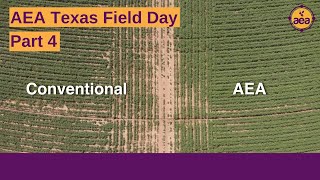
John Kempf and growers Larry and Jace Wood compare cotton fields side by side: the traditional side used 105 units of nitrogen and plant growth regulators, while the AEA side used zero nitrogen and no PGRs. Four years of no-till with cover crops and delayed herbicide timing shifted both toward vegetative growth, complicating the balance between plant development and reproduction.
Chapters
All right, so in this field, we've got a really good comparison. This is the only real opportunity we're going to have today to look at a traditional treatment side by side in the same field to an AEA treatment. Qualify that with. This is the first year AEA outside of. And these are the growers here, Larry and Jace Wood. Larry did use, and I don't even know that it was on this field, but he did use some, some seed inoculant, biokoat gold, prior to this year, and then coming into this year, decided he was curious enough to understand what we were doing, that we'll try, you know, a real comparison side by side. So it did get a soil primer, but that was in the spring, 30 days, 20, 30 days ahead of planting time. And then after that, you know, timing was, as most of you know, on the high plains has been all over the place because of. It went from no rain to all of a sudden it's raining over three or four days, which nobody has had to deal with in some of our lifetimes that, that you couldn't get back in the field because of. Of rains. And so, you know, we're. Everybody's fighting weeds trying to get all of that under control and, you know, and just getting timing off on a bunch of things. But this is the traditional treatment side. This is the AEA side. One thing I will point out here that's unusual for me is that I have never seen our treatments produce a larger plant every. You know, in the past two years. All of our treatments compared to a traditional treatment where we were really driving with calcium energy, it was very easy to get that plant into reproductive mode and shorten everything up, shorten up all of our node lengths. And those plants were always more compact than what we've seen here or what you will see here. I mean, if you look, this is a 3050 pattern on both sides, and you can't even hardly tell where the rows are. And so. And that's a more growthy plant than what we really want. The plant is fruited well, but it's still at a larger node spacing than what we would really like. And I know that the reason for that is, you know, first year in the program. How much nitrogen over there? 105 units. 0 over there. So all of this still happened based on improving photosynthesis, but still having so much vegetative energy pushing that plant. You know, our chlorides are high, our potassium's high. I mean, basically everything John put on the board this morning is high. In these fields and particularly with traditional treatments. So the energy that we're getting from that is still driving. I mean, who outside of you guys here who maybe think that, I'm not a liar, who would walk into this field and believe that there's no nitrogen applied over there? And this is where 105 units were applied. Now we do have some PGRs here, about 60, 60ish ounces through the season. Nope, no. No PGRs on our side. So again, this is. And I made the comment in the field earlier, you know, this is the, the first time using the management practices and the products that we are that I've ever felt like, wow, we're just not getting it shortened up as much as I have seen in the past and as much as I would like. But it's because that, that reproductive energy balance is, is. It's harder to achieve because of the way these plants were growing. And then I think the timing of. I shared with you earlier that after seeing 2020 and waiting to make our first treatment, after we got SAP analysis back, which is it's really hard to get true leaves because we don't use cotyledons, we have to have true leaves. So by the time we get a true leaf big enough to take a SAP analysis and get that back from the lab, get an application made, we're usually at Pinhead Square, real close to it. I think we could easily say we need to be applying at least by Pinhead Square. Maybe we could back it up a little bit, which is what I intended this year. But just because of the nature of the season, we actually wound up being many nodes further than that before we started making applications because of the weather and the battle for the weed control. So when you consider that a lot of our herbicide treatments are actually contributing to the deficiency of some of the micronutrients that we need to get that reproductive balance, we're driving with our foot on both accelerators, if that makes sense. So we're contributing more to what's creating the deficiency and we're not having the opportunity to address the deficiency. And so what I see is, you know, I should have been more aggressive in my early treatments based on how far along the plant was, rather than kind of following my accustomed to, well, we'll do this and then we'll let that plant tell us what it really needs. We should have been a little bit more aggressive earlier to get that balance more reproductive. That we just couldn't tell and, you know, and we didn't know how long it was Going to be before we could get back in the field. So that's.
What is the history of this field. What was the crops the last couple years?
It's been all cotton.
It's a cotton cotton rotation.
We switched it to no till five, four years ago, I think.
Four years ago.
And we've been no till for four years.
And you had covers.
Wasn't good at all.
How much nitrogen did it have last year?
Excuse me?
How much nitrogen did it have last year?
155 units.
And you did have a cover this year? Yeah, we've had a cover every year. So anyway, those are some things that we want to point out. One of the things that I noticed, you know, pretty late in the season after we had stopped making herbicide treatments is. And if you'll look over behind me, it's pretty easy to see we've got breakthrough weeds, and that's no criticism of their ability to manage it as good as they could. But we're not seeing the same weed pressure, and I think we're continuing to see that more and more. Where guys have been doing it for a couple of more years is that sprayed on primer ahead of planting time. And then with the season that we've had for that biology to really go to town cycling those minerals, I think we reduced our weed pressure and I think it's that. So weed control on both sides is essentially the same. Same, you know, timing a little bit different on it, but. But essentially the same herbicide program, same number of applications, but. But we can see the pigwood sticking his nasty head up over there. Just, you know, and it's. And it's not because, like I said, it's not because they weren't doing everything in their toolbox. It's just that that soil was just, you know, staying with that weed pressure because it's trying to cycle what it needed to cycle. So that field was planted two weeks, three weeks. This field was three weeks earlier.
Just died.
Yeah. And again, that was due to, you know, the plan was to plant that side and then put our application in the tanks and go plant this side. And it was three weeks before we could get back in the field. So again, this is, you know, I'm pleased that we had the energy that we did, obviously, by maximizing our photosynthesis that these plants just really took off and got after it. I'm a little bit disappointed that our node length got as long as it did. And it was not as easy to get back under control with the nutrition. But, you know, again, I Mean, it doesn't really matter, you know, what we can see. It matters what we have at the gin and what the quality of it is. But I, you know, so I invite both of you, we can, we can look at both sides and talk about it, or y' all can just spread out and look at what you want to. You know, these are again, these are bigger plants than what we're really striving for and what we have gotten, generally speaking, but they still have a lot of fruit. It's just on longer nodes than what we really would, would desire. But one of the other things that, you know, you may be able to see it here. We saw it real prevalently in Dale City yesterday, day before yesterday. That what we traditionally see when we're using John's expression, driving with the foot on the accelerator and the brake at the same time, you get a lot of energy from your, your nutrition or your minerals that are driving that vegetative growth. And then you start hammering it with the brake, putting PGRs on. What that actually does is when that, when that hormonal response happens, it shuts the metabolism down of that plant. And that gets a kind of a back filling of reproductive energy because the stress that that creates, that plant says, oh my, I have to reproduce. And so you generally get that on higher nodes. And those plants generally will wind up being very top heavy. Like we were in some irrigated drip irrigated and Del City that according. We didn't see it before it fell over, but according to the grower, you know, three days ago or four days ago, it was two feet taller than it was when we were there. You couldn't even walk down the rows. I mean, it was just laid over. Now, was it a good crop? It was a pretty good crop, but it's not what I have seen in other places. But the thing about it is, is all of those heavy bolls were in the top half of the plant and there was nothing on the first 18 to 20 inches of the plant. That fruit had not been set or had not continued to grow. And then you hit it with that PGR and all of a sudden it pops on three bowls right together on that fruiting branch and then another one here and another one here. And then it stretches out and then you hit it again and all of that crop winds up being here and lays that plant down. Instead of when we get that balance really good, we start seeing multiple fruiting positions on those lower branches and that plant just grows and fruits and there's some guys here that I know we've done an excellent job with getting that reproductive energy early on so that we get those lower bolls, which are typically higher quality, those first position bolls, first fruiting branch and first fruiting position always has the best chance to be the highest quality. So the further out and the further up you get, generally speaking, the less quality that you have in that lint, because the less time it has to provide the sugars that are needed to make that fiber, the quality that it should be.
More from John

Episode 186: The Power of Precision Management and Multi-Species Covers with Mike Thompson





Podcast Extra: John Kempf on Soil Biophysics, Plant Immunity & Foliars on the Permaculture...


