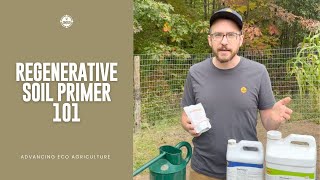
A walkthrough of applying a three-product soil primer in fall: Spectrum (microbial inoculant), Rejuvenate (carbon and minerals), and Sea Shield (fungal support). The video covers mixing ratios, hydration steps, and per-acre rates to build biologically active soil before planting a cover crop.
Questions this video answers
15 minutes.
50 grams per acre.
1–2 gallons per acre.
1–2 gallons per acre.
In the fall, before winter (prior to planting a cover crop).
Chapters
If you want to build biologically active soils, it is critical in the fall to apply biology with biological support. The reason to do this in the fall is because biology never really stops working over the winter, even when the soil is frozen. It'll slow down a lot, but it won't stop. And so you have that entire winter season when the soil is undisturbed. There's no tillage or planting or anything. And there's not that intense nutrient demand of a growing crop that the biology can just work, multiply, make humus, and extract minerals to provide the coming season to your crop. Here at aea, we've developed a three product combination that we call regenerative soil primer. It contains everything biology needs to thrive. And fall is an excellent time of year to apply this. I'm here in my garden. I've just harvested a really nice crop of weeds from this garden bed. And so it's a great time to prime the soil, plant a cover crop and let it rest for the winter. This applies at any scale, up to thousands and thousands of acres. The only difference is application equipment and obviously a quantity of products needed. First up is a biological inoculant called Spectrum. It's made by our friends at Tinyo Biologicals and we sell it. And it's just a bunch of different species of really beneficial soil microbes. You can add other inoculants as well, including homemade things like compost tea. We really recommend you don't skip on the spectrum, but go ahead and add them in addition, because with microbes, diversity is king. I'm gonna do this first because you should let it sit for 15 minutes to hydrate this little package. 50 grams will cover one acre. For my purposes here, I'm just gonna use a smidgen, so I'll just mix that up. Now, just applying biology to degraded soils is kind of like airdropping people onto a desert island. Just like people, biology also need food, shelter and tools to hunt more food and build more shelter in order to thrive in that environment. So if you were a soil microbe, here's some things you might be interested in having on your desert island. You'd probably want a nice robust sugar source like molasses to get eat. In the short term. You'd probably want the soil particles to be bound together by something like humic acid into stable soil aggregates that you could use as housing. You'd want broad spectrum trace minerals to use as enzyme cofactors so that you can digest more food in the soil. And you'd want Something like seaweed that just has lots of enzymes and more complex compounds to use as resources. So thankfully the good people at AEA have combined all those things into a single jug. This is called Rejuvenate. It contains molasses, humic acid, concentrated seawater, liquid seaweed and a whole bunch of other good stuff. And it's basically a single package microbe booster. It's applied at a rate of one to two gallons per acre. In my case here, I'll just be putting in a tablespoon. It's important to shake it up. Rejuvenate is kind of an alive product. It has a tendency to form a biofilm on top. So to save trouble with your application equipment, you should definitely strain it. Now, the final ingredient in our soil primer is fungal support for the soil fungi. So this here is Sea Shield. It's a cold processed fish hydrolysate. This is the fungal support component of the soil primer. This is applied at the same rate as Rejuvenate, one to two gallons per acre. So I'll be using a tablespoon here for my purposes. I'll pass it through the strainer. It's been 15 minutes now, so I will add the spectrum to this concoction and then I'm going to dilute the whole thing. You want to dilute it with water enough so that it'll soak into the ground. It'll get down into the root zone of the plants and out of the direct sunlight. You can also do this right before you irrigate or before a soaking rain and let that water soak it into the ground. Alright. This soil primer is ready to be applied to the soil. I'm just going to drench it on the bare soil and then plant a cover crop to cover the soil through the winter and hopefully next year produce a much more profitable harvest than the weeds I got from it this year. I'm expecting the first rain I've had in a long time shortly here. So that should soak the soil primer into the ground and let those microbes do their thing for the next eight months or so here. I hope this helps and wishing you many bountiful harvests to come. Thank you.