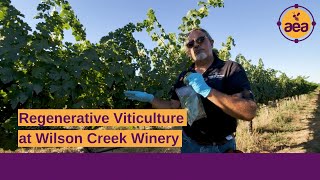
Greg Pennyroyal, vineyard manager at Wilson Creek, describes the farm's shift from conventional to regenerative viticulture. Starting with soil that had less than 0.25% organic matter, they added 60,000 to 80,000 pounds of green matter per acre and switched to gentler equipment. The result: better soil structure, fewer pests, and improved water retention.
Questions this video answers
Less than one quarter of 1% (i.e., <0.25%).
Approximately 60,000 to 80,000 pounds of green matter (then composted).
Composted down to the equivalent of about 15 pounds of compost per acre.
A D8 bulldozer with rippers.
A 110 Kubota 'horse' tractor (able to drive in second gear with the ripper).
Chapters
When I first got here, we were pretty much a conventional farm. We were disking, we were using glyphosate, you know, pretty much standard chemical practices. The soil had less than one quarter of 1% organic matter. And quite frankly, the health wasn't that good. My name is Greg Pennyroyal. I am the vineyard manager at Wilson Creek Winery and Vineyards. The first time I came into this vineyard and was trying to open up the soil, I. I rented a D8 with rippers and the soil was so hard, the back end of the bulldozer was lifting up off the ground. The first thing I did was add a lot of organic matter to the tune of 60 to 80,000 pounds of green matter that I then composted down to the equivalent of about 15 pounds of compost to the acre. But I noticed the whole system was kind of stalled, which is when I started interacting with John and we started developing a system through aea. Last year I got the same size ripper and put it on 110 Kubota Horse Tractor and I was able to drive through in second gear without the tractor really struggling that hard.
As we look at the soils here around Wilson Creek Vineyards, we see, especially in wintertime, we see water stay where they want it, it stays on the vineyard, it doesn't run off many of the more conventional vineyards in the valley here we see lots of erosion and runoff with winter rain because of their leaving soil exposed, not keeping cover over it, and just following conventional practices, which leads to high tillage. And through that you're losing soil, you're losing the potential for moisture that's needed in the ground for bud break and development of the vines early in the season. And it's just different here at Wilson because of the regenerative practices.
Regenerative agriculture tells you what should you be doing to regenerate the entire system. With regenerative health, we are taking a lead from the natural biological systems and we are emulating those and increasing those. So you have a self contained system. So the plants are feeding the soil, the soil is feeding the plants. The microbiome is creating an overall naturally modulating system that corrects itself. We use a lot of foliar nutrients early in our program so we can feed the plant. The plant develops more photosynthesis that creates excess sugars. The sugars go into the soil. The microbiology in the soil picks up. It naturally allows more nutrients to be available to the plant and you get this cycle going. It's like having an engine. You got to prime the flywheel and once the flywheel gets going, that's what we've established. Now I see the evidence of that flywheel picking up. I see the plants starting to self regulate. My pest problems are mostly going away, and I'm spending way more time now looking at maximizing the nutrition and the health of my vineyard versus constantly out looking for problems and putting fires out. This was a comprehensive system where we were not only looking at soil tests to see what our basic soil chemistry was, but we started doing bi weekly SAP analysis and we take samples from different parts of the vine and we connect it with the different physiological, developmental stage that the vine is at. Having this broad spectrum of all of the major compounds and elements that we need gives me real insight to what's going on. And quite frankly, it was a game changer. We saw week by week in each physiological phase of the grapes war where we had deficiencies and where we had excesses. I was surprised to find that a lot of my issues weren't actually deficiencies. They were excesses that were causing problems in the uptake of other things. So it's all about balance. And if you don't know where your excesses are or your deficiencies, you can't balance it. If you're like a lot of winemakers, you want to be on the cutting edge, on the bleeding edge. You want to have absolutely terroir expressing grapes that will create 92, 3, 4, 5 point wines. You just want to blow your clients away. With great wines, there's really room for this to innovate. AEA is very adaptable, they're very open with their technology, and we do a lot of innovative research here. So if you're a winemaker that wants to just blow the doors off the current quality and do something that's really exciting, really unique, there's room to take that extra step. So those are sort of the two tiers. You can get into a mode where you're going to just do better and have stability and make good wine, or you can just go for it and just make great terroir driven wines, which to me, that's what winemaking is about.