The Benefits of Regenerative Systems in berry production
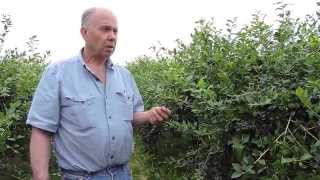
Bob Wilt of Sunset Valley Organics describes using biological/regenerative farming with organic inputs (fish fertilizer, kelp, minerals, AEA products) on blueberries, blackberries, and raspberries to boost soil microbiology, mineral availability, plant health, yield and fruit quality. He gives field examples (large clusters, berry sizing), reports management practices (SAP leaf analysis for rapid plant monitoring), and emphasizes reduced reliance on nitrate fertilizers and pesticides through improved nutrition.
Questions this video answers
306 berries
24 inches
Almost 10 berries per bud
About 10% of the crop
About one week
Chapters
Hello, my name is Bob Wilt and my farm name is Sunset Valley Organics. We're an organic farm. We raise primarily blueberries with some raspberries, blackberries and strawberries. Right now we're standing in our blueberries and we're going to show you what biological farming can do if it's used properly. We practice biological practices, but we use organic inputs and we've been able to have some really good results. You can see that how our clusters are real full and the berries are going to size very nicely. We've got very good growth for using organic inputs, but the real thing is we are following biological practices. That means that we are enhancing the microbiology in the soil. And when you do that, and if you mineralize your soil, then the microbes will solubilize those minerals and put them into the soil solution and available to the plant. And when that happens, the plant becomes very healthy, very vigorous. You have a good opportunity to reach your genetic potential. And that's really what we're all trying to do when we're farmers, is reach our genetic potential and get the maximum yield with the maximum quality. And that's what we try to do every year here on our blueberries. As you can see, we've got very vigorous growth, we've got very good color, and we've done this without nitrate fertilizer. And in our practices, we don't need nitrate fertilizer. We use fish fertilizer and we get our nitrogen source from that. But fish is a source of amino acids and protein, which is actually more efficient than using nitrate. And by doing that, we get way better healthier cell structure and just a healthier plant using fish fertilizer or a lot of other organic sources. The important thing is you don't need to use nitrate fertilizer to get growth. There's lots of other things you can use. Another thing we use here is we use sources of calcium, which give us very good growth. Not only are we getting nice growth on our berries, but we're getting nice sizing. I'm holding this in my hand just to give you an idea. These berries are probably bigger than a nickel, maybe just a little bit less than a quarter. And also look at how many berries is on the bush. It isn't like this is the only cluster. So in other words, we're getting a lot of energy into the, into this plant. And when you do, you make, you can make nice sized berries along with lots of them. And a lot of people don't feel that you can do that. Organically, and it's about understanding biological farming and what the microbes can do for you. So the other thing is quality. We will let these berries hang for maybe another 10 days at least, and let these green berries ripen to where when we harvest, it'll be our objective to maybe machine pick these and pick 90% of the crop in one pick. A conventional grower cannot do that because if he hasn't fed and got the minerals and made those berries nutrient dense, they will not hold up. The they'll start deteriorating before the green berries get ripe. Whereas with the way we're doing things, using biological farming and microbes and getting that nutrition into the plant, that berry is full of minerals, and it will just sit there and hold and hold and hold until, shall we say, his little brothers catch up with him to where we can pick almost everything. So that's another benefit to biological farming. So you can get good solid growth that will be very good bearing fruit for next year. You can get. Good yields, you can get high quality. And maybe the most important thing that we should be considering is we get good nutrition, good minerals into the berries, which makes very good, healthy food for us. And that might be the most important thing.
Okay, here we have an illustration of possibly reaching our genetic potential. Instead of a cluster that's only 6 inches long, we've got a cluster that's 24 inches long. And we've got 306 berries on this cluster and an average of almost 10 berries per bud. Where a lot of times on, on this variety, you'll have five, six, or seven berries per bud. And so biological farming can also help you reach that genetic potential that everybody's talking about. Now, this particular CL cluster is not typical yet, but when I started biological farming, I was lucky if I had a cluster of berries this long. And now if you look at the average, I've got some pretty decent clusters like this that I didn't used to have. But the next step that I want to go to would be to have all my clusters like the one we just looked at. So biological farming or regenerative farming can help you get to that genetic potential. And I don't think any of us know what the genetic potential of a lot of our crops are. We're willing to settle for just whatever we can get when we should be striving for more. And a lot of that has to do with the inputs that you use. There's very harsh fertilizers and chemicals. And if you can resort using biological farming, a lot of Times the plant will resist insects and diseases. And when you do, then you don't have to use all the pesticides and harsh fertilizers. And pretty soon you start seeing things like what you see here. And some of the products that we use is fish fertilizer, different types of kelp, AEA products are involved, different minerals. And so it's a whole basket of different materials that we use. And we always look for the highest quality products we can find. And because I'm a firm believer that the better input you have, the better output you're going to have.
Okay, we're in my blackberries now and would like to show you the fruit that we're going to be harvesting. And we're just starting to get some berries turning black. And here's an example of the size of blackberries that we expect to pick this year. Hopefully, they'll all be that size, surely not all. But as we become better and better at what we do, our expectation that our last berries should be as good as our first berries. And we have seen that happen over the years with where we've started, with small clusters of berries, whether it be blueberries or blackberries, whatever. And now we see by using biological farming practices, we can see bigger clusters and the last berries will have very good quality along with the first berries. And the way it used to be is your last pick on something would go into the juice barrel. Whereas now, like on our blueberries, we find that our last pick, which is usually about 10%, we will still run that for a grade instead of going in the juice barrel. So that shows you what biological farming can do as far as the health of the plant and yield and how maybe a little extra work at the front end by doing all the things you got to do for biological farming can give you rewards. Another technique that we're using this year, which is brand new, is we're using SAP analysis out of the leaves. And we're doing this through aea. I think they're the only people in the United States that are doing this. And we're finding some very interesting things. We're able to analyze what's going on in the plant very quickly, like within a week to where we can come back. If something is lacking, we can change it, or if something is in excess, we can change it. And so we've been able to monitor our plants and manage a lot better. And the SAP analysis is, in my opinion, an excellent management tool. And I think once we learn how to use it to its full potential, it's going to be just irreplaceable for managing a good high quality crop. So you can kind of look down the row here at the berries we're going to have. We're just starting to get some berries turning black and hopefully we will feed this crop well enough that the little tiny guys back here are going to end up like the, like the first guys. That's our goal and we'll see if we can meet it. The other thing that we've found is if we feed properly. And when I say feed, we're not only feeding the plant as a foliar, but we're also putting minerals on the soil to feed the biology. And when you do that, the biology will solubilize those minerals and make them available for the plant. And when that happens, the plant is extreme, extremely healthy and it will start making very healthy berries. And when you have those healthy berries, you're going to be resisting insects and disease. We have practiced this and we see it happening. The more we practice biological farming, the less problems we have with disease and insects. In fact, here in the Northwest we have a, an insect called the spotted ring, Drosophila swd. And it's a little fruit fly. It will come along and it will lay an egg in a berry that's starting to ripen, possibly even a red berry like this, definitely one that's just turning black like this. And when it does, in about three days, that egg will turn into a worm and that worm will start feeding on the berry and damaging the berry. And of course nobody likes to eat a berry with a worm in it. So there's almost a zero tolerance for SWD in berries or any food. And it's become a very big problem almost across the whole United States. And the way we have dealt with it, because we're organic, we can't use a lot of insecticides in the first place. So what we've done is we are fighting that insect with nutrition. In other words, we are putting enough nutrition into that berry to where we're making enough sugars that the insect just, it can't digest the sugars that the berries making and it will die. Or even if you've gone to the next level, if you've got the right minerals or enough minerals in that berry that plants putting out a frequency that the insect doesn't home in onto. And many times the insect won't even stop to lay the egg in the first place. And it's all about nutrition. And in order to have that nutrition, the only way you can get it is through biological farming or regenerative farming, whichever term you want to use, at least to my knowledge, because I've got a lot of conventional friends and they all are spraying weekly for this insect in order to keep from having it. And here we are. I have not put an insecticide on these berries yet and I don't intend to. So that's another aspect that biological farming can do for you. And again, it's a matter of using good products such as AEA products, which I endorse, but also other products. You got to have a full spectrum of products and you just got to have a complete program. And there is no one silver bullet. You've got to have a full toolbox of different tools to do this. Okay, we have moved from our harvest blackberries to our growing blackberries. And what we're doing here is we're doing what's called ay alternating year. So we were showing you the harvest blackberries a minute ago and now we're.
Over into the growing blackberries.
And what we've done is these berries were our harvest berries last year. We have cut the canes off and we've let new canes grow up and we're culturing these canes for next year. Whereas on the other side, those canes grew just like this last year and now they are bearing. And what we're doing is we're concentrating all of our energy into either growing or fruiting. Rather than trying to make the plant grow next year's wood and grow this year's fruit, we're trying to make the plant do one or the other really good instead of trying to do the both jobs kind of, shall we say, ho hum. And an example of our vigor is the size of our leaves. Here's my hand and that leaf isn't too far from the size of my hand. The other thing, if you can get down here and look, is we're developing very nice caliper and hopefully you can see that. And that all comes from good growth energy which is coming from the soil. And so again, it shows you what can be done with biological farming. It's pretty obvious. I'm a firm advocate of biological farming. I used to be the world's biggest conventional farmer and I have just switched 180 degrees. And now I'm the biggest advocate for biological farming because you can just do so many neat things that we struggled to do when we were conventional. Okay, we're in the raspberries now and you can see there's lots of berries and there's pretty good size, and it looks like even the little ones are going to size. We just got to keep feeding nice berries. If you look at the plants, we're nice and green down low. And then we get up here on top, we're a little bit yellow, but I think that's typical for this time of the season because those canes are just about done doing their job. But the important part is the lower section is nice and green. Then we got nice canes coming up. I think I told you six foot. These are considerably more than six foot, and they're still growing. The other thing to look at. Is the. The distance between the nodes. We're only about 2 inches, and so it looks like we're going to. That's the makings of a really good fruit set for next year. You can see that we got good vigor with our canes. And the berries are kind of hidden part of the time just because of the foliage. But then if you look, we got lots of berries and there's more coming down here. And I think if we keep feeding, we'll get them all. And it looks like if they. If they're fed properly, they're going. They're going to get good size. And it should be, I hope, the makings of a very nice crop. We went through with a harvester once already. You can't even tell. And the fruit was excellent quality and held up very good when we packed it. And it looks like the cell structure of the berries is real strong, and I think it comes from all the calcium we're feeding Ram.
More from John

Episode 186: The Power of Precision Management and Multi-Species Covers with Mike Thompson





Podcast Extra: John Kempf on Soil Biophysics, Plant Immunity & Foliars on the Permaculture...


