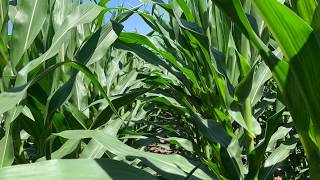
John Kempf describes a farmer example (southwest Kansas) where organically certified dryland corn—grown without manure, compost, cover crops, irrigation, or added nitrogen—was approaching tassel with no visual nitrogen deficiency and an expected yield of about 160–180 bushels per acre. Kempf attributes this to stimulated soil biology from a fall "soil primer" package (Rejuvenate, Spectrum, SeaShield) applied the fall before planting (noting results after three applications) and emphasizes that fall applications give months of microbial activity to solubilize phosphorus/potassium and fix nitrogen for the following season. He positions fall priming as the highest-value timing and suggests the approach can deliver large nutrient supply benefits in a few years rather than decades.
Questions this video answers
Southwest Kansas.
Approximately 160–180 bushels per acre.
No — the organically certified crop had no nitrogen application and no irrigation.
Rejuvenate, Spectrum, and SeaShield.
Three applications.
Chapters
Hi friends.
It's been an interesting summer and we.
Keep learning new things.
This past July, I was out in southwest Kansas. I saw a corn crop that I.
Was incredibly impressed by. Recorded some comments that were then posted on YouTube and what I was really impressed by was a cornfield that was.
Growing dry land corn on corn.
One corn crop every 24 months with.
No manure application, no compost application, no.
Cover crops, no nitrogen application, organically certified crop. And the corn was approaching the tasseling stage. I was just beginning to tassel and the leaves were bright green all the way down to the base. There was no nitrogen deficiency.
This is a crop not been harvested.
Yet, but we're expecting it to be in the 160 to 180 bushel per acre range on completely dry land with no irrigation, which is very impressive. What I'm really impressed by is the capacity of biology to deliver nitrogen.
The farmer made the comment.
He said I can use the fall soil primer less expensively than growing a.
Cover crop to deliver all of my nitrogen requirements. There was no other nitrogen requirement other.
Than the nitrogen that was released from biology, fixed from the air and made available to the crop. So there have been a lot of.
Conversations in the regenerative agriculture space by.
Growers and agronomists who've been speaking about the capacity of biology to deliver nutrients.
And the idea that we can develop agricultural models and systems where we do.
Not need to apply fertilizers and where we don't need to apply nitrogen and.
Phosphorus and potassium because biology can fix nitrogen from the air and can release phosphorus and potassium from the locked up.
Reserves in the soil and supply 100% of our crops requirements. There are many examples where this has actually been demonstrated to be true for extended periods of time on a number of different farms. And often the idea is that it takes a lot of time to get.
To this level of productivity and biological activity.
It'll take a decade or a couple of decades of working with COVID crops and rotational grazing of livestock, etc.
To achieve soil biology to that level of performance.
But this grower didn't do any of those things.
He only applied rejuvenate and Spectrum and SeaShield, our fall soil primer package the.
Fall before planting his crop.
And he was able to achieve those types of results. In fact, he was able to achieve.
Those results after only three applications. There's been all these theoretical conversations about.
What is possible and what can be.
Achieved by having an optimum biological population.
But what I'm excited about so much Is the idea that we can accomplish those types of results in a matter.
Of a year or two or three.
And not measured in decades. As farmers being connected to the cycles.
Of the planet and harsh winter months.
The rebirth of plants in the spring, it is usual and common for us to think about the season beginning in the spring. But in reality, when we start thinking.
About developing our soil microbial populations, our season doesn't begin in the spring. Our season needs to begin in the fall. Because when we have robust microbial populations.
Working in the soil throughout the winter.
Months, they have the capacity to release a lot of nutrients, solubilize phosphorus, solubilized potassium and fixed nitrogen, and make it available for next year's crop.
We originally developed rejuvenate to increase residue.
Digestion in the fall so that we get rid of the residue, we remove disease carryover, and so that we have very strong disease suppressive soils the following year to suppress potential pathogens from causing an infection.
And rejuvenate was so effective at stimulating.
Biology to have all these effects on the soil environment that it's become our number one product.
It's used by growers of every different type of crop.
And it's become so widely used that growers today are also using it during the growing season. They're applying it in the furrow app.
Planting, they're putting it in irrigation systems.
And using it throughout the season. And it certainly is providing a strong benefit and a strong crop response when used in these environments.
But still, the biggest economic value that.
It provides to growers is the fall application.
Because when you put on an application.
In the spring, let's say you put it on in the furrow app planting.
The biology that is added in the soil only has a period of a.
Few weeks to a month or so.
In which it can release and solubilize nutrients.
Before we start getting to a point of very serious crop demand and the crop begins pulling a lot of nutrients out of the soil profile.
When we apply the fall primer in.
The fall, we now have months of biological activity to solubilize and release nutrients.
And make them available to the crop the following spring.
You know, I'll use a hay crop as an example of what really is possible.
We've become used to the idea that.
The first cutting of hay should be the strongest and the most robust in the spring. And this is due to a couple of different reasons. It's partially due to moisture. We have very good moisture levels in the spring, but it is also due.
To an abundance of microbially active nutrition, where we had all the nutrients that.
Were released through the winter months solubilized.
And now the. The first growth of alfalfa in the.
Spring, first growth of hay in the spring has this abundant nutrient supply from soil biology. So we get very robust growth. And then the second cutting is significantly less, the third cutting is even less, the fourth cutting is even less, and it tapers off throughout the entire growing season.
And this varies of course, depending on.
The environment and which region of the country we're speaking about. But we have worked with growers who put on the fall primer in the fall and produced not just a tremendous.
Nutrient release from soil biology, but a.
Consistent nutrient release not only during the winter months, but also the following summer.
So that there was no drop off in yield in later cuttings.
In fact, one of the growers that we worked with has produced higher yields.
In the second and third and fourth than he did in the first cutting.
The yields constantly improved throughout the entire year, both in terms of actual yield.
And in terms of forage quality as well. Imagine what can be delivered to a corn crop or a soybean crop when.
You have such robust biology that they can actually supply 100% of the crops nutrient demands when you get to the grain fill period or when you get. And the same is true of tree fruit and nuts and vegetable crops as well.
Imagine what would happen and how plants.
Would behave differently if the soil biology was able to supply 100% of the crops nutritional requirements.
We know that this can happen depending.
On the soil geology.
Of course, you have to have a.
Soil profile that has the presence of.
Potassium and phosphorus that can be released. We can supply 100% of a crop's.
Nutritional requirements without adding imported phosphorus and potassium and nitrogen in really robust biological activity soils.
Fall soil primer can deliver those results.
It can help us get there much.
Faster than many people anticipate.
And it can happen in a matter of a few years.
We get strong crop responses immediately the first year.
The fall primer and Rejuvenate in particular has become our number one most popular product because it works, because growers see it work.