Webinar: How Crops Benefit From Robust Soil Microbial Populations
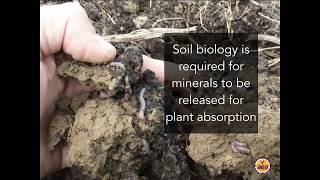
John Kempf explains how bacterial inoculants and mycorrhizal fungi break down crop residue and release minerals from soil, reducing synthetic nitrogen needs by 30 to 50 percent. Fall applications work over winter to mineralize nutrients. Field examples show yield increases and improved soil structure.
Questions this video answers
August 16, 2018
800-495-6603
30–50% (commonly observed; verified with SAP analysis)
Untreated >1000 (very compact); treated 320–400 on very dry soils
Dry and under 100°F; claimed shelf‑stable indefinitely (examples 20+ years retaining viability)
Chapters
Well, good evening, friends. Welcome to the webinar talk where we're talking about soil health and soil biology. It's been an entertaining day getting here to this point. I've spent the last three days visiting a number of different groups of farmers in Indiana and looking at cover crops, looking at different crops in the field. And I've been really excited by some of the changes that we're observing and some of the things that are happening with COVID cropping and with soil biology. And about two weeks ago, I was visiting some farms in Saskatchewan and we noticed some very intriguing soil regeneration effects and soil softening and soil loosening from using biology. Over the course of the last couple of days in presentations with a number of different farms throughout Indiana. One of the recurring themes that I've spoken about a number of times is this idea that the fastest way to rebuild soil health is to grow really healthy plants. Of course, when you grow really healthy plants that are photosynthesizing very well, those really healthy plants now start transferring a lot of sugars into the root system. And with all of the additional sugar production, sugar profile of the root system, we get this tremendous bacterial populations which then extract minerals from the soil mineral matrix and make them available to plants. So when we look at this integrated soil plant system and ask ourselves the question, where can we hack the system and where can we make the greatest difference with the smallest amount of input there are, from all the pieces that I've observed over the last decade or more, there are two areas which I think we can put in a small amount of product, small applications, and produce tremendous crop responses and tremendous soil responses. Those two areas are applications. The first is applications of biologicals and microbial biostimulants. Or over and over again, I've observed growers putting on applications of mycorrhizal fungi or bacterial inoculants as a seed treatment at planting or as a fall application and produce a tremendous crop response. I think that is perhaps the single biggest ROI application of any application that we see. That is the most consistent strong ROI application. And then the second area where we see really strong economic responses is with well designed foliars that are applied at the right time, where with a foliar application we really harness the photosynthetic engine and bring a lot of new energy into the soil plant system. The topic for the discussion tonight is in this first area, using microbial inoculants and using biostimulants. And where can we best position them to have the greatest impact and to have the greatest Effect. As we have worked with different farms in different environments, I've observed that we often think about microbial inoculants and microbial applications and biostimulants perhaps a bit differently than the way some others might think about them. And so I wanted to talk about what are some of the things that we believe to be true about microbial inoculants, and where is the place that they really fit the best, the framework and the context for this discussion? A number of growers have asked us to talk a bit more about how we use Rejuvenate and the Rejuvenate Program. As many of you know, the Rejuvenate Program, also that we're also referring to as the Soil Health Program, is something that we've. I developed probably seven or eight years ago, and it has really taken on a life of its own since then. It's gone in some very interesting directions. So the original idea, the original intention when we developed Rejuvenate and started applying it in the fall, was to use it as a residue digester to help break down crop residue from corn stover or soybean residue, and particularly also for tree fruit, because in tree fruit and vegetable crops, crop residue can be a vector and a carryover for disease organisms from one season to the next. And so it was very important to digest that residue very quickly. Unfortunately, many of the tools that growers had available that they were using before we started using Rejuvenate and Spectrum and other products was the typical application would be just to apply nitrogen to help speed up the digestion of the crop residue. And that was effective, and it worked. But the challenge was that you oxidized and lost a lot of your crop residue and your organic matter in the soil by simply releasing it back in the atmosphere as CO2 and as carbon dioxide. So our desire is to rapidly break down crop residue and also build organic matter while we are doing that. So it was intended and designed to tremendously increase bacterial activity, bacterial digestion, and fungal digestion. We got some very interesting responses, some very interesting effects in improving soil tilth, soil structure, flocculation, getting much better water infiltration and better water holding capacity almost immediately, within weeks or months after application. That really kind of caught us by surprise. So I want to talk a little bit about some of the things that we've learned about bacterial and fungal communities and how they release nutrients for growing crops and. And how we can leverage that to our advantage. The first piece that we believe is underappreciated is that crops which are grown in soil with optimal biology are going to produce substantially higher yields. The last two days I've spoken about the benefits of adding mycorrhizal fungi as a seed treatment to a number of broad acre crop growers in Indiana. And I heard probably half a dozen testimonials from growers who used mycorrhizal fungi as a seed treatment at planting and saw visual crop differences and noticeable yield responses. And to me, this is really exciting because these are applications that cost a few dollars per acre, they're very inexpensive, and they can produce a tremendous crop response. So mycorrhizal fungi is one of these that is well understood and well studied. And the benefits and the effects that we can see with those applications can also happen with fall applications of bacterial inoculants and rejuvenate and also putting mycorrhizal fungi on cover crop seed as well. The second piece that I believe is not well understood is that soil biology is required for the particularly strong bacterial populations are required for the mineralization process to extract minerals from the soil mineral matrix and make them available to plants. So think of it this way. When you have a really healthy plant that is photosynthesizing well, it is producing a surplus of sugars and carbohydrates more than it needs to successfully reproduce. And it transmits the surplus of sugars that it is producing out through the root system as root exudates into the soil profile. When you have root exudates and all these sugars in the soil profile, that triggers very rapid bacterial digestion. But bacteria. So sugars are simply carbon, hydrogen and oxygen. They don't contain calcium, magnesium, zinc, manganese, copper, sulfur. There are no minerals in sugar. Yet bacteria need minerals to form their own cells to form their own bodies. So as bacterial populations feed on sugars from root exudates, they extract minerals from the soil mineral matrix and incorporate them into their own cells. And then as that bacterial population cycles as it is grazed upon by protozoa and by nematodes, and you get natural die off from bacterial populations, the minerals contained within their bodies are now bound as organic acid chelates with citric acid and carbonic acid and acetic acid, et cetera, and also with amino acids just as glycine. So you now have amino acid chelates and organic acid chelates in the soil profile. This is a natural biological process that is intended and designed to function. Those contained within their bodies are now bound as organic acid chelates with citric acid and carbonic acid and acetic acid, etc. Also with amino acids such as glycine. So you now have amino acid chelates and organic acid chelates in the soil profile. This is a natural biological process that is intended and designed to function this way. These trace mineral chelates are now extremely absorbable. They're very readily available for plants to absorb, and they're extremely energy efficient. In four, I've described the various levels of plant health, talking about the plant health pyramid. If we want to achieve higher levels of plant health, where we achieve resistance to all the airborne bacterial and fungal diseases such as bacterial speck and bacterial spot downy and powdery, mildew and fire blight, late blight, etc. We need to have plants that are producing high lipid concentrations, high levels of oils. The formation of high levels of oils is dependent on plants absorbing these microbial metabolites, these organic acid and amino acid chelates. So the highlight, the headline, if you will, is that many soils throughout America have an abundance of phosphorus and potassium in the top six inches of the soil profile. So through many soils on the Great Plains in America Midwest, we have in the top six inches we'll have as much as 42,000 pounds of potassium per acre, 9,000 pounds of phosphorus. So we have an abundance of phosphorus and potassium. We simply need to release that and make it available for plants. And that's. I'm just talking about the top six inches. By the way, A question that I've been asked recently is where can we analyze soils and know the total mineral profile of everything that is present? So laboratories that can do that analysis would be what are used for mining assays, for geological exploration. Two of them that I'm familiar with, both Canadian. One of them is Acme Labs, spelled Acme, which is from British Columbia if I'm not mistaken. And the second is Aget Labs, a G, A T, which is in Ontario, I believe. So the latter of the two agit labs is the one that I'm the most familiar with and have the most experience with. And so you can use that laboratory to measure the total mineral profile of what is present in your soil system. You'll be amazed at how much potassium, how much phosphorus and calcium and magnesium is present in the top six inches of your soil profile. But in order to release that, in order to make that plant available, we have to have strong bacterial populations. If you go back and you read the literature and the research that was conducted in the 60s and 70s and 80s, they often described the capacity to rapidly regenerate soils by putting on some manure applications and Some limestone and some rock phosphate and being able to produce this tremendous plant response from using simple soil amendments today, we don't see that happening anymore. And I believe the reason that is true is because there is one thing that has changed substantially between 2018 and 1970, which is that today we have a history and an accumulation of herbicides and fungicides and insecticides in our soil profile that is very well documented as having suppressed our biological community. So we no longer get the effects from soil amendments today that we did 40 years ago. The way to replicate that and regenerate that capacity of soils to respond is by replenishing the bacterial populations that are now missing and or have gone dormant over the last couple of decades as a result of chronic pesticide exposure. The next piece is that there are many microbiologists who speak about the need to have the appropriate fungal to bacterial biomass ratio. Many of the crops that many of the soils that we have today have substantially more bacterial biomass than they do fungal biomass to such a wide degree that. And so the solution that is commonly prescribed is that we need to provide more fungal foods. We need to provide a liquid fish that has a high oil content or humic substances, etc, etc, these variety different substrates. The way to replicate that and regenerate that that can really stimulate and develop fungal populations. However, capacity of soils to respond is by replenishing the bacterial populations that are now missing and or have gone dormant over the last couple of decades as a result of chronic pesticide exposure. The next piece is that there are many microbiologists who speak about the need to have the appropriate fungal to bacterial biomass ratio. Many of the crops that many of the soils that we have today have substantially more bacterial biomass than they do fungal biomass to such a wide degree. In actual practice, I found that we get the greatest degree of fungal development when we feed bacteria. And this seems that. And so the solution that is commonly prescribed is that we need to provide more counterintuitive. I believe what is happening is when when we just look at fungal foods, we need to provide a liquid fish that has a high oil content or humic substances, etc, etc, these variety different substrates that can really stimulate and develop fungal populations. However, in actual practice I found that we get the greatest at bacterial biomass and fungal biomass we do have ratios that are strongly skewed in favor of bacterial biomass. We have too much bacteria relative to the amount of fungi that we have present. But the problem was with just looking at the ratio is that both bacterial populations and fungal populations are often severely depressed. So it doesn't matter if we have 100 to 1 bacterial to fungal ratio if both of them are extremely low and are not where they need to be. So as counterintuitive as this may seem, what we've observed in actual field practice on a large scale is that when we begin feeding bacteria and we support bacterial populations, those bacterial, we get this tremendous surge and spike in the bacterial population that is then followed by a surge in the fungal population. So there seems to be this effect where the presence of a strong bacterial community creates an environment. Either by creating available food sources or stimulating plants and plant biomass development, they create an environment that then allows fungi to thrive. So as crazy as this may sound, if you want to develop tremendous fungal populations, feed bacteria, focus on feeding the bacteria, because they are really the pioneers. And when you feed bacteria, the fungal population, fungal biomass will increase right behind them. One of the challenges of our modern agricultural production systems is that in many soils, many of the cultural management practices that we have adopted result in strongly suppressing soil biology. Where many of the fertilizers that we use, nitrogen applications, et cetera, phosphorus applications, many of these fertilizers are, they're sometimes referred to as being high salt fertilizers. And I don't really like that terminology because many people associate salt with being sodium, sodium chloride. What we really mean is they are fertilizers that have a high electrical conductivity, they have a very high concentration of electrolytes. They serve as an electrolyte, and as an electrolyte with a high electrical conductivity, they create an environment that is not conducive to soil biology. They, in fact, they actively suppress and antagonize both bacterial populations and fungal populations. And in addition to that, we also, we know very well that fungal, or excuse me, that tillage, not always, if we have compacted soils, etc. There is a time and a place where tillage is appropriate. But using tillage the way that it's commonly used to aggressive, where soils are aggressively tilled before planting and outplanting, those practices where we introduce a lot of oxygen into the soil repeatedly have a very strong oxidizing effect. Also strongly suppressed biology. Knowing this and recognizing this, these are, these are still tools that we need to use that many farmers are using today. It's not enough to just recognize that there's a problem. We need to then actively also do something about it and fix the problem. And before planting and outplanting those practices where we, I think the, the way to correcting this is to Balance the negative that we are applying. If we have a need to continue applying phosphorus and nitrogen fertilizer, a lot of oxygen into the soil repeatedly have a very strong oxidizing effect and also strongly suppress biology. Knowing this and recognizing this, these are still tools that we need to use that many farmers are using today. It's not enough to just recognize that there's a problem. Then let's balance that out by putting on microbial inoculants and biosimilar. We need to then actively also do something about it and fix the problem. And I think the way to correcting this is to balance the negative that we are applying. If we have a need to continue applying phosphorus and nitrogen fertilizer ones at the right time, that can reverse the negative effects that we have had on soil biology. The same with true tillage. It's not useful to have a conversation and describing something as describing tillagenders. Then let's balance that out by putting on microbial inoculants and biosimilar nutrients as being having a damaging effect. Instead, let's think about how we can balance out that damaging effect. One of the original reasons motivations for developing rejuvenate was to digest crop residue so that we could eliminate disease carryover from one year to the next. And we were delighted by how effective it was in achieving that and removing residue. I'll show you some images of what the possibilities are in just a moment. From all of the different product applications that I've observed working in many different farms, many different environments, many different types of crops. Microbial inoculants applied at planting, in the furrow or on the seed as a seed treatment, or applied in the fall. In fact, I would say the fall application is probably the biggest ROI response. All of those bacterial populations are the low cost, high ROI application. They're the least expensive and they produce the greatest economic response of almost any application that a farmer can put on the fall applications. Putting on a fall application of a bacterial inoculant, such as Spectrum, combining it with rejuvenate is so effective. It's so particularly effective as compared to a spring application, because when you put on an application in the fall of a bacterial inoculant, it has the entire winter months to continue extracting minerals from the soil mineral matrix and make them available for the following spring. This is one of the reasons why with forage production, with alfalfa production, for example, there is we get this, what we call the spring flush on forage, on grazing, and with alfalfa Production. We expect the first cutting to be extremely strong. And there's a couple of different reasons for this. One of the reasons is, of course, that we have abundant moisture. But it's not just the moisture. It's also the fact that we have abundant nutrition from microbial metabolism that happen throughout the winter months. It happens even when the soil is frozen. It slows down, but it's still happening at a very slow level. That's very mainstream is to, it's the mainstream expectation to have alfalfa where we have a very strong first cutting and a weaker second cutting and then a weaker third cutting and it gets progressively weaker throughout the season. That doesn't, that is commonly true, but that doesn't need to be true. In fact, we've worked with a number of alfalfa producers where we have observed the third, fourth and fifth cutting to be equal to, and in a few exceptional cases, even higher yielding than the first cutting. How do you do that? The key to achieving that is to making sure that you have very strong bacterial digestion through the winter months that produces such an abundance of nutrients, available nutrients, that it is more than the first cutting can consume. So you have this, you are essentially creating this surplus of available nutrients in the soil profile that can last for an entire growing season. And that isn't tapped out by the first cutting. One of the pieces that we've observed is, and this is very true of nitrogen and phosphorus applications. We, we have the advantage and the benefit of using plant SAP analysis to actually monitor plant absorption and plant requirements of nitrogen and phosphorus and potassium and other elements. But off the top of my head, I would say that 80, the majority, 80 to 90% of the farms that we first begin working with, particularly on commodity crop production, broad acre crops, corn, beans, canola, small grains, etc. And also on some tree fruit crops, it is very common for us to cut nitrogen application rates the first year by 30 to 50%. And we do that very safely by looking at SAP analysis and we actually know whether the plants have enough nitrogen or not. We don't take any risks. So we're not, we're not cutting nitrogen application rates by 50% just because we think we can get away with it and then experience a yield loss. We actually make sure that the plants have enough nitrogen. So what that means in effect, is that we are supplying 50% or more, some cases more of the crops, and nitrogen requirements with these bacterial applications. And this is actually, this is a really big deal, something that we haven't spoken enough about in the Past the application of rejuvenate and spectrum in the fall. Spectrum contains four different strains of bacteria, A Zodobacter, a couple strains of different azodobacter, a couple strains of Pseudomonas fluorescence that have the capacity to fix nitrogen from the air in the absence of legumes. So what this means is that when we put on these bacterial inoculants and we spray them on crop residue or put them put on a fall application, remember that bacteria need nitrogen. Bacterial populations have an extremely high protein content, an extremely high nitrogen content. They're a very protein rich cell, so they need nitrogen to form their own cellular proteins. And if we apply bacteria on crop residue that has a very broad carbon to nitrogen ratio, such let's say it's corn stover with a 30 to 1 carbon to nitrogen ratio or 20 to 1 carbon hydrogen ratio, bacteria need nitrogen to break down that residue. If we don't apply it, which we don't want to do, if we don't apply it, they will actually sequester that nitrogen from the air and use that nitrogen to balance out the carbon and nitrogen ratio. The air that we breathe is 78% nitrogen. There shouldn't be the need to add any more. So these bacterial cultures and bacterial break down that residue. And if we don't apply it, which we don't want to do, if we do, populations have the capacity to sequester a lot of nitrogen in a single six month period from fall to spring, don't apply it, they will actually sequester that nitrogen from the air and use that nitrogen to balance out the carbon to nitrogen ratio. The air that we breathe is 78% nitrogen. There shouldn't be the need to add any more. So these bacterial cultures and bacterial and we can see a lot of nitrogen benefits with the following year's crop to the point where we can substantially reduce nitrogen applications the next year. How much we reduce them, of course, depends on, depends on a lot of factors. The relative health of the crop, the organic matter content in the soil, moisture availability, et cetera, et cetera. The important part is that we don't have to guess. We don't have to guess about how much hydrogen we can reduce because we can actually measure it with SAP analysis. So the key question becomes how can we incorporate biology? Where are the places where we can produce the greatest benefits and the greatest effects? I would say that there are three places. One, as a seed treatment. Seed treatment is inexpensive and very effective. And anytime a seed is planted, even if it's cover crop seed that is just broadcast onto the soil surface that should be treated with BioKoat Gold with a mycorrhizal fungi and bacterial inoculant to inoculate that seed. The second place, which may be in lieu of depending on the crop, sometimes instead of a seed treatment, we can also apply microbial inoculants in the furrow at planting, and it is optimal to place them in the furrow right where the seed is placed or immediately underneath the seed, if that is possible. Because our goal is to the moment the seed germinates, have those roots make contact with that microbial inoculant so we can colonize the entire root profile as that plant grows. Then the third area and the area that I believe has the One of the greatest ROI impacts on both yield and on soil health is a fall application of a bacterial inoculant and rejuvenate now in the fall. I'm specifically not speaking about mycorrhizal fungi unless you are adding, unless you are planting a cover crop, and hopefully, ideally, if you have enough moisture, you should be planting a cover crop. The key with mycorrhizal fungi is that they need a living root system to thrive and survive. So if you just have bare soil with corn residue, soybean residue, or something like that, then there is no benefit of adding mycorrhizal fungi in the fall, and the focus needs to be on rejuvenate in a Spectrum application. But if you do, if you are planting a cover crop in the fall, then using Biokoat Gold as a seed treatment can get that mycorrhizal population into the system and can give you additional benefits, even greater benefits during the winter months in the following year. The fall application of rejuvenating Spectrum is so valuable because it can work at breaking down crop residue, building organic matter and releasing minerals, extracting minerals from the soil mineral matrix and making them available to plants for six months or more before the crop is planted. So if you put on an application in late September or October after the crop is harvested, you have all the way through until, let's say a corn crop. For example, if you harvest in October and you put on an application at the end of October, that microbial and that bacterial population will continue to release and extract nutrients and make them available all the way through until the soil dries out the following summer to where there's such a low moisture content that it can't continue to thrive very well. So essentially from October until July, so you can build a tremendous reserve of Nutrients that plants can then absorb from through the fruit field period and the grain field period, when they really need it the most. I had another important thought that I wanted to express, and it's escaping me right now. All right, I'll come back to that. Yeah. I've already described what we. We see. Microbial applications in the fall have a bigger effect and a bigger crop response than almost anything else we can do. Let me. Let me just say it very simply. We have. At advancing eco agriculture, we have developed a number of different products, Quite an extensive product lineup that is designed to be customized and tailored to fit a specific situation in a given farm. So we can add some specific nutrients, take some specific things away, and basically customize to match whatever is needed with that broad array of different products. We have quite a number of products that are very popular and that many growers use in many different types of environments. Rejuvenate is our number one product. More growers use rejuvenate on more acres than anything else. And the reason is very simple, because they put it on and they can see the difference. They can see the response. When I was in Saskatchewan two weeks ago, we visited a farm where there was a split application of rejuvenate on barley ground about approximately 18 months post application that we visited. There was just one application in the fall and treated versus untreated. The untreated section was very dry to begin with. And in the untreated section, we couldn't get a spade into the ground past about an inch and a half. And that was jumping on it with both feet. And on the treated section, we could get the spade in full length of spade, full depth of spade with a single foot. So tremendous difference in soil pressure. On the untreated section of penetrometer readings went up to over a thousand. Treated section penetrometer readings went up to 320 to 400 on very dry soils. That was with a single application. And we see those types of effects and those types of responses over and over again on so many different farms. Farmers that are still tilling their soils will often tell us that they can till their soils one gear faster with a tractor, that the tillage equipment pulls a lot easier. So there are a lot of benefits that happen. And it's our number one product for a very good reason. It's because it works so well and so many people really like it. So what we've developed is what we've learned over the years. We originally applied rejuvenate just by itself, but we have learned that we get this synergistic effect when we combine rejuvenate and spectrum. That it's a case of one plus one not equaling two, but one plus one equaling three or eleven or four and a half. There can be this very profound effect when these two materials are applied together. So rejuvenate is not a bacterial inoculant. It's not a microbial inoculant. It doesn't contain any living organisms that we have intentionally put in there. The spectrum. Instead, rejuvenate is a very strong microbial bio stimulus designed to provide enzyme, cofactors and enzymes a food source to really aggressively drive bacterial populations in the soil profile. Spectrum is the bacterial population bacterial inoculant that contains a number of different. I forget, I think I want to say there's a couple dozen different species of bacteria that there are a lot of beneficial aspects that have been well researched and studied for these bacteria in terms of breaking down crop residues. There are several chitin digesters which can go after nematodes and insect pressure in the field. But very importantly, there are. There are two groups of bacteria in here that I think are very important. One of them are what I would just generally categorize as disease suppressive bacteria. So Pseudomonas fluorescens and Bacillus subtilis and others have this very strong disease suppressive effect when they build a population of soil profile so we can develop disease suppressive soils that are resistant where soils themselves suppress diseases such as Fusarium and Rhizoctonia and Pythium and Verticillium and Phytophthora so we can develop soil profiles that are very strongly disease suppressive. Secondly, as I described earlier with Azodabacter and others, we can actually fix nitrogen in the fall and throughout the winter months so that we build our own nitrogen supply in the soil system. So rejuvenate cannot do those two things by itself. The reason spectrum is important because of the way many of our soils have been degraded with herbicide and pesticide applications. And we need to reinoculate and re establish some of what is missing. One of the questions that I've been asked the last couple of days is am I suggesting that we need to continue biological inoculant applications for an extended period and would say the answer is no. Spectrum and mycorrhizal fungi, we need to continue applying that for a two year or a three year period until we've established a viable population in the soil profile. If someone is recommending an inoculant and suggests that the same inoculant needs to be supplied year after year after year for 10 years into the future. That means just one thing. The inoculant isn't working. It's not successfully establishing a viable population. Mycorrhizal fungi can be a bit of an exception. If you are growing a crop such as canola or mustard that doesn't have a mycorrhizal symbiosis, you can have, you can benefit from then re inoculating the crop following that. But in general, we should be able to build and develop viable populations of these microbial communities in the soil profile. And then as long as we give them a food source, grow healthy plants that are sending sugars out of the root system to feed soil biology, we shouldn't need to continue applying them year after year. This is actually an image of canola crop in Saskatchewan when I was there a couple of weeks ago. Drone footage NDVI where you can see the green, darker green section to the right of the red arrow at the top. Also at the bottom there's another line as well. And that section is where rejuvenate and spectrum was applied last fall. Then this spring. Also last fall was an application of 100 pounds of nitrogen, 100 units of nitrogen, across the entire field, both the AEA treated and the untreated side. And then this spring, the untreated side that didn't get the rejuvenated spectrum got an additional 60 pounds of nitrogen. The untreated side has a total of 160 pounds of nitrogen. The treated side has rejuvenated spectrum and 100 pounds of nitrogen. When we were there, it was noticeably visually darker green, taller. It had blossomed for about two weeks longer and had substantially more pods and larger pods. So it's still too early. We have to see what actually happens with the final harvest. It was pretty intriguing that we saw such a strong nitrogen response from where we applied rejuvenated spectrum. And that's a very common response that we see on corn, on soybeans, on alfalfa, on all the crops that we've used it on. This is an example. This is a farm in central Ohio a couple of years ago where we did a test plot, a couple of different test plots that were replicated and measured with a Wei wagon. The grower standard row starter yield 154 bushels per acre. Grower standard row starter plus rejuvenate and Spectrum yielded 183 bushels per acre. And then when we Combined the aea row starter plus rejuvenated spectrum and those two combined that yielded 212. So pretty strong. Considering that the rejuvenated spectrum was. I don't know what the numbers were right off the top of my head, but I would expect that they were less expensive than the AEA row starter. The rejuvenated spectrum is showing a really strong ROI and a really strong economic yield response. One thing to be aware of, and this may be useful or detrimental in some cropping situations, a rejuvenate application in the fall will get rid of crop residue fast. Very fast. We've actually in some areas with dry land farming, there is a desire to keep residue on the soil surface, to keep the soil from drying out and to keep from dust, keep dust from blowing around with wind erosion, etc. In those areas we may need to be careful with the rejuvenate application because rejuvenate gets rid of crop residue and crop residue digests and breaks down and turns into stable organic matter very, very quickly. I'm talking, what we're talking about is that you can see a visual difference in residue breakdown, usually within of course, depending on moisture. If you have enough moisture for it to work, you can see a visual difference within two to three weeks of application. And you can see a majority of the residue on most fields completely disappear within a matter of a month. So six weeks, eight weeks, 10 weeks, you see a lot of residue starting to disappear. This was an example of rejuvenated spectrum applications the fall and differences in root biomass. So we see much larger root biomass and again that's coming because of that flush of available nutrients that was developed during the winter months. This is a penetrometer readings on a farm in Central Indiana. After 16 months there's an initial spike where we see very strong reduction in compaction, very good water infiltration and soil porosity that peaks about two to three months after application and then gradually drops off over about a three to a four year period as the biology winds down from that strong stimulation. Unless there's a key point on less, you are growing really healthy plants and continuing to supply sugar into the root system, then you do not see the drop off and in fact you see it continuing to accelerate. So in summary, AEA has an offer right now, this fall. What we're referring to as a soil health program is the combination of spectrum and rejuvenate. For every thousand dollars worth of rejuvenated spectrum that you use, you will get a free plant SAP analysis set for next year. So feel free to reach out to your AEA representative or call into the office at 800-495-6603. Speak with the team. They'll be happy to talk with you about application rates and how we commonly use this on the farms that we're working on. Those are the thoughts that I wanted to share, but I'd like to open it up to any questions that you may have. We have a number of people here with us tonight. Kent asked the question, are the nutrients that are available from the biological digestion in the winter stored in the soil as exchangeable nutrients or soluble nutrients, or how are they stored? Kent, this is a, that's an awesome question. Nutrients, the nutrients from biological digestion and specifically from, I'm going to say bacterial digestion because it is specifically from bacteria that have this effect. They are present in the soil profile in the form of amino acid chelates and organic acid chelates. So when you think of it's not the typical sense where you think of calcium being attached to a soil colloid, for example, in the cation exchange capacity or etc. It's rather that you have an amino acid such as glycine, or an organic acid such as citric acid or carbonic acid, that is attached to a manganese ion or a zinc ion or an iron ion and is holding it in the soil and the location where it's holding it. So these amino acid, organic acid chelates will often be combined with the organic matter and the organic material that's present in the soil profile. So it's not so much that they're present on clay colloids or on soil particles that they are present in the humic fraction, the humus fraction of the soil. And in fact, it will even be the humus fraction of the soil that they have created that they have helped to develop during the winter months. Kenneth asked the question, how do you apply rejuvenate and spectrum in the fall? Is it sprayed onto the ground or through irrigation in case of having this option? So, Kenneth, most commonly, most growers spray it onto the ground. With ground rig spray rig, we're typically looking at water application rates of somewhere between 10 and 20 gallons per acre, although we've had growers that have done have done a bit less than that. And so that is what we're most familiar with and what we see most growers doing. However, we have also had growers apply rejuvenate and spectrum through pivot irrigation overhead pivot systems. And that seems to work very well as well in Fact, I think I can say that from the limited experience that we have with that a couple dozen growers and farmers who've applied it in that manner, I believe it may even work a little bit better than just ground applied. And I suspect that may be because of the additional moisture that helps kickstart it and get it going, particularly in a dry land environment or drier environment. So when you have adequate moisture and you have good soil moisture, then I don't think there are any additional benefits to putting on an irrigation system. But if you have dry soils, then putting it on through a pivot irrigation system or traveler or whatever the case might be, can I think help kickstart it and get it off to a really strong start? Darren Greenfield asked the question, hi Darren, what impact on weeds will applying these two recommended products have when we apply rejuvenated spectrum? Darren that's an intriguing question. So we know that every different each plant has a specific environmental or ecological niche in which it thrives. So we know that tomato plants have different mineral and different biological profile requirements from the soil than say, blueberries, which are different from alfalfa, which are different from corn. So each of these crops thrives best in specific types of soil pHs, specific mineral profiles, and very importantly, specific biological profiles. There's been a lot of discussion over the last number of years on managing weeds and reducing weed pressure based on how we manage the mineral profile of the soil. And there are a couple of really great books out there on this topic. One of them is titled Weeds Control Without Poisons by Charles Walters. Another is Weeds and why they grow by Jay McCammon. Both are very good resources. Both of those books focus intently on managing the mineral profile to shift the weed profile. And that is a very useful and very powerful tool. But I in my opinion it is incomplete because it's more than just the mineral profile, it's also the biological profile. Rejuvenate and spectrum applications do change the soil's biological profile. One of the things that are they're very noted for is improving soil flocculation, soil porosity, and that tends to have a pronounced effect on all of the weeds that thrive in tight compacted soils. So all the weeds that have a rhizome type root system, quackgrass, bindweed, foxtail, and others that thrive in very tight compacted soils. Canadian thistle. Rejuvenated spectrum applications can tend to have a really strong impact on the populations of those weeds by shifting the soil's microbial community. Lawrence Demartin asked the question going Back to the comment or what I was describing, of nutrients from microbial and bacterial digestion being held in the soil as chelates. Do chelates remain in the soil profile or do they leach with rainwater and groundwater flow? So that's a good question, Lawrence, and the answer is that chelates attach to the humic substances and the organic matter fraction rather than to soil colloids. And they tend to be very stable. They don't leach. They don't move through the soil profile at all with water. Pretty much the only way they're going to leave soil with soil particle runoff. So if you have erosion or soil particles leaving the soil system, then you're going to have some of those nutrients moving off as well. But for the most part, they don't leach out through the soil profile. This can actually be a very powerful tool because you can use this same approach, let's say, if you want to add nitrogen in the fall, as in the canola example that I described, if you want. If a grower believes they need to apply 100 pounds of nitrogen in the fall, which I'll be very transparent here, I think that's a very bad idea and doesn't make a lot of sense. But if, for whatever reason it needs to be done in the fall, because of application availability, etc, you can trigger this process of bacterial digestion in the fall and convert all the applied nitrogen to amino acids, which means that it is going to be a lot more stable and it won't leach through the soil profile. And that can be a very, very powerful tool. James Pingree. Good evening, James. James asked a question. I'm seeing fertilizer enhancers that have amino acids and Leonardite added to their product. With good microbiology, is there still a benefit? James, that's, that's a, that's an interesting question. So if I'm understanding it correctly, the question that you're asking is if you have really good microbial systems in your soil, is there any benefit to adding fertilizers that have amino acids and leonardite? I would suspect just based on field experience, and I'm thinking of different experiences that we've had, I would suspect that you can develop systems that have such rich microbial communities, you can get to a point where there isn't any increased benefit from adding these fertilizer enhancers. Also, I would add that once you have such aggressive microbial communities, your need for applied fertilizers is likely to drop substantially, because the reality is that really active and really aggressive bacterial communities can supply Almost all of a crops nutritional requirements, long as the nutrients and minerals that are required are present in the soil geological profile. So if you have limestone based soils and you have active biology, there should never ever be the need to add calcium. If you have, if you're in the Great Plains Midwest and you have soils that have an abundance of potassium and phosphorus, once you have extremely high performing biology, you should not need to continue adding phosphorus and potassium. Now it's, that's, it's going, of course, of course it's going to take time to get to that level of biological activity. But that is some, that is an achievable goal, that's a realistic goal. And there are a number of farmers who have had notable results. Gabe Brown is a notable exception or a notable example where, and there are, there's Dave Brandt and others who are producing very high yielding crops for their climate and their environment with absolutely no fertilizer application as a result of having really aggressive bacterial populations. Lydie Fogel, Good evening Lydie, glad to see you here. Asked the question, any experience or comments regarding maintaining biology in a peat moss based system? That's a fun one. So peat moss doesn't support mycorrhizal fungi very well as well as other fungi and some other bacteria. They tend to not really thrive very well at all. The counterbalance that I have seen work reasonably well is applying or blending in leonardite and humic substances and also compost. High quality plant based compost cannot be manure based because peat moss already has a very high potassium content. We can't afford to add any more potassium. So if you can get high quality plant based compost that can help balance out the soil environment where you can have a viable mycorrhizal fungi and bacterial population in a peat moss based medium. It's a great question, Lighty, thank you for asking. Adrian Johnson, Good evening. Adrian asked the question, do you see a higher brix reading after you have applied these products? Well, the answer is that if you don't see a higher brix reading after a product application, then from my perspective the product application hasn't had the effect that it needs to. So we expect to see increased brix readings happening whenever we apply these materials into a system. With that being said, rejuvenate and spectrum are really their soil applications, not a plant application. So it's a, it's a bit more of a delayed reaction or delayed response than a foliar spray would be. So we put on the soil application and we expect to see an increased brix reading, increased sugar content the following year with the following year's crop because of all of the available nutrients that the microbial activity has released in the soil profile. Kent Davis asked the question what's the shelf stability of spectrum and how are the bacterial strains chosen? If different plants have different nutrient and bacterial requirements, are these strains chosen to benefit a certain target group of plants? Awesome questions, Kent. Thank you for asking. So to your first question, what is the shelf stability of spectrum? As long as it is dry and under 100 degrees Fahrenheit, it is shelf stable indefinitely. There are samples that now have been on the shelf for 20 plus years and they still have the exact same viable population that they did when they were stored. So keep it cool, keep it dry and the shelf stability is it's extremely stable. It's one of the benefits of having it as a dry powder instead of in a liquid formulation. To your second question, do these bacterial populations target a specific group of plants? They don't. The so there are tens of thousands of different bacterial strains and species and we understand so very little about what's going on in the soil underneath our feet. It's sometimes a bit frustrating. But these particular strains that have been chosen have been chosen for their disease suppressive and nitrogen fixing and insect egg digesting effects and capacities along with a number of other characteristics. And they are more of the generalists that should be present in all soil environments across the board and that have a synergistic relationship with many different plant species. So these are kind of the real workhorse generalists that show up in soils pretty much across the board or should show up in soils across the board. Hamish Bielski asked a couple of different questions. If we apply a biological seed coating, will we just kill it all off? If we carry on with our same pesticide and fungicide, there isn't any increased benefit from adding these fertilizer enhancers. Also, I would add that once you have such aggressive microbial communities, your need for applied fertilizers is likely to drop substantially. Be kind of herbicide applications. Do we need to change our entire approach so or will our yields plummet if we don't apply these pesticides? So these are some very good questions. Let me put it this way. If you apply when you apply a biological inoculant as a seed treatment, they don't tend to get along very well. In general, our goal needs to be to use these microbial inoculants and use foliar sprays and develop an entire farming system and ecosystem that we can eliminate the need for pesticides, that we develop such a vibrant and such a healthy ecosystem that we no longer need the fungicides and the insecticides and the herbicides, etc. So those, those herbicide and pesticide applications definitely are a limiting factor and they do have a suppressing effect on soil biology. So our goal needs to be to get to a point where we need those a lot less or perhaps where we can eliminate them entirely, if that's our goal and objective. But in order to get from point A to point B, we have to earn the right to reduce pesticide applications. And we can do that by working with these microbial inoculants and first producing a much more vibrant ecosystem. Faith Reeves asked the question how do amino acid chelates adhere and adsorb to humic substances overall negative charges? Faith, this is an intriguing question and it's one that the all the technical details of how this works are described in William Jackson's book Organic Soil Conditioning. To answer your question directly with an oversimplification, when you have a chelate, the chelate by definition as an organic molecule, cannot be the way that it attaches to humic substances is generally referred to as a complex. So there is a complexing action that occurs that is somewhat similar to the way humic substances complex anions such as phosphorus nitrate. So if you think about it, phosphorus, or let's say phosphate, PO4 is technically not an ion. It is a compound of both phosphorus and oxygen combined. The same is true of nitrate. So there's this complexing action that happens with humic substances that where the carbons hold these chelates and hold these anions. There is few agronomists talk about anion exchange capacity. We're very familiar with cation exchange capacity, but there's also an anion exchange capacity in the soil profile that is directly, that directly corresponds with the presence and the quality of humic substances. So hope I was able to answer your question with that. Craig Floyd asked a question. Is there any lab other than Elaine Ingham's lab that can test for microbial life as well as bacterial fungal percentages and also identify good guys from the bad guys? We've been using PZ1000 micro 5000 spectrum rejuvenate for 3 years yet tests do not show sufficient microbial life in the soil. And I can't understand why, except perhaps for high sodium. Craig, it sounds like this might be worthy of a bit of a deeper conversation to explore a bit better what's happening and what's going on. First of all, high sodium applications can definitely suppress the development of both bacteria and fungi in the soil profile. So there is a unique Spectrum product that is. It used to be called Spectrum Extra and it's been rebranded. I forget exactly what it's called, but there is a specific Spectrum formulation that can sequester sodium and digest sodium and take it out of the system. So we suggest you use that and I would expect to see your sodium levels dropping and then to see your microbial life recover and grow much more quickly. And then combined with that, I would also ask the question if you really want to see bacterial populations and microbial populations grow, you need a food source. The way, the best way to apply a food source is to grow really healthy plants that are moving a lot of sugars into the root system. You can do more with that than you can by applying compost, by applying fish. You cannot economically afford to compete with the photosynthetic engine there is. You can't afford to put on enough compost to match what really healthy plants can do. Stephanie Yamada asked the question in intensive crop production, cover crops are not always feasible in the fall. But addition of compost, leaf mold, or partially broken down to leaves, the soil surface is would rejuvenate and Spectrum be useful to help incorporate them into the soil? The answer is absolutely yes. Rejuvenated Spectrum will help decompose and break down any organic residue inorganic matter that you apply them to, irregardless of whether that's from a crop or from applied mulch or whatever the case might be. Michelle Griffiths asked the question. We are told that we need to add fungi yearly to gardens, as since we were aerating soil, we would be destroying the fungi network and not allowing them to spoil it. Is this correct, Michelle? This is a really good question and the answer is that let's speak specifically to mycorrhizal fungi, since those are the species or the group that questions are often being asked about. You need. So mycorrhizal fungi need a living root system in order to survive, and you definitely do damage fungal hyphae networks with tillage. In fact, it can damage them very substantially. But if you have a green growing crop, a green growing plant, and you till the soil even very aggressively, and then you immediately plant right back into it. So you're going straight from a crop that was present with a living root system and you're seeding back into it and you soon, within a matter of days or weeks, you again have the presence of the living root system, the mycorrhizal fungal population can reattach to those young seedling roots and regrow can rebuild a population. Now is there a negative effect and do you lose out some of the mycorrhizal fungi from the tillage? I would say generally yes you do. There is the potential for that, but you're not going to kill it off 100% just with a single tillage application. One of the tools or one of the practices that can be used to mitigate that effect is to apply or to not till the entire zone. So this is the. Because the reality is that really active and really aggressive bacterial communities can supply almost all of a crops nutritional requirements as long as the nutrients and minerals that are required are present in the soil geological profile. So if you have limestone based soils benefit that some farmers have of zone tilling. If you're only tilling in a certain zone, you're leaving an undisturbed zone. Mycorrhizal population can remain viable in undisturbed zone and migrate back into the disturbed in the tilled zone. So this can be either horizontally or vertically. If you're only tilling 2 or 3 inches deep or 4 inches deep and you have a viable mycorrhizal population below that, then they can emerge back and repopulate the soil or horizontally. If you are only tilling in a 10 inch band and you have a 20 inch band that is undisturbed, they can come back and repopulate that disturbed zone. Faith Reeves asked the question, should we use the irregular spectrum or should we use one of the specialized spectrum formulations depending on ecosystem and soil type. So there are two specialized spectrum formulations. One of them is designed to sequester sodium, which I mentioned earlier, and one of them is designed to solubilize phosphorus, increase the phosphorus solublation effect. For the most part we only use regular spectrum. I'd say that's probably on 90% of the acres that we work with. Just get the regular spectrum application then. Reeves. Faith to your second question. Since Spectrum contains strains of free nitrogen fixtures, could it be applied to the leaf surface to the phyloplane or are the strains specific to the rhizosphere? It's my understanding, I don't know this for certain, but it's my understanding that they are strains that are rhizosphere specific and are meant to be used in the soil profile and not on the leaf surface, which is really where PZ 1000 and micro 5000 can be used. So thank you very much for attending I hope that you found this information useful and viable and if you have any further follow up questions, feel free to reach out to the team at aea. We look forward to working with you and we hope that you have a lot of fun, a lot of success in your farm. Thanks everyone. Have a wonderful evening and we'll talk with you soon. Be well. And you have active biology. There should never ever be the need to add calcium. If you have if you're in the Great Plains Midwest and you have soils that have an abundance of potassium and phosphorus, once you have extremely high performing biology, you should not need to continue adding phosphorus and potassium. Now it's, that's, it's going of course, of course it's going to take time to get to that level of biological activity, but that is some, that is an achievable goal. That's a realistic goal and there are a number of farmers who have had notable results. Gabe Brown is a notable exception or a notable example where and there are, there's Dave Brandt and others who are producing very high yielding crops for their climate and their environment with absolutely no fertilizer application as a result of having really aggressive bacterial populations. Lydie Fogel Good evening Lydie, glad to see you here. Asked the question any experience or comments regarding maintaining biology in a peat moss based system? That's a fun one. So peat moss doesn't support mycorrhizal fungi very well as well as other fungi and some other bacteria. They tend to not really thrive very well at all. The counterbalance that I have seen work reasonably well is applying or blending in leonardite and humic substances and also compost. High quality plant based compost cannot be manure based because peat moss already has a very high potassium content. We can't afford to add any more potassium. So if you can get high quality plant based compost that can help balance out the soil environment where you can have a viable mycorrhizal fungi and bacterial population in a peat moss paste medium. It's a great question Lighty, thank you for asking. Adrian Johnson Good evening. Adrian asked the question do you see a higher brix reading after you have applied these products? Well, the answer is that if you don't see a higher brix reading after a product application, then from my perspective the product application hasn't had the effect that it needs to. So we expect to see increased brix readings happening whenever we apply these materials into a system. With that being said, rejuvenate and spectrum are really their soil applications, not a plant application. So it's a, it's a bit more of a delayed reaction or delayed response than a foliar spray would be. So we put on the soil application and we expect to see an increased brix reading, increased sugar content the following year with the following year's crop because of all of the available nutrients that the microbial activity has released in the soil profile. Kent Davis asked the question, what's the shelf stability of spectrum and how are the bacterial strains chosen? If different plants have different nutrient and bacterial requirements, are these strains chosen to benefit a certain target group of plants? Awesome questions, Kent. Thank you for asking. So to your first question, what is the shelf stability of spectrum? As long as it is dry and under 100 degrees Fahrenheit, it is shelf stable indefinitely. There are samples that now have been on the shelf for 20 plus years and they still have the exact same viable population that they did when they were stored. So keep it cool, keep it dry, and the shelf stability is, it's extremely stable. It's one of the benefits of having it as a dry powder instead of in a liquid formulation. To your second question, do these bacterial populations target a specific group of plants? They don't. The so there are tens of thousands of different bacterial strains and species and we understand so very little about what's going on in the soil underneath our feet. It's sometimes a bit frustrating, but these particular strains that have been chosen have been chosen for their disease suppressive and nitrogen fixing and insect egg digesting effects and capacities, along with a number of other characteristics. And they are more of the generalists that should be present in all soil environments across the board and that have a synergistic relationship with many different plant species. So these are kind of the real workhorse generalists that show up in soils pretty much across the board, or should show up in soils across the board. Hamish Bielski asked a couple of different questions. If we apply a biological seed coating, will we just kill it all off if we carry on with our same pesticide and fungicide and herbicide applications, do we need to change our entire approach or will our yields plummet if we don't apply these pesticides? So these are some very good questions. Let me put it this way. If you apply, when you apply a biological inoculant as a seed treatment, they don't tend to get along very well. In general, our goal needs to be to use these microbial inoculants and use foliar sprays and develop an entire farming system and ecosystem that we can eliminate the need for pesticides that we develop such a vibrant and such a healthy ecosystem that we no longer need the fungicides and the insecticides and the herbicides, etc. So those herbicide and pesticide applications definitely are a limiting factor, and they do have a suppressing effect on soil biology. So our goal needs to be to get to a point where we need those a lot less, or perhaps where we can eliminate them entirely, if that.
More from John

Episode 186: The Power of Precision Management and Multi-Species Covers with Mike Thompson





Podcast Extra: John Kempf on Soil Biophysics, Plant Immunity & Foliars on the Permaculture...


