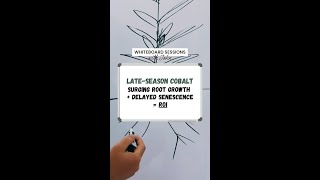
John Kempf explains late-season foliar applications of rebound cobalt and why they can increase grain yield and delay senescence. He cites an anecdote of a ~10 bu/acre response from a late application (within weeks of harvest) and describes two primary mechanisms: (1) mobile rebound cobalt moves to root tips, stimulating cytokinin production and causing a flush of root growth that restores nutrient and water uptake during grain fill; (2) mobile cobalt in leaves/grain delays ethylene synthesis, slowing senescence so photosynthesis continues longer. Kempf also notes application-rate cost estimates and argues the treatment often provides strong ROI.
Chapters
In a recent podcast episode with Jake Brewer, he described how he put on a late season application, as in within, as I understood it, within a couple weeks of harvest of rebound cobalt and got a 10 bushel per acre yield response. And we discussed a little bit the mechanism and the modes of action of, of how, of what might have contributed to that yield response. But this is actually a very common result that we see with rebound cobalt applications on a number of different crops. And there are a couple of key mechanisms. First, when you put cobalt on a leaf surface or spray it on a plant, it doesn't stay in the plants, not if it's in the right form, as rebound cobalt is. Many, many cobalt products that you apply that are commonly available in the marketplace would just stay in the leaf, stay in the aerial parts of the plant, and there it has an effect, but not nearly the effect that's possible. If you apply cobalt as rebound cobalt as a foliar, a large proportion of it will move down into the root system and out to the root tips, where it stimulates cytokinin production and it stimulates root tip progression. So you can actually develop a flush of root growth from a cobalt application right at a time period when this plant has critical nutrient absorption needs. So it's very common as you have an ear on this plant and you're in the grain fill stage, it's very common for the majority of sugars from the leaves to go down into the ear, and particularly here from the ear leaf to move into the ear from these older leaves, all the sugar is migrating to the ear at the expense of the root system. So this is costing the root system sugar. So the root system slows down. Um, and as you no longer have growing root tips, the root system essentially starts to senesce before the upper parts of the plant, before the ear does. And so you get less nutrient absorption and less water absorption to move up to the plant to facilitate photosynthesis and continue sugar production. With a foliar application of rebound cobalt, you can reverse all of that. You can trigger a root flush that reinvigorates nutrient absorption and reinvigorates water absorption and helps produce send more nutrition and more water up to the upper parts of the plant for better photosynthesis. And that's one of the mechanisms that is contributing to the grain yield increase. I mean, 10 bushel per acre a full year application of rebound cobalt, depending on the context. And the application rate is somewhere between $350, $7 an acre. If you're putting on a pint or a quart per acre or something like that. So this is a very significant ROI application, one that's fairly low cost to apply and produces a very nice response. The other aspect of the other mechanism or mode of action of a rebound cobalt application is that when it is applied to the leaf surface and you get cobalt throughout the leaves and into the grain, and again, you need mobile cobalt to accomplish that, it inhibits the synthesis or delays the synthesis of, of ethylene, which is going to delay plant senescence. So your leaves and plant and stalk are going to stay green longer and continue photosynthesizing longer because of the delayed synthesis of this hormone that triggers, triggers senescence and makes senescence happen more rapidly. So all of this, this combination resulted in Jake's case. And we've seen, we've seen this on other crops. We've seen something similar on beans, we've seen it on vegetable crops and fruit crops. This has a combination effect of delaying senescence and of increasing yield as a result of driving root development and driving photosynthesis during that late fruit fill period.