Why Are Spider Mites Only Attracted to Certain Fields?
John Kempf and David explore why spider mites infest some fields but not others. They discuss plant immunity, soil health, and organic pest management, drawing on experiences from farmers like Brad Kane who've dealt with spider mite problems.
Chapters
This morning, we'll start with who we are. Some of you may know who we are, some of you may not. And so for those of you who don't know who we are, we're a team of agronomists, consultants, people who work with farmers spread out across the United States, from New York to Washington down to California, Florida. We're working with some global projects, working with all kinds of different crops, ranging from corn and soybeans to cherries and apples and vegetables. Part of that team is also a manufacturing team in Ohio, where we manufacture some plant nutritional supplements. We don't do anything with the commodity fertilizers, but we do have some products that we manufacture there in Ohio. So that's who we are. And we're known for looking at challenges and helping farmers solve challenges, which is the reason we're here today. We hear that some farmers are interested in looking at what the challenges are and how we can fix them. And one of the things that we do very differently than many people is looking at the reason why we have the challenge. We go to the root instead of just looking at the symptom. We want to know why is the symptom there.
If you have a headache, it's probably.
Caused for some reason. So we're very passionate about growing healthy plants. We believe that healthy plants will produce healthy soil, and when you have a healthy soil, you can grow healthier plants. And so we focus on growing plants that are healthy. And John will be talking more about that. So I'd like to introduce the rest of the team that we have here, here with us. John Kempf is the founder of Advancing Eco Agriculture and an amazing young man. And I will let you. I will let John, when he talks, I will let him share how he got started and what. What has driven him to this point and, and how we have come to understand the things that we have and, and are pursuing. And then we have. Jason Stoll is a customer service representative in Bloomington, Indiana. And so if you call the 800 number, you'll probably talk to Jason and he will either answer your question or connect you with the person who has the answer for it. And then my son Josiah isn't on the AEA team yet, but he's here with us yet. Yeah, keyword being yet. Often when we get home from meetings like this, he'll do a presentation, you know, afterwards, and he'll. And then I'd also. Most of you probably know Brad Kane. He has been working with us as a farmer and is also working with us as A point of distribution out here. So Brad has been a vital part in what's happened here in Kansas. So for today, our goal for today is to look at what the challenges are. I mean, there's all kinds of challenges that we all face, regardless of what industry we're in. And in farming, there's, you know, there's many challenges, and some of those we can't control, like weather variabilities and weather extremes. There's challenges of intensifying pest pressure. Pest pressure. One of the things that we've heard a lot working with Ashley, working with Brad, is spider mites. What about this? This picture is just a clip. And I don't know how plain you can see it, but that's giant ragweed, that green stuff as tall as the combine. And that's the thing that was at the bottom.
There's.
Maybe you can't even read it, but it's. It's basically saying that there's a lot of weeds that have become resistant to insect or to herbicides. Weeds are continuing to become more and more challenging. One of the challenges that we often see on farms is compaction, is that most of the farms I've been on, that's been.
It's a way bigger problem than people. Than people realize.
Yeah.
I was just on a farm last night over Garden City area, and it was sand. We took the shovel four or five inches down, we hit a hard pan, and then I was digging across and I was able to find the ridges where either they had a disc or something in there and the ridges were in. And it was. This was probably two or three years prior or two or three years ago because this farmer hadn't done anything. So compaction is a challenge. Soil fertility. How many of you look at your soil samples and you see lots of soil fertility, P and K, but you look at tissue samples or whatever, and it seems like it's not there. Or you put on a lot of nitrogen and. Or potassium. I've heard that a couple of times. Put on a bunch of manure. And my soil sample's not. Potassium's not moving up this slide is. This is really what got me started on this whole journey six years ago, is to realize that 1950 to 1999, and this is USDA data. We really dropped in a lot of crop or foods that we eat. 50% decrease in calcium on tomatoes. It's just that whole thing is what. What actually got me started thinking that we need to eat. The presenter that was talking about this, that we need to eat three apples to get the same nutrition our great grandparents got from one. And somehow that, that sparked within me. I was like, that's going to be a problem. My, my great grandchildren will need to eat a bushel of apples to get the same nutrition I got from three apples, which is the same nutrition my great grandparents got from one. And they'll be eating all the time. So we have a lot of challenges and we like to take those challenges and turn them into opportunities. In every challenge there's an opportunity. And what we focus on doing is building, regenerating the soil, building that soil carbon back up, building that organic matter back up various different ways and really focusing on the soil biology. And when we do those things, we focus on quality, Great things start happening. And so I've asked Brad who was the first farmer out here, what is that four years ago now? Brad called me up and we had a long conversation and things got started on small scale. He's been doing it all these years now, you know, kind of growing into it. So we've got a couple slides here that Brad's going to talk about just to give you all an idea of what he has seen with the regenerative model of agriculture.
Well, good morning everyone. Yeah, it started four years ago with a failure in garbando beans, which I think all of you don't know or have it themed, probably a galbano plant, but if you have it, hummus to make hummus out of. And I was looking at a plant that I could raise with low water and I over watered it, I watered it like corn. And so we had a failure the first year. And although in our organic acres, we planted a lot of acres behind our failed wheat, two gabonzo beans and they did not come up. So we have pythium in our soil that took after the disease and make them come up. So then at the quest I looked forward and that's why I called David and we started talking about, hey, let's raise gabonzos next year, let's make it a success. So we took SAP samples on a half circle of garbanzo beans and looked at the mineral deficiencies, what the garbanzos needed, come up with a plan and we sprayed on them and put on a little nitrogen, put on some foliar product. I forget what those products were put on and they quit nodulating. But they re nodulated and those Garbanzo beans made 45 bushels to the acre, which is good for garbanzo bean crop. So I felt like that was a pretty good success. Then we moved into 2015 and I did. David, we have got a circle of organic. Go back a little bit here. That gabbanzo beans were not organic. They were commercial. I have durum wheat that froze out. I want to plant organic corn. What do we do to this corn to raise good crop organically? So we came up with the plan. We put out what we've always used compost in our area. We put some gypsum out there. We put a half a ton of humid, which we had made with Edwin Blather's technique to making humid more carbon in the manure and building humus. So then we raised the crop of oak and peas before the COVID crop. When we add the COVID crop, we put on Spectrum Rejuvenate and Sea Shield, which is a fall primer. But I did it in the spring on the COVID crop. We did it later in the season and we dipped down the COVID crop and we planted corn. And this is the corn crop that came out of that. I think it was the year we had a lot of rain and we planted it later. Is that correct? So the corn was put in 1st of June. We rotary hoed it once, we cultivated it twice, but there was hardly any weeds. The year before was durum wheat. And we had to swath it down because the weeds were so bad. To kind of give you an overview of what. Yeah, we had weed seeds in the soil. And with the COVID crop, with biology working, it changed the soil to where it made it more balanced per se, and the weed pressure was minimal. I spent $30 an acre in roguing because I was particular. I did not want any weeds in the field. So they went through the field and just pulled weeds out here and there. It wasn't solid by any means. We harvested this corn in November. It was 19 moisture because of planting it late because of the wet seeding that we had May 215.
In the.
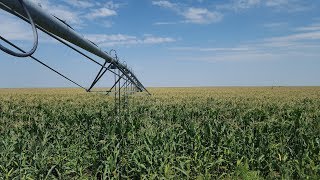
Course of the season, Iowa putting on nutrition through the foliar application, through the pivot fertigation. And I put in seashield, phosphorus and some other products. I did not know there were spider mites out there. My agronomist called me the next day and he said, what did you put out there? You're killing the spider mite. Well, I said, I'm just vertigating and I'm not doing anything different. I'm just putting on nutrition. And he said, well, they're dying. Well, that's interesting. So as we went on longer into the season, they did not come back. He said, Our next challenge is going to be corn borer and earworm. And he we did not have issues with that either. As you see, there's the corn crops before we harvested it. Now this year's corn.
Yeah, that's the picture.
She said, kind of blurry.
Anyway, I was impressed with that. So that's what the one circle of organic corn. So I asked David, I said okay, can I plant two years in a row of organic corn? Well, he said yeah, you can. No problem. So we did another year. We still did not have phytomite or corn bore issues. It made 220 last year. I said, david, I still want to go another year with the organic market. It's good. The. Certifiers will say it's kind of a gray area to go the third year, but we'll go a third year. We're going to take that rift.
Between.
Every crop of corn here we did a cover crop of oats and peas.
For.
Diversity out there. Keep the biology alive. The change. Our fourth lecture, weed pressure. So this is actually picture of our corn crop this year. It's the third year in a row of organic corn. No synthetic fertilizer applied, no nitrogen applied other than I've had 3 ton of compost or conditioned manure, whatever I call it on this field. And so I do not know what the yield potential is here, but it looks just as good if not better than last year. I have not counted the years or it's at that 32,000 population. What that any mite pressure? Spider mite? No. I just looked at my report from Woodrow a little bit ago and I did not have spider mite pressure in its field.
What about in your area up there in northern Kansas? Is it a summer for mites or.
We did not have it much this year. I did play some other commercial field with four spider mite took care of it. There's been spider mite in other areas around us, but it's not been a spider mite year in our area. But they're there there, there some of it there. This is actually a field of dry land corn that I have out that's organic. Is that correct? Looked like it to me anyway that I just then just did the biology and spectrum and rejuvenate after the corn was up. Rotary hoed it once cultivated at once. The field is pretty clean. I don't know what happened here, but it doesn't look bad at all. We'll see what it makes. We'll go back here. I've got about $50 an acre in fertility. And it's organic corn of AEA product and biology. This here is a local farmer that's using the program. It's organic. That side is a half a circle. That was this year, the first year on the AEA program. That's more compacted soil. He's got more spider mite. He put 10 ton of manure on. No, 8 ton of manure on that half. He wanted to build up his soil. This other side is second year AEA program. There's darker soil, more root and two ears per plant. And no spider mites. They're side by side on the same circle. Anybody have any questions?
I got one question for you. Just minor thing on. Just so I understand, on the organic part of things, if I understand right, is there a restriction in organics, like marketing and crop in the same year you put raw manure on? Whereas there's not a restriction with composted manure.
There's not really a restriction on Robin or. As far as I know, or compromise it. The only restriction that you would have is if the. The feed yard. You'd have to get a statement from the feed yard that they're not putting any fly spray or commercial application of fly spray on there when they're killer flies. That's the only thing.
On manure.
If it's composted, there's less restrictions than if it's rock. And then there's also a restriction on anything that's a ground fruit, like cantaloupes or if it's potatoes or anything in ground. There's a number of days that you cannot apply manure before harvest, and that changes from state to state. But as long as it's composted, I think the restrictions are okay.
That puts it in context for me for what I.
For what I heard. Okay. Who's your certifier?
Brad Zoa out of Ohio.
Betty. Yeah. Okay.
Yeah, she.
Good girl. Yeah.
I don't know if anybody met Den Warnake from tinyo. He behind the company that makes the biology. So he's with us here today. All right.
Dennis. I missed you.
That's all right.
Also with, you know, with the condition manure, why we do it that way, the compost is that we get it up to heat so we don't have to have to put more weed seeds out on the plant. I mean, on the fields. And we break it down for more availability. So anything else?
How do you apply your compost? What? That.
How do you apply it with the compost? Get the.
Broadcast.
Yeah.
Brad, how many, how many tons did you reduce your application from going from the raw manure to your process manure?
What we've been doing for quite a few years is five tons of condition manure.
Five ton versus how many were you have just raw?
Probably 20. But that's been backed off also because of the over saturating soil. Right. And water usage. I think a lot of guys are putting 10 on. We're backing down to three already. Some guys are doing two. The nutrient. If you get a nutrient test, it's the same as it is with conditioned manure. Other than when we add the biology to it. We add biology to our compost also. And that actually gives us a little bit more phosphorus and potassium. Our nitrogen pretty well stays the same. It's actually 30, 45. 45.
Are you guys producing in the biology also?
Yes.
What, what do you got for biology facilities and more.
It actually a whole array of beneficials within our biology. Depending on which products you're using, there could be any as much as 35 to 40 strains within the product.
And so he's got, he's using Daniel's products and I'm familiar with Daniel's. You for 50 bucks you're producing 215 to 220 bushel corn organic. That's phenomenal.
Well, let's back up a little bit. That that dry land field, I put $50. That was compost history. I did not put that on this year. I just did the full year through AA at 55 on that.
That's still phenomenal. I mean BO plus the price of organic corn, I think. I mean, and I wonder why. I mean I produce an organic product too. But I mean it's phenomenal what that they've done.
Well, and one of the keys to.
That is not only the biology, but the full package program paying attention to fat SAP analysis and nutrition. And all those things come together as a package.
And that's what we've seen in the organic industry is, you know, it is sustainable where with conventional products. The NPK program has long been proven.
Unsustainable.
You're talking about your hard soils. I mean when we're irrigating, what are we putting on the soil? Calcium carbonate. They use it in cement. I mean, all we're doing is making our soils harder. Well, we gotta have biology in there. We gotta have humus in there. I've said for a long time we and the humic acid fraction in it. And that's what we're doing. If we could get organic Soil or organic matter up to five, which is unheard about here.
Okay, it is.
I mean, I asked Dan Oak and Dana Dines when they did the humic acid test back in Iowa the last three years. And I asked Dan at Acres last year in Omaha. I said, how come you did it in Iowa? What organic? Matter of fact, 5%. Why didn't you come out southwest Kansas or south central Nebraska where we have organic matters of two and less? And he said, yeah, we screwed up, Steve. I mean, and I said, well, come on out anytime you want. So. Yes, but it'll be interesting to talk to him this year in Columbus. You know, it's. No, you're proven what we've seen for a long time, you know that. Why aren't more people moving towards that organic.
Side?
I mean, yeah, it's, it's. You got that conversion, it costs money, but yet you're showing that with minimal input. You guys are showing an roi. That's phenomenal. I, I mean, I got a friend of mine up in south central Nebraska that's been organic for 20 years now. And, and Rex has seen, you know, he started out with 75 to 100 bushel corn, but with the biological approach, now he's doing the same thing that you guys are seeing. I think it's phenomenal.
I'll back up a little bit too. He brought up the organic matter. That first year of corn, I took a thorough sample. It was like 2%. The next year, I took the thorough sample again. 2.8 in one year's time. And it pretty well stayed there. I wonder if my Last 1 is 3.2. John will explain more here theft today and we'll just. What kind of fun day here?
Were they just field peas or cow peas or what were you using?
They were just cow peas with the. They were just in the mix.
Okay.
You plant cover crop on your dry land? What's that? You plant cover crop on your dry land. I did not. That's where my fine line. That's where my. I need to grow into. I have to step into it.
That's a paradigm shift.
Thank you, Brad.
So.
You can see how when we work with the soil, when we work with biology, things happen. And so it's one of the things I think it's important to understand is that it's not. We're not about a magic product, a magic bullet. It's like Dennis said, it's about the whole system. It's about the way we manage our crops. So we've talked about the challenges, the Insects, the diseases, the weed pressure. Brad has shared what he has seen. And so we want to spend the next, however much time we have before lunch to John's going to talk about why, why are we seeing or why we believe that all these insect pressures are increasing. Why are the diseases mounting? Why is weed pressure. Why are they becoming more resistant? It seems like it's on a downward spiral. As Max Burney put it when we met with him.
It's.
It seems like the last three years, it's not going in the right direction is what it feels like. And that's what Brad told me five years or four years ago in our first conversation. He said, something's wrong. I've got all these traits in my corn, and I'm still using the same amount or more of my fungicides. Something's wrong. And so that's why Brad has, you know, wet his feet and been very successful. So, John, tell us why and how and feel free to ask questions, even about how John might have come here.
All right. Well, good morning, friends. It's an honor to be here. We have an hour and 15 minutes between now and lunch, and Brad and David have asked me to talk about things that I normally talk about in three hours. So I've been listening to the conversation this morning. David asked you the question about what are the major diseases, major insect problems, and there's many different pieces that I could talk about that I would love to talk about, but we don't have time to fully do some of these topics justice. I'm going to do the best that I can, make them as simple as possible. And I'm also going to be speaking very rapidly and very quickly. I'm not from Kansas. I don't speak quite as slowly as Brad does. I'm going to speed it up a little bit. My own background is that of growing up on a family fruit and vegetable farm in northeast Ohio, about 20 miles south of Lake Erie. So. So we're in the snow belt off of Lake Erie, which means that we get about 90 inches of snowfall every winter. And our summers we get an average of about 40 inches of rainfall and very humid conditions, which is the perfect environment, a petri dish for disease and insect problems on the fruit and vegetable crops that we were growing. So we were very mainstream growers using very intense pesticide applications. My dad was the pesticide distributor for the local region. I was a licensed pesticide applicator when I was 16 years old. And as a result of dad being the distributor, we were the first people to always try the newest, latest and greatest insecticides and fungicides that were released on the marketplace. And at this point, we started growing vegetables in 1994, and fresh market vegetables. Our crop mix kind of evolved and changed over the years. In the early 2000s, we were growing four crops that represented about 70% of our planted acreage. Those four crops were cantaloupe, zucchini, cucumbers and tomatoes. Those four crops were about 70% of the acres that we were planting. We had a three year period, 2002, three and four, three years in a row, where we had a variety of different weather stress, severe rainfall, different times of the growing season, and we were unsuccessful, completely unsuccessful, at managing diseases and managing insects using pesticides. We could not get control of powdery mildew. We couldn't get control of downy mildew. We couldn't get control of bacterial speck and bacterial spot and early blight and late blight. Three years in a row, we lost more than 70% of each of those four crops to a variety of different diseases and insects. So we were obviously, we were stressed economically on the farm, stressed emotionally, and we had a lot of incentives to try to understand what was happening and see if there were better ways of figuring this out. But then kind of the real light bulb moment happened in 2004. So 2004 was the third year of this three year period. And in that year, we began renting a field from a neighboring farm that bordered right up against one of our own fields. So we used to be farming this one field, which was a very long, narrow strip. And we were tilling it and planting it up and down the slope because it was fairly narrow. And now we had the field right beside it. So we switched the direction that we were tilling and planting. We started planting crops directly across the field border. That year we planted that field into cantaloupe. And it was right up beside the road where everybody could see it, that was driving by. And at harvest time, on the old soil that we have been farming for the last decade, we had 80% of the leaves infected with powdery mildew. In spite of all of our fungicide applications, every five days we were out there with fungicides, 80% leaf infection with powdery mildew. On the new soil that we were farming that year for the first time, there was no powder mildew. You couldn't find any. It was not like 5% or 10% leaf infection. It was zero. This was the exact same variety, had been planted the same day, had the same fertilizer applications had the same fungicide applications, but we got two completely different results. That was kind of the real wake up moment for me is I wanted to know what are the differences between these two plants? What allows one plant to, to be resistant to powdery mildew when the next plant two feet away is susceptible? So I started doing a lot of studying, research, calling people, talking to people all over the country, all over the world for that matter, and developed a group of mentors who guided my studying and reading for the next several years. And over the next couple of years of very intense learning and applying what I was learning on the farm, I learned a lot about plant immune systems and the capacity of plants to be resistant to diseases and insects. And to simplify it all down, very simply, almost an oversimplification, we understand that each of us have our own immune systems, but our immune systems don't all work equally well. All of us know friends who become ill with the first cold or flu bug that comes along. And then we know other people who practically never become ill. The only difference between those two is how well their immune system has been supported with nutrition over the course of their entire lifetime, in fact, from even before they were born. And the same concept also holds true of plants. Plants also have an immune system that is called an immune system that provides the same or similar mechanisms. And I can say with complete confidence beyond any shadow of a doubt that plants have the inherent capacity to be 100% resistant to diseases and 100% resistant to insects if they are supported with the right nutrition. That's a really big mouthful. That's a bold claim. It's a big statement to make. But we have seen the evidence of that today on thousands of farms. I'm not saying that based on wishful thinking or based on reading something in a book. What then happened from that experience on the farm? Eventually, by mid summer 2006, I founded Advancing Eco Agriculture as a consulting company. We did consulting work only primarily on dairies and on fruit and vegetable farms for several years. And then eventually we got into product manufacturing out of frustration with the quality of products that were available in the marketplace at that point. They've evolved a lot since then, but they still have a long ways to go. And today, Flash forward to today. Advancing Eco Agriculture is a company of about 25 people. In agricultural terms, we're a relatively small company, and what we have become known for is really three pieces. One, disease and insect resistance on all types of crops. We have had this degree of success on fruits and vegetables on nuts, on avocados, on macadamia nuts, on wheat, on corn, on soybeans, on rice. At this point, the list of crops, the total list of crops that we've worked with in some way is 200 crops. Crops that we have in depth, knowledge, and experience with is about 60 crops at this point. The reality is that when you begin understanding the underlying principles of disease resistance and insect resistance and how it works inside a plant, all plants are different, and all plants are the same. Photosynthesis is the same in any plant. The same with the immune system. The immune system processes are the same in any plant. So I have complete confidence the things that we have learned in other areas, in other plants, places will work here equally as well as they will work anywhere else. So what brings me here today, what brought me here today is and led to the formation of advancing eco agriculture. In these early years, as I was working with growers, as a consultant, doing consulting work, the intention, the reason growers hired us and wanted to work with us, was to help them grow crops that were disease and insect resistant. That was kind of the hook that we hung our hat on. But then two other pieces happened as well. We learned two other things. The first was that when we grow plants that have an immune system, a functioning immune system, they have the capacity to transfer that immunity to the people who consume that food. So with blueberries, for example, blueberries are supposed to be really nutrient dense. They're really good for you. They enhance your immune system. Why? Because of the anthocyanin content. The anthocyanin concentrations of blueberries can really enhance your immune system. Right. Well, in 1992, Michigan State University conducted some research where they compared extensive blueberry samples, and they discovered that the anthocyanin concentration of blueberries can vary by a factor of as much as 25x based on variety and environment. So 25 times higher anthocyanin content in healthier plants, that's a huge variable. It's a huge variable. So I realized that these same compounds that give a plant immunity also enhance our immune systems as well. And we can have a legitimate conversation about growing food as medicine. But the second piece was perhaps even more startling, which was when we observed. The first time we observed this was on a strawberry trial in California. We observed that it is possible for us to build soil organic matter while we are growing a crop. So within agriculture, we have had this paradigm, this perception that the process of planting a crop and harvesting a crop is somehow, by its very nature, inherently extractive. That we are extracting nutrients and extracting organic matter from the soil, and that we are depleting the soil in some way. That can be true, and that is true if we manage in that way. But it doesn't need to be true. It is completely possible for us to grow a crop that is so vigorous and so healthy that we can actually build soil organic matter while we are growing a crop. And I don't know if I'll have time to do this conversation justice today. You heard Brad give a brief example where he's gained in three years, he went from 2% organic matter to 3.2%. Growing corn. You can grow corn. In fact, corn is one of the best crops to build soil organic matter with. So that's a whole other topic that we'll talk about later today if we have the time and the opportunity. So then I looked at these three pieces and these three pieces in combination, say, wait a minute, we can grow plants that are resistant to diseases and insects that are produced producing food that really is food as medicine, and we can regenerate soil health at the same time. This is something that is incredibly inspiring. I find it incredibly inspiring personally. And I became very passionate about seeing those models, these nutritional models and these frameworks of how to manage plants become the mainstream, become the status quo. But I realized that I can't go talk to cherry growers in Washington and talk to strawberry growers in California and talk to corn and soybean growers in Kansas and have a conversation about building soil organic matter and growing food as medicine and growing disease and insect resistant plants. Because with the exception of disease and insect resistance, for the most part, that is not what pays the bills. That's not what is going to inspire growers to change. And I realized that if I really am passionate about wanting to drive change, then we have to figure out how to accomplish these types of results successfully, repeatably, consistently. And there has to be a really strong economic motivator. The comments that you were just talking about earlier, what Brad has experienced, we are at. One of the things that we obsess with at advancing eco agriculture is we want to make absolutely certain that every single time, time we work with a grower, there is a tremendous economic upside. Because when you have that and you see an economic incentive to begin managing things differently now, you have the opportunity, the wherewithal, and actually makes sense to try things and try to work with them.
So can I say something in regard to that?
Yes.
I've been doing ag consulting now since 1976 and I still don't see people. This plays right into what you're saying. There's, in my opinion, there's too much talk about my, my yield. You know, like I'm getting 250 bushels break, or I'm getting 225 bushel per acre. Well, I got 175 bushel grain, sorghum. Nobody's talking profits, nobody's talking inputs versus outputs. And there's a way, way bigger opportunity for more profitability, which means you're going to get a lot more off the same acres if you just pay attention to this stuff.
Absolutely, yeah. There's no question about that. So usually we have these seminars and these conversations in January and February when people have the time to sit down and have longer conversations and we have more time throughout the day. Today that is not the case. We're supposed to be done here at 2 o' clock this afternoon. Got about an hour to lunchtime and about an hour afterwards. There's lots of things to talk about. Because of that, we have often the feedback that we get at conferences, seminars. One of the things that we have really taken pride in as a company is providing a lot of information explaining the why. Why does this work? How does it work? How can you make it work? On our farm, we give the growers that we work with and the people who come to our seminars enough information that they don't need us to figure it out. They can go onto their farms and do it themselves. They don't need to use our products. They don't need us to figure it out. They can take our information and do it by themselves. However, the feedback that we have gotten quite consistently is that people are frustrated that we don't talk enough about the products. And actually, how do you do it? What's step one, step, step two, step three, what are the problems that we see and what do you actually do about it? So as a result of that feedback, today, we're going to split this conversation into two different pieces. One is for the next hour or so until lunchtime, I want to talk about the why, what is happening? Why do we have problems with spider mites and sugarcane aphid and all the various insect pests that you listed off. Why are they present in the first place and what can you do about it? I want to talk about that piece until after, between now and lunch and then immediately after lunch, David and I will both be talking about, okay, what do you do about it? And because of the limited time, I do not want to sound crude or Rude. While I say this, and I don't intend it in that way at all, but we're going to be. I'm going to be very candid. I'm not going to pull any punches. I'm going to say exactly. I've been here in Kansas now several times. I'm going to say exactly. From my perception, what I'm seeing is the problem, why we're having the problems that you're having from the management practices that you're using and what we can do to fix them. It's going to be straight talk because we only have time for straight talk talk. There was something else I wanted to mention as well, and now it's escaping for the moment. Okay, so we're going to jump right into this. Let's talk about why we have insects showing up, why we have diseases showing up, what are they are dependent on and what we can do about them. So actually I'm going to skip through some of these. This is. Whoops. This is some of the background of where we came from. A lot of our knowledge originally came from the fruit and vegetable production world. And I think this is worthwhile mentioning. You may think that, well, fruits and vegetables are very different from growing corn. And I'm not sure this conversation is really worth listening to. But the reality is when you have a strawberry crop in California that's worth $40,000 an acre, you had better not screw it up. You had better not screw it up. So we have, our history really is in working with very high risk, high value crops where any mistake that you make can end up in a lawsuit really easily. So we've learned how to deal with these very intense crops, very intense management, and we've learned a lot about plant physiology that applies very well to corn and soybeans that we'll be talking about a little bit. This is table grape production in California. This is a table grape cluster that will probably end up weighing about 8 to 10 pounds when it's fully mature. This is what the entire field looks like. So starting point. We'll begin with the concept that healthy plants can be completely resistant to diseases and insects. The idea within agriculture is that insects and diseases show up at random. They attack fields at random. They're here in this one field or in that field. And it just happens based on wind conditions or climactic conditions and so forth. And that certainly is a contributing factor, but it is not the only contributing factor. In fact, it may not be even the biggest contributing factor. So I want to talk about. And so diseases in insects do not occur at random. There's actually a tremendous amount of research about plant immune system. I'm not going to go into this just to give you a couple of examples. Here are two books that talk about plant immune systems. Here are two more. Here are two more. And here's another one that talks about mineral nutrition and plant disease. My point is that there are hundreds of articles, no, thousands of articles, dozens of books that have been written about plant immune systems. There are several journals as well. And for the most part, that information is not talked about in agricultural circles because there are no economic incentives for pesticide companies to get this information out there. All right, so I want to talk about what the differences are between healthy plants and unhealthy plants. We understand that that every living organism has different nutritional requirements. So our nutritional requirements that we require for our own body and the food sources that we require, specifically, I should say food sources that we require for our own body are quite different from those of, let's say, a cow. And we are capable of digesting things that a cow is not capable of digesting and vice versa. A cow can digest things that we can't digest. Why? Because the enzyme systems in our gut are completely different. So with a cow, for example, a cow can digest grasses and forages because she has cellulase enzymes in her room and in the digestive system so she can break down cellulose. We, on the other hand, have the enzymes and the acids that that are needed to break down very long, very complex proteins found in muscle meat. So we can digest meat. A cow can't do that. That same concept, same idea holds true irregardless of what organism you're talking about, including insects. This is very important because every insect, the insect pest that you listed off this morning, all have specific nutritional requirements in two groups. First is proteins. They have very specific protein and amino acid requirements. And secondly, they have very specific carbohydrate requirements, very specific types of sugars. So it is possible to change the plant's amino acid profile and to change a plant's carbohydrate profile so that they are no longer a food source for the insect. So when we talk about plant immune systems, there are two different types of immunity or two different ways of thinking about it. One is passive immunity, and the second is active immunity. So with passive immunity, this is what I'm talking about. When I talk about passive immunity, we're simply removing the food source. You put grass on the kitchen table for lunch, and that grass is passively Immune to being consumed because nobody wants to consume it. You've removed the. The food source. Active immunity is a little bit different. Active immunity is when plants are so healthy and so vigorous that they're actually producing these immune compounds that have the capacity to kill bacteria, to kill fungi, and to kill insects. So those are the differences between active and passive. For the moment, we're going to talk about passive immunity.
So.
When a plant is photosynthesizing, everything starts with photosynthesis. So photosynthesis is the foundation. The plant is absorbing water from the soil, it's absorbing carbon dioxide from the air, and it's combining those into a simple sugar called glucose. So glucose is C6H12O6. Forget the chemistry formula. Think of glucose as being a short chain that has 24 links. It's 24 links long. Okay? Now that glucose then gets snipped apart, cut apart, rearranged, rebonded, stuck back together again to form much longer, more complex chains. So sometimes when glucose is aggregated, when you have an aggregation of different glucose together, you end up with starch. Perhaps this is. It's restructured in different ways. You can end up with. You have these different types of sugars. You have the monosaccharides, which are simple sugars, short chain sugars. You have polysaccharides. Then you have compounds such as lignin and cellulose and hemocellulose and pectins. These are all structural carbohydrates that build part of the plant frame. They all start with this simple building block, this Lego brick that has 24 links. That's it. It's that simple. That's the carbohydrate side. On the protein side, you again start with this short chain that has 24 links, and it's now reorganized and nitrogen gets added to it. The combination of sugars plus nitrogen is now called an amino acid. So there are 23 common amino acids that are found in plants. There are. There's several hundred others as well, but 23 main ones. And those amino acids are now hooked together in pairs of two or three. And now they're called peptides. You may have heard of a dipeptide or a tripeptide that's simply two amino acids or three amino acids bonded together. And then those peptides are now bonded together to form much longer chains that are now called complete proteins. I know I'm boring all of you with this, but this is really important. This is a very important piece. Imagine that happening inside a plant constantly, all the time. This is the way sugars get built. This is the way amino acids get built. This is the way peptides get built. But now imagine also you have this raw chain. And now when we talk about amino acids being bonded together, one amino acid to another amino acid inside the plant, the plant needs a catalyst to make that reaction happening. There is a welding crew inside the plant that is cutting this chain apart into various links and reassembling it and putting it back together again in various configurations. And this welding crew are enzymes. Enzymes are crystalline proteins. They look, they're shaped like a crystal. Enzymes are fascinating in that when I talk about a welding crew, they are very much like a welding crew in that the way an enzyme works by this crystal function is by collecting and absorbing photonic energy and releasing it in a beam, almost like a miniature laser beam as a blast. That's how it puts these bonds together and also takes these bonds apart. But you look at this enzyme, this crystal, it's dormant. There is nothing happening. These enzymes are completely 100% dependent on what is called an enzyme cofactor. So you bring in an enzyme cofactor. Zinc, manganese, copper, boron, and that manganese cofactor. The enzyme cofactor are all these metal ions. Without the metal, the enzyme doesn't work. It's dead. So what happens? Let's talk about enzymes a little bit more. Enzymes are like an end wrench in that each end wrench fits only one size nut or bolt properly. And an enzyme, each enzyme can only produce one specific reaction. It can only tie one specific amino acid to another specific amino acid. So as a result of that, because there are dozens of amino acids, dozens of carbohydrates, thousands of possible combinations, plants have over 10,000 different enzymes that have been identified so far. And every single one of these enzymes needs an enzyme cofactor. So what this means is if the enzyme cofactor is missing, let's say a plant is missing manganese or zinc or one of these metals. That means that all of those enzymes that form are dependent on that cofactor don't work. The machinery doesn't work. So it's like that chain manufacturing machine that we saw where one of the arms is out of alignment and every link gets misshaped. The entire machinery breaks down without the enzyme cofactors. Okay, so why does this even matter? Why is this even worth talking about? Why is it worth me spending the last 10 minutes talking about this? Because the digestive process in the digestive system of an insect or a cow or our own digestive system is exactly the same as this process of building compounds inside plants, except in reverse. Now, instead of having enzymes to build all these bonds and to put all these chains together, we now have enzymes that are designed to break apart the bonds. They take apart the various peptides, they take apart the amino acids, and they break it down to a point where it is soluble enough that it can cross the gut lining and be used as an energy source by the cow or the person or the aphid. The key is that the enzyme system, an aphid, is radically different from the enzyme system of a cow or of a human. And what this means in we refer to some groups of insects as insects that have simple digestive systems. What it means, very simply, is that you have this progression. You start with glucose, you add nitrogen, you now have an amino acid. You bond two or three amino acids together. Now you have a peptide, and then you bond the peptides together to form complete proteins. So these complete proteins might be chains that have as many as 200,000 to 300,000 links. Well, guess what? Sugarcane aphids and all larval insects, such as corn earworm and cabbage looper and tomato hornworm and alfalfa weevil and so forth, do not have the digestive enzymes that are needed to break the peptide to peptide bond that is used to make a complete protein. So if you have a plant that has a completely functioning enzyme system and it is building complete proteins and complete carbohydrates, then you have removed the food source. You've simply taken away the food source that the aphids and the other insects and spider mites are dependent upon. They can't feed on that plant anymore. Literally the exact same way that you could not consume grass because they can't digest it, they can't break it down. Enzymes are like end wrenches in another context as well that they never get used up. An end wrench can tighten 100,000 nuts and bolts. An enzyme can do the same thing. It can produce that same type of reaction over and over and over again without being consumed. That's why you only need very small concentrations. These enzyme cofactors are all either metals, like copper, cobalt, iron, manganese, magnesium, et cetera, or they are B vitamins, which in turn are dependent on metals. So B vitamins, like vitamin B12, cyanocobalamin, is dependent on cobalt, et cetera. So I feel almost as though I'm doing you a bit of an injustice because I'm condensing all lot of this down very simply. But I want to make sure you Got the piece that I just been talking about. Is it all clear? Clear as mud. Okay.
It's the whole key to the whole thing that goes on in plants.
I've just condensed an entire plant physiology semester at a university down into 10 minutes. It's basically what it amounts to. This is the only thing that really matters. Yes. John, tell this crowd about those mentors that you got together and their previous experience with finding.
Well, was it a cure?
Yeah, I'm not even sure. That's not appropriate for all audiences.
Well.
I was very fortunate. I developed the first year I had some seven mentors in the next year, 10. And there's been many mentors over the years. I still have a group of mentors that I work with today. But in the first group that I worked with, when I started asking questions about plant immune systems and resistance to diseases in insects, I quickly discovered that there were not very many people who were able to answer the questions that I was asking. But there was one group in particular, three, four friends who had known each other and worked together at one point who were able to answer all my questions almost right off the top of their head. These were Don huber and Michael McNeil and Bob Kramer, who were three out of the original seven. And the reason they knew so in depth about how to manage diseases in insects using nutrition was because of their military experience in the 70s. Don Huber has now retired from the army, but is still a consultant for them. Don Huber was the colonel who was in charge of biological warfare research for agricultural crops at Fort Detrick, Maryland, during the Cold War with Russia. And Bob Kramer and Michael McNeil worked on underneath of him. And the task that they were given was to identify all of the potential biological warfare agents that Russia was working with that could possibly deployed on food crops and to develop a solution for them. So if there was an epidemic of disease, they needed to know how to stop that disease instantly and prevent it from costing itself United States, its food supply. And the solutions that they developed to all of these diseases were nutritional solutions so they could identify if we had problems with. It's actually funny because they were working with soybean rust in the laboratory in the 70s, and when soybean rust first came out in the Midwest, had conversations with them and they said, yeah, we know what this is. We know all about it. We know exactly how to deal with it nutritionally too. This is not new information. It's been out there for a long time. So I don't know if that was what you were asking for or not.
But it's kind of a shift in thinking.
We think that we've got to go out and buy a commercial produced product.
For a synthetic to offer or to give us results. When it's the protein, it's actually a natural. Exactly. Every one of these organisms, even all these disease organisms, the pathogens. Right now we have major problems with HLB and citrus greening. Supposed to be this huge insurmountable problem. Well, as a company, we have worked with one citrus grower in particular, where we completely reversed citrus greening in 18 months. Reversed it. It's gone. But do you think we could get anybody in the citrus industry to listen to that? They're not interested. It's not a GMO plant and they want a GMO plant anyway. No point in having that conversation. So this next piece that I'd like to talk about. As we have worked with growers, hundreds of growers, thousands of growers, many different types of plants, many different types of environments, we have observed a consistent shift and evolution of plant health in all these different crops that is consistent irregardless of the crop where they become resistant to different types of diseases, different types of insects, based on what is happening inside that plant physiologically. So we developed this diagram that we call the Plant Health Pyramid to describe what we saw happening inside plants. There is a lot of information in this Plant Health Pyramid. I'm going to review it in about 10 minutes or less. And if you want to learn more, you can also. I think we have a YouTube clip on YouTube that you can look at and review and get more information from it as well. But this is what we see happening. And there might actually be a handout in your folders that has the Plant Health Pyramid on it. If not, certainly there's a number of articles and YouTube clips online on our website that you can access as well with more information on it. So the first piece that we see happening is when we have plants that are photosynthesizing well and they're producing complete carbohydrates. The moment the plant begins producing complete carbohydrates. What this means is that every 24 hours, in every 24 hour photo period, at the end of that 24 hours, 100% of the sugars produced in that photoperiod have been converted to complete carbohydrates. In other words, they're pectins, lignans, cellulose, hemocellulose. You do not have any simple sugars, such as glucose, left over in the plant SAP. It's all been converted. When it has all been converted, you've now removed the food source and remove the soluble sugars that are dependent on required by the soil borne fungal pathogens. So these soil borne pathogens are Verticillium, phyllode, Phytophthora, Pythium, fusarium. All of these soil borne fungi are dependent on plants that have high levels of soluble sugars and soluble carbohydrates. And again, I could talk about that for 30 minutes, but we're going to keep moving. Second level is when plants begin forming complete proteins. I described this process for you. The moment these plants plants begin forming complete proteins, which means they have no nitrate in plant SAP, they have no ammonium in the plant SAP and they have no soluble amino acids in the plant SAP. The day that happens, you've removed the food source for all these insects that have simple digestive systems. So the simple digestive systems are insects such as aphids, corn, all the larvae insects belong in this group. Anything that is a larvae has a simple digestive system and all the sucking and chewing insects. Spider mites are technically not an insect, but they belong in this group. Aphids are in this group. Leafhoppers are in this group. I was looking at the list that you guys were discussing this morning. Spider mites, rootworm, caterpillar, alfa alpha caterpillar, beet army worms. Beet army worms are a bit of a question, but they are in the caterpillar family or in the larvae family. Sugarcane, aphids, corn earworms all belong in this second group. They're all here in the second group and I'm really excited about that. Why? Because these first two levels, the first two levels of the plant health pyramid, we have been extremely successful at producing plants with these first two levels in a very straightforward fashion. These first two levels are purely a result of balancing the chemistry and balancing the nutrition inside a plant. You can do this in a hydroponic system. It does not take soil, it doesn't take biology. It's very straightforward. Then you get to level three. Level three is a bit different. Level three, the plant begins, it has a surplus of energy. It's photosynthesizing so well, it's absorbing nutrients so well that it has more energy than it needs for its own use. So it begins storing the surplus in the form of fats and oils, lipids, exact same thing that happens to animals. You give it more feed and more energy than it requires. It stores the surplus as fat. Plants do exactly the same thing when you see this. When plants begin producing these higher levels of lipids, you see this glossy, waxy sheen on the leaf surface. And with that glossy, waxy sheen, these plants now become resistant to all, all of the airborne pathogens. Bacteria, fungi, downy mildew, powdery mildew, scab, speck spot, et cetera, the list goes on and on. Anything that lands on the leaf surface. So how does this work? Just a simple explanation. Again, it's all about enzymes. When a bacteria or a fungi lands on the leaf surface, most of them, I think actually practically all of them release enzymes. Enzyme that is called a pectolytic enzyme, meaning it is designed to digest and break down pectins, specifically the pectins that are found in the cell membrane, so that it can go through the cell membrane into the cell and use the nutrients contained within that cell as an energy source. The result is an infection. Well, if you have a plant that has high levels of lipids and you have this waxy layer on the leaf surface, you have a shield the fungi of the bacterial lands, it releases a pectolytic enzyme. But in order for that, remember, the enzyme can only do one thing that's digest pectin. If you have wax there, it can't do anything. It's shut off before it ever starts. So the result is you never get an infection. Level four is when plants begin producing high concentrations of these compounds called plant secondary metabolites. In plain English, we call them essential oils. These compounds are compounds such as anthocyanins, resveratrol, found in red wine, lycopene found in tomatoes, phytoalaxins, terpenoids, sesquiterpenes, bioflavonoids. These are all compounds that plants produce as plant protectants to protect themselves from ultraviolet radiation, from disease attack, from insect attack. These compounds at the top of the pyramid have the capacity to kill on contact bacteria that many of them have very intense, very potent bactericidal and fungicidal properties. And what we see is that plants, this is where we're talking about active immunity, where plants are actively going after diseases and insects. And at this stage, these plants also become resistant to all of the beetle family, Japanese beetle, corn rootworm beetle, marmorated stink bug, Colorado potato beetle, et cetera. Now, level one and level two, in our experience, are very straightforward. Level three and level four, in order for you to get to level three, you must have good soil biology. Not, maybe, not, perhaps not. If you must have good soil biology, you cannot achieve that in a hydroponic situation because well, again, lots of science behind this, but very simply, when you have really aggressive soil biology, nutrient absorption from the soil becomes much more efficient. And plants now have a surplus of energy that they can convert into lipids and store as fats. All right, I have to keep moving here.
I have one question.
Yep.
I'm not an expert, but, like, say.
A rootworm beetle is eaten silk. Like, if everything is in place, will it not.
First of all, it won't be attractive to them. Secondly, if you have a plant, and we've actually observed this, if you have a plant that is, let's say the nutrition is for the most part balanced, but it is deficient in magnesium and manganese. I'm making up a hypothetical scenario. And as a result of those two deficiencies, the plant is not doing well. And you have corn rootworm beetles present, and they're actively feeding on the plant. And you put on a foliar spray that precisely addresses what that plant needs. While the cucumber beetles are present, that plant's chemistry changes, the protein profile changes, and it will actually kill the insects that are already on the plant. We've seen this with Colorado potato beetle, We've seen it with corn rootworm beetle, We've seen it with Japanese beetle, we've seen it with corn earworm. It's a ton of fun.
It's a ton of worm. The way you get to like, how do you know? Is that with tissue samples?
Yes. Yeah. You have to. We use SAP analysis. I'll be talking about that in a little bit. But you must. Guessing doesn't work. You have to know exactly what's going on in order for you to get those types of results. Yeah, it varies depending on other stuff that's going on, the stage of the plant, the climate and so forth. But I'd say usually it's within 20, 24 to 72 hours. That's what Brad saw with the spider mites. That was 48 hours they were gone. So it happens pretty quickly. It certainly happens quickly enough to be an effective consideration for replacement for insecticides, that's for sure. So do insects and diseases occur at random, or are insects attracted to plants at random? According to the research work of Dr. Philip Callahan, the answer is no. Philip Callahan was an entomology researcher at the University of Florida, Gainesville. His research work was actually financed by the US military. This is again during the 70s, 80s, 90s, and he published over 400 papers that were classified for a long period because his research work was actually the basis of the military developing anti Radar cloaking devices for military aircraft. And that technology has now been exceeded, so these papers have been declassified. He also published a number of books for public consumption. But what he described in his research, again, this is simplifying and gelling things down. Very simply, he said that. This is a quote from William Albrecht. Insects are nature's garbage collectors, and diseases are her cleanup crew. They're here to take the unhealthy plants out of the system. Philip Callahan demonstrated, did this improve this with his research. Several of the books that he wrote. If you want to learn more, you can read this one. Tuning into nature is really good. This is actually the bottom side of a tomato leaf. 4000 times magnification. All of these are micro antenna vibrating at 26,000 MHz. This is an antenna that we actually call an antenna. The only difference between this antenna and this antenna is the optimal frequencies that it picks up. Fundamental. It's the only fundamental difference, the different wavelengths that they absorb. So this is that moth antenna, also underneath the microscope. And now when you take one of those smallest hairs and you put that underneath the microscope, this is what that looks like. It's like fractal geometry. You have antenna upon antenna upon antenna. And all these antennae are communicating, specifically each in the infrared spectrum. They pick up wavelengths from throughout the electromagnetic spectrum, but they are primarily in the infrared spectrum. They're communicating with their environment and what is happening around them. So, based on this research that Philip Callahan did, what he described is that when we see healthy plants out in the field that are dark, vigorous, growing. Well, this is what we see when we have unhealthy plants that are not doing well, have insects present. This is what we see, and this is what insects see. In Dr. Philip Callahan's own words, and this is a direct quote, he said that unhealthy plants, which have a high ammonium content, stand out in the infrared spectrum like a neon light against a dark background. They stand out that strongly. And specifically, he mentioned ammonium. Why is ammonium a problem? Because ammonium, the ammonium compound, is what is called an infrared signal pump. It's an amplifier. Whenever you have ammonium present, it will produce a tremendous flash and a signal in the infrared spectrum. So this is why when you go out and spray an insecticide and you spray a plant and you eliminate all the insects, you haven't fixed the problem because the sign is still there. You're going to be inviting. You still have the welcome sign for the next wave of insects that's going to come along. If you want to remove that signal. If you want to fix the problem, you have to fix it at its source and remove the signal in the first place. And then the insects are not going to show up. How do we actually make this work and how do we make it work in the field? So I've given you a very quick introduction and background to kind of our thinking and how we approach these problems, what the underlying causes are, and now it's time to start talking about, okay, what are the nutrient interactions and what is it that you need to manage in the field? So this is a chart that describes all the nutrient, various nutrient mineral interactions. How many of you have seen this chart before? How many of you have memorized it? Oh, come on. That's exactly the point. We haven't memorized it. We don't remember and retain what is in this chart because it's too complicated, there's too much information and it's not obvious, it's not clear. So actually, let me back up just a step, give you a little bit of history and context for this. I had read tens of thousands of white papers and books and everything else about planets, immunity and plant disease and correlation of disease with specific nutritional profiles. And it was intensely frustrating as a consultant that I could not see in the field what all the research indicated should be true. For example, when we talk about powdery mildew, there are at least 40 published peer reviewed white papers that describe a clear correlation between powdery mildew presence and manganese levels. It's there, it's well recognized. But when we were doing tissue analysis and pulling leaf tissue, sending them to laboratory, having them analyzed, there was no correlation between the manganese content in the tissue analysis and the powdery mildew content in the field. It was intensely frustrating. The research said it should be there, the practical application said it wasn't there. So in 2010, December 2010, I was at a national conference and speaking with several of my mentors who were also present. And I was expressing my frustration with our inability to clearly see what was happening and what was going on. And one of them suggested that I reach out to a laboratory in the Netherlands that he.
More from John

Episode 186: The Power of Precision Management and Multi-Species Covers with Mike Thompson





Podcast Extra: John Kempf on Soil Biophysics, Plant Immunity & Foliars on the Permaculture...


