How Strategic Storytelling Created $7 Billion Brands in Just 3-5 Years | John Bohan
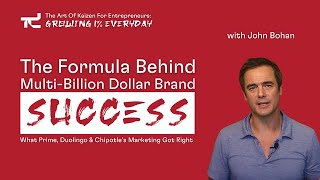
John Bohan, founder of Social Ties, built a $7 billion brand portfolio in 3-5 years by going deeper than most agencies. He drills two to three levels below surface-level creative and algorithms, using gamified hooks and serialized content to predict virality. His clients include Toyota and Disney.
Chapters
Hello and welcome to The Art of Kaizen for Entrepreneurs podcast, where we get to discuss how to grow 1% every day in both business and itself. Today we have John Bohan from Social Ties, where he and his team are redeveloping how customers see his clients in the world through storytelling. Social Ties' team of strategists, scientists, creative directors, graphic artists, photographers, videographers, engineers, client service specialists, copywriters, and media geeks are skyrocketing your revenue, and your potential return on ad spend for every client that he's working with. Welcome to The Art of Kaizen for Entrepreneurs, Growing 1% Every Day podcast. John, awesome to have you on here. Super pumped talking today.
Thanks, Kyle. Thanks for having me.
No problem, man. I got to go through your website. We talked a little bit offline and you're really in the space of taking a business, getting the real story out of why they do what they do, getting it in a way that would be acceptable for the customers, and then putting into a media buying structure that actually actually grows their revenue month over month, year over year, and really helps them build. Can you gimme a breakdown down to kind of where this all came from, where your motivation to start this business is, and kind of how you guys are going through the process today?
Yeah, 100%. So I've been in the digital marketing space now for about 30 years. It seems crazy. I got into it just because I always wanted to be an entrepreneur. I was an entrepreneur in many little ways. Paperboy, you know, painting business. I had Bohan's Brush when I was in college. At a promotions company in New York City, a buddy of mine, and I used to throw parties back in the day in New York, largely in the '90s, even in the late '80s. So I've been at this for a bit. And so I worked in television for a bit and then jumped into the internet in the mid-'90s, was one of the first people to advertise on the internet. And then got into behavioral marketing in the early 2000s and then Facebook media. Around 2009, January 2009. So I've always kind of continuously wanted to innovate and push the envelope. I maybe I'm a glutton for punishment or something, because I'm always trying to be at the edge. And I think the beauty of the business that we're in, in terms of digital marketing is always adapting, just technology changes, things flip, it doesn't stay the same. It's a real pain in a lot of ways. But it just keeps things interesting. It keeps things fun. So, you know, I started this business just to, to continue to, to enjoy myself, be on the leading edge and, and kind of have fun every day.
I love that. And be on the cutting edge. You know, if you started Facebook ads back in 2009, it's right when they actually got launched. So you were in the position a lot like what we hear Gary Vee talk about with his Google ads and his family liquor store, but you're doing it in a position where you're constantly helping other clients and kind of building up these new opportunities in the market as you're pushing this cutting-edge new technology, new opportunities, new platforms where people are interested. But to do that, you gotta go through a lot of issues and, and to build a business like you have today, you have to solve specific problems. Was there a problem in the market that you saw as these tools were coming out and as this innovation of the market happened that your company continued to solve for these clients, um, that you didn't see other people doing?
Yeah, 100%. I mean, most of the time, especially in paid media, most people aren't drilling down to the next level and the next level. And that's always been the case. Even today, it's like, you know, the easy way to do it is say, oh, the algorithm will take care of it. You know, the algo is so good. You just, it's the creative that matters. Creative does matter. But yeah, it's kind of like having an incredible race car and then you, and it's like you need a driver. You need a jockey on a horse. You need an astronaut. And Elon's, as amazing as Elon's rockets are, at present, I think they need humans to actually run them. So it's kind of drilling down 2 and 3 levels deep. And what we found is the people that are most curious on their own are the ones that tend to do it better just because they're going to want to know the next step. And what I find oftentimes, and this has happened, it happens all the time, it's like You can't do it. You know, that's the answer that people say. It's impossible. I had one situation where I was trying to get the team to find a solution to determine what's going to go viral. This is 7 years ago. And the response from the team, and nothing against them because they were really, really smart in a lot of other ways, was, you don't know it goes viral until it goes viral. I said, yeah, the guy on the street can tell me that. How can we determine what are the tea leaves and what can we figure out to see how it's going viral? So, person with the most curiosity is going to continue to drill down to find those answers. I don't know if that answered your question, but—
No, I mean, it does. I instantly think of Simon Sinek and the Golden Circle and understanding the why, right? And then it's a great example of that, what you broke down of a problem that most people would just throw their hands in the air and say that it's not solvable. There's no real solution behind it. But I loved your analogy of the tea leaves there, right? Because in all honesty, it is all solvable. There is a formula to success in everything that we do. And it seems like that's really why you guys have found success. You push for that why, you push for the reason for the success, not just to find the success. It allows you to get a lot more granular and find out how to actually make something viral or make something successful because that's, you know, I don't know about you, but when I look at a lot of the marketing positions, it's not so much of what works and what doesn't work. It's removing the bad as fast as possible. Because there's always going to be problems. There's always going to be a market that doesn't absorb your messaging or your creative. And the goal of every advertiser is to find revenue, find success. So if that's the case, removing the bad spend and only letting the good spend run gives you that success. And you're diving into the why is going to allow you to break past the boundaries that most companies and agencies just throw their hands up and say, I can't do anything about that. With that, are you working with every client, John? Are you trying to dive into the why of each one of these businesses and find a virality for everything from a small mom-and-pop shop to the Fortune 500 companies? Is there a specific category that you normally work with? What's, what's the ideal client for you guys?
Yeah, it's kind of interesting. We, we have, for the most part, worked with large brands. Uh, we have worked with 250 different brands, uh, Toyota, Intel, Disney, DreamWorks, Universal Pictures, Paramount, Lionsgate, a lot of movies, uh, back a couple of years ago. Uh, uh, Pilot Flying J is one of our largest accounts now. Del Monte, Dole, so Kraft. Walmart, uh, no, not Walmart, but Kmart. So yeah, we've, we've worked with a lot of big brands. Um, we're a little bit more discerning right now. Uh, and we really look at, at two different paths. You know, one, we love working with the big brands if they want the help that we can provide. Uh, oftentimes they would like to go with their large agencies. They like to keep things in-house. If they've come to a point, whether it's a large brand or an emerging brand, it could be a brand that has raised $10 million and really wants to crush it in social media. When you have some money available to you, what we found is a lot of brands like to go in-house, and that's great. We've also found a lot of brands where they're major brands or they're emerging brands that have tried to do it in-house, have tried to do it with their current agency. And they struggled and they're not making it happen. When they've hit that point, that's when we like to work with them because they've already gone down that road. And, and so we're more discerning on who we work with. So yeah, the big brands definitely, and emerging brands are, are thing, you know, places that we're very comfortable in and have been doing for 17 years now. We have, however, opening up to smaller brands as well under a different division. And what we're doing is we're helping business owners and smaller companies to win in social media because it's not going away. We're seeing a lot of real estate agents who are in their 40s and 50s and 60s who are doing really well in terms of revenue, but they're going, oh my gosh, I got to do my social. I have to do Instagram. Most of these guys aren't even on Instagram. It's crazy. So, so there's a lot of need there and, and we have a lot of knowledge to help them. So you asked the question earlier, am I involved in everything? In the emerging brands and the large brands, I am. In the past, I've removed myself in a lot of ways and it just hasn't worked. You know, Gary Vee did that too. He wasn't the COO, he was just the CEO and chairman. And I think several years ago became the COO as well. So was very hands-on. I don't know what he's doing now, but I like to be really hands-on. For the smaller businesses, I'm setting up the strategy and letting the team, you you know, team handle it.
Handle it across the board. Let's dive into something you brought up there, which is the uniqueness of, um, an agency that's trying to do it in-house or a company that's trying to do it in-house and how they come to you and you're able to deliver something different, something that will bring them results that they can't figure out in-house. Can you dive into your uniqueness a little bit and how you would go about that? What's different about you guys that, that maybe the in-house company just couldn't comprehend or couldn't put together?
Yeah, I think a lot of it is just spending so much time in social media. You know, I, we were working on some giveaways for the holidays earlier today. And one of our creative strategists said, instead of, every time there was, it was a trivia question. So there are trivia questions. If the contestant gets 3 right, they win a prize and this is all shot. So now we're pulling it together. So instead of just asking a question and waiting for them to get 3 right, we said, why don't we do this? How about 30-second clock there ticking down instead of just having 3 right, why don't we have Christmas trees pop? And then instead of just the Christmas tree popping for 1 right, let's put little boxes down in the middle and, and the boxes need to be filled. So what, what that does is someone takes a look at their screen and they're like, oh, oh, a clock. I get it. Oh, oh yeah. There were boxes. Oh, they used to be filled. Oh, I wonder if they're going to fill all the boxes. Oh, that's a cute question. Oh, that's funny. I like that. They're in it, right? And so what the algorithm does, the algorithm just wants more watch time, right? It just makes the platform more money. So if there are little tweaks that we can do to, to make, to, to get higher watch time, what that means is higher reach. What that means is more organic reach. What that means is potentially a viral video. What that means is a page that continuously has significantly higher video views and engagement. And all of a sudden the algorithm goes, this is a great page. Let's pay attention here. And I was like, you know, their, their social media is booming. So that just takes a lot of time. And we've been at this for 17 years. So tweaking and looking at all this different stuff and we, we have the team to, to, to do it all. So what the, the, the issue is, is in social media day, whether it's, you know, running media or it's creating content or it's getting creators, it's like Anybody can do it. Sure. Go down, click on advertising, set up your campaign. Sure. You know, license a tech platform or don't even do that. Go into Google and search for influencers. Go ahead. Or sure, create social media, take out your phone and start putting stuff. So we like companies that have gone down that road and have finally said, you know what, we need somebody who really knows what they're doing. Because if we get in earlier, it's just, it's, it's, it's kind of a drag because it's, everybody wants to, it's human nature. They want to do themselves, but they're, they're not the race car driver. They're not the jockey. So once they realize that, that's when they're, that's when we like to work with them.
It's a crazy world today where most business owners think that their, their little niece or their cousin can run their social media and there's no real strategic plan behind it when there's multiple, multiple businesses that become multimillionaire at 7, 8-figure businesses just using social media. And for the entrepreneurs and business owners listening to this right now, what he just broke down is immensely powerful. Make sure you understand what he said. One, he took something that would've been a basic level form and gamified it, made it so it's so engaging on the social platforms for what the consumer's actually looking for. These platforms want one of three things: entertainment, education, or inspiration. Those are the three categories that are gonna help you go viral. And he's saying that working with a professional, allows you to take something that would be very basic and engage it in a way that makes these social platforms light on fire. And what he explained about watch time, what he's saying is that if you can get the actual consumers to engage with your content more, these algorithms start to favor you and support you in all of your efforts around that. And only the professionals actually know how to do that. Listen, I honestly, John, to understand those type of positionings and to have the mindset to be able to make these creative changes, You have to have a solidification confidence on what you're doing. Now, you said 17 years, you've been doing this for a long time. You got your stuff together. My biggest question is, do you have, say, a problem or a failure in the, in the process of building this agency over the last 17 years that has helped you define that confidence, helped you to define how you do things? Could you think of anything that maybe our listeners would resonate with that you've gone through, uh, in the process of helping these companies build?
Yeah. You know, I always, I have two problems. One is, and I don't say this lightly because I don't want to, I want to always want to be humble, but I'm always kind of two and three steps ahead of things in terms of where things are going. You mentioned inspiration, education, entertainment. I started saying that three years ago. And it's pretty funny. Nobody, nobody caught on. And now for whatever reason, whether they, somebody else picks it up with it, it's more popular. I did those 3 things, or I started saying that 3 years ago. It's not incredibly brilliant, but it's the point is I'm oftentimes ahead of the curve and I tend to push things that are ahead of the curve before the marketplace is ready. And so we spend time on things that are ahead of the curve. That is one challenge I think in running a business. You want to be just a little bit ahead of the curve, but not too far ahead because you're going to waste a lot of time and a lot of energy. I mean, you saw in the dot-com business back in, you know, 2000, in the late '90s, a lot of those businesses, most of those businesses came to fruition. There was this business called Webvan that raised crazy amounts of money. You know what it is? It's Instacart now, right? A lot of the businesses were different derivatives of what Amazon is today. Amazon basically is the big juggernaut that took over a lot of this business. So being ahead of the market's not so good. The other struggle I think is consistency. You want to— there's so many things happening in the digital marketing space that you always want to be, okay, I'm going to be a community manager. I'm going to be, I'm going to do paid media. I'm going to be a storyteller. I'm going to do talent management. There's so many things you're better off really zeroing in on what you're good at and then kind of outsourcing the stuff that your clients may need, but you don't want to focus in on so much. I mean, even the large agencies, you go to the old gamey Mathers of the world. Sure, they do everything, but they don't do everything well. They just happen to be, you know, in with the large organizations. And there's so many, there's so many, they just, they're not doing everything well. I guarantee you that a company like yours does, I think, paid media extremely well. So for us, what we are focusing on is really storytelling and it's the creator economy and how do we tell better stories. We do have a paid media division. It's not the main thing we do. We've been doing it for a long time. We really kind of wanted to focus on, on developing that creative. So that's, that's where we're focusing on. So two things, don't be too far ahead of the market and be consistent on what you're really good at.
Incredible, incredible piece of advice. And it's so relevant today. I mean, a lot of people with the addition of AR, VR, and all of the AI technology that came out, everyone jumped on it and thinking that it was gonna be the next evolution. I still haven't seen a single VR style ad, right? And I know individuals that were developing that. It just hasn't popped off yet. Will it? Who knows? It could be in the future. But great advice for the entrepreneurs and business owners listening to this. Stay ahead of the curve, but don't go so far ahead that you're in a true blue ocean that nobody knows what the hell you're talking about, right? Because then you have to go through the whole education traditional process and then sell them afterwards. It just takes some time.
I mean, look at the metaverse with Zuckerberg. Boy, did he get in some trouble, right? I mean, the guy's smart enough to pivot. It's amazing. He was drinking the Kool-Aid and he was so into it. I remember he was fencing 4 years ago with the gold medalist from 2020 or 2021 from Tokyo and just really getting into the metaverse and the haptics and all of that where you actually can feel like the sword hitting you. And he's like, everybody's going to do this. Zuck, not everybody can afford to do that. It's, it's, you're talking 2030, 2035. And so he pivoted back. So there's a lot of shiny toys out there that we all need to wait on.
Yeah, shiny spoon syndrome is definitely a real thing, especially in marketing. It's ever-changing, but you're hitting on one of the questions that was one of my favorites in this interview, which is where are we going? Where is this world of marketing and advertising going? I believe that you guys are on the cutting edge. I think that we've gone through a weird turmoil of new platforms coming out and these platforms being overwhelmed with direct response style advertising where everybody was going after a sale, a lead, generating revenue. And a lot of people forgot about telling people why you do what you do, the actual storytelling around the process. And you, like you said, being on the cutting edge, realized this way ahead of everybody else. I think everyone's just starting to catch up to you now. But John, question is, where do you think it's going to be in 3 to 5 years from now? Where do you think that the development's going to come within the paid media space and the growth of these businesses? That maybe that you're looking at today that you just can't even release yet because it's not quite ready?
Yeah. Well, we're releasing it. We're not, we're starting to get some interest, but not as much as we should be. And it's really weird. I mean, marketing moves really, really slowly. I mean, business owners, whether they're CEOs and CMOs or of large multinational corporations or they're emerging brands that just raised $5-10 million. They got a lot of moving parts other than advertising and marketing. But here's the thing right now is storytelling and marketing can be your differentiating factor that scales your business. You could create a billion-dollar brand pretty quickly, call it 3 to 5 years if you do your advertising and marketing really, really well. So why do I say that? Because Prime did it. Prime's having some troubles now, but Prime built a, it would be, it's between a $4 and $8 billion valuation before some of the controversies when Pepsi came out. I don't know what it is now, but they sold a billion bottles in 2 years. Duolingo is a $7 billion valuation right now. They were really nowhere 5 years ago until they created Duo and started social media. Dunkin' Donuts is off the charts in terms of their marketing. They really, really get it and you start to see their revenue popping as well. Starbucks is another one. Oatly, I think it's a $10 billion brand and that just really happened. We went from like 7 to 10 just in the last few years. Take a look at their social media. It's like there's a direct correlation there, whether you're an emerging brand or a big brand. So where are we going? And I'm glad you picked, I think, 3 to 5 years because that, that is the period. 10, you were just throwing darts. Right now, I think we're at a stage where the algorithms have gotten so good. That, you know, guys like you can tweak it to make more magic. But I don't think the white space is necessarily there. It's been there in programmatic and behavioral marketing and firms like yours are definitely needed. But I think the biggest white space in my opinion is social storytelling. And it's basically building your brand. Um, because brand is the difference, right? I mean, if you bought, you can buy, I think it's $3.25 for a, for a, well, it's like $5, $6 for a latte at Starbucks. If that just had a white cup and it wasn't, it wasn't a Starbucks, it'd be like $1.50. So brand, building your brand is key and doing it in social media is key. So I think that's the biggest opportunity right now.
I couldn't agree more. I was literally on a client call earlier this morning and I was talking to a young woman who just started her business talking She's about 400 followers on Instagram and she goes, what do I do to increase followers? I go, well, you need an engagement. You need people that want to stick around. You want people that will stay with you forever. Why don't you make a series? Why don't you make a 5 to 6 video series? And I, I think what you're saying on the storytelling is the evolution of all social, right? Where instead of watching a Netflix series, you're following an Instagram page because you watched a video of part 1 of 10 that explains the story of a business or a problem that they solved or an amazing case study and review from somebody, right? Instead of doing this as a one-off pitch and just undervaluing the actual story that you're telling, emphasize the story, put it into sections, make people need to follow and engage and become a part of your community to absorb the whole thing. And your company's already on top of that. So it's, do you have any tidbits, maybe a little bit of advice for someone that's trying to start off on the story process within their social and they just don't know where to look first?
Yeah. First of all, Kai, I like what you said about the storytelling and how you can make it serialized. And I do like the linear storytelling within, let's just say Instagram, where it's kind of like episodic with Netflix or any streaming service is that you wait around for the next episode to come out. So it continues to tell the storyline. And I think some people have started to do that, but that's That's a really, really cool model. The other cool model is serializing content where it doesn't necessarily need to be linear, but it could be around a particular topic. So we had a topic on my Instagram, which is— I'm @thejohnbohan, by the way, if anybody wants to follow. So @thejohnbohan. And I have— I'm the guiltiest one in social media because I've been at this for so long, but I haven't focused on my social until probably about 6 to 8 months ago. So I'm building my own social. On Instagram and LinkedIn. So I'm @thejohnbohan. So one of the things that we created is Be Like MrBeast. So, you know, there's a lot of hacks. It's, I'm hijacking MrBeast, you know, for good reason, right? He made $80 million last year according to Forbes because he's the best at this. So I analyze what MrBeast is doing. So I'm posting about that. That's one serialized piece that I'm doing. Do another serialized piece on archetypes. I'm actually We're creating one today. So archi— knowing your archetype is like the best thing that you can do as a brand, whether you're a big brand or a small brand. Some people in marketing have heard of it. I would say probably most people in the marketing industry have heard of it. I would say maybe 10 to 15% do it really well. Most emerging brands or people who are maybe a real estate agent have never really heard of an archetype. But if you get your archetype down, down, it starts to build your entire story, your tone and voice, your look and feel, et cetera. So those are a couple of tips.
Yeah. And as an entrepreneur and business owner, you listen to that and he said archetype and you have no idea what he's talking about, make sure you look that up. It is the foundation of how you're gonna represent your overall stigma as a business inside the market. Are you funny? Are you serious? Are you, uh, are you drawing through the hero's journey? There's multiple different ways to define it. The CEO of my company, Santi Lozano, is a nerd addict. That's all he talks about. So I, I'm a little ignorant too, but he's really on top of it. But you're right, John, that's, it's such a, it's such a disservice that I think a lot of business owners do to their own company by not leaning into why do I do what I do? Who am I and how am I supposed to represent this business in the market? How is it supposed to feel? How's it supposed to sound? How are people supposed to actually engage emotionally, physically, and visually when they see my brand for the first time? And what can I do to ensure that that sticks, that locks into the customer, and that's where storytelling really comes in. So amazing advice, great overview. And I, I gotta ask, so one of my, this is my favorite question on the podcast, is how do you find your kaizen? For the business owners listening to this right now, kaizen is a Japanese business philosophy term that means 1% progression every day in both business and itself. Personally, I am a 30-year-old hardhead go-getter that thinks I'm the dumbest dude in the room. So I'm constantly listening to podcasts, watching YouTube videos, reading books. And then in the accounts every single day to see the media buying practices and what affects what and how it actually develops. John, what are you doing every day to find your personal kaizen, both in business and in self? Are, are you meditating? Are you running? Are you reading books? Are you speaking at podcasts? Are you meeting people? How do you find your constant improvement?
Yeah, there's a lot of quotes that I like to follow as reminders of how I can continuously improve, right? That's a Toyota The pursuit of kaizen, continuous improvement. You know, one quote is, I think it might have been Galileo or someone like this said that the only reason I was able to do this, I was standing on the shoulders of giants, right? There's another Chinese proverb says the best way to climb a mountain is ask somebody on the way back, right? So, and then a quote from my previous creative director, he goes, you know, I always like to take a look at the people that are kicking my ass. So looking at other organizations like yours that are just crushing. So I spend a lot of time looking at Gary Vee, you know, he's just crushing it out there. And I'm always like, what is he doing? What is he saying? And then, you know, I look at a lot of social media storytellers, people that are in my business that are doing really, really well. I mean, whether they're beating me or not, I don't know. They always have in— a lot of them have insight. I spend a lot of time on Instagram. Uh, and I look at, uh, a lot of different, uh, people that, that are just giving advice and giving tips. And, you know, I think that for the people that are watching this, look at the, look at your mentors, your mentors, uh, may be within your industry and then be outside of your industry. You're looking at something more broad, but I like looking a lot of times in the industry and, and in social media and what they're saying and how they're positioning themselves and just dovetail off that. The other thing you can do is you can, you can go into, you know, put in a topic like real estate in Manhattan Beach or something like that. And it'll, and look at Discovery on, on Instagram or real estate in general and look at all the different posts there to see which ones are really popping and what they're doing differently. So that's one thing, you know, personally, you know, meditation is, is, yeah, I do meditate. I like to meditate more. I, I live now in Hawaii and in Maine. I'm pointing to the east. So I love swimming in the bay. I, it's, it's, it's amazing in the, in the, in the Kailua-Kona Bay. I like swimming far out there because it scares me because there are definitely sharks out there without a doubt. You see them in drones. In fact, some of them have names. Laverne and Bruno are two large sharks out there. But the chances of getting bit are small, but it just, it just puts you on edge and keeps you alert. And, and it's an amazing exercise and you're getting your cardio and your breathing. And anytime I start the day off that way, I mean, everything is, is, is really smooth. So I think the key for continuous improvement is, is being mindful, finding the time to look at people that are doing it better than you are, or people in your industry, people you can get inspiration for. Secondly, I find that exercise is amazing. And I also found that just not drinking is amazing. I've kind of gone up and down over the last, I would say, 10 years. And I just stopped. I, you know, I might have a, I'll have a drink in my, a glass of wine at my daughter's graduation this year. Some friends got engaged. I had a little champagne, like a glass, but other than that, I've just gone cold turkey and it's It's done wonders for me.
Keeping your head clear. And John is always on the edge, as he said earlier on this interview, on the edge of technology and marketing, but also on the edge of the water, swimming with sharks. Crazy, man. I mean, honestly, but I love that. I truly believe it. I'm in the same position you are. If you can make your mornings harder than anything else throughout the day, everything feels easy. If you can go hit a PR on bench press or run the farthest you ever had before you start your day, when you hit your first fire in the morning, it will feel like nothing. So John, I love that. And, and the combination of how you speak about the mentors inside and outside the industry is super important. I think this is something that a lot of people don't look at, especially outside the industry, right? One of the quotes that I always love is Picasso artist theft, right? So exactly what you're saying, going through and finding who's in the industry doing good and kind of stealing from them and, and being on their, um, their coattails, but going outside the industry and finding out how to change your overall market. A lot of things like Russell Brunson's Lynchpin, right? The book that, that was released and the ideology around subscription models, specifically in the e-commerce and the online space. I've taken that same concept to home improvement businesses, to restaurants, to all these different businesses that create a linchpin ideology. And 90% of them, because they're not looking outside of their industry, think it's so mind-blowing that it would never work. But if you want to stay on the cutting edge, if you want to be in a, what we consider a blue ocean, AKA you are so ahead of your competitors that they're not really able to to touch you anymore. You have to look both inside and outside your industry. John, I think you hit the nail on the head. I got one last bonus question for you. Have you ever read the book Atlas Shrugged?
I have not. No, it's okay.
It's super long book. I ask this question to almost everybody and I got about 50% of who've read it and who haven't. But for the listeners out there and anybody that hasn't read this book, it's an incredible concept that explains that business owners like you, John, like me and the listeners that we have here today, we put the world on our shoulders every day and we're the ones that actually move the world forward. If it wasn't for business, if If it wasn't for putting ideas into operations and executing them, things would not change in the world. The book Atlas Shrugged talked about what happens if we just all shrugged it off. What if you, me, and every business owner in the world today just said, we're done. We walked away from our business and there is no more business operations happening. All the infrastructure's still there. The restaurants are there. The home improvement materials all exist, but there's no operating businesses. If that was the case, John, What would be the first business that you would start tomorrow?
Is Bezos running away from Amazon? Yeah. I pick the biggest business and jump in there. I mean, you know, it's an interesting question. I love these questions. Alex Hormozi is someone I listen to. He's not necessarily in my industry, kind of is, but he's in so many industries, but he just provides amazing advice. He said it takes the same amount of time to make, I think he said $100,000 as it does $10 million. And he said, because you just need bigger ideas, you know, look for the bigger idea. You're going to take the same amount of time to do it. Maybe it's a million versus $100 million for God, but he's right. You just got to go for the bigger idea. And then the other thing is this, is that what I've learned is, is I love what I do. I love storytelling. I love the creativity around it and the things that I'm doing, but You know, the main thing for me is it's a, it's a business. And I think I could probably do almost anything as long as it had a lot of growth and opportunity to it. So I would, as business people out there, you know, if you're not already ingrained in your business and you're just starting out or thinking of switching careers, pick a business that has tremendous growth opportunity. If you figure, if you kind of like it, you know, then do it. And as opposed to going into, you know, I love the music industry. I'm in that too. A lot of creators are in the music industry, but it's harder to do well in the sexier businesses. Uh, my, my neighbor is doing really, really well. He's in accounting. He does all the boring stuff that the companies don't want to do, but he's crushing it. He's driving around in his $200,000 car and he's an amazing guy. So the key is, is, is you don't necessarily have to pick the sexiest business. Oftentimes the boringest business might be the most successful for you. And then also I would probably go and answer your original question. I would probably do eBay or Amazon. I met Pierre Oudemar actually when he first started eBay shortly after he created the Pez dispenser. And I was like, is this business really going to take off? And it's like, you don't know until you know, but if you're able to go back and everybody stop, pick the ones that have done really, really well and just accelerate those.
And for the listeners out there, he goes right back into what he's doing every day. Proves that what you do, you love what you do, right? You're, you're gonna go out and you're gonna try to expand business. You're gonna try to grow. You're gonna try to develop in a way that allows you to expand yourself, keep yourself on the edge, and always pushing yourself to find new heights and new opportunities for your clients. John, I, I mean, I absolutely love it, not only from your 17 years of experience, but your true understanding of the resonation of how the story within the business is gonna make you that, give you the opportunity to really be able to scale and hit numbers that you never thought fathomable. So for the entrepreneurs and business owners out there, contact John. If you're looking to really grow your business and develop it, you're in the space where you're a larger business, maybe you have an internal agency that you've been working with and it's just not hitting the numbers that you're looking for, go ahead and contact John Bohan at Social Ties. John, how would they be able to find you? What's the best way for someone to be connected with you?
Yeah, the best way is, is go to Instagram, go to the John Bohan and DM me. That's the best way to do it. So go to Instagram, go to the John Bohan and send me a direct message. And, uh, that's a great way to get connected.
And living on the platform every day. You wouldn't want anybody else in your pocket besides someone that says, hey, find me on Instagram cuz that's where I'm living my life. And ensuring that I'm helping my clients evolve from those platforms. John, thank you so much for the time. For the listeners, all of John's information is gonna be found below in the description. If you made it to the end of this video, make sure you like, comment, and subscribe, and we'll see you on the next one. Again, John, thank you for your time.
Thank you, John. Appreciate you.