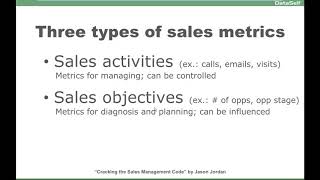
Jason Jordan's framework divides sales metrics into three types: activities like calls and emails, objectives like pipeline movement, and business results like closed deals. Most teams measure results, fewer track the activities that drive them.
Chapters
So let's start with powerful metrics for sales management. And there's a book called Cracking the Sales Management Code by Jason Jordan. If you are into sales, I highly recommend reading this book especially for analytics. It has a lot of great information. It can help you also understand better the processes, kind of metrics that might relate to your business. So highly recommend. Anyhow, Mr. Jordan, he researched through several large organizations and the main idea was to learn from these organizations key metrics for effective sales management. And in this research he gathered more than 300 different kind of metrics. A lot of metrics. So a lot of people using a lot of different ways to look at data. But one of the things that he did, which I thought it was very insightful, that sometimes we don't really think hard about it is can we manage this metric? Can we actually influence it? How much effort should we put into analyzing metrics? And it's a process. You know quite often that when people start measuring in trying to managing things, they have an idea of what might work, they give it a shot and quite often they realize it's not ready, it's not right, they have to twist it, tweak it, change it and it's a journey, it's part of the process. But being able to measure something and act on that measure is critical. It is just information that nobody acts on. It's usually not that critical. So a big chunk of this book message was can we manage this metric? So he went through this whole research and then he found out out of those 300 plus type of sales metrics, there are three main types or buckets. The first are the sales activities like calls, emails, visit to clients, demos, things of that nature. Sales activities are usually things that are easy to measure, how many you are doing and usually they are fully controllable in a way. Make more calls, visit more clients, send more emails while you're not reaching the goals of those things. So sales activity is usually something kind of almost 100% within the measurement in the management of metrics in a sales organization. Now there are the sales objectives. Well, sales objectives is pretty much are you getting more opportunities open to, you know, push through the pipeline, Are you being able to move them quickly or how long is taking to move from one step of the pipeline to the next one. So those things are your objective, you want to get more opportunities, you want to get then moving forward and eventually to close them of course. And these metrics are usually called or very useful for checking your sales process, how it's going and how can you tweak your different processes, your different interactions, the speed, the approach, what materials you should send, looking at different trends across the whole sales process to try to create more things in the sales objectives step of the metrics. So these things you don't control fully because to create an opportunity, the prospect say no. Yes, send me a proposal. So in a way you don't control the full process, but by looking at the sales activities and how efficiently you're doing things, you start to find pattern between or among things you do and getting more of your sales objectives into the sales process. Finally, what's the ultimate goal? Is the actual business results, how many sales you're getting, how many new contracts have you closed? This is pretty much you're looking at lagging metrics. You know, it's what you did in the past. You have no more control of what happened in the past because you're closed opportunities. So it's great for reporting, it's great to learn what happened, to see how you can do better in the future. But it's something that has already passed. So these are the three main types of metrics. And the interesting thing if you check the book by Mr. Jordan is that there is no one size fits all, what you should do. It's great to learn what options are available, what other organizations are doing and, and try to start to experiment in your own sales process to see which ones can actually help you and your sales team do better. Anyhow, I want to do a quick poll to ask your opinion or your feedback. So let me just launch this poll and if you please, just tell which one of the following sales metrics you're actually measuring with your sales team and that you're actually trying to manage. So you're measuring and manage. So click all the ones that apply to you and be sure to click the submit button. 10 more seconds. Five more seconds. All right, I'm going to close the poll and just share the results. So most are measuring the results, a bunch of objectives and actually about half checking the activities. Pretty good. Thank you very much. All right, so this is actually what Mr. Jordan found on average among this organization that he was dealing with in as a guideline. These organizations are fairly, they have fairly efficient sales processes and he found that a good chunk of their metrics was around sales objectives, a small amount on sales activities and relatively well for business results. If you just remember what we just look at our own survey here, we got 80%, 86% for results, 71 for objectives, and 57 for activity so we have a little different arrangement here. There's no right and wrong. I'm just conveying that for these organizations. They found out that. And you know, if your sales process is fairly mechanical, quite often there is less management of sales objectives in more kind of doing sales activities. If your sales like B2B is more complex, sometimes you have to work harder and get more things into the pipeline so they can move into your sales objectives. So those specific things of your own business, you have to see which one to apply better and then try to increase the buckets depending on those kind of needs.