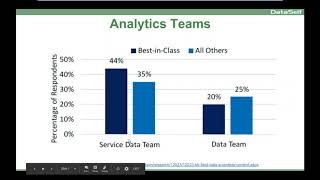
A spoken presentation summarizing industry research (citing Aberdeen Group) on how service organizations invest in analytics to drive service excellence. Key points: BI/analytics and real-time monitoring are top investments; best-in-class firms have dedicated analytics-for-services teams; some tie IT compensation to customer-data objectives; and analytics can diagnose causes of failed service visits (e.g., part unavailability, customer/asset not present).
Chapters
All right, let's get started. So first of all, we did some research to look at in the industry about metrics and trends when it comes to investment in analytics. And Aberdeen Group is actually has some pretty good research around numbers for the industry. And at the bottom of these pages you'll see links and we will make this PowerPoint presentation or file available later so you can actually check those resources. But one of the very interesting things in the industry we have found out is what organization service organizations are investing to bring data to service excellence. So this chart shows how much they're investing in different type of technologies. And interesting, interestingly is BI analytics is pretty much one of the top technology investments that best in class service organization are investing for bringing data to service excellence. What are they using? BI and analytics. So most of it is to do consistent benchmarking of service performance. I mean if you want to really take, take your service to the next level is really critical to look at your service performance from any different angle and see which of these trends can affect customer service, customer satisfaction, productivity, lower cost, increased revenue. So a lot of analysis has been invested into that bucket, which completely makes sense. Some of it is also invested into real time monitoring. So seeing what's happening on the fly right now. And also about the same percentage is real time visibility into service performance by senior management. So some interesting stats of how other organizations are investing in analytics and how they're using it. This is interesting as well, what kind of analytics teams these organizations are investing in. And a smaller number of these organizations, they have a analytics team that works across all departments of the organization, financials and sales and services, production, whatever it is. But if you look at the best in class service organizations, they actually have a dedicated team to look at services, just to analyze service exclusively. So it's not a generic department, but only department focusing specifically on that. And I think part of the reason based on what I read is services. It's a very sophisticated, I mean it's a very complex problem with so many variables and they change it so frequently that if you don't have a dedicated team that understands the analytics side, understand your data sources, understand the services initiatives, you know, the people, the processes, the technologies, you know, it's not as efficient. So having people that are dedicated in analytics for services is something that you know best in class organizations are doing apparently very successfully. Now this was also very interesting. I actually never thought about until I read this particular survey. But quite often it is heavily involved in helping service organizations actually anytime organizations to get more out of their systems overall. But quite often it talks a very tech talk while the business departments talk a very business talk. And sometimes there is miscommunication between things. So setting the right priorities, sometimes it's hard to meet them. You know, it sometimes doesn't really understand the real business problem and find solutions that are easier in their perspective. So this part of the survey was very interesting telling that best in class organizations, they actually compensate IT team based on achievement of objectives related to better managing customer data. So if you know they are putting places ways to compensate IT based on the success of the teams that they support. So not so much about the success of IT per se is the success of the clients of the IT inside the organization. And this can change dramatically how it works because now they're much more interested in making their clients internally more successful than them just meeting their own internal goals. When you look at this perspective, at least on the BI side we see so many organizations investing bi analytics because the cost of the software is lower. They really are comfortable with some kind of platform. But those factors may not be the best for the user is best for the IT department when you compensate them based on the success of the users. Hopefully they can have this look in a more detailed perspective to really find the technologies, let's say the analytics technology that empower the users so they can do more, they can be more self sufficient. So I think this is interesting perspective that you should consider if you're not already looking into compensating IT based on the success of your of their clients, internal clients. Now what I think is most important for any service organization is to look at your own internal KPIs and start asking questions, you know, how are you doing? Is this effective or not? This is just a very simple example that we saw in this research and we asked some of our clients in the service industry is what are the top reasons for failed service visits? And these usually have a big impact in the business. First because if you have a failed service visit, your costs will increase. But most importantly this affects dramatically customer satisfaction. So ideally if you have a service call you want to be sure that you're going to be addressing hopefully in the first call when you or very quickly. So what are the main reasons why you have failed service visits? Well, in the industry based according to Aberdeen part unavailability is one of the top reasons. So as usual people go to do a service and there is a broken part that the person doesn't have any stock and they have to come back some other time. The second most frequent reason is the customer or the asset that needs to be served is not available for service. Both of these problems, it's very interesting to see how companies can address them, and I read a lot of different ways that you can improve it. Sometimes at first, some of these problems look like it's very hard to solve. But when you break down the problem in different pieces in different regions and whatnot, usually with analytics, you can understand in much more detail the reasons why whatever failed service business is happening in your business, and hopefully fixing some of those problems to improve the efficiency of your services. So overall, analytics should help organizations to address to break down the problems in more little pieces, understand which part of the process is actually maybe causing bigger issues or more productivity. Overall.