3 DataSelf Analytics: Maximizing Value from BI
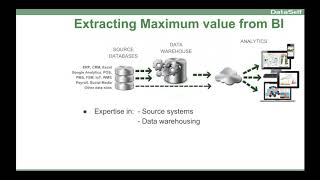
DataSelf explains how to get more value from your BI investment. The video covers data sources, data warehousing, and analytics platforms, then shows how pre-built reports and dashboards can speed up implementation.
Questions this video answers
December 17, 2017.
More than 5,000 reports, dashboards and KPIs.
Tableau; claimed to be considered by Gartner as the gold-standard analytics platform for the last five years.
Chapters
Okay, so let's talk about maximizing your bi, maximizing the value from your BI investment. Many organizations, when they start with a BI project, they go through what I call the baby steps. They are excited to get into this framework where they can give users easier, better access to the information. Quite often at the beginning the project is very small, it's very focused. Let's say the company wants to see better sales analysis, or maybe they want to focus on CRM opportunities, or maybe they have some Excel files, or maybe they want to see some financial information. It's a very narrow, focused approach and quite often, you know, people using Excel to do that or they poke around with different tools and quite often there is success and they can do a few things forward and make it nice. And that's how it starts. Now, what happens almost consistently in all organization that we have worked with, when you look several months out and probably even years out, what's going to happen is something like this, the very small project when you started using whatever tool, maybe Excel or Tableau Power, BI eventually will grow into a much more comprehensive BI platform. At the beginning, maybe you're only looking at sales or only at financials, or only cash flow, but eventually you'll have most piece of your ERP incorporated into the bi. If you have CRM, you're probably going to have a lot of CRM information, Excel files that you use for budgeting, forecasting and other information. Most likely Google Analytics, other systems like point of sales and professional services software, Internet of things on social media. I mean eventually most of the data that is important for data analysis will be incorporated into this BI solution and your business will be much more efficient. When it comes to data analysis and analytics. It's a great, great initiative and you help your decision makers be on top of the trends. But what is going to take to get that job done and how long is it going to take you to get that job done? Let's talk about it. In order to do this successfully, in order to bring all of these things together, make it easy and make it fast to give decision makers information anytime, anywhere. What you'll need is expertise. People that have expertise in your data sources, they need to know the ERP system, the CRM, whatever you have as data source, you need people that knows those data sources. It will know where to find the information, what tables to use, what fields to use, how to bring them together. Now if you want to combine the data with another system, you will have to have expertise in two systems now and then be able to Understand how to put them together. So one piece of the puzzle is expertise in your data sources. Second is you will need some kind of data warehousing framework. Maybe a data warehouse, maybe several data marts in a data warehouse. Anyhow, you'll need data warehousing expertise to bring the data outside of the data source, to massage it, to clean it, to optimize it, to organize it, to make it easier and faster to decision makers. So you will also need people with expertise in data warehousing. You will also have expertise in your analytics platform. When people start with the baby steps, quite often they start with whatever that they have that they think is comfortable. Again, can be Excel, can be Access, can be SQL, Tableau, Power, bi. Whatever the tool is, they start with something. But very likely if they didn't think hard enough at one point, they'll have to scratch the old thing and replace with something more robust, something faster, something easier. So you have to have expertise in the analytics platform to know which one to select and how to maintain it, how to do security and all the things related to the BI platform. Then you also have business analyst role. There will be people talking with your decision makers to understand their questions, to understand the requirements and being able to translate those business requirements back with this whole team to build, to customize, to fine tune the whole thing to deliver awesome value. And if you have people doing all of this awesome, you'll get it done, you'll be successful and you'll be so much more efficient with great data analysis. Now to do all of these things, you'll need, you'll need time. You need time to connect the dots, to integrate the systems, to roll out to different departments, to set up security, to train people. It just takes time. And if you start from scratch, typically to incorporate all of this, typically it's years of work doing this, fine tuning and developing, it's worth it. But it takes time to connect the dots. Now if you do this from scratch, starting from scratch using your own team, or using a BI consulting company or a reseller, if you do that pretty much from scratch or from a very small initial starting point, guess what? Be sure to maintain these people that are building your solution in the long run, because you'll need them when you upgrade your systems, when you change your systems, when you have to do maintenance, if your BI team has changed, good luck, you'll have to hire new people. The new people will likely not understand what was done in the past. They'll be rewriting things, scratching things. And I've seen many BI projects to have a huge total cost of ownership because changes in the team. So if you're going to have build this from scratch, be sure to have a BI team or maybe a consulting company that will be able to support in the long run to be sure it's smooth, its transitions, will not be rewriting and will continue to grow smoothly and easily. So those are the recommendations regardless of what direction to take from a BI standpoint. Now if you're here, it's most likely because you have one or some of these data sources. These are very popular mid market vendors that sell erp, CRM systems and some other systems. So very likely you're here because you have one or several of these. And then I have very good news for you. Instead of starting from scratch, pulling your financials, your sales, your inventory, your services and everything else slowly, and taking months and years and hiring people instead of taking months to years to build this with Data Self, in a matter of days we can deliver you more than 5,000 reports, dashboards and KPIs. There's a ton of things out of the box covering sales, inventory, financials, P and L, balance sheet, financial analysis, payables, receivables, purchasing services, work orders, CRM opportunities, tech support, activities, account manage. There's a lot of things out of the box so you don't have to start from scratch. You can give your business users a lot of insights because we provide this comprehensive out of the box that will dramatically reduce the time to get value. So what Data Self is, is a lot of reports out of the box. We have SQL Server, data warehousing, Data marts, data warehousing, whatever it takes, we will architect a solution to tackle your needs. We do this framework in a fairly code free environment so the data warehouse has very little programming, easier and faster. And for the analytics platform we use Tableau, which has been considered by Gartner as the gold standard analytics platform for the last five years in a row. So very easy to use and very fast. So that's pretty much what's Data Self is. If you have any of these source systems, we can dramatically reduce the time that it takes to deliver value to get maximum return from your investment in bi.










