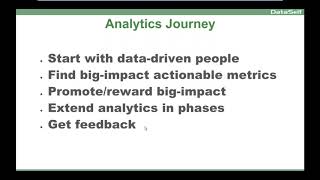
A talk about strategies for engaging teams in analytics adoption within service organizations. Recommends a phased, user-focused journey (start small with 'data-driven' users, then expand), emphasizes gathering feedback, rewarding participation, monitoring user traction, and using an easy, fast analytics platform that supports varied environments and blending data from multiple systems (FSM, ERP, CRM, GPS).
Chapters
All right, let's talk about engaging your team with analytics. And the main questions are who should you engage with analytics? When should you do it? Our approach that we usually recommend is not a one size fits all, but we say that once you need to start engaging with analytics, it's a journey. So let's start with baby steps. You know, you need to start crawling, then walking, running, eventually going to be flying, but it's a journey. So let's start, you know, with the baby steps. And usually what we tell people is when you embrace analytics, it's welcome. You're going to be able to do a lot of things that before was very hard, was very slow. So you have visibility to your business. And what you should do at the beginning is focus on people. They'll be really excited to be part of this new initiative. And typically these people are the data driven people, people who like to see data, they what they're asking for and they will be very excited to help you figure it out. Again, at the beginning you may think that you know what you need to look at, but as you start to experiment and look at the metrics and compare and discuss, discuss with people and see how, how those metrics really, you can have. Very interesting and exciting process. But once you find big impact, actionable, actionable metrics with the small number of people, then is when you start promoting about it, talk about it with. Folks that usually would say, not really, I don't care. It's very common to see many organizations, people that are not data driven and they're not going to be very excited about this extra thing that I have to do. But if you promote it, if you show the success that the other people are doing with it and having with it, and you attach reward programs, guess what, Slowly but surely you're going to have more and more of these other people that are not so data driven to embrace it because they're hearing good things about it, they're seeing other people being more successful, they want to be more successful, they usually want to get more money and then you get more people to embrace it. So usually that helps a lot. And then, you know, as you start seeing this, you start to extend the analytics to more people and do it in phases. Don't push it too hard, don't push it too soft, kind of, you know, feel how things are embracing and keep on pushing, pushing it out, push it out to more and more things, get feedback. You know, sometimes, usually the beginning, the data driven people are going to be the ones giving the most feedback. But as you push this to more people and as more people embrace, always be open to hear people just write down, get their feedback by email, talking with them. And sometimes you learn certain things that sometimes from someone that you would never expect. The person will have a good command, good suggestion and right there you get a great suggestion that helps everyone else. So make people excited to share their feedback, hear them and try to incorporate the people feel that they are being heard and what they are suggesting is making things good for the whole company. And always attach this back to telling everyone, oh, this person gave this great suggestion. Sometimes give rewards for good suggestions because they will help everyone being excited to be part of the process. Finally, monitor user traction. If you have the right tools, you'll be able to see who is using your analytics. And sometimes you know that can be good for you to see why it's some, you know, some people are using a lot and why some people are not using at all. So having a system that give you visibility into that is also a critical component for this process, for this journey to be very successful in the long run. So what kind of analytics features are critical for all of these things? I'm talking about to be a success and to be fast. So first of all, service organizations have usually very different environments for different users. Some users are in corporate, sitting on their desktop, some users are meeting customers in well controlled environments. Some people might be in very harsh environments where they have to access their information. So, so having a platform that can deliver information in different environments, it's very critical overall when it comes to analytics, being able to look at your data. The solution must be really easy, really fast and allow people to change things dynamically by themselves, even if they're not too technical from an IT standpoint, computer based, but it must be easy, it must be very intuitive, so very critical to have those components. And finally, most or pretty much all service organizations use different systems to take care of their jobs. There is usually a FSM system, a field service management system, project management systems, ERP systems, CRM systems, GPS based systems. In all of the system, they have the data from the whole process. And for an analytic standpoint, you often need to have all of this data together to blend them together to see how they affect each other. So blending data from different systems is also a critical component of your analytics system to deliver data.