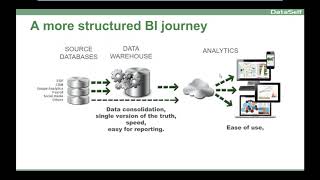
A structured BI approach needs three things: a data warehouse for consolidation and speed, an analytics tool that's easy to use across devices, and BI expertise with real business involvement. Without decision-makers at the table from the start, the solution won't stick.
Chapters
If you're not happy the way that your system is operating from a reporting BI standpoint, then usually a better way is what I called a more structured BI journey. What is a more structured BI journey? One of the most critical components is having a data warehouse. What is a data warehouse? A data warehouse is a data repository where you can bring all of your data sources, your erp, your CRM, Google Analytics payroll, social media data, Excel files, whatever you have as data silo you can bring into this consolidated data source. So the first main advantage is data consolidation. Maybe multi company with different systems, doesn't matter, you bring them all together. Second is single version to the truth. This is a way to guarantee that all of your main metrics, your KPIs are defined in a single place. Place in the data warehouse. Let's say you define how your gross profit is calculated in a single place on the data warehouse. Maybe you look at your revenues minus cost of sales, or maybe you change to also include shipping handling because now you're doing for free. So it's a single place where you have this calculation in all your reports will pull this gross profit from the single location. So you don't have the situation where you go to a meeting in every person, let's say bring a different report. And sometimes the reports were looking at different rules to calculate gross profit and you don't even know about it and you're making decisions based on inaccurate information. So data warehouse can guarantee a single version of truth because of that functionality. Speed. If you want the reports and framework to run fast, usually you have to have a data warehouse. And finally with a data warehouse, overall you get much easier reporting. Now that's the backend, what I call the pipeline of your BI solution. On the front end, you have to have an analytics tool in. One of the most critical features of the analytics tool list is a fuse. Most of the time, people that will be accessing your reports and dashboards, they are not IT experts. They are business people. They know business, they know how to manage people, build things, sell things. So you need to give them a tool that they can easily see their data, slice and dice it, drill down and even build new reports from scratch without calling for an expert. So ease of use is really critical. Second, speed. In our experience, if a report takes more than 10 seconds to run, most likely many business users will not run that report. People have no patience. It was going to be a waste if the reports are taking too long. So speed is really critical. You have to have a platform that runs reports in seconds. Finally, people have different needs to consume the reports. Maybe they're sitting on a desktop, maybe they're using web browsers, maybe they want to use mobile devices, maybe they want to receive alerts. So you need to have a platform that will render information the way that the users want to consume them. Not how you want it, but how they want it. So very critical to have different ways to access information. Now, when you take a more structured BI journey, it's very important to have BI expertise. You need people that will help you select the the right platform that will help you deploy it and maintain in the long run. If you don't have the right BI expertise, it might be a bumpy road. So that's a more structured BI journey. Now, what are three main ingredients to make your BI journey successful, regardless of what tool you select? First of all is what is a right BI platform? Maybe something simple, quick and easy. Maybe is the more structured BI journey. Yes, having the right BI platform is critical and you need to pay attention to it. Once you select it, then be sure that you have people who will know how to deploy and maintain the solution. Sometimes you can build this knowledge in house very quickly. Sometimes you need partner with other companies to do a good job or hire more people. So be sure you have the right BI expertise. And the most important component in my perspective is be sure you engage decision makers in the whole process. BI at the end of the day is for them, is for people who make more informed decisions. And a lot of the BI benefits, the pros and cons are very business oriented. It's not tech talk, it's actually a lot of business conversation. So be sure the decision makers are engaged, engaged in the assessment, understanding the pros and cons, not the technical details, but the business benefits. And you'll help have this project really well sponsored with the right budget, not too much, not too little, the right budget to make it successful. So be sure you have those three ingredients.