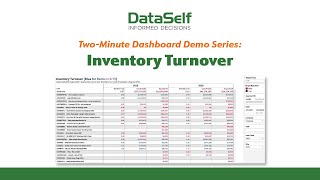
Inventory turnover is hard to calculate right. You need COGS, average cost on hand, and clean ERP data. DataSelf shows why a data warehouse cuts reporting time from hours to under 10 seconds.
Chapters
Inventory turnover is one of the most useful statistics for a distributor or manufacturer. Unfortunately, it's also one of the most challenging to generate. The challenges are hinted at in the very name of this metric. It's typically referred to as a financial efficiency calculator. It uses a sophisticated series of calculations, including a turnover formula and a days formula, to determine how fast a company sells its inventory over a specific time frame. This determines manufacturing and sales efficiency. Consider the current dashboard. By default, it's looking at annual turnover. However, many organizations need this calculation to be performed on a quarterly or even monthly basis. Although the idea of annual versus quarterly or monthly analysis might not seem like a big deal, it becomes one when the calculations have to be performed on ERP data. We're talking about thousands of transactions multiplied by hundreds or thousands of items, all put through complex calculations to derive figures like cost of goods sold, average cost on hand, and turnover rate. The complexity of this kind of analysis and the processing power required to generate it usually exempts such analysis from an organization's list of standard reports. And that's too bad, because such a report shows more than just which items have a good turnover and which don't. A progressive turnover report shows management whether their evolving strategies are working, which strategies are improving turnover for certain items, and which are not. The key to making this report a practical reality lies not so much in the report itself as in the data that comprises it. Raw transactional ERP data is not an option here. What's required is a data warehouse and data optimization, both of which are used to cleanse and standardize turnover data, create the underlying metrics, and generate turnover reports in under 10 seconds. That's the data self. Better data for better reporting.