Power BI vs Tableau - Maximizing the Value from BI * OUTDATED, SEE LINK BELOW FOR NEW VIDEOS
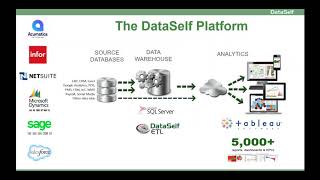
DataSelf compares Power BI and Tableau, arguing that real BI needs more than tools: data warehousing, ETL, and data marts. Their framework includes 5,000+ prebuilt reports and runs dashboards in under 10 seconds, claiming 2-17x lower cost than building from scratch.
Questions this video answers
12 years
More than 5,000
Under 10 seconds
2 to 17 times lower total cost of ownership
Chapters
Let's talk how data self analytics maximizes business intelligence, return on investment and provides long term peace of mind. First of all, when organizations start investing in bi, it's very common for them to take baby steps. And very often what I see is they get a analytics product like Power BI or Tableau. They have a very simple project initially, like sometimes a sales analysis, inventory analysis, maybe some kind of financial analysis, maybe some Excel files, maybe opportunity analysis. Well, anyhow, they take this analytics product, they connect to these data sources, they put it out and they get some fun and great results. They can actually build several reports and dashboards fairly easily. So baby steps they start, you know, little. They start with some product that they think will work well for them and they move forward. But eventually, you know, sooner or later, as decision makers get excited about this, they start to ask for more complex requirements. Just to give you some examples here, this particular dashboard combines together data from four different modules. It has open receivables, it has opportunities from CRM, it has orders to be shipped from the ERP typically, and also actual invoices. But if you're using baby steps, it's not simple to put it together. Let me show something also a little bit even more elaborate. This is another dashboard that is an example of a CFO dashboard and it combines data from 11 different data sources. You know, AR, AP, money in the bank, CRM. There's sales, there's financial, there's inventory, there's a lot of different data sources. If you're taking baby steps, this dashboard also is not obvious. Actually for these dashboards, if you're still going to the baby steps, it's likely it's going to take weeks worth of effort to put them together. You know, just the time invested is in the matter of weeks. And when you need to refresh them, get the latest information, sometimes it will be a manual process, or if it is automatic, it's going to run very slowly. Just the way it is. Bringing all of this data together, it is challenging. It can be slow. If you're not using the right BI platform, I'm just showing two examples. As you move forward and your decision makers are asking for more information from more data sources, it gets complicated. When you look in the long run as you refine and you improve your BI system, what you end up with is something like this. To get the maximum value out of your bi, to make it fast, to make it easy. What's going to happen in the long run is your organization or your BI project will be incorporating data from a Lot of different of your data sources. You know your ERP system. If you have a CRM, sure you're going to have CRM, Excel files, Google Analytics, field service management, social media, payroll, whatever you have. Capturing your data, most likely some pieces, if not a lot of pieces will go into the bi. And to make things easy and fast overall you will need some type of data warehousing framework, probably several data marts and data warehouses. But you'll need a data warehouse framework to do blending, to clean data, to vet data. And then you'll be using an analytics platform that. But when you started, maybe you chose something that was quick and easy and expensive. But eventually you have to decide for a platform analytics platform that will really do the job easily and efficiently. So these are pretty much the software pieces that eventually you'll have to really get great value from it. Now in order to put this together, you have to have expertise. You'll need people that know the data sources in find the fields and tables and how to link them to get the data into the bi. You'll need people that know data warehousing to really get this data and optimize it for faster and easier reporting. You need people that know the analytics platform, the administration part of it, security servers. That's usually more of an IT kind of role. And then you'll need business analysts that will be able to talk with the business people, gather requirements and translate all of those needs, talking with the rest of your team to actually set up the system to deliver value. So it takes a lot of different expertise to do the job. Some organizations, sometimes they're lucky to have a single person that knows and will be able to walk through all of these different areas and do a great job. Yes, if you're lucky, it's awesome. Most likely you're going to have many people involved in this project in the long run, taking care of different pieces of the puzzle. That's just how it goes. The good news is once it's well done, it is amazing how much value, how much speed you can get out of a system like this. Now, besides all this kind of expertise, to bring all of this together and to maintain in the long run, it just takes time. It takes time to connect the dots, to bring the different systems, to be able to blend them together. You might have simple requirements, you might have more sophisticated requirements. Sometimes multi company, multi currency, or your organization acquires different businesses and need to consolidate their data into your framework. It takes time to do all of these things, integrate systems and being able to deliver Information to the right person at the right time all takes time. If you build all of this from scratch or with a solution that starts with a very simple framework, these people you'll be involved, they're critical. So if you build this from scratch, be sure to retain your BI people in the long run because if you don't, it's likely going to get very bumpy. I've seen many organizations, the BI projects of many organizations to fail or to be very costly because people, you know, they have changing people over the course of the project. Sometimes the project was, you know, failed people left the company, new people came in, they start from scratch, it's a mess. So if you're doing this, be sure to keep these people around. I highly recommend hiring a BI consulting company to help you with this process. So even if you have internal people changing, these other organization will be able to complement and augment your resources. So in the long run will be less bumpy. But it's exciting if you do this. If you have the right pieces, the right expertise to put the pieces together, the business people will get so much value out of it. If you work with any of these popular mid market ERP and CRM systems. So the first good news is typically a good portion of your BI system will be pulling data from these systems. Many of our clients, pretty much the whole BI is centered around the ERP and the CRM systems and some Excel files. So the good news is, well, data self focus, specifically our business for clients and organizations that have these ERP and CRM systems and they need to augment BI around them. So we've been doing this for 12 years. We have an out of the box solution that includes a data warehouse framework using SQL Server as the database platform. So we have data warehousing data marts that are automatically out of the box that come with templates to connect to these source systems. We also provide our own extraction, transformation and loading tool that makes data warehousing easier and faster. We provide tableau as the analytics platform and it's the best in class. So it's an awesome tool. Now we've been building, refining this framework for these different data sources for over 12 years now. In these 12 years the out of the box has grown into a very comprehensive several reports and dashboards that today there are more than 5,000 reports Dashboard KPIs ready to go and they're looking at sales, inventory, financials, payables, receivables, purchasing services, opportunity analysis, tech support, activity analysis. There's a lot of things out of the box. So you don't have to start from scratch, you have something to build on top of. So in a nutshell, that's the software components that we add and to expedite the process. If you have any of these ERP interim systems, if you look from a high level benefit that we deliver, first of all, we use Best in class platform, again SQL Server for data warehousing and Tableau for the analytics component. Second is for these different data sources, we will dramatically reduce the time and cost that it takes to integrate them into ubi. But I really mean dramatic. If you don't use our framework, it's very likely it's going to take months and most likely years for your organization to bring all of the pieces, all of the pieces that you need from your pncrm. It just takes effort, a lot of effort with data self usually takes hours, maybe a few days, maybe a few weeks tops to bring them all together. So it's dramatic. Dramatic reduction in timing cost. Now we do this for a living and we have lots of clients that we have done a lot more customizations bringing the other data silos into the BI framework. We'll also reduce the total time that it takes to connect all the dots from bringing data sources as well as to setting up security framework to deliver to your different users anytime, anywhere. Now, from a team standpoint, because we have expertise in all of these areas that typically are required in this project, most of our clients don't have the need to hire more people. What if they have is only an extra person or so instead of having a whole team to build the bi? Actually many of our clients were able to free some of the people that were previously involved in it to do other jobs because our framework dramatically reduces the effort required to get the job done. So lower cost from a labor standpoint for your organization and as importantly, long term peace of mind for BI maintenance. Our framework has been designed to make it easier to be maintained in the long run. And from a team standpoint, we are here to support you. We can train your team now and in the future as required. We can augment your team as needed. And if your team changes in the long run, you just call us. We're here to help you maintain the long run and train new people as you get them on board. So we'll guarantee that you're not going to have disruptions that you're not going to have completed changes that will have to start things from scratch. So long term peace of mind for BI maintenance, if we look at those two dashboards that I showed before in Data Self, the effort to put them together pretty much is a matter of hours and the time to run these reports and dashboards is pretty much under 10 seconds and it's automatic. What we have learned over these 12 years is if a report or dashboard takes longer than 10 seconds to run, most likely most business people will not wait. People are not patient nowadays. So it's almost kind of a worthless reporting dashboard if it's running in more than 10 seconds. So we have optimized our system to pretty much guarantee that all reports and dashboards run below the 10 second mark and automatically. So in a nutshell, Data Self analytics. You know, first of all, if you watched the prior video, that will talk about total cost of ownership. You know, TCO. With data self we deliver 2 to 17 times lower total cost of ownership than the traditional approach. If you start from scratch or from a very small set of templates compared to ours, in the long run, we will deliver a 2 to 17 times lower total cost of ownership. We maximize business intelligence return on investment by pretty much reducing the cost dramatically and by providing a lot more value, a lot more quickly, so a lot more return in this investment and by providing long term peace of mind. We're here to support you as you grow and as your bi people change.










