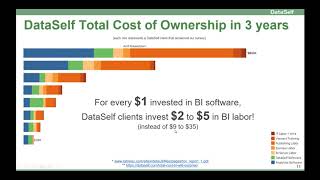
A 2017 analysis of BI total cost of ownership comparing Tableau and Power BI. A Tableau-funded survey of seven large organizations found labor costs of $9 per $1 software with Tableau versus $35 with Power BI over three years. DataSelf's own survey of mid-market clients showed much lower labor ratios by using a SQL data warehouse, an ETL tool, Tableau, and pre-built reports for common business systems.
Questions this video answers
November 8, 2017
Seven large organizations (three-year period)
Approximately $9 in labor per $1 software for Tableau, and $35 in labor per $1 software for Power BI (three-year comparison)
Tableau's total cost of ownership was about 29% lower than Power BI in that survey
Eight mid-market clients
Chapters
All right, let's talk about BI total cost of ownership and how a poorly selected BI software is a major culprit of high total cost of ownership. As I mentioned before, do not select a BI software based on its cost, but based on the right fit. And this will tell you in more detail two case studies among 15 different organizations to prove this point. So the first survey was done by Tableau. It was released by in August talking about the BI total cost of ownership in a three year period among seven large organizations. Well, this report came from Tableau and these seven organizations. Tableau was the right fit for them. And because of that, when they compared in the course of three years how much money was invested, they look between Tableau and Power BI being dark blue the labor and the light blue the platform, you can tell that in three years more, most of the cost investment was actually in labor. And because Tableau was the right fit for these organizations, what happens at the end of those three years was that for every single dollar invested in the BI software, the label required to get the job done was about $9 using Tableau and $35 using Power BI. The idea here is because Tableau was the right fit, even though Tableau is more expensive than Power bi, in three years, the ratio was significantly lower for Tableau. And at the end of the three years, the total cost of ownership of Tableau was about 29% lower than using Power BI. I'm not saying here that Tableau is the answer to your question. What I'm saying is be sure to select your BI platform based on the right fit. Because if you do that, you're going to be saving significantly in labor costs down the road. Do not select because it's free, because it came with your product, because it's a great product. That's not a criteria. Make the selections, learn the options and select the best fit. When we saw this survey from Tableau, we decided to do our own survey. We work with mid sized organizations, not with large Fortune 2000 companies. And we have hundreds of the deployments and we thought what is happening in our client base? So we did a survey and eight companies answered the questionnaires. So each line or each bar here represents one of our clients among hundreds. We have eight of them. It's a very nice representation because we have some very large clients that invest a lot of money in the course of three years, but we also have some very small clients that invest little money in the course of three years and a few others in between. So it's a great Representation of our client base. And on each bar the blue section represents the investment in the analytics software. Most of the time in Tableau, but some others as well. The green is how much they paid for our own software. And then the orange sections represent different type of services that they invested over three years. Now what happens is in our client base, for every dollar they invested in BI software, on average they invest from 2 to $5 in labor. Way less than the other survey there was from 9 to 35 in labor. So much less work involved for our clients to get value from this framework in three years, you might wonder why. Let's talk about it. If you do have any of these ERP and CRM systems that are very popular in the mid market, you know, Acumatica, Infor, Netsuite, Microsoft Dynamics, Sage, Salesforce, Most likely a big chunk of your BI project will center around them and bringing their data together. So with Data Self, what we have is we have a SQL Server data warehouse. We have our own ETL tool that eliminates SQL Server programming. From this data warehouse, we use Tableau as the analytics tool which is the best in class. We've been doing this for 12 years as a business bringing these popular data sources, source systems into the analytics platform. And as we learn what our clients reporting needs are, we started to build out of the box solutions. So today we have more than 5,000 reports, dashboards and KPIs from the source systems covering things such as sales, inventory, financials, payables, receivables, purchase order, sales order, CRM opportunities, tech support, contact management. There is a lot of things built out of the box. So as you start your BI project, you don't need to start everything from scratch or from a very small, simple out of the box solution. You start with a very comprehensive solution that will likely answer many of your questions right off the bat. And that's a major savings in time and money invested to get value out of bi. So that's pretty much in a nutshell, the value that Data self adds to the puzzle. If data warehousing, SQL Server is a good fit for you, if Tableau is a good fit for you, boy we have the best offer out there because we have expertise in the source systems, we have expertise in data warehousing, expertise in Tableau, and a lot of reports and dashboards out of the box with a lot of data sources to plug and play to your system to get value in hours or days instead of in the weeks, months and years to build the equivalent platform from scratch. That's In a nutshell, what datasouth does My final recommendation When Power BI is a good fit? Well, what I recommend is search for experts in Power BI to evaluate your needs. We can be a source to give you education because I personally know quite well Power bi, but sure to come consult Power BI experts to understand the possibilities and costs associated to get your needs covered. When is Tableau a good fit? Overall, if you're looking for a mature analytics solution, tableau is awesome. And if you're looking best in class analytics and you're willing to pay a little bit extra in license, Tableau is a great fit. When is Data Self in Tableau a good fit? Well, if you need to augment your BI team with a team that can be there to help you with training on source databases, data warehousing, Tableau, how to put them together and deliver value to your clients. We have a lot of expertise in those areas so we can augment your BI needs. We can even completely outsource them if you need them. We're here to support you in any capacity and at the end of the day it's time when time to value is critical. We usually when we look at a prospect and we are a good fit, we'll give you a time to deliver and cost to deliver and we rarely ask for more money. We're really efficient, we're really good at what you do. We can make this project very successful. You know when our solution is a good fit. I hope you found these videos informative. We'll try to keep them updated. If you have questions, if you want comments, Please like our YouTube videos, please subscribe to them make comments. If you have any question or comments, please feel free to call me. This is my cell phone, my email address. I love to learn from people out there what they're doing with PI. I love to share some of my learnings. I'm here to help the world move forward and if a right fit for you, I'll be super excited because we can help you get the job done very efficiently and in a fun way. Thanks for watching.