90% of Startups Fail to Execute. Here’s the Fix.
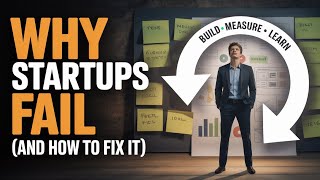
Joshua Fraser explains why 90% of startups fail: they build the wrong product for the wrong audience. The Lean Startup method fixes this by testing ideas fast with Minimum Viable Products instead of lengthy development. Dropbox, Instagram, and Buffer all used this Build-Measure-Learn loop to find product-market fit.
Do you ever wonder why 90% of startups fail even with smart founders or millions of dollars in funding? It's not because the idea was bad. It's because they built the wrong thing for too long for the wrong audience.
Most of the startups that I've ever built have been failures, although the company I built failed. Not because we didn't have a great business plan, not because we didn't build great technology, but because we didn't understand how to translate that plan into a product that customers actually wanted.
That's where the Lean Startup changes absolutely everything. It's not just a framework, it's a survival strategy for modern entrepreneurs. And at the heart of it, it is one of the most powerful loops we can use in our businesses. Build, measure and learn. So today I'm going to break down how to apply it in your business so you can stop guessing and start growing. The Lean Startup was developed by entrepreneur Eric Reiss based on the hard lessons from failed startups and the customer development teachings of Steve Blank. The idea is simple. Don't build a product, build a test. Instead of spending 12 months and half a million dollars building the perfect MVP minimum viable product, the Lean Startup approaches build something simple. A minimum viable product or an mvp. Measure how real users respond and learn and adjust before scaling. This mindset prevents wasted time, burned cash and silent launches. Even it helps you with your go to market at the end of the day. That's what we're trying to solve here. And so as Eric R. Has put it in the book, the only way to win is to learn faster than anyone else else. So let's look at the data. 35% of startups fail because there's no market need. Startups that pivot once or Twice have a 3.6x better user growth than those that don't. 70% of startup funding is typically spent on product and engineering in the first 18 months. Yet according to Failory, 90% of startups fail and 42% cite no market need as the cause. So. So that's when you go to market and no one actually wants your product because you over engineered it. You added too many features and you went to market too late, not knowing who your customer was going to be. Why? Combinator's top hundred startups overwhelmingly share one thing early MVP testing with feedback loops. The Lean Startup works because it's built to fail early so you can succeed faster. Here's how the loop will work in real life. Don't spend months perfecting a product no one asked for your Job is to build what the users are asking you for. Instead, create your minimum viable product or mvp just enough to test your assumptions within the marketplace. With real clients, think a landing page, a FIGMA mock up and a no code prototype. You can refund them if they pay. Just see if they get to the checkout page. And this is not a masterpiece you're trying to perfect here. It's just a hypothesis to understand what where can we actually build this business and how can we scale it? Number two is to measure. Get your MVP in front of real users, get feedback from them. Measure what actually matters. Do they actually use your product? Are they going to have good retention? Are they going to keep using your product? Are you able to convert them from a lead to an actual user? And then what is their feedback? Why do users drop off? What's working? What's not working? We need to measure the most important things. You can go back to the last video about North Star metrics and how important they are in a business and how they can help. Next is to learn we have to take that data from what we were measuring. Do we pivot and change direction? Do we remove things, add things? What do we preserve and double down on what's actually working here and why is it working? Or do we kill this idea and go completely separate? So I'm going to share with you guys a real life example of what happened at a stated we had this mission to collect and own all the public record data in the entire United states. We hired 30 engineers, we started collecting it from 3100 counties in the United States. And when we went to market we realized we'd only collected 70% of the data for the entire nationwide and our clients, that was not good enough for them. And so we had to pivot and actually purchase the entire nationwide data set to see where there were gaps and what we had collected and how to improve it now. We realized that the data that we purchased was actually a lot easier to sell and we pivoted and went down that path because our customers freaking loved it. And so the goal here is not perfection, it's just progress based on proof from what your users actually want. We knew they needed better coverage, so we pivoted and got them better coverage. Traditional startups often over build but undervalidate. The lean startup flips all that on its head. By saving time and capital, reducing risk, accelerating figuring out your product market fit, and building loyalty by co creating your product with your best users, you're not just launching once you're Launching like every single week. A great example is Dropbox testing before building the original 2007 Dropbox Explainer video was not what Dropbox is today. Dropbox didn't start with code. They started with just a video. Before building the product, they released a one minute explainer showing how it would work. The result was 75,000 signups in just a few a few days. They validated demand for the product. People needed something like Dropbox that was easy to use and they didn't have to write a single line of code. That is Lean startup in action Instagram the power of Pivot Instagram began as a bloated app called Bourbon with check ins, games, filters and messaging. But when the team looked at the user behavior, they saw that everyone was just posting photos. So they scrapped everything and relaunched as a simple photo sharing app. The the result 25,000 users on day one. A million users in two months. Acquired by Facebook for a billion dollars. Just a couple years later with a very small lean team of 30 people, maybe one of the most efficient acquisitions that's ever happened. Buffer another amazing tool. Their founder Joel launched a landing page with pricing tiers before building anything social media marketing tool. And when users click they saw the feature isn't ready yet but sign up now, we'll let you know. Again this is just validation to see if people want it. I'm working with a couple startups right now that haven't done this in their marketplace yet. I believe they over engineered their products, they sold their ideal customer profile, they closed the deal and then the client was basically like strip out 80% of everything that you built and it's like holy. We spent hundreds of thousands of dollars building this months and months and months and now you want us to take it all out. And that was going to market to late. So here's how you can actually apply this in your business today. Step by step, list your riskiest assumptions. Users want X, people will pay for Y. Build an mvp. Just to test that one thing. It can be a landing page, a demo or even a sales call. Define your success metrics up front. If 20% call to action, we move forward. If we're at 5% call to action, we accidentally move on. Repeat this loop over and over and over and over again. Measure, learn, adjust. That's it. Repeat that loop and you're good to go. If you compare this with the old school way of building a startup, it's go raise around spend 12 months building a product. Exactly what we did at a stated launch of V1 realize no one wants it. Exactly. What happened to us? It's the worst case scenario for a startup. If you spend 12 months of time building something that people don't want, you're going to punch yourself in the face after. Seriously, that's the worst thing that can do. It's literally just like the building trap. Keep building, keep building, keep building. Never actually validate and sell into the market. And before you know it, there's going to be a competitor that launch way faster with you with an MVP and you'll have no defensibility of your customers and or your revenue. But if you stick with the Lean Startup, you're going to get feedback before you go broke. That's the difference. So before we wrap this all up, let's talk about like some of the common traps you need to avoid. Don't confuse MVP with poor quality. It's just V1. It still needs to solve a problem. Don't build first and validate later. Talk to customers before you start writing code. Don't stop after the first cycle. This loop will never, ever end. If you're an entrepreneur, build, measure, learn, repeat. Makes a lot of sense, right? The lean startup isn't just about building fast, it's about learning really quickly. You and if you want to reduce risk, save time and actually build something that people want, this is the playbook. So let's recap. Start with an mvp, measure real behavior, learn from what works, and then pivot and persevere. I hope this changed how you think about building your startup. Way too often we spend too much time over engineering what we're doing, not actually knowing if the market is going to adopt what we have been building for such a long freaking time. And so I freaking love this. And you should pick up the Lean Startup by Eric Ries. It's an incredible book and I'd love for you to drop a comment if you are building a business right now. If you use this feedback loop within your business today, please reach out and let us know if there's anywhere we can help with it. We do it for everything. So let's build smarter together. Thanks for tuning in today. You can join us@school.com everyday entrepreneur or subscribe to this channel. We got 100 more business lessons. Feel free to take which ones might work best for you, but thanks for tuning in. My name is Josh Fraser. We'll see you in the next one. Thanks for watching Sa.
More from Joshua



How Secrets Will Ruin Your Life - Monday Mini Lesson #8 - Everyday Entrepreneur




Why Entrepreneurs Need Humility: Learning from Google, Facebook, and Silicon Valley's Evolution

Never say more than exactly what needs to be said - Monday Mini Lesson #6 - Everyday Entrepreneur


