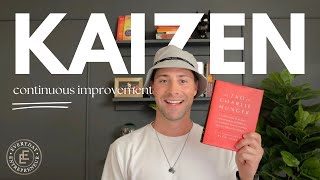
Joshua Fraser breaks down Kaizen, the Japanese concept of continuous improvement, into five principles for entrepreneurs: embrace excellence, adapt to change like the shift to Web 3.0 and AI, learn from failures, build a learning culture, and listen to unhappy customers. He draws on Carol Dweck's Mindset and Amazon's customer obsession.
Chapters
Foreign. Ladies and gentlemen, welcome to the second module in the everyday entrepreneur fundamentals. In the previous video I talked about one of my core values of always be learning. And in today's environment I think it's more important than ever, especially with the rapid innovation in AI and being able to use chat GPT in your business you always have to be learning and Kaizen encompasses this perfectly. So it's a Japanese word that translates to good change and improvement. And over the years a lot of lean methodologies and principles for business have turned it into continuous improvement. I believe it's an old word from Toyota. So let's dive right into kind of the five top principles of what Kaizen is. Embrace continuous improvement. Perfection is not attainable, but if we chase perfection, we can catch excellence. That that's from Vince Lombardi. Constantly seek ways to improve your business operation and personnel skills. You should always be learning. In today's environment it's so easy to learn with all the online tools that we have like YouTube and Google and AI. It's unbelievable how quickly we can learn and how much these can improve our day to day lives, but also make our business and just everything easier. And there's a book in here called Kaizen that you can go and read the second one. Adaptability is key. It is not the strongest of species that survive, nor the most intelligent, but the ones most responsive to change. We are in another technological change. There was web 1.0, web 2.0 and web 3.0. Today we're starting to see what web 3.0 can do. That's the AI. The easiest way that I explain to people of what Web 3.0 is is Web 1.0 was just readability on the Internet. You could go on Wikipedia, you could read a document. Web 2.0 was when you could start to search the Internet, but you could also produce content onto the Internet. Now web 3.0 is when that can be automated and augmented and changed and responsive to what you're inputting on the Internet and it can actually generate that for you. So all these words like generative AI that are coming out the new Sona soma video with ChatGPT that that can create minute long trailer videos just with a prompt is absolutely unbelievable. So you have to be adaptable to change no matter what's happening. Another great example of this was how did we all adapt as business owners through the pandemic? It was one of the hardest things we ever had to go through. We had to gather as much cash as we possibly could. We had to extend our Runway as long as possible, try and make our companies profitable. We had to make changes when the pandemic happened. We had to move out of our offices. So many things happened that we just had to respond to and adapt and continue working. And so being adaptable is absolutely key. The third one Learn from your failures. Well, I don't even like to call them failures in my business. I just called them lessons. What did we learn when we screwed up? And you need to be able to look at it that way because business is going to be 98% failures and 2% wins, maybe even 99% failures and 1% wins. So failure is simply the opportunity to begin again, this time more intelligent. Learn from your lessons and failures, document them, keep track of them, and anytime that you run into a situation, you can go back to them and it's an opportunity to learn and do it better next time. Mindset's a great book on this by Carol Dweck. Foster a culture of learning. An organization's ability to learn and translate that learning into action rapidly is the ultimate competitive advantage. Jack Welch well, in today's world you want all of your employees using chat GPT. Seriously, it can help with absolutely everything. And one of the things that I'm seeing is when I was growing up and building my businesses, I would always just tell people, did you Google it already? Before they would come and talk to me because I knew that I hired intelligent people, they could use Google and they could go and learn online. Before they came to me with a problem, they could probably already find a solution. So you really want to implement that flywheel of always be learning. The Fifth Discipline is another great book on this that I wanted to share. Prioritize customer feedback. If you're building a business, the most important people other than your employees are going to be your customers. We talked about that in the Core values like Amazon's customer obsession. Your most unhappy customers are your greatest source of learning. By Bill Gates Whatever you think of Bill Gates, that's a fantastic course quote. Whatever your customers are telling you are things that you need to be reviewing because they're talking about your business from a third party view. Sometimes when you're in the fast lane as a CEO, as an entrepreneur, you're going at a hundred miles per hour and you don't see all the things on the outside. And I see this all the time with entrepreneurs. So anytime that you get customer feedback about your product, about your team, about the way you responded in an email, seriously listen to that and then change it continuously be improving it. That is where you're going to make those incremental changes. And the more of them that you make, the better off you're going to be. Your business is going to be. Your life is going to be The Lean Startup is an absolute classic book. You can go to the library and see a list of a hundred other books that are amazing, but this one is an absolute must read for the business fundamentals. So just a quick review. Embrace continuous improvement. Adaptability is key. Learn from your failures. Foster a culture of learning prior towards customer feedback. Straightforward, right? If you guys want to see more of this, I'm posting all this on YouTube. You can follow me on Twitter, which I share a lot on. LinkedIn is another place that I think I just realized I have 5,000 followers and I've been posting on a few times a week. I also just kind of day to day post stuff on Instagram TikTok. I have no idea what I'm doing. I still call it the Talk Ticks, but it is what it is. If you want to see some funny videos, they're going to be on there. So thank you so much for tuning in today. Can't wait to see you in the next one. Sam.