Learn how to sound smarter when speaking business English by using concise, advanced vocabulary. The speaker breaks down techniques with examples from a tech CEO interview and professional contexts to help you communicate more effectively.
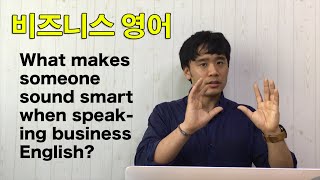
Splashenglish.com today I'm going to talk about business English. What makes someone sound smart when speaking business English? What makes business English a little different from an ordinary daily conversation? In a business setting, it's important that you know how to present yourself. You want to be professional, you want to be trustworthy, you want to be persuasive. So what are some of the things that makes someone sound smart? Could it be the vocabulary? Maybe they use a different set of vocabulary. Maybe it's that they have a good structure to their story. When they tell a story, they have a structure, they have a point. They know how to use formal and less formal expressions. Also, they know how to be impactful and be persuasive. And they know when to tell a story and when to present a list of facts. Today we're going to talk about the word usage. What I observed among these business people is that they use fewer words to express ideas rather than saying longer sentences. They use fewer words, fewer words that condense an idea. And when they use these words appropriately, they sound smart and intellectual. They make you appear intelligent, and you reduce redundancy because instead of taking longer words and sentences to describe something, you're using less words. And also you get to the point quicker. So let me show you an example. This is a recording of an interview with a tech CEO. So the interviewer asks him why he expanded his company to Korea. What are your thoughts on Korea and why Korea was the choice?
Sure. So the obvious answer is that I'm Korean American. And so, you know, there's sort of this, like, homeland attachment, I guess, to doing something here in Korea. But I think even more broadly than that, I think Korea has a lot of things going for it. The first thing is that Korea is a great testing bed for the broader Asia region. The mobile connectivity, the ubiquity of the Internet, the willingness a lot of the consumers and organizations to be able to test a lot of new technologies are unparalleled in a lot of other countries. And so that's something that we thought a lot about.
Okay, so let's go back and listen to what he said again and let me show you what's going on here.
Sure. So the obvious answer is that I'm Korean American. And so, you know, there's sort of this, like, homeland attachment, I guess, to doing something here in Korea.
For example, he used the word homeland attachment instead of saying, I feel nostalgic for my parents, my grandparents, home country. And then he goes on to talk about three things that he thinks Makes Korea interesting.
I think Korea has a lot of things going for it, right? So the first thing is that Korea is a great testing bed for the broader Asia region, right? The mobile connectivity, the ubiquity of the Internet, the willingness a lot of the consumers and organizations to be able to test a lot of new technologies are unparalleled in a lot of other countries. And so that's something that we thought a lot about.
He said the ubiquity of the Internet when he could have said the Internet is accessible everywhere. And then he used the word unparalleled, which is another word for exceptional or special. So using advanced vocabulary is helpful because they make you appear smarter. You can reduce redundancy and say the same thing in fewer words. They're useful when the person you're talking to shares the same background knowledge as you do. For example, two business people working in related fields, they can use advanced vocabulary, industry specific vocabulary to communicate with each other. And of course, there are also words and adjectives that business people prefer to use and I'll show them later. Also, people with medical professions working in related fields, doctors, nurses, they can talk to each other using these difficult words. And also in academic settings, professors, graduate students, etc. But using advanced vocabulary is not helpful when the person you're talking to does not share the same background knowledge as you do. So, for example, marketer and consumer. So when Apple marketed its product iPhone a long time ago, they said 10,000 songs in your pocket, right? Apple didn't say, this iPhone has 56 gigabytes, blah, blah, blah. Didn't get too technical because those are not the words that consumers use. But 10 songs in a pocket, consumers understand those words. Engineer and manager. This is a classic problem that I've seen in my work experience where a junior staff will go up to the manager or the CEO or the decision maker and come up with a budget. Or they're describing a problem they're having with the project and the engineers and technicians are so focused on the technical aspect. The code, the PHP code is not working, it's not integrating. But the manager and the CEO are looking at the bigger picture and they're using completely different words that describe the same problem. Next, teacher and student. For example, if you're a fitness coach, you don't go up to someone and tell them, hey, stop eating foods with a high glycemic index. People don't know what that means, but you can tell them, eat vegetables and beans and stop eating bread if you want to lose weight. So I have a word of advice. When you come across these difficult words and phrases, immediately translate them into your first language first, take them, look at them, and try to make a simpler English with that. Because you want to be able to use both the advanced version and also the simpler version, you need to use both. One is not better than the other. There is always time and place to use both each one of them. Now this is only just a glimpse of what you can do with Business English. If you want to learn more about business English, how to speak formally, how to use the right words, how to use industry specific words, then you can join my Business English class that I'm doing right now. So if you're interested, just go ahead and click the link below and I'll see you hopefully in class.