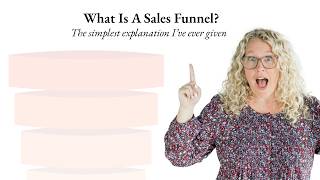
In this instructional video, Julie Chenell explains the concept of a sales funnel using the "yellow brick road" metaphor. She describes a funnel as a series of communication touchpoints—ads, landing pages (often offering free "bait"), email sequences, upsell pages, messenger bots, and text messages—that guide a prospect from first awareness to purchase and eventual loyalty. Julie outlines how different types of advertisements (paid ads, podcasts, social media, search) interrupt or attract potential customers, how lead capture works via a free offer in exchange for an email, and how email sequences serve as guardrails to build trust, re‑engage lost prospects, and introduce low‑cost introductory offers. She emphasizes the importance of product interlocking (e.g., shoes → shoelaces → socks) for natural upsells, and notes modern channels like messenger bots and SMS for reaching audiences whose inboxes are crowded. The video concludes with an invitation for viewers to ask follow‑up questions.
Chapters
Hey, Julie here. Today I want to talk to you about what a sales funnel actually is. It's a path. Think of it as the yellow brick road. The yellow brick road for people who have no idea who you are, the journey to discovering you, buying from you, and then becoming a loyal fan. In its most basic form, a sales funnel is a series of web pages, emails, texts, Messenger bots, basically lines of communication. In the olden days, a sales funnel would be something as simple as an ad in a newspaper leading to a phone number, which would lead to a call, which would lead to you going into that store or shop. So with the new way, we use webpages, emails, and texts to communicate all the deals and offers that we want to give our customers. So let me take you step by step through a really simple sales funnel. A sales funnel begins with an advertisement of some kind. Now this doesn't have to be a paid ad. It could be something on the radio or a podcast where they hear somebody's voice. Maybe it's a video or something that they've seen on social media, or maybe they've done a Google search and your blog pops up. So it's something that interrupts what they're doing. Either they are going out looking for it or it comes to them. So advertisements, you know, interrupt what we're doing, whereas Googling or searching is us actively looking for the information. And what do we find? Bait. Bait is usually something free, whether it's a course, a guide, a sample of some sort, and it's on a webpage where all we have to do is give our name and email address in order to get that free gift. That is the entry point to a funnel, and that's really just a webpage. Now, once we put our email address in, the next part of the funnel kicks in, and this is usually email. Emails start to fire off that give people an introduction to who we are and what we sell. Now in the more complicated funnels, when they put their email address in, they go to another webpage. This time they're offered something low-cost or introductory. And the good sales funnels work really well where the products kind of interlock with each other so it makes natural sense. Here's a pair of shoes, now get a pair of shoelaces. Now get some socks. So those are the good funnels. So you can continue to offer page after page where they click and they click and they click and they continue to buy more and more products. Now most people don't do what we want them to do, so the emails act as guardrails. They bring people who have fallen off of your funnel, out of your web pages, off the yellow brick road, and they bring them back to remind them of the things that you offer. Emails also act as a way to build trust and authority. Because usually if you've been interrupted by an ad and you have enough curiosity to click, you sometimes don't have enough trust yet to buy. And so that's what the emails do. And in recent days, things like messenger bots and text messages are another way to reach people. Some people have inboxes that are so crowded that they don't open their emails. So we're using new methods to always reach our customers and to remind them that we exist and that we can serve them. So a sales funnel is literally just an online version of the yellow brick road consisting of webpages, emails, and texts. And we use copy or we use video to communicate our message and get our customers to buy. I know the best conversations happen after the camera stops rolling. So if you have any questions about Sales Funnels 101, leave a comment below and I will be sure to get back to you.