Mometrix MDA Campaign with Jay Willis mometrix.com/mda

Jay Willis, founder of MoMetrics, shares his 8-year-old son Benjamin's diagnosis with spinal muscular atrophy and how a Biogen spinal-cord injection has halted disease progression in trials. MoMetrics donates a percentage of study-material sales to the Muscular Dystrophy Association.
Chapters
Southeast Texas Weekly, brought to you by the Modern Vein Surgery Institute at Previty Clinic for Surgical Care.
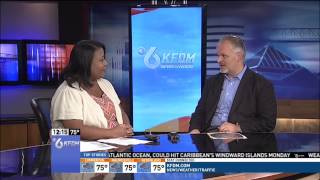
Hi there, I'm Mary Sturgill. Welcome to this edition of Southeast Texas Weekly. This week we talk to a father who is doing all that he can to help his child and others who suffer from muscular dystrophy, and a local author who's written about a fascinating woman Mothicket, and the Letcher Theater has an amazing season on tap. We have a preview of that for you, and a young barrel racer who is a world champion. We'll talk to her about that top title. But first, Jay Willis and his company MoMetrics raises money for research for the Muscular Dystrophy Association. Welcome, Jay.
Thank you, Mary.
So you have a very close tie to this disease. Tell us about your tie.
Right, so we have an 8-year-old son, Benjamin, who has a form of muscular dystrophy called spinal muscular atrophy. Okay. And when he was about 2 and a half, he was diagnosed. And it's the condition— his brain works great. In fact, he's a very bright boy, and his muscles actually function fine, but he eventually loses communication between the two.
Okay, so some people describe it as, you know, your brain is going at normal pace, but your body is like way behind.
Right, right. It's essentially just the little carrier signals that go between your brain and your muscles. Those eventually die off.
Okay.
Because there's a specific gene that his body doesn't have to produce a protein that feeds those little—
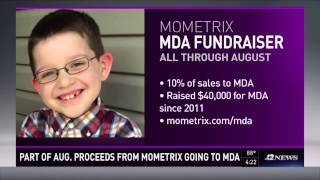
Gums. Yeah. And so this is a picture of little Ben when he— how old is he in this picture?
That's his newborn picture, actually. He was still in the hospital when we took that one.
Yeah. How old was he when you found out that he had this disease?
He was 2 and a half, about 2 and a half.
What kind of— what did you notice about his progression that kind of clued you in that something was going on?
He's actually our first child. We have two daughters as well now. But two different pediatric nurses approached my wife at different points in time and said, "Hey, he's just— there's something different about him." And of course, being first-time parents, he's perfect. I mean, we weren't willing to accept that there was something wrong for a while, but over time we eventually decided there may be some truth to it. So we took him in, and then sure enough, they diagnosed him with spinal muscular atrophy.
What is— what's the process for that? How long did that take from the time that someone told you something is wrong with your child to the time that you knew what it was and how you could start getting treatment?
The neurologist was pretty confident that it was— they actually were— had it narrowed down between Duchenne and spinal muscular atrophy, which are both types of muscular dystrophy.
Okay.
They just weren't sure which one.
Right.
They have a test that can eliminate Duchenne within about 30 minutes after the blood test. The other though, the spinal muscular atrophy, it takes about 6 minutes, I'm sorry, 6 months to get the results back. So it takes a while. There's probably 2 months of time.
[Speaker] That had to be extremely difficult waiting just to see if they were right or if they were wrong. Did you have some indication at the beginning that, oh, we're probably going to be dealing with this, we need to start getting ready for this?
[Speaker] Once they confirmed that it wasn't Duchenne, we were about 95% sure that it probably was spinal muscular atrophy. So that's really the point where we're pretty confident that's what we were dealing with.
Right. How is he doing today?
He's doing well. He, you know, when I was on your show back in December, he was able to actually get himself up from bed, walk all the way across the house all by himself, completely unassisted. And just probably since about May, he's now only able to take maybe 2 or 3 steps and that's it.
How does that affect him in his daily life? Can he play with other kids? Does he go to school?
It is a challenge. We actually homeschool. He goes to Veritas Classical Academy 2 days a week, and then we homeschool the other 3. But certainly it's changed a lot. I mean, we can't— we don't feel comfortable leaving with babysitters a whole lot because then they have to lift up on him, and he's not comfortable with other people taking him to the restroom. Things like that are a little more challenging, certainly now that he's less mobile.
Yeah.
And so it really affects a lot of different areas of life, but, you know, like we continue to tell him, it's not It's who you are on the inside that really matters most. This is just a shell.
Exactly. And so he's at the age now where he's beginning, you were telling me the other day, he's beginning, he understands what's going on and he can help you in that, in his care, in talking about it, I guess.
He's very aware, a little too aware sometimes. We can't really use code words anymore for anything, you know, as parents sometimes we can't really do that anymore because he totally picks up on it. Yeah, he's very aware of his condition and his limitations, and he's able— he's getting better and better at communicating, "I need this." Yeah. And sometimes, you know, he can ask for things that maybe he shouldn't ask for. Right. Sometimes he can rely on a little too much, but he's learning with that too.
But there's hope in research, and we have a website I want to pull up right here real quick about the research. We have a few more minutes left to talk about this. You're raising money, but specifically the money that you and your company raise goes to research, and there's one of these On the left, that's a list of research studies that are being done, and the second one on this list you say is promising. Tell us why.
Right. Of course, I'm not an expert. I'm not a scientist, but I do try to follow the research as much as I possibly can. The second one on the list, you know, a lot of these might have some side effects, but this particular one, the one by Biogen, it's an injection to the spinal cord, but it actually stops the progression. It's something they'd have to have every 6 months, but it effectively stops the progression of the disorder, so it won't get any worse. And in talking to a lot of parents who are actually involved in the clinical trials, several of the children who are involved in the trials are actually showing improvements. So they can now do things they lost the ability to do, and now they're regaining the ability to do those things.
Okay, so people can help you. I'm going to switch computer websites here. All you have to do is go to MoMetrics. Www.mometrix.com/MDA. And you'll see Ben's story right here on the front of the page. And how do they, Jay, how do they help you?
There's several different ways. Of course, you can read about Benjamin and his story there. Our company, Mometrix, about for the last 4 years now has donated a percentage of sales that go through my division to go directly to MDA to help fund neuromuscular research. So if you, you know, we offer study materials for over 1,000 different standardized exams like the ACT, SAT, GED, STAR exams, pretty much anything you can think of. So if you or someone you know has a standardized exam coming up, you can at least go check it out, see if we have something to help. Or there's a place right there where you can donate directly to help MDA. And if you don't have any need for study materials, just donate directly to them, even if it's $5. I spend, I waste $5 on so many different things.
Starbucks every day.
But if a lot of people donated just $5, then that would go a long way toward helping out with research. Or at a minimum, you know, if you just share shared it. You know, there's a place on the page where you can share it on Facebook or LinkedIn or Twitter. Just share with other people, right? Because you never know who might help.
Absolutely. Jay, thank you so much.
Thank you, Mary.
I appreciate it. All right. Again, if you would like to help, just go to MoMetrics website and you'll get the information there. And of course, share. And after the break, we talk to a local author who writes about a fascinating woman. We'll meet Michael Gracie, and he introduces us to Ma Thickett. That's after the break.