ALERT: Multiple nations to storm Gaza with aid?
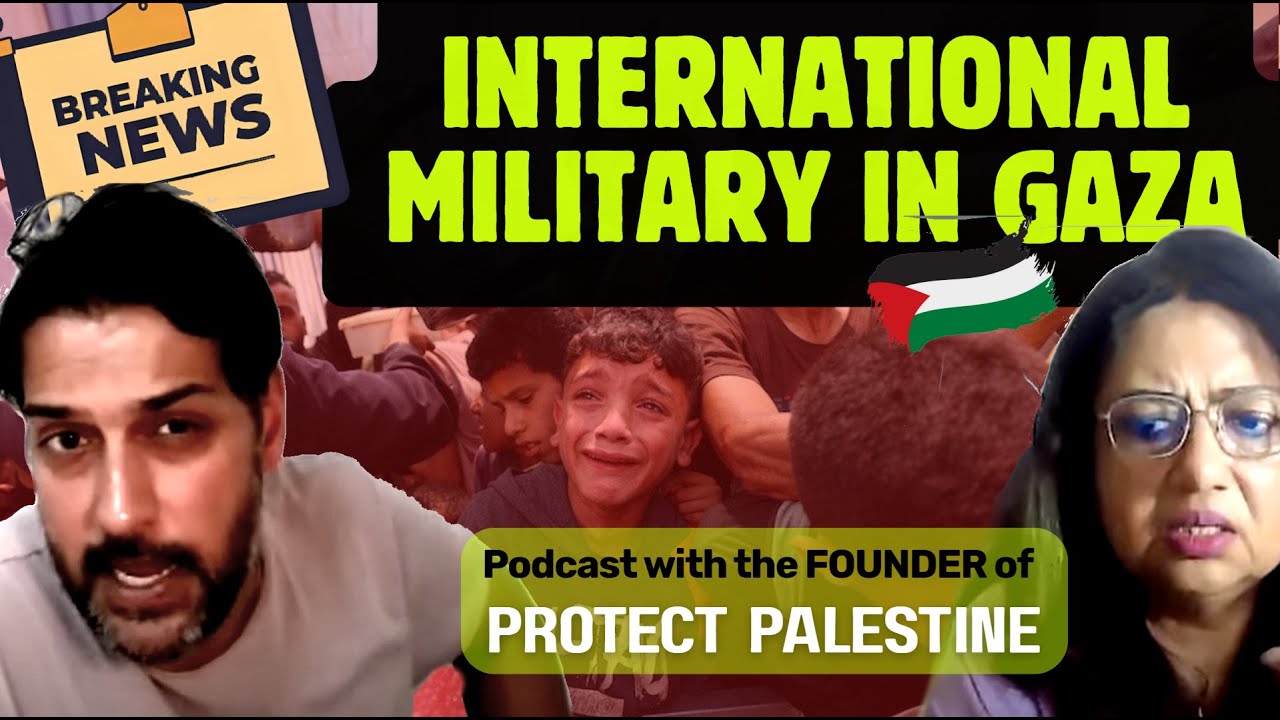
This content was created by Kaberi Dutta Chatterjee. This content was uploaded by Kaberi Dutta Chatterjee. This is a YouTube interview titled "ALERT: Multiple nations to storm Gaza with aid?" (uploaded 2025-08-13) in which an interviewer (labelled SPEAKER A) speaks with Usman, identified as the founder of Protect Palestine and a barrister. The conversation is an activist/political discussion about the humanitarian crisis in Gaza, arguing that existing diplomatic and legal mechanisms have failed and advocating for direct interventions (no-fly zones, naval convoys/ flotillas carrying aid, and protective coalitions of states such as members of the described "Hague Group" like Cuba, Colombia, South Africa, Namibia, Malaysia and Sierra Leone). Usman critiques U.S. support for Israel, discusses legal obligations to prevent genocide, dismisses sanctions/ boycotts as insufficient, and outlines the Protect Palestine campaign’s plans and calls for public support and mobilization.
Chapters
Hello viewers. Today we are here on a very, very serious and very, very sad note. We all must be knowing what's happening in Gaza and we cannot. we cannot, as civilians, as conscientious civilians, cannot stay away from this anymore. So we know what's happening in Palestine, right? And the kind of genocide that is happening in with the children, that is unacceptable completely. So it can be a political war, you know, all the countries are in war, but what is this happening in Palestine? Today I have with me Usman, who's the founder of Protect Palestine, and he's a barrister and he's operating, um, on behalf— he's talking to us on behalf of Protect Palestine, and he's going to let us know exactly what is happening now. Why are so many countries, so many states getting involved in this? So Usman, the first thing I want to ask you is, how are you going to get involved, uh, militarily into Palestine without, I mean, with any, without any official intervention or any official permission from UN?
Well, states have militaries. States all around the Mediterranean, around the Middle East have militaries. And states also have an obligation. It's not just that they have an option, they actually have a legal obligation to prevent genocide. What we've seen for the last 22 months is that the judicial and diplomatic mechanisms to stop genocide have failed. There had been efforts to stop the genocide via the International Court of Justice. They made orders that Israel must not go into Rafah. That was in May 2024. They went into Rafah and they carried on exterminating people. There was an order that they ensure the unhindered flow of aid. That was a legally binding order of the International Court of Justice. And one year later, we see absolute starvation, emaciated children, People who will likely never recover from the damage that's been done to their bodies as children. So we have a state that is fascist in its purest form. It considers itself above the law, and it defies the entire international community and is committed to the genocide, the extermination of the Palestinian people. This is not something new. That's something that they have been committed to for decades. But we are now seeing it in full force, the unrestrained use of the worst forms of violence and massacre in front of us. So we have reached a clear point here that there has to be a mechanism to stop Israel from doing what it's doing. We have hundreds of lorries of aid just around the borders of Gaza. And yet just 2 kilometers on the other side of the wall, we have children, emaciated children dying from starvation. Not, not that there is famine, but because they're being starved to death. It therefore, it is common sense that that food needs to get to the children, that there needs to be the right medical services get, get into those children immediately because they are being killed dozens by the day, children now. Israel therefore has to be physically stopped.
Yeah.
So the question was, how do we get this without UN backing? Actually, the legal obligation already exists. States already have this legal obligation, and they have obviously a moral obligation, and they have a humanitarian obligation. It is just a case of political courage. States need to have political courage. Political courage can come about when there is public pressure and mobilization. And that's what we're seeing now, demand for a military intervention. And there are front runners in that political landscape of states that may do this. Things are getting closer towards that as a reality every day. But we have to make sure that it is Sooner rather than later, because it should have happened yesterday.
Okay, so why do you think you would jump into military intervention? I mean, weren't there other options before this? Do you try out— did the— do you think the state should try out other options instead of jumping into military intervention? And what kind of military intervention are you talking about?
Yeah, I mean, let's talk about all of the options.
Yeah.
So we have different diplomatic mechanisms that can work. That is primarily the function of the United Nations. You have the vast majority of the world recognizes the State of Palestine. Okay, there has been—
you could—
you wouldn't be able to count, it's countless resolutions in the United Nations General Assembly, in the International Court of Justice rulings and advisory opinions, clear, even states, I think, except for Israel and the US, recognize the Palestinian right to self-determination. That is the extent of diplomacy, right? That, you know, that you could persuade them through the mechanisms of lobbying and putting pressure through diplomatic channels. That has been what Palestine has been doing for decades. That is what the Palestinian administration, which is essentially now complicit in the genocide, has been wrangling themselves in and utterly failing to actually stop the so far unopposed march of the apartheid state that is annexing further and further land. That's the diplomatic route. And then you can talk about legal routes. I mean, Israel has breached every single law in the book, from collective punishment, starvation as a method of warfare, indiscriminate bombing, even the use of nefarious forms of artificial intelligence to commit genocide. You know, every law in the book has been torn apart, right? So though— so then we can move on to boycotts and sanctions and things. We have seen enormous mobilization across the world for things like boycotts. But as consumers, we're very, very limited as to what we can actually do by not buying certain products. When you are dealing with an unhinged fascist entity that is intent on killing everyone, you know, it's not like they respond to commercial pressure, actually, because they actually have an unlimited tap of resources from the United States. That's all that they need commercially. So, you know, then a few companies going bust in Israel isn't going to change their ideological course, which has been extermination since the inception of Israel. So these mechanisms, we've seen how they failed, because we've seen, you know, the International Criminal Court issued arrest warrants for Netanyahu and Yoav Gallant. They would have been able to travel to states that actually have the International Criminal Court as binding, legally binding in those states. And yet he's just visited them and nothing happened. So you have a total impunity matched with an ideological commitment to extermination. It therefore, it's just simply logical that they have to be stopped. So if we want to stop Israel from bombing Gaza, we have to stop Israel from bombing Gaza. Are we talking about a no-fly zone? That's what we're talking about. We're going to stop the bombing happening. This is the basic—
Do you think the US has a huge hand in this whole thing? Because they— he's got so much immunity. It's because the US is supporting it. And why would the US support it in the first place?
The US has been— the US Democratic institutions have been entirely captured by Zionist lobby and Zionist influence. That is across the House of Congress, across the Senate, the presidency, of course. You can't get elected. I mean, I'm not exaggerating. AIPAC celebrate and publish these facts themselves. They say you can't get elected Unless we support you. And they show that statistically. They say every single one of their candidates is the candidate that won in a certain election cycle. So you have an absolute capturing— you know, this is a deep flaw in the US American democratic system. It's bought. It's totally controlled by wealth. And unfortunately, that— what does that buy you? It buys you vast amounts of propaganda. to make the American people believe that it is the Palestinians who are the terrorists when the evidence is, you know, just speaks for itself.
Hamas is the part of the Pakistan, right? And Hamas, we've seen a history of their terrorism way back for a very long time, for a very long period. So like Canada has asked for Hamas to surrender, if Hamas surrenders, then Canada is going to protect, like, support Palestine. So do you think that should be the course of action? If Hamas surrenders, we can— a lot of countries can actually get involved in this.
Look, any— if we read any book about colonialism, the first thing we see, I mean, it's so obvious. How do you colonize a people? You divide and conquer. And what you do is you make a certain group fear the other group. And what you're actually doing is annihilating both and dominating both. That is how Hamas is vilified. When it is actually, I mean, it is, it is inextricably linked to white supremacy. If you look at a country like the UK, it is obvious to anyone that if a foreign force annexed Cornwall, it is obvious to everyone that the RAF and the paramilitaries would obviously defend England. Goes without saying.
Yeah.
And when— so if you don't accept that paradigm, And then you immediately just place the same paradigm on Palestinians. You have a foreign force that illegally annexes a huge part of your land, says you are no longer welcome here, we're destroying your communities, we're going to execute a vast number of you. It is obvious to any normal society that you will respond and retaliate. And so that is when they say Hamas has to surrender. What they mean is you must never resist our orders. That is how colonialism works. It's like it's you, you put down your weapon and we won't chop your head off, and then you've got no resistance left. That is how they dominated. So of course Hamas should never put down their weapons. That is to, that is to accept slavery. And it is very direct. I'm not going to use that word exaggeratingly. That is exactly how apartheid works. They are subhuman compared to the Israelis in the Israeli psyche. So for as long as you know, the whole thing about Hamas surrendering is just a neo-form of colonialism. It's exactly what Canada, how Canada was made, how the US was made, their whole history. We read books like Bury My Heart at Wounded Knee, where we learn about how time, it was just a series of duplicitous lies and annexation and then massacres and constant divide and conquer. That's— yeah, look, this is, this is when we say we understand that it's imperialism.
Yeah.
You had, um, a group of people who were massacred from their land, thrown out, and told that they, uh, never allowed back. And then a different group of people come and, um, take take all of that land, uh, and insist that it was always theirs.
Yeah.
Um, that's imperial. I mean, that's settler colonial. That's what the British did in Australia. I mean, what the Spanish did in South America. That's— this is the continuation of that.
Yeah, yeah, yeah. Okay, so on that note, I just want to ask you, which other countries which, uh, who are, you know, like, um, joining the— you're asking them to join the Middle East event?
At the beginning of this year, a new political formation was created called the Hague Group for Palestine. And it was 8 states. They are Cuba, Colombia, I believe Guatemala, South Africa, Namibia, Malaysia, Sierra Leone. And interestingly, These are states that, you know, have all been colonized and overthrew colonization. And they formed a political group that was committed to the liberation of Palestine.
They know the pain of colonization. They know the pain.
They know the pain, right? And not only do they know the pain, but they've liberated themselves. Think about South Africa, the struggle against— you think about it psychologically. They realize that they could beat the colonizers.
Yes, yes.
And they see the merit in that and taking back what is rightfully yours. So they are leading in terms of political groupings on Palestine. We have been lobbying them to commit to a protective force. And this is unfortunately where politics comes in, is that states will then say, well, why don't we broaden this out to a wider group. And then when you have a wider group, those wider groups tend to diminish what the purpose of the protective force is. And so you'll have a country like France saying, yes, okay, let's send some protection, but it's there to stabilize the status quo. We just need to stabilize. And the stabilizing the status quo is a rampant apartheid state.
Yeah.
So it needs— this is why civil society is important, because it needs a strong public demand that actually, that's not what we're talking about. We're talking about enforcing international law that Israelis have to evacuate from the occupied territory according to the International Court of Justice's advisory opinion, followed by the UNGA's resolution giving them until September 2025 to evacuate. That's international law. So they should be evacuated, forcing them to evacuate from Palestine. They have to establish a no-fly zone. This, we need to be clear that this is a genocide that's being stopped. But when we go to the UN, you will find very, very meaningless words basically being used in order to try to make it look like the whole world is supporting it. And then several months later, perhaps the state does something based on that, where in reality, they actually have the ability to go now. We need to, we need to realize we have the power to go now. There's a legal basis to go now. So we shouldn't give too much credit to the UN systems. I'm very, very skeptical of the UN. I used to work as a lobbyist on UNGA resolutions.
On this, this is a big big elephant in the room, that is the US. So do you think this kind of military intervention would kind of— the US would be— they would say we are forced to attack Palestine or forced to send weapons to Israel to attack Palestine. So will they be instigated to attack Palestine because of— based on this? And Do you think there's all these countries who are getting involved in the military intervention, will they be strong enough to fend US if US gets involved in this?
So yes, very important question. That is exactly what the US will respond. They— you can expect Trump to say, I'm going to whack 500% sanctions on any state Right? That's how— that's his playbook, right? Um, now here is where we really realize that the US imperial beast is not as strong as it once was, and, and, and people are not as reliant, uh, on it as they once were. And there is talk— has been going on for a couple of decades— about a multipolar world. Um, that can only come about in, in material terms if there is a defiance, a moment of defiance to the US hegemony. And what braver and more powerful way to do that than having 8 or 9 states— imagine states like Malaysia, states like Indonesia, states like Algeria, states like South Africa. These are not small states. Now, if 9 of them were to work in concert and say, All right, let's try this. And let's send a navy. Is Trump going to be able to get away with putting 500% sanctions on 9 big countries at the same time? And it's a show of strength for those countries to show they're willing to defy it. And I think it will help unravel the US myth that they have absolute control over the world.
What about the larger countries who are also, also faced colonization, like India and South Africa? India is, I know, is an ally of Israel, so India will not be able to, you know, intervene in this. What about South Africa? And what about the other bigger countries? Like, why don't we take a larger—
Well, it should be a country that we know is politically committed to the liberation of Palestine.
Okay.
Because when, when and if this military intervention happens, we're not looking for an occupying force to come in and lay some claim to something in Palestine. We need a state that is spiritually, politically aligned to the Palestinian people. So yes, South Africa, yes, Namibia, yes, Malaysia, yes, Colombia, yes, Cuba. You know, many of these states, Algeria, have knowledge of beating imperialism and have militaries, actually. I don't think Israel would withstand— look, think about it from their perspective. They've already got quite a fragile makeup of their demographic composition. 10 states turn up to Tel Aviv with 100 Navy vessels saying, we're here to stop the genocide. What kind of effect would that have on the Israeli people? I think if we want— if you're hoping that there's going to be some implosion of their society that stops them from doing what they're doing, the kind of thing that would do it. So I think it's very possible. In fact, it's necessary. It's not— It's not even— if we're thinking about stopping the genocide, we shouldn't think about is it possible. We have to realize that it's the only way. It's the— Israel is committed to genocide. So there is no other way, actually. And if it's the only way, then if we say we want to stop the genocide, then we have to make that a reality. That's the Protect Palestine campaign.
Yeah. So in the end, I would like to just, you know, ask you, What kind of a major intervention are you looking at? And how soon are you looking at? What kind of— is it a physical, or is it an AI intervention, or is it a digital, like cyberattack? What kind of thing are you looking at?
Well, I think, as I described, the most obvious way would be for navies from states to be sent to through the Mediterranean heading to Gaza carrying aid with the mandate to open the gates ultimately, that they are there to get on the ground. So, so, so look, it's laying the gauntlet down. Would the IDF suddenly open fire on 10 states It's a it's a bit of game of dare, really. Like you there needs to be a moment where you look each other in the eye and say you're you're stopping. That has to happen. So you would expect these navies to turn up and say if you stop like we will we're bringing we're here to bring aid. Okay, we're not here to declare war on Israel. We're here to fulfill our obligation to prevent genocide and. Stop the starvation of these people. We're bringing aid. You get in our face, though. If you get in our way, if you shoot at us, you're making a declaration of war against us. The way that it could happen is, look, our position is this should have happened yesterday. Yeah, it should have. So let's, let's, let's just talk about what's realistically possible. There's a global Sumud convoy of— they're intending to have 1,000 ships. Civilian ships bring aid to Gaza like the flotilla had done that got— that is going to be a standoff point. Imagine if that happens, and there's going to be 1,000 civilian ships. Israel has to either do 2 things. Either it sets up a blockade, in which case this is a tense standoff moment, at which case that is the ideal— why don't I say ideal? It would be inexcusable For states not to send support. That's what we hope will happen. And that would be, that would be a very, very tipping point moment for the people in Gaza. So, but look, the truth is, by the way, we already have a state that is taking military intervention. It's Yemen. Yemen's been since the beginning clearly in a league of its own and has said, you know, if we are allowed to go to Palestine, we will turn up. We just need safe passage. We get there. We will liberate Palestine. They're clear on that. So it's not like no state has done this. In fact, Hezbollah did this. You could say Iran did this, although perhaps more for its own protection rather than for Palestinians. But look, it's— it just takes other states to have the same attitude, and ideally a coalition of states that are principally committed to implementation of international law as well.
Thank you so much for your time, Usman. It was Great speaking to you and trying to understand the military intervention that is going to going to. They have declared a military intervention to bring in the aid to the starving children. I don't think any country should have any problem with that since they're not there. The children are dying on the other side of the border. They're starved to death. So I don't think anybody should have any problem. Problems when they— when the military navies bring aid to the children. So viewers, if you are watching this, please support Protect Palestine. Please support. And, uh, I'll, I'll be sending the link. I'll be giving the link below. And as many people— if we can— more people can support this movement, the more children can be saved in real time. Thank you so much, Usman, for your time. And I hope so much. I hope everything turns out well for you. I really pray that. Thank you.
Thank you. Thank you.
More from Kaberi


Real Life #blackmirrorvibes | Gen Alpha Will Be The Dumbest Of All Generations!


My 1995 Planchette Story | The Science of Ghosts | Author Kaberi D. Chatterjee's story

60-Yr-Old Breaks Down To "Earth Song" | Fan From MJ's Cassette Era #michealjackson


#micheal #michaeljackson I can't believe we actually saw these created in real time!