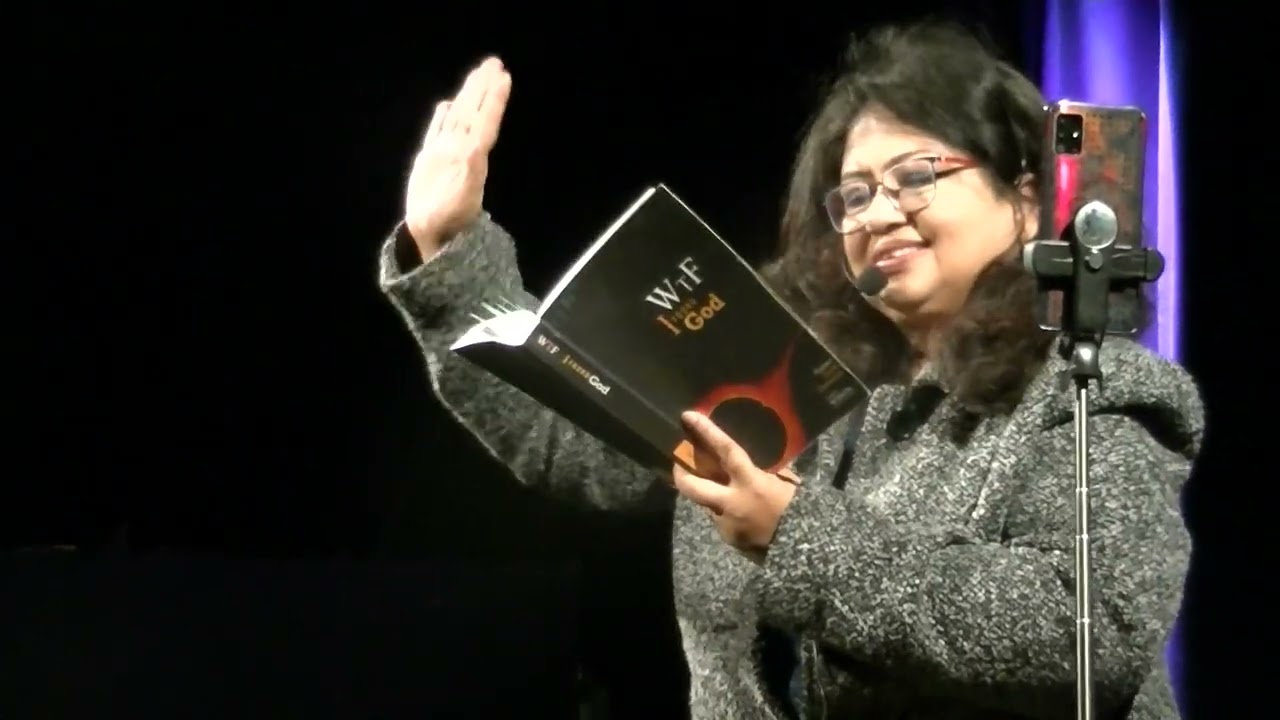
In this opening monologue at the launch of her book WF I Found God, Kaberi Dutta Chatterjee recounts her journey from a hard‑nosed news desk journalist to a semi‑retired author living in North America. She explains how a curiosity‑driven habit of consuming a mix of scientific, quasi‑scientific and pseudo‑scientific material on the internet sparked the idea for a 400‑page investigation into religion. Drawing on her childhood in Kolkata—a street where Hindu, Muslim and Christian communities lived side‑by‑side and celebrated each other’s festivals—she describes a carefree, syncretic upbringing that treated religious rituals as cultural events rather than doctrinal commitments. After moving to Canada, she encountered people for whom religion was tightly bound to identity, prompting her to study Hinduism more seriously and to question the origins and purposes of all holy books. She raises classic theological dilemmas—the apparent absence of God in the cosmos (citing Voyager 1), the problem of evil witnessed in wars and atrocities, and the paradox of a supreme power overseeing a universe teeming with suffering. Throughout, she maintains a personal, reflective tone, expressing both reverence for a higher power and skepticism toward organized religiosity. The monologue serves as a personal and philosophical prelude to the book’s deeper analysis of religious tenets, authorship, and the human need for a supreme guide.
Chapters
And so, yeah, I'll just make it this way so that you can see. Okay, you can see the audience a little bit. I can show you the audience around. Still have people coming in because there's a huge construction and people haven't been able to arrive as yet. But I have to start on time. So, you know, all of you who are on the way, you can start watching the live and I'll repeat it for you. But So I have to start right away. So I started writing this book. When I started writing this book, it was just a fun recording of whatever I learned after having semi-retired from being a hard-nosed news desk journalist and was welcoming the change of operating 2 fun businesses from home and leading a reasonably peaceful but boring life in North America. So due to a curious mind, Through various scientific, quasi-scientific, and pseudo-scientific knowledge floating in the internet sphere all around me, I found a lot of contradictory and thrilling concepts that I wanted to share. So I started— when I started writing this book, I think I need to do— I was born in the world— a lot of us were born in the world where blackberries and apples were just fruits. Web was a thing that tiger's— the spider's pun, and net was something you caught a fish with. Hardware was hammers and saws and nails you worked with, and software was never heard of. Rams, spiders, Blu-rays, bugs were all living creatures, some of them even creepy and crawly. I do not know, I don't understand how they made their way into textbooks. Our generation began with a simple radio and rotary telephones, where phones didn't have any caller ID screens and we were free to make any number of crank calls. Then we witnessed the magical invasion of the black and white television, complete with its giant crate and sliding door, giving it a dramatic stage-like effect. It made its grand entry and perched in a pivotal role in our living rooms for life. Even today, larger and larger screens, getting slimmer and slimmer over the years, These TV sets are incontestably the most important device in our lives after smartphones. I had kind of liked our generation. We believed in ghosts, believed in UFOs, Santa Claus, love, and miracles. It was a pleasant state of mind to let someone else take the onus of your existence. It was relaxing to let your imagination construct a guardian angel for yourself. I still do. In fact, I leave a lot of decisions to God and gods. There are 2 types of gods. 2 gods which I have mentioned in my book, one with a capital D and one with small d, that's personal gods. Of UFOs, I am also still a gleeful believer. Born a Hindu, raised in a Hindu household, we never took religion seriously. In fact, we lived in chaos. When I was small, the street in front of my house in Kolkata, India was categorically divided into 3 parts. The heritage yet decrepit Hindu Bengali residence area, complete with Baroque takutdalans, which are like constructions and stages where the idols were worshipped. The multicolored arch-shaped Muslim houses and mosques. And stretching into the last part of the lane were the Gothic structure, deep green wooden stair buildings that were inhabited by the Christians. So as children, we had the best of all 3 religions and often forgot which religion we were supposed to follow. During Ramzan and Eid, the same street would be dressed up with lines of colored triangular flags fluttering in the autumn sun. Young boys would run up and down the street wearing skullcaps and vibrant new clothes. Right after the flags begin to tear— start tearing, and the young boys have made airplanes out of them, strings of mango leaves and colored thermocol balls would be hung over the street heralding the advent of Bengal's greatest festival. What festival? Festival, the Durga Puja. Right after that, during Christmas, the same street would be illuminated with huge paper starlights, balloons, and decorated with the statues of Jesus and Mary. I grew up hearing the litanies of both Azaan and Mahalaya permeating in through my sleep and learned Christmas carols and hymns from childhood in the Protestant school that I attended for 14 years. They were just festivals for us and not any fervent religious occasions. We bought new dresses and ate awesome food for almost all the occasions. Biryani for Eid, Nahum's cake for Christmas, completing our celebration with a small Santa Claus and an artificial Christmas tree, and at least half a dozen new dresses for Durga Puja. I read from Feluda to Naroda. and learned about the scientific contributions of Bose to Higgs. I only believed in humanity. I never knew religious differences. So I was caught unawares in Canada when a Christian judgmental friend asked in a corny way, oh, do you know about Christianity? You decorate the Christmas tree also. A Muslim colleague asked me one day, do you eat biryani too? I've never seen— I've also seen how a prejudiced senior member of a church When I walked into the church one day unannounced, struck by the serenity of it. You're a Hindu, right? She asked suspiciously as I flustered to explain why I love churches and have wailed in front of Jesus with all my troubles so many times. Okay, we come to the— now we're coming to the controversial parts of the story. In Canada, most people I met were clinging on to their religion much as though their identity depended on it. After encountering many people in Canada who were starting to take my jokes on religion seriously and thinking I'm a freak or something, I began to scour Hinduism sincerely for the first time, researching beyond my childhood's carefree celebration of Durga Puja, Eid, and Christmas. This search led me into so many interesting facts that I felt the need to write them down. Now it has become a 400-page book. This book will try to go deep into the tenets of all holy books and will try to find out who wrote them in the first place and who made religions and why. And why do they all talk about a supreme power guiding us? Rationally speaking, when I look at the Voyager 1, which was launched by NASA on September 5th, 1977, and that it has sped its way into the— through the sky through the solar system and found no giant bearded figure with white robes at the edge of the universe, I'm a little stumped. Yet I worship my God. I burn an incense every day to my Hintra deities and chant a Zen Buddhist mantra while doing so, and decorate my Hindu goddess with maple leaves during Durga Puja. Religious zealots would actually be blasphemed by such concoctions. And I still believe there is a superpower who has plans for my future. And in the same breath, I think, even if there is one, why would he? He has so many creatures to handle, so many more viruses to create. I am so minute in his realm of things. How can he see or partake in any of my problems? I'm so sad to see that God had not been there when we needed him in the wars of Syria and Afghanistan. where children were being sold in cages, women were being treated as sex slaves. Do you think none of them prayed to God? Where was God when Nazis did whatever they did during World War II? How did evil come to play? Was God not there during the Dark Ages? Yet there are those soothsayers sitting on earth with a group of people at their feet, telling them that God is above us and that he loves us.