Social Media is the 5th Estate now!
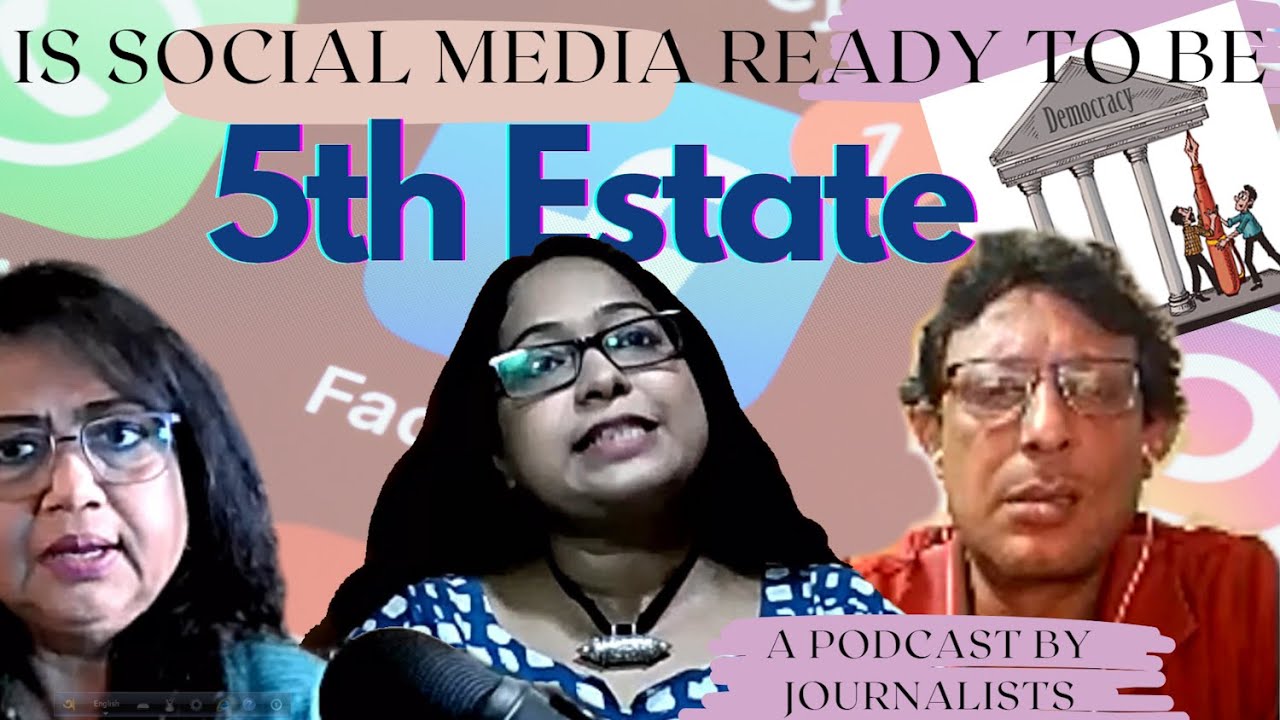
In this YouTube panel‑style podcast hosted by Kaberi Dutta Chatterjee, journalist‑academician Momita De Das and veteran reporter Diganta Guha examine whether social media has become the "fifth estate" and what that means for traditional journalism. The conversation moves from the rapid rise of platforms that can break news faster than print, to the ethical erosion caused by click‑bait headlines, unverified videos, and the phenomenon of "WhatsApp University". The guests discuss legal ambiguities, recent Indian court rulings on platform accountability, and the challenges of regulating a global, largely indomitable medium. They highlight the erosion of print media’s influence, the rise of trolling farms, and the impact of political parties exploiting social media since 2014. The panel also critiques media education, noting declining general knowledge, plagiarism, and the lack of rigorous training in many private journalism colleges. Throughout, they stress the need for media literacy, responsible content creation, and a hybrid future where digital and print coexist, urging the next generation of creators to wield the power of social media with greater responsibility.
Chapters
They run any video and they say that this video has not been verified.
I have taught in a couple of media colleges and honestly speaking, I was told that whatever answer they give, let them pass.
I remember once I made a huge headline on the back page and it was something to do with Hitler and this— it was all caps and the spelling went as Hilterd. You don't know English, you can't edit your copies, you go there with a thesaurus. Next time when I'm going I went back, I told my boss, you don't know, you know, they don't know what is a thesaurus. They said, what, Saurabh? He used to see bastards of brain is brand.
Very few who read, who knows, you know, coming to media, the first thing they know is entertainment, glamour, I'll become anchor.
Very exasperating, you know. And once you get into the video, you realize the story is different.
Yeah.
So you come up with catchy, catchy headlines and you want to lure the viewers, but in the process you are actually compromising on ethics.
Hey guys, welcome to my channel Frontline and Chai. Today we have with us Momita De Das, journalist, media researcher, and academician. And of course, Diganta Guha, who is a veteran journalist from India. So today's topic is very interesting, you know, and it is a much-awaited topic. Is the social media emerging as the 5th estate? We know the 1st estate was the clergy, the 2nd estate was the nobility, the 3rd estate were the commoners and bourgeois, and the fourth estate was the press. Now, fifth estate is a sociocultural reference to groupings of outlier viewpoints in contemporary society and is most associated with bloggers, journalists publishing in non-mainstream media outlets, and the social media. That's it, with social license. So then, is social media emerging as the 5th estate? Is the mainstream media dying a slow death? So we have over here, we have seen print media almost dead in many developed countries. Even the digital media is bound down to the free and first responders of the social media, where a tweet on Twitter makes news faster than any mainstream digital media. Where a YouTube shot garners more views. And sometimes we see mainstream media, renowned media people embedding the YouTube links in their website to fill up their own space. What began as a— as to be called as a WhatsApp university or a YouTube university are now actually filling up the gaps of the hugely demanding social network who are getting the news straight. From the horse's mouth, everything out there is on public domain. So where do we draw the line? Who says what is legal and what is illegal? With the entire globe under its purview, what law can regulate the social media? So I'll throw this question to Momita and Digonto first. Let's talk to Momita, ladies first. So Momita, how are we? How is print media? Combating the social media influx.
Thank you, uh, Kabrithi, for inviting me on your podcast. Uh, it's very interesting topic, and the point you have, uh, questioned, it's very tricky one, uh, because in print media, how we are tackling right now, we can't say that only citizens, we are netizens, everyone, be it 8 to 80, They are all, all time we are on our mobile, and with that set, we are connecting to the entire world every time, every second, be it news, be it entertainment. Uh, we can't think of without internet. So you can, you can, uh, you can understand that, uh, going back to that, uh, uh, that preliminary with Spider-Man's message that I would rather hear, with great power comes great responsibility. I think with that we can start off with our discussion that we can't deny the fact with the social media. And as you have pointed out, the 5th estate part, it is slowly and gradually becoming 5th estate because it's challenging the other 4 estates, uh, which, which, which are there evident in our, uh, governance and democratic process. So here comes our, uh, question whether, uh, social media, the power of it, along with the ethical part that you have pointed out, rightly pointed out, whether there are very thin line where There are times where it has crossed its you know periphery of ethics and unethical points. So we will discuss it along the way. All these points. Thank you.
So yeah, Digon. So let me my next question is to you. So where do we draw the line? How do how social media is a global phenomenon? It's a global like ballooning phenomenon. So what where is it that we draw the line? And there is there any legal Implications and who takes charge of the legal procedure, if there is any?
It's a very tricky question to answer. I would say that at this point of time, social media is kind of indomitable because, uh, as I've always discussed, that, you know, journalism has become much easier than ever. Earlier on, Momita would endorse, you would endorse, that getting a story was a big deal. We had to depend on our sources, but now everything has been broken on the social media. So celebs or, you know, renowned personalities, uh, are actually, uh, a bit relaxing in the sense that they know that they can tweet and the posts are coming on social media. So when you— when it comes to drawing a line, I think at this point of time it's very difficult. Well, there are legal procedures. You must be knowing the High Court verdict that, you know, some regarding Twitter, some, you know, questionable or objectionable handles uh, needed to be blocked. And Twitter had filed a suit against, uh, you know, the appeal, and, uh, it has lost. So at this point of time, obviously, you know, the court is there to take a call, the court is watching. But I think I would go back to what I said. I mean, social media at this point of time is perhaps, you know, I mean, indispensable.
Yeah, so social media is particularly indomitable, and it is grasping the entire world, and we kind of beginning to believe what social media— earlier, we used to, like, not believe, and we used to go for the print media edition, right? So, and we used to believe whatever is to come out in the newspaper. But now we are beginning to slowly believe whatever is there on social media, because we see within seconds, within a few hours, that same story is now on print media. So, right. I have seen print media, I have seen the death of print media very, very jarringly. When I was in India, I was working for Hindustan Times. And I came from there to Canada. And here, let me tell you this little story to substantiate our discussion. Here, print media is like newspapers in the buses and trains were kicked around on the seats. They were kicked around till they got— people, you know, rubbed their foot on them. Nobody read newspapers. Like, I think I'm the first only person in this, uh, uh, in this entire neighborhood who reads a newspaper. Like, I have this newspaper, I read this newspaper, and everybody else is there on— they are taking the newspapers and using only the discount coupons on them, and they're throwing away the newspaper. They're using it for cleaning purposes. So I have seen the print media With so much power, print media also had a lot of power. Like recently we saw this movie Scoop. I think Momita, you also saw it. Digonto, we saw this movie and we saw the power of print media put a person in jail for seven years. That kind of power we had seen, you know, print media wielding that kind of power. So now do you think this this is a turn of karma events coming in social media? Actually, you know, nail. Driving the last nail to the print media editions and all print media, because print media had been misutilizing its powers for a long time. What do you think, uh, Momita?
Yeah, I was, uh, I'm just, uh, telling that yesterday I was watching this, uh, you know, uh, film by Sudhir Mishra, Afwa. And Afwa means fake, uh, information. I would not say— I, I don't like the term fake news because I think if Uh, if we— if you're calling it news, then it's not— it can't be fake. If you, you have verified your sources, then it cannot be, uh, fake news. I would rather use this term as fake information. So how the power of social media, everything that comes, uh, within our small screen, and I— we believe it. We have used a term like WhatsApp University, if you remember, during COVID times. It was also we are we we stated that along with the pandemic we had this the information epidemic. You know, the it was thoroughly it was a fake news which was circulated over the WhatsApp and and there was no one to see through it and there were so many instances happened especially in the in certain zones of India northern India we have found that there have been issues there have been you know murders. Uh, relating to this fake information, uh, recently we had this social media, uh, news, uh, you know, uh, Government of India has, uh, circulated or regulated its, uh, social media, new rules and regulations after this Twitter controversy, uh, in and around the times where farm laws were going on, the controversy related to that. Uh, so Government of India came up with this social media angle, and also there were this ह्यूज़ सीसाम मटेरियल, सीसाम मटेरियल इस चाइल्ड सेक्सुअल अब्यूसिव मटेरियल विच वर अवेलेबल ड्यूरिंग कोविड टाइम्स तू चेक दोस सोशल मीडिया चैनल्स देवर आस्क बिकॉज़ यू नो दिस आर ऑल एमएनसीज़, दे आर नॉट इंडियन ओरिएंटेड, यू नो दे हैव दे बेस इन अमेरिका मोस्टली, यू Uh, or, uh, you know, Insta. So in the Telegram and the Signal, all of them have this, uh, uh, international, uh, uh, you know, organizations. So they were bound to, uh, uh, to, to have this rule of the law. And, uh, they should— what we are having social media angles and the rules and regulations that Government of India has taken up. Earlier I used to think that no, these regulations were not needed. Then, uh, I, I read it more thoroughly as I teach media laws and Uh, that these regulations were very important because they were flouting, especially Twitter, were flouting our, uh, you know, laws, law of the land. And even it was accused by other countries too doing, uh, the same way, uh, with the Government of India and not, uh, flouting their rule of the land. So, uh, especially the WhatsApp University, whatever it comes and we are circulating, even I have seen educated people doing this. I have checked with my friend circle An inner circle. I have checked them. I have asked them that from where the you have so you didn't check or verify from where it has come. Even I ask my students to do the same. My parents who are elderly, who have crossed their seventies, they tend to do this. They they tend to believe whatever they see on you know YouTube. I remember once my mother was very disturbed and called me. You know some Tollywood actor, Ruud Koel Koel. क्वेल्स फादर, ही डाय रंजीत मौलिक डाय। सो आई सेड जस्ट होल्ड ऑन लेट मी चेक वेदर इट्स अवेलेबल ऑन द मेनस्ट्रीम मीडिया। देन आई चेक नो देवर नो न्यूज़ सो आई टोल्डेम वेरेवर यू हैव पाउंड इट। YouTube, I, I have saw that you know video is coming on YouTube. So I said please don't believe anything that comes on YouTube. You never know these are created to you know these are all fake information. Please don't believe it. You know, media literacy is very, very important aspect where, uh, Government of India has introduced, I think, uh, from, from this year with the central government schools, uh, to introduce media literacy as part of their curriculum. You know, we are calling it netiquette. Yeah, how we, how we use it, the net, okay? We should be responsible citizens, how we, uh, tweet, how we, uh, in Instagram, how we, how we should message. We can't do as ever feel like. You you should keep in mind that your two words or two sentences can have records. Okay, it can impact to thousands and millions. Over to you.
So, Divanto, echoing on Momita's words, you have been in very much in print media. You know, thick in print media. From there, you are now emerging in the social medias like like I am. So we are emerging as YouTubers, as content creators, and we are doing it responsibly, okay? Because we know that this impact, like Moumita said, the impact of social media has to come with responsibility. What do you, what do you want to say to the new YouTubers who are coming, uh, to the, um, you know, foray, and they have billions of views and millions of subscribers? What do you think, what do you think will control them? How will they be controlled?
Well, taking a cue from what Moumita said, I think you need to be responsible. The problem is that there's so much of competition. It's, it's a rat race. It's a mad rat race. And today's social media, thanks to the advent of social media, everyone is becoming a journalist. So I at times wonder whether I was a good journalist or not. Everyone is having the luxury of, you know, writing anything or anything under the sun without even verifying. In fact, Amitabh Bachchan has been killed so many times. As Momita said, Ranjit Malik was also, you know, dead thanks to the social media. Well, I personally feel that it boils down to the owners of various social media handles. I mean, already they have started cracking the whip, and it's important that, you know, they keep a strict watch on, as Momita said, fake information. It's not fake news. You know, the problem is, uh, with the advent of this digital media, what is happening is I worked for various portals, and I know that there's so much of competition, there's so much intensity in the race that you want to sort of go ahead of the rest. In the process, what you do is you don't verify. You get something on Twitter, you get something on Facebook, you just jump onto it and you publish that story. Eventually, you realize that it's all false. In fact, I almost ended up falling into that trap a couple of times, and I was heavily reprimanded. So I think more than regulations, I think it also boils down to your mindset because as I said, and I would reiterate that it's a very serious job, you know, it's a very serious job. You can't write anything. And so you come up with catchy headlines and you want to lure the viewers, but in the process you are actually compromising on ethics.
And those videos actually get millions of views.
Lakhs and crores of views. Yeah, people do not know the content. Right, Kaberi, so far as YouTube is concerned, I think it's imperative. that, uh, you know, YouTubers are not only responsible, you know, somebody has to sort of stand up and stem the rot. Because the kind of videos that I come across, you know, I mean, they're very catchy, but I know that they are all fake. You know, how can you just make an observation without verification just for the sake of garnering views, which I have been reiterating over and over again? So I think it's, uh, I don't know. I mean, I mean, it boils down to laws, it boils down to, uh, owners, you know, social media owners like Mark Zuckerberg and Elon Musk and all that. So just for the sake of garnering views, you can't afford to cross the line.
Yeah, so that is what I think that you know like like I was saying people they have these keywords or which is called the the click words clickbaits. So they clickbaits they use the clickbaits to garner views on your video without giving them the content. So in the process what happens? I think if you ask me, I think the public is public सब जानती है. पब्लिक है वो सब जानती है। There's a there was a song, remember? So the public knows what is right and what is good and what is not good. So I guess if you if you at the end of the day the public will people will decide what is good and what is not good.
But I don't think so, Kabiri. I don't think so. I'm very you know sad and I'm very dismayed by the fact that these videos you know these irritating videos which are bereft of authenticity, they actually run amok, you know. I mean, just go through and it, you know, I would say that even at my own expense, at my expense of my own future, if you have— if there is a toss-up between a Narindra Modi story and a Parineet Chopra-Raghav Tatta story, I can bet on my life the latter is going to rock.
Yeah, yeah.
So it also boils down from the taste. People, people love those kinds of stories.
Yeah, actually. So that that's what I've also seen. If if a video is titillating, some kind of titillating message is there, people will go for that video. I mean, there are millions and billions of YouTube doesn't have a control over its videos, over the content. So they they just ask you when you're uploading whether your video.
So I have something to add here, Kabirji.
Yeah.
If you remember any We have we know the fact that any any publicity is publicity. It can be negative or positive. Here, I would rather add one aspect to social media that is trollers or the trolling community. You must be knowing that nowadays all the political parties have certain community who have been hired to troll. You know, trollers are hired. With thousands and lakhs of salaries, where they picked up some pointers and they troll. And to make it more viewers, you know, they did. They do it. Yeah. So it's it's all the story of every party is falling, especially after 2014 when Modi government came to power. Our entire political dynamics changed. The communication. Why this is very evident point? The social media, the the role of political parties and the social media dynamics and political dynamics entirely changed since 2014 because they have shown the way how to use it. I'm not going into the part of any war. We can say प्यार और जंग में सब कुछ जायज है. These this is one of the term that we known. They have put up many points where ethical and unethical means, how they have achieved this. I'm not getting to that, that going to the Gautam would be also knowing it. But the point is every political party is doing the same thing. And as of, I would rightly, you know, agree with the Gautam that I do public सब जानती है और public समझती है। I don't think so anymore. Because your media literacy is very important. Even Digonada said that he has also fallen in sometimes. If you remember, even Rajdeep Sardesai has also fallen for some very important point where he was banned for certain period when during farm laws when he was covering in from Delhi, he fell for one of the fake information that he received that somebody died and then you know if you remember that for say fake information. So I have some point, here comes the role of mainstream media. Uh, you all will agree that in at some point these mainstream media, especially television broadcast, where there's no norms, nothing comes, not even, uh, print, though have Press Council of India, but, uh, I don't think so broadcast media have anyone to say anything. Uh, so they, they run any video and they said that This video has not been verified. How come you're showing a video without verifying it? Yeah, and this is where the ethics comes. If you people don't verify it, we public—you are saying that public would, you know, obviously public would agree what you are showing, and you're not—you are stating that you have not verified. How can you show it? How can it be a responsible journalism if Dikanta would like to, you know?
I would, I would, I would. Yeah, yeah. I would definitely echo what you said, Momita. The thing is, as I said, I would just go back to you know what I started off from the outset that it's all about competition. You you come up with anything, anything just to your viewers. You know, I have seen big portals, you know, important portals which we follow, which we adhere to. They are coming out with videos which say, "इता." इतना वेरिफाइड ना हो व्हाटेवर ब्रिंगली व्हाटेवर दे से। I mean, this is really funny because I mean, this is this is irresponsibility at its height. What do you mean by purportedly? Allegedly. What do you mean by purportedly?
That's the word. Allegedly. Allegedly.
Purportedly is purportedly is more popular, right? See, I think I'll tell you something. I'll just add to what Momita said, add to what you said. See, I mean, we are on a very sticky wicket. We are actually getting swayed by the lure of glitz and glamour associated with social media. But eventually, you know, I might sound a bit old-fashioned, but eventually, you know, true journalism has to come back.
How do you think journalism will come back?
Yeah, I will, I will, I will, because print media is dying.
Nobody's— no, no, no, no, who is buying print media?
I will, I will add to it. A lot of responsibilities lie with all these media colleges. If Momita would agree with me, I have taught in a couple of media colleges And honestly speaking, I was told that whatever answer they give, let them pass. I have asked them questions like, you know, there was this girl who wanted to be a sports journalist. So I asked her, so you want to be a sports journalist? Okay. You've heard of Muhammad Ali, obviously. Who is he? She asked me. There was one more girl. I asked her about Kashmir. She stood up and said, sir, it's a beautiful place. Now, if this is the lot— see, I know I, I might be, you know, ruffling feathers, but let me be very honest. These private media colleges have a lot of responsibilities, have a lot of responsibilities. They can be exasperated by the fact that this is the quality of journalists we have, young journalists who don't even know what the capital city of Pakistan is.
Some of them— general knowledge is generally dying among young people. It's gone for a toss.
That's what I'm saying, that I have an objection to all these private media schools coming up at the drop of a hat? And because I think, you know, I know I'll be sort of vilified after this, but it's true, you know, going by my experience, I've seen that anybody and everybody is becoming a journalist, but once you put them on the job, they make a mess of it.
Yeah, I think, um, the next generation, uh, seriously lack, uh, knowledge and, uh, grammar. Like, when I've been— I've— I'm seeing the digital, why I got so disillusioned, like Digontu says, I got so disillusioned with the digital media is that when I came to this country and I was seeing the digital post, I worked in the digital media also. They were all copy pasting, copy pasting, copy pasting. Okay, that was understandable. But when you copy and paste, look at the spellings. If you how are you copy pasting the wrong spellings and wrong grammar? Like there was so many mistakes. I remember we would be like we would be sacked if we made such a mistake. in our newspaper, we would be sacked on spot. It was so strict with us when we worked in HT and Telegraph. I remember once I made a huge headline on the back page, and it was something to do with Hitler, and this— it was all caps, and the spelling went as Hilterd. So I was petrified the next day. What's going to happen? It came out in print in block letters, such a big Thick font, that is impact font, and it was hilter. But my boss did not notice. Nobody noticed, and I went scot-free today. I'm saying I went scot-free.
Yes, it happened. You know, there was a Subhash Ghai interview. The interview was carried, and I was very excited. I opened the papers next morning, and I saw the headline going gobal. Gobal. Yeah, gobal. L was missing. So Mr. Ghai called me up and asked me, "दिगांता, is this a new word?" I said, oh, I think it's a typo. You know, like, so far as today's age is concerned, we always have the provision to change, you know, edit and re-edit. But once it goes on print, it's gone with the wind. So I was very embarrassed.
Yeah.
So I asked the chief, sir, what do you mean by gobal? Is this a new word? Maybe my English is questionable. She just looked up to me and said, my mistake. I said, you've made my life hell, darling.
So that is the thing, like we had so much strict parameters and now there is nothing. You can just make up a word like I do. I make up a word like that. I said, okay, everybody is making up words, I'm also going to make up words and just make up words and put it. And today everything, like some strange words are being added to Oxford Dictionary and which we had thought to be our Bible of our, uh, you know, education system. We, we thought Oxford and Webster's Dictionary, they were the Bible to refer to. And now strange words are being added to Oxford and you don't know, those words don't— never existed in our times.
So coming back to what, uh, Digantoda was saying, that today's education system and especially Gen Z, uh, yeah, I, I am teaching for last 8 to 9 years and across Kolkata. Now I'm in a district, I'm in a district-based university बादों कोलकाता स्टूडेंट्स कम। The point is, you know, students, I would not say everyone, but few of them are truly into it. But most of them are in a very superficial manner. They think that media is very easy, very entertaining. Entertainment is the point where they glamour in entertainment. That the basic knowledge truly it has went for a toss, especially for last 2 years with the COVID 2 and a half years with COVID you know, everybody was just, you know, asked to get past. School makes you or breaks you.
So that is what the world has come to. Like, I feel when I came to this country, I was dismayed that, you know, people did not know English. This I should tell you, that when I was coming here, my boss told me, you don't know English, you can't edit your copies. You go there with a thesaurus. The next time when I went back, I told my boss, you know, they don't know what is a thesaurus. They don't know what is a thesaurus. They said, what, sorus? People like my son's friend, he used to say past tense of bring is brang.
But we are the ones who cherish the fact that we don't know Bengali. Amar Bangla taashna. Look at Deepa Shavas. She's a Bengali. She was born and brought up— exactly, she studied here, she stayed in, I think, South Calcutta. You know, I know people who know her, and now she hardly can speak in Bengali. She would just, you know, use— she would just say a few sentences, maybe one or two. After that, she would sort of break into English or Hindi. It's all crap.
Eventually, I think Passing generation now, we are the aunties of our generation, at least I am. We are now resorting to visual media because I see that my blogs are not being read so much. People do not read, so they don't even read blogs, they don't even read books, leave alone books. I've written so many books, nobody reads. So we are trying to, you know, communicate. Why? Because we are communicators and we'll remain communicators all our lives. Right, Mumita. So you you have your students like you can at least groom your students.
I have one question for Mumita Kaveri. If if I can just sort of step in, I have one question for Mumita. What exactly do they want? What is their kind of outlook? What is their kind of approach towards life as a whole?
As of I have you know the point is in class there are very few students where we find that. Through a sense of, you know, interest. Uh, very few who read, who knows, you know, uh, coming to media, the first thing they know is entertainment, glamour. I'll become anchor. Uh, and, and they think that anchors, uh, do not need any reading or writing or know the knowledge of news. They think it's— they just read. Okay. Uh, and the point is to write. Uh, to write you have to read. Most of them are into, uh, content writing, academic writing. There are ghostwriting— I hope, uh, ghostwriters, okay, doing research about articles, writing, researching for them. These are the some of the where the people who can write, they are getting into it. And, uh, some are going to the sales department, PR department. And what do they want? They want that easy. Okay, it's very easy. We don't have to study, and they get marks very easily. If going by what are the— I teach journalism papers. I teach media laws and ethics. For me, assignments, the deadlines, and there is a point that Mumita ma'am is very strict about the deadlines. So deadlines are sacrosanct. I'm after them. Then you do it. No copy pasting because I check plagiarism. It's very important that we check plagiarism. So why we have— we use software. So we are very much, you know, want to give the quality education. The point is, you can understand it's a 2-way communication. I would give, but whether they are ready to take it or not, and how much, and discuss it. I have found that they don't like lecture. They like discussions. They like that they would give them that space to listen to, you know, that I refer to Social Dilemma, to you, if you remember, Kaberi Ji, on Netflix, whether it is social media. Yeah, I watched it, I watched it actually. Yeah, so the perspective of social media, the power of it and how it works. We are all commodity. Invariably, we don't know, but it's the free services, but we are the commodities, we are being sold every each moment because Every time we we sell our own privacy, the you know where we are going, where we are, what kind of attire I'm prefer. So what kind of political ideas I believe. So every time each and every one of us giving up our privacy. So yeah, we are doing it voluntarily as a community. You know, we are selling our.
We are giving it up voluntarily. We are giving up our privacy voluntarily. So this is the new age that we are— we have transitioned and come to. We can, you know, wrap up this session by saying that, uh, yeah, um, do you have any last, uh, things to say?
Yeah, I think, you know, going by the discussion, uh, we've had so far so good, I mean, to infer, it's essential that print media stays because, you know, like you, like me, like Moumita, we've all grown up on print media. We have whatever little we have achieved, whatever little we have learned, it's all thanks to, you know, The Statesman, The Times of India, The Telegraph. We didn't have the luxury of digital media during our growing up days. So I think if you really want to have good journalists, if you really want to have solid talent around, I think print media should stay. So this is the other side to it. But overall, I think if you look at the larger interest, and we are all, you know, in love with journalism, we are all in love with this profession. I think if you really want to have quality journalists around, print media has to stay in its own way. Now, how it's going to sort of innovate, how it's going to evolve, how it's going to bounce back, well, this is a matter of debate. We can have another round of discussion on this. But overall, you know, in the, in the interest of journalism, print media has a role to play.
So, I'd like to ask you one thing. What is the quality of print media that you want it to stay, that the fact that it is indelible, unalterable— is that the word? That, that the thing?
I'll tell you, I'll tell you the challenge. The challenge with print media is we've all worked on that desk, okay? We've all worked on the desk. So there is a limitation. There is a limitation in the sense this is the space you have to give a headline. There is a limitation. You have 500 words, you have 600 words. So within that space, you have to convey your message to your readers. But so far as the digital space is concerned, you have the floor open in front of you. 2,000 words, 3,000 words, 4,000 words. So you're writing, and I'll tell you something, whenever there is a— what should I say— the follow-up news, the first 3, 4 lines, they are all new. The next, they are all padded up. That's what I'm saying. Yeah, that's what I'm saying. Yeah.
So, uh, in the end, like, to wind it up and, uh, We must, as we said, that digital and print media is there. We cannot stop it. We cannot, uh, resurrect it. But, uh, digital media can be, you know, made better since we are— we— there's a term called, if you cannot beat them, join them. So if we cannot beat the advent of the digital media and the social media, we can join them to make it better. So this is a to appeal to all the an appeal. That's all I can do because we are the passing generation. We are going away, and you guys are taking over. The young generation is taking over. So this is an appeal to all of you to make things better, and it's in your hands. And with greater responsibility, like Momita said, with greater power comes greater responsibility. And social media is powerful. It's almost without any. Legal or any legal bindings anywhere. You know, nobody binds binding you, but you have to know what watch what you post.
I would just don't mean to undermine anybody. We don't mean to post cons on the current generation, but from our little experience, whatever we've had, we're just trying to share our expertise so that ultimately it helps you in the longer run.
So yeah, all the slides on on you know the future generation as Gen Z. Even my My son who is 14 years old, I learned many things from him.
I also think I learn a lot from the next generation. Like my son is 26, but he says he's old. So yeah, I am like older than him, and he says he's older than the next generation. So I really do not have any clue about the next generation after my son. So anyway, I'm sure there will also are coming up with a lot of responsibility, and we are going to, you know, see a very good social media network. Hoping on that note and closing on that note, thank you guys for being here with me, and it was a wonderful discussion we had. It was much, much awaited. Thank you so much. Thank you. Okay, bye-bye everybody. Bye-bye. Bye to the audience.
More from Kaberi

Real Life #blackmirrorvibes | Gen Alpha Will Be The Dumbest Of All Generations!

My 1995 Planchette Story | The Science of Ghosts | Author Kaberi D. Chatterjee's story

60-Yr-Old Breaks Down To "Earth Song" | Fan From MJ's Cassette Era #michealjackson

#micheal #michaeljackson I can't believe we actually saw these created in real time!