#856 (Video): CRMC Keynote Kaihan Krippendorff on making your brand a disruptor not disrupted
In this episode of The Agile Brand Podcast, host Greg Kihlstrom interviews Kaihan Krippendorff, founder of Outthinker and keynote speaker at the upcoming CRM&C conference. The conversation explores why large, established brands must shift from defending market share to actively disrupting their own markets. Krippendorff explains that the core customer job remains constant, but the way value is delivered changes – illustrated with Sony vs. Apple in music and Blockbuster vs. Netflix in entertainment. He introduces the concept of "proximity," where companies create solutions at the exact moment, place, and context of demand, rather than predicting demand in advance. Krippendorff outlines his IDEAS framework (Imagine, Dissect, Expand, Analyze, Sell) as a repeatable process for generating and executing breakthrough ideas. He details seven common internal barriers to innovation – intent fatigue, unclear needs, limited idea generation, misaligned business models, demanding business‑plan proof, siloed teams, and unsupportive culture – and offers ways to overcome them. The discussion moves to measuring long‑term ROI, emphasizing customer‑lifetime‑value (CLV) metrics, portfolio‑style experimentation, and the need to treat multiple bets as a single strategic portfolio rather than isolated projects. Krippendorff also describes emerging organizational models such as internal marketplaces where multiple “marketing agencies” compete for budget, and the shift toward platform‑based coordination of previously controlled resources. Finally, he highlights broader macro trends accelerating disruption: AI, IoT‑generated data, API connectivity, physical‑digital convergence, supply‑chain reshoring, and heightened customer expectations for real‑time personalization. He urges leaders to stay agile by constantly learning (podcasts, interviews, roundtables) and to focus on the front‑line customer experience as the true source of disruption. The episode closes with a plug for the CRM&C conference and a call to action for listeners.
Chapters
Hi, I'm Greg Kihlstrom, host of The Agile Brand, and here's a question for you. When you look at your 5-year strategic plan, how much of it is dedicated to defending your current market share versus actively making it obsolete? Agility requires more than just reacting quickly to market shifts. It demands the foresight and structure to initiate those shifts yourself. Today, we're going to talk about the accelerating pace of change being driven by forces like artificial intelligence and digitization. These changes are creating a clear divide in the market, sorting brands into 2 distinct camps: the disruptors and the disrupted. We're going to explore the patterns that separate these 2 groups and discuss practical frameworks for how established organizations can learn to shape the future rather than be shaped by it. Welcome to season 8 of the Agile Brand Podcast. This season, we're going all in on expert mode, martech, AI, and customer experience. Talking with the people and platforms behind the brands you know and love. Again, I'm your host, Greg Kihlstrom, and I help Fortune 1000 companies make sense of martech, AI, and marketing ops. Hit subscribe or follow to make sure you always get the latest episodes and leave us a rating so others can find us as well. This episode is brought to you by CRM&C. Drive your customers to new horizons at the premier retail event of the year for retail and brand marketers. Learn more about CRM&C 2026 June 1st through 3rd in Frisco, Texas at www.thecrmc.com. To help me discuss this topic, I'd like to welcome Kaihan Krippendorff, founder at Outthinker and keynote speaker at CRM C taking place June 1st through 3rd in Frisco, Texas. Kaihan, welcome to the show.
Great. Thanks for having me. Great to
be here. Yeah, looking forward to talking about this with you and definitely looking forward to CRM C.
I know, I'm very excited about the conference. It's going to be amazing.
Yeah, yeah. Before we dive in, though, why don't you give a little background on yourself and your role at Outthinker?
Yeah, so I started my career as a consultant at McKinsey, and I started writing books in 2004. I've written 6 books. I publish in Harvard Business Review. We started Outthinker in its current form about 5 years ago. And think of it as kind of like a peer network ecosystem of chief strategy officers that get together like a think tank and talk about the trends and issues and support each other.
Nice, nice. Love it. So yeah, let's dive in here. And certainly there's going to be a lot more to hear at CRM C when you do a keynote there, but give people a little taste of what you're going to talk about maybe as well. Yeah. And I want to start with this concept that I teed up in the intro, which is this line between disruptors and the disrupted, which is certainly distinct, yet for a large enterprise, sometimes this isn't a simple switch, right? So, you know, what's the most significant mindset shift that a leadership team at a large organization needs to make to even begin that journey from being a defender to being an innovator?
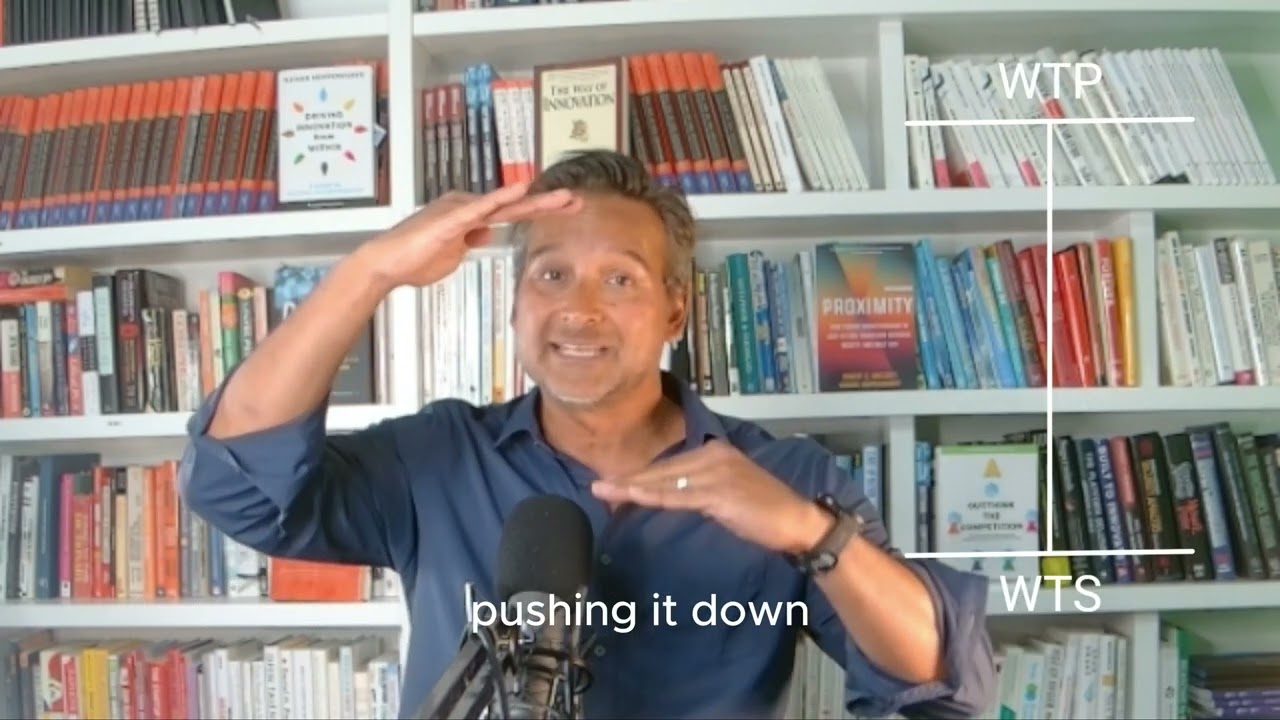
Yeah, no, I'm glad that you called it a mindset shift, because I think it really is a mindset shift. We look at when games change, like when music went from, like, Sony Music to Apple. Often the incumbent gets— falls behind, but the incumbent doesn't have to fall behind. Garmin, for example, went from GPSs in cars to wearables. And, you know, it's killing it in wearables. And it really comes down to the mindset. If you understand the patterns, the core job that, you know, people want your product or service for doesn't change. But the way that you do it now, like music, it no longer becomes about high-quality recordings product. It becomes about placement or distribution. And when it becomes— the game becomes distribution, now that requires a different capability. It's about technology and compression, not about curating and recording, right? Yeah. But underneath that is that mindset. And so that's what we're gonna kind of COVID cover is the mindset shifts. There are a few, but one of them we'll talk a lot about is this idea of proximity, which is we're moving into a world in which the way you win is not about predicting demand, but actually creating products and solutions at the moment of demand in space and time.
Yeah, yeah. Well, and just to go back to that Sony-Apple example, I mean, to your point, Sony had the superior, you know, auto audio quality. You know, people that are less familiar can Google DATs and, and all that kind of stuff. But, um, but yeah, to your—
They were the dominant MP3 player, right?
Right.
They, they had, they had the Sony Walkman. They, they had— yeah.
Right, right. And yet, you know, Apple comes along at the right time. And, and, and I think it's— to me, it sounds like not only a mindset shift at a company like Apple, but also shifting the mindset of the consumer as well, right?
Yeah, I think it is. It goes back and forth, right? Your consumer mindset shifts. You start offering that what they want. And then they realize, oh my God, this is actually possible. And it changes what they want. I think another good example of that would be the Netflix Blockbuster example, which I think a lot of people kind of get wrong, that Blockbuster just didn't see the mindset shifting. Mm-hmm. They did see the mindset shifting. They copied Blockbuster— Netflix. They created a separate company, Blockbuster.com, Blockbuster Online, a separate building, a separate leadership team, separate culture, and just said, go take all this money and just go do Netflix. And when the websites were released, they were shocked that the Netflix website was not a website. It was an interactive experience where people would see what they, you know, see recommendations based off their. And so kind of that mindset is they were still building a storefront. but a storefront in the cloud or a storefront online, they weren't thinking of it as music, entertainment as a service. So that little subtle shift of like, what business are we in? Entertainment as a service or a storefront changes thousands of decisions and that informs what customers expect.
Yeah. And I think at least some of this points to that innovator's dilemma, right? You know, classic challenge for, even, you know, very successful companies. From a strategic standpoint, you know, how do you talk and talk with and help leaders reframe the perceived risk of— even in the Blockbuster example, it's like there was this paradigm of, okay, a website for us needs to do X, Y, and Z versus the Netflix example. So, you know, there's risk of self-disruption. You know, how do you balance that versus the greater and often quieter risk of inaction.
Yeah, I think that's a great point, 'cause I think it is often the quieter risk of inaction. I think rarely is it like someone says, we have this business case and we have this business case and we're gonna debate it and we're gonna choose our old business case to protect our core. It is more subtle than that. It is the mindset, it's the belief. I think it really comes down to like 5 things. One is, and I'm not sure if I'll do this exactly like this, this in the keynote, but it spells I-D-E-A-S. Imagining a different future. Okay, the future's going to be digital distribution instead of store, right? Yeah. Dissect is the business model changes. It becomes no longer about product, it becomes about placement, distribution. Then expand is about the mindset, is the underlying metaphors that we use to think about what could we do differently? Those change. which reveal options. Then Analyze is about choosing the options. The options that we choose, before we would throw them out because they looked crazy, but now reality has changed. You know, AI enables us to do things that we couldn't do before. And now an idea that was a crazy idea, now, hey, what, you know, it is now feasible. And then Sell is about building enrollment and buy-in with your ecosystem. Your ecosystem partners change. And increasingly companies that are winning are working through ecosystem partners.
Yeah, yeah. So let's talk a little bit about activating this. And so you've developed the Outthinker process to help generate powerful ideas. Can you maybe walk us through at a high level, what does this look like and how, what are some of the tactical steps that a team could use this for?
Yeah, I'll kind of like dig into that. You know, I laid out the IDEAS. I call that the Outthinker process. I believe all models are wrong and some are useful. I don't think that this is like the magic, but it works. And I've done it like 500 times for all kinds of companies from, you know, from QVC to Walmart to all kinds of companies. It just works, right? But if we take IDEAS, we look at the middle one, E, it is expanding your option set. And the options that we see are really, if we look at like how, and you think, you know, this is how consumers think. Yeah. But it's also how B2B marketers and leaders think. It is an underlying metaphor or a story that we're telling ourselves that tell us what is the next step in the story, what options are available to us. And there are certain new narratives that are coming to bear. One of them, for example, is I call it coordinating the uncoordinated. There's stuff that we used to have to control that now we can increasingly coordinate. And that's why you see platform business models. You know, why is— Urban Outfitters, their stock price has been killing it for the last 5 years because they've proven that they can create a rental business for clothing in Nuuly, right? They can do Rent the Runway, and they can do it actually profitably. They're generating like $100 million per quarter profitable revenue from that. And that— those are— I could give you tons of examples. But the whole concept is it used to be the mindset was to create compliance and predictable outcomes, we needed to control things through a hierarchy. And now increasingly we can coordinate things through a platform, for example.
Yeah, yeah. You know? Yeah, well, and within organizations, I think there's a couple different ways that innovation at least tries to happen, right? So you mentioned, you know, I think the Blockbuster example, and there's plenty others where they set up this separate team of like, go be innovative and things like that. But, you know, the other model would be to try to innovate within, but there's a lot of barriers to doing that. And when you have siloed teams and competing priorities or even just, well, yeah, competing priorities, some of that stuff can get in the way. What advice do you have for leaders to get around some of that? And because scaling innovation requires kind of reaching across the aisle, right?
Yeah, absolutely. Yeah. I mean, I've spent 5 years just studying that. And I'll give you really briefly 7 barriers. But first, I want to say, like, I published something on HBR like 4 months ago. And what I showed is that companies are just terrible at what you're talking about. There's someone in the company who recognizes a customer need, right? It's probably that customer experience marketing person says there is a need. Then there's someone in operations or product, and they actually have a solution to that need. But they can't communicate with each other. What I asked— I asked Amazon. I asked Microsoft. We interviewed a whole bunch of companies. like 35 different innovation officers. And we said, if you find a customer need and you broadly let it be known inside the company that, hey, the customers want this thing, how often do you find that a solution already exists? Average, 71.4% of the time.
Oh, wow.
It already exists. So we do all this R&D creation stuff. Why? Not because we don't have the solution, but we just can't talk, you know?
Yeah.
So 7 quick reasons. One is your people have given up. That's intent. Need— they don't understand what the customer needs or what the company needs. Options— they don't generate enough ideas. They only create a few ideas. Value blockers— the business model around those ideas is inconsistent with the existing business model. Act— we ask them to give it— prove a business plan in order to do it. When they need to take action, do an experiment in order to prove the business plan. Team— to your silo question— they can't reach across the aisles and assemble a cross-functional team. And then environment— it's about leadership and culture. So all 7 of those things are barriers that successful internal innovators figure out how to overcome.
Let's talk a little bit about measuring success of this. And, you know, so, so big ideas, first of all, they're not going to be implemented and launched overnight. So, you know, some of these things are long-term when, you know, so many execs and leaders are being asked for short-term results from shareholders, boards, stakeholders, so on and so forth. How do you show ROI on something that's not set to show ROI for months or whatever? I guess, how do you show progress that's meaningful?
Yeah, it's very complicated. That's a book that I've been working on for the last 3 years with this gentleman, Pete Fader. He's a professor at Wharton, kind of like the leading expert in customer lifetime value. And we were looking at the barriers of adopting CLV, but I think that As an example, there is one major fast fashion company. Because it's not a positive case, they don't want us to tell the name. Right. But they want to adopt CLV. They want to start measuring at the store level, not revenue per store, but revenue per customer, or repeat purchases, or frequency of visits, right? And so they tell the store people, yes, that's what we want to measure. But now that ladders up to the region. And now the region is still being judged off of overall quarterly sales of the region. And so the region manager is now like, ah, my bonus and my is not so, you know, I love your idea of the CLV thing, but I'm gonna reward, you know, and then it just collapses on itself. So I think we need to kind of ladder up and you actually have to get investors. This is why Amazon, you know, I think what they did was so brilliant early on, attracting investors and reporting on metrics that were long-term metrics. So you start seeing, especially in software SaaS sales, you start seeing like Spotify, for example, training investors to look for metrics that are more longer-term metrics. And so if you take customer lifetime value, I'm kind of like a customer lifetime value now after doing this work, kind of a— I've drunk the Kool-Aid. I think it's much deeper than many people think it is. But that is a way to trick the market and trick the the enterprise to look for long-term value.
Yeah. Well, and I think the other thing there is looking at it long-term, the obvious thing that may not be so obvious to many is when you do experiments, when you try things, 100% of your experiments are not going to be traditionally successful. I deem learning as success, but not everybody thinks that way. And so, I think that also puts a lot of people off from not only the short-term, you know, being held to results for short-term gains, but also what if it doesn't work? Then, you know, what happens to my bonus or my future at the company? You know, how do you, how do you coach leaders to get their teams to be okay with, you know, with, with less than success for every single experiment?
I think that there's an— it's not easy, but the easiest way out is not to try to measure I think it'd be great to learn to learn, but people are talking about measuring learning. It's like, ugh, you know?
Yeah.
Jeff Bezos says, if he said, if you have a 1 in 10 chance of 100 times payoff, you gotta take that bet every time, but you gotta be ready to lose 9 times out of 10, right? And what he's speaking to, I think, is don't consider those as 10 different bets. Consider it as one bet. And just like you, and when you invest in the stock market, you diversify and you measure the return on the portfolio, not on the individual investments. I think that's what we have to start doing is wrapping a collection of bets around as one thing. Maybe there's one team around it instead of individual teams. You know what I mean?
Yeah. Yeah. Well, and I mean, in that scenario, totally agree. The end goals don't change overnight. You're always going to want either, or probably all of the above, but greater customer lifetime value or to sell more widgets or greater market share, whatever those things are. Those don't change day to day. How you get there though, I mean, that's part of what I talk about a ton on the show is just the agility to what happened, what got us here is not going to get us there and all those kinds of all kinds of things. So yeah, I mean, I love that concept of the portfolio play, right? That's kind of what you're talking about.
Yeah, right, exactly. And that's a way to kind of like staying with metrics. That's a way to kind of— so that's kind of metrics and organisation. But I do see like very successful companies that are kind of like mostly like, I'm thinking the ones I've studied kind of more in the appliance space, like selling washing machines and stuff like that. exploring also a new kind of organisational model where, let's say marketing, there isn't just one marketing department, there are 10 marketing departments. Right. And the branding people or the product people, they can decide which of those marketing departments they should work with. And if I don't think that Kaihan is doing a good job, I wanna switch to Greg, I just, at the end of the year, I'll just say, Greg, I'm gonna sign a contract with you instead of Kaihan. And now what you've done is you've basically reallocated budget, but not through a centralised budgeting function, but through an internal marketplace.
Yeah.
Do you see that? And so now what happens is marketing and IT and legal and finance, they become entrepreneurs with their own P&L, and they have to try to sell their goods internally. gives them the upside and it kind of aligns them also with customer success.
Yeah, I like that. And it also kind of, not that there's always gonna be a need for agencies to some degree, but I think outsourcing too much strategy and knowledge and all of that has challenges as well. Some of my agency friends may disagree, but it is what it is. And so that, in other words, it keeps some of that core knowledge in-house and yet makes it competitive.
Yeah, exactly. Make them compete with— now, you could still have a thing where we prefer if you work with our internal agencies. But it's also fun, right? Then you can get more leadership roles for more people who can basically run their own internal agency.
Right, right.
And you keep, as you say, you keep that knowledge in-house.
Yeah. So as we're wrapping up here, a few things here. I want to get your thoughts. Certainly, you talk with a lot of large organizations about their challenges. I know there's tons of talk about AI and, you know, GenAI, agentic, you know, probably by the time this episode airs, it'll be something else as well. But either in addition to that or maybe a focus of AI, you know, what's an underlying shift that you're seeing that maybe enterprise leaders are not paying enough attention to?
Yeah, yeah, I think that AI like is the bright star in a constellation of other trends. When we talk to our strategy officers, there's kind of like 12 trends are kind of top of their line here. I'm not going through all of them, but you got AI. Now, AI is getting information from IoT-connected devices and smart spaces, creating a proliferation of data. Then API advances are allowing us to share that data both internally and with our ecosystem partners, which is then being able to feed it to AI. AI this year is going to start getting arms and hands, and it's going to start moving physical spaces. More of what we sell is digitally delivered versus physically delivered. And that part of it we can customize. And then we've got the war in Iran, and we've got the global uncertainty, and then we've got shifting customer expectations of more personalization. And what I think that all leads to is, A, we can sense demand more real-time. I know that you've talked a lot about, like, having real-time data of customers. Now we can then personalize. We can change the interface of your car. We can 3D print the piece that's going to go on the whatever, right? I remember. And then we've got the cost of distance increasing. Oh, I don't want to— I did something for a bunch of clothing retailers, and it's like nearshoring, onshoring, the risk of these long supply chains is increasing. And then at the center of that, you've got customers who expect to get exactly what they want when they want it as they want it, right? And so all of that is like— those are kind of the 4 Yeah, yeah,
love it. Well, you know, I'm definitely looking forward to seeing your talk at CRM C as well. What are you most looking forward to about that event?
I mean, I'm just excited to be able to meet with the people at the front line who are actually, like, fighting the fight, who are actually in front of the customer, because I think that is— that slice, that's going to determine who's a disruptor and who's the disrupted.
Yeah, love it. Well, Kaihan, thanks again for joining. Last question for you before we wrap up. What do you do to stay agile in your role, and how do you find a way to do it consistently?
Well, I mean, I do 4 podcasts a month, and so it forces me to like read, read, read, and study. And so, and then we do 200 interviews with our members and we do roundtables. So like I get to, I'm always learning.
Yeah. Yeah.
ABL, always be learning.
Yeah. Love it. Well, again, I'd like to thank Kaihan Krippendorff, founder at Outthinker and keynote speaker at CRM C taking place June one through three in Frisco, Texas, for joining the show. You can learn more about Kaihan and Outthinker by following the links in the show notes. This episode is brought to you by CRM C. Drive your customers to new horizons at the premier retail event of the year for retail and brand marketers. Learn more about CRM C 2026. June 1st through 3rd in Frisco, Texas at www.thecrmc.com. And thanks again for listening to the Agile Brand Podcast. If you liked the episode, hit subscribe and drop a rating so others can find the show too. And if you're interested in consulting, advisory work, or if you need a speaker for your next event, feel free to reach out. Just visit gregkillstrom.com. That's G-R-E-G-K-I-H-L-S-T-R-O-M dot com. The Agile Brand is produced by Missing Link, a Latina-owned, strategy-driven, creatively fueled production co-op. From ideation to creation, they craft human connections through intelligent, engaging, and informative content. Until next time, stay curious and stay agile.
The Agile Brand.