The Art and Science of Driving Innovation While Running Your Core Business
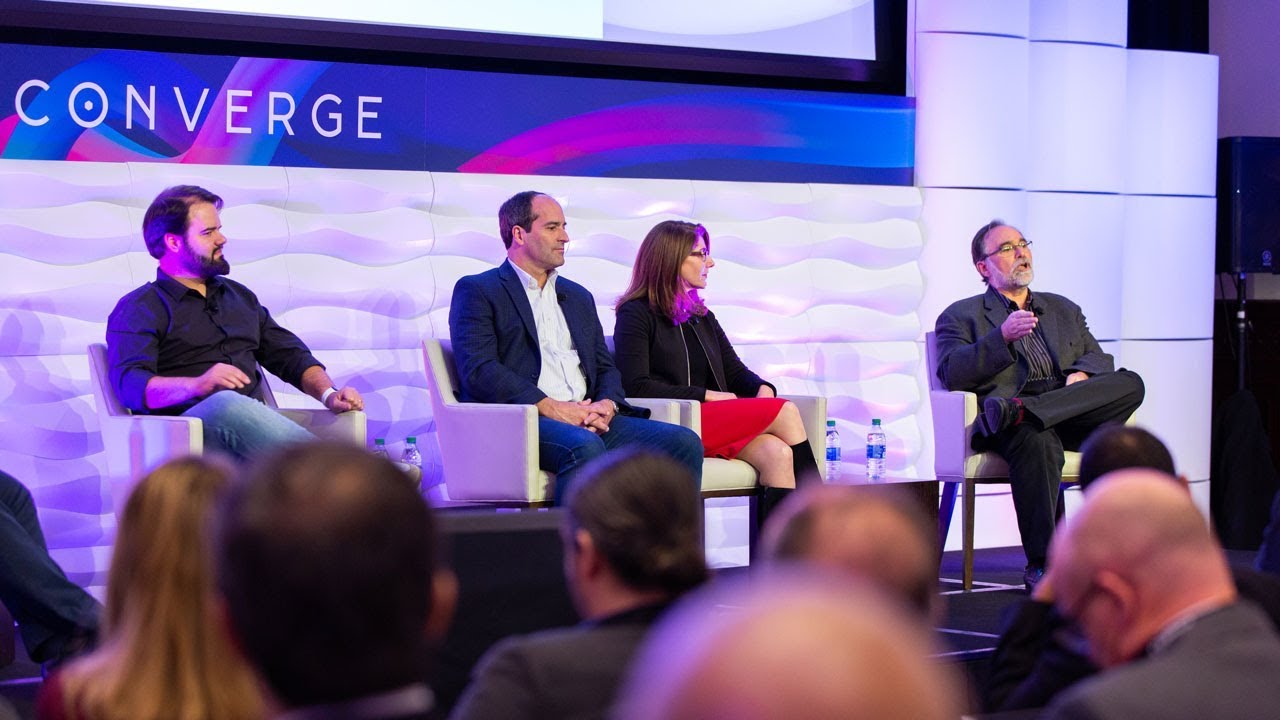
In this IDC‑hosted panel, moderator Sean Fitzgerald opens with research showing that between 2019‑2023 companies will spend $8.2 trillion on ICT, yet only 4 % consider themselves fully digitally transformed, highlighting a gap between investment and maturity. The discussion then moves to four senior leaders from AB InBev, Realogy, Merriam‑Webster, and Hershey, each describing how their legacy‑heavy organizations are tackling digital transformation while still running core businesses. Luis Barros (AB InBev) frames transformation as a consumer‑centric mission to bring people together, emphasizing culture, new talent, and data‑driven insight over pure technology. Dave Gordon (Realogy) describes a shift to a product‑framework that aligns agents, data, and analytics, and details the move from legacy systems to cloud‑based APIs and Agile. Lisa Schneider (Merriam‑Webster) explains how a 190‑year‑old dictionary modernized its database, adopted Agile, and leveraged social media to re‑engage both customers and long‑tenured staff. Pete Angeline (Hershey) outlines an “evolution‑over‑revolution” approach, the four C’s of transformation (culture, communication, cooperation, consistency), and a disciplined ROI‑driven prioritization process. Throughout, the panelists stress the need for a cohesive enterprise strategy, a multi‑horizon roadmap (foundational, capability‑building, art‑of‑possibility), and disciplined focus amid countless buzzwords. The session concludes with each panelist offering practical advice: maintain focus, start with the consumer or frontline employee, build incremental MVPs, secure cultural buy‑in, and act as the bridge between innovators and the broader organization.
Chapters
Good afternoon, everyone. My name is Sean Fitzgerald. I'm the Worldwide Research Director of Digital Transformation Strategies at IDC. And with me today on stage— I want to make sure I get this right— I have Luis, Dave, Lisa and Peter, and I'm gonna have them introduce themselves and their companies in a minute. But I wanted to just start with what is digital transformation and how do we view it? At IDC, we research this and have looked at digital transformation over the last several years. And our own research says that between the years 2019 and 2023, companies are going to invest $8.2 trillion in hardware, software, and services. And by 2023, over 50% of all ICT investment will be digitally transformation-oriented types of investments around those categories. And so what's interesting is you hear all this investment, it's a huge number, and only 4% of companies have realized themselves as fully digitally transformed entities. So the takeaway is Lots of investment, very early maturities. Lots of people are trying to get there, but they're not there yet. And as I like to say, digital transformation is both a team sport and a long game. So if you're not a tech company or a digital native, as we like to say, it's gonna be a 5, 10, 15-year journey depending on where you are and where you want to achieve to in terms of capabilities. And you're gonna have to partner to do that with different hardware, software, services companies. So very important to not have a transactional view of how you enable your digital capabilities through third parties, but to have a very much a relational view on realizing those capabilities with the right partners based on your journey and goals, et cetera. So having framed that, I'm going to have each of my panelists introduce themselves, describe their company and how they're viewing and approaching digital transformation Then we'll talk a little bit more about the struggles of trying to do that at the same time you're still trying to run a business. With that, Luis.
Thank you.
I'm Luis Barros. I'm the global VP of data, media, and digital products at AB InBev. AB InBev is the biggest beer company in the world right now. Digital transformation for us is more than using technology to be closer to consumer, to change the way we produce our beers or how do we get more efficiency to our business. But it's more about how we can fulfill our dream as a company of bringing people together to a better world. It's not about selling beers. We don't talk about selling beers when we talk about our dream for the future. But bringing people together is not something that only alcohol does right. In the past 10, 20, maybe 30 years ago, whenever we think about having some good time with friends, you were thinking about going to a bar, to a restaurant, open a beer, having a drink. Right now, people are socializing in many different ways. They are socializing online, they are using Tinder to meet other people, they're going out less and less, they're doing mood management not only with beer but with functional product, with cannabis. And how do we fulfill that need of people that goes much beyond beer and beverage itself, right? Right now, of course, beer and beverage overall is 99.9% of our business, but why we're not going to be a technology company that's going to create something that's going to enable people to go out more often, see their friends more frequently? And that transformation is much more about people and mindset and capabilities than technology itself. I'm new to the company. I joined 7 months ago. And one thing that I repeat a lot in our internal meetings is that if we didn't have the right technologies right now and the right capabilities internally, we could be doing much better if we only had the right people, right? So bringing specialists, people that can challenge the way we think, the way we behave, the way we think about our consumers and our business overall is as important as it is to develop technology and bring data and any other thing that we know that is helping most of the companies transform. What we want to achieve is to understand how can we fulfill real needs of the consumers, how can we be truly relevant for them, and what's the role of technology and data to make it happen.
Thank you, Luis.
So I'm Dave Gordon. I'm the CTO for Realogy Holdings, which very few people know what Realogy is. We're the largest residential real estate, you can think of home buying and home selling company in the US. You probably know us by Century 21, Coldwell Banker, Sotheby's, ERA, and on it goes. So we really have a very large position in the industry. Very few people can say this, we are one of the last great unregulated industries. We're very localized, very unconsolidated industry. So we view it as a huge opportunity. We're sitting around between 15% and 20% market share, and we're twice as big as anyone even close to us. That being said, pretty much everyone thinks the real estate process is pretty painful, a lot of paper. What's this broker for? What's my agent for? Those kinds of things. And there's been a lot of attacks on the industry. So I would say our position is this. We really want to both protect our current brands, protect our current business, and make sure we remain competitive, but then are really digitizing and creating products for our real estate agents. Because as much as we, in our strategy work, as much as you think the real estate agent may not be necessary someday, 'cause we're gonna digitize them out of a job, there's actually higher usage than ever. And as you look at millennials, they're gonna be, even though they want more of a digital experience, they still want someone to basically take care of the— take care of the work for them. And so we're positioning, that was not a criticism, by the way. But no, we're taking, what we're really doing is trying to digitize basically that agent experience with the consumer on the other side of it. And both replacing the products we've had for years with a bit of underinvestment historically in that, as well as then bringing in data. We've got the biggest data assets in the industry by far. We're the only national player, so we've got all the MLSs in the US and are really using those assets to take the products we're putting out to our agents, and I call them making them intelligent products. Leads are better for agents. We can actually start predicting who's going to sell their home, and so the agent can contact them through the seller leads analytics and a lot of other capabilities around insights in the industry that this industry is just that has not yet developed. A lot of your traditional mindset around digitizing, around creating analytics, but I think we really are in a place where we can leapfrog our competitors and create a better value prop for our workforce, for our sales force.
Hi, I'm Lisa Schneider. I'm the Chief Digital Officer and Publisher at Merriam-Webster. You may have heard part of Merriam-Webster. We're a dictionary company. Usually when I'm on stage, I'm the oldest company on stage. We've been around for 190 years, so definitely a legacy company. For many of those years, we did many things the same way for many, many, many, many years. For us, I think digital transformation was a combination of sort of 3 separate areas. One was what we're talking about when you say services and software and vendors and all of the things that you need to modernize your operation. But before you can do that, you need to get your team on board. You need to change the mindset. We can't do things the way that we did 200 years ago. And so a lot of digital transformation is really changing the mindset and creating more of a forward-thinking, agile organization I run the software team, among others. We do Agile development with a capital A, but I also really like to stress lower a, agile the concept. And so it means that you're responding to things and you're changing. That's a really hard mindset to engender and to change in a legacy company. And the third piece is how do you present yourselves out there to the world? So I can do all of these things. I can update our database and I can change all of these ways that we're creating the dictionary and storing the dictionary, what does it really mean to be a dictionary in the 21st century? And what does it mean to provide information to people in the places that they are? And so we really started with those concepts, and we started with that exact question, right? You know, what do we do? We write definitions. By the way, it's not a mission statement, right? That's a function. That's a thing that you do. And so we developed a mission statement, and our mission statement was, one, to propagate our irrational love of the English language, And 2, to help people understand language better so they can better understand and communicate with the world around them. When you understand that as a mission statement that is disconnected from the product that you provide, right, so it's not, you know, we do film cameras, and it's not, right, we sell real estate in a certain way. What is the underlying mission of what you do? You free people up to think about how that iterates on different platforms. And so we've been able to do that by changing our thinking, really engaging the organization, connecting with people, and kind of having that high-touch turnaround where we really engage everybody and really make them part of the process so that they get to do some of the creative thinking and take ownership. Then they're able to make the other changes that we wanna bring in in terms of the workflow and the tools that they use because from the get-go, they're part of that conversation. They understand how this is going to iterate. across things that will help us as a business.
Pete Angeline, Hershey Foods. For those who don't know, we make candy. My basic responsibility is to shepherd emerging technologies and innovation through the company, try and make the right people aware of them so that they can know what's coming down the pike, and then be able to leverage those as soon as possible. Technology at Hershey and the introduction of new technologies and transformations into more innovative systems, to use a more— a fairly topical example, is sort of like building Wolverine. You've got this— start with a human, start with something that's organic and has been functioning very well for a while, but now you're going to take out all of the skeleton, all of the bones, and replace it with adamantium. In order to do that, you've got to avoid killing the patient in the process. That's one of the tricks we have to deal with with Hershey. We've got all of these legacy systems. We've been around for 125 years. It's our 125th birthday this year. And we have processes that I think are still 125 years old that we're still using. But some are also moving forward. We have to be able to do this in a number of ways. And there are a couple of things to remember. And I'll touch on just a couple very, very briefly. The first is evolution over revolution. If you're going to do something that's that pervasive, you can't sit there and you can't go in and say everything's going to change at the same time. That's too hard. You're going to get too many opportunities for risk. You've got to be able to be focused. You've got to be able to move forward in a principled way, and you've got to be able to bring other people onto the process as you go through. And then the other side of that is and this is part of it, and this is going to repeat much of what's already been said, is the observation of the 4 C's of transformation. The first is culture. You've got to be aware of the culture that you're in. You've got to do it organic to that culture, which is the way people typically talk about it, is organic. You've got to be able to communicate to the people. That's the second C. You've got to help them understand why you're doing it. You've got to help them understand where it's going, where they fit in. You've got to have cooperation. You've got to have your people on board with you pushing in the same direction. And lastly, you've got to have consistency. You can't change over in the middle of it because all that work you did beforehand is going to get lost and you're going to confuse people in a situation where it's already difficult to understand.
Thank you, Pete. Thank you all. So where we see, and we heard each of the panelists touch on it, was that to be successful at digital transformation, You need a cohesive enterprise strategy. You need to have an implementation roadmap by horizon. To Pete's point, I can't do it all simultaneously with trying to run the business. One of my observations is when anybody talks about digital transformation or we advise, they typically start with a whiteboard. I jokingly say, no, you've already got a Rembrandt on the page. You're trying to paint a Pollock over it and eventually get the Rembrandt to go away. You know, that's where the complexity is. So having that strategy, having that roadmap of what do I need to do today that's digitization foundational that I can build capabilities on and kind of my second build-out horizon, and then what's the art of the possible in the third horizon. And then the last thing that we see at IDC around digital transformation are those investments. Building a digital platform that is scalable, that really centers around intelligent core, that extends into your markets and ecosystems so you understand customers that extends into your value chain and your supply side so you can actually empower and enable workforces and deliver value. And so what I would ask each of the panelists as we have, uh, you know, several minutes left is, what are you prioritizing? What's the most difficult part of creating your Pollock over the Rembrandt? And, and really, and I appreciate the sharing of your stories, but the last thing I'll ask each of you to do is what's the best advice you could give the audience as far as if they're engaging in their own transformations or part of that team that's helping other companies engage transformation? Luis?
The biggest challenge is the balance between deliver and transform. There are a lot of things that we need to keep doing to keep moving the business forward, to keep growing, and technology, data, and digitization overall can help us to be more efficient. But we cannot take one step after the other and wait to be transformed in the next 30 or 40 years. At the same time that we're delivering at a more efficient way, we need to be building the foundations that will allow us to transform the company. So making sure that we don't keep— we don't lose the focus on doing what we need to do to keep growing, to keep delivering value from the consumers to the stakeholders, and by the same time invest time, money, and resources in transforming the company, measure what is working, what is not, And being able to prioritize what's going to help us to go to the next steps is paramount. And I think another challenge that we have on top of that, again, going back to the culture point that I started, we need to bring new specialists but also help foster the culture that brought us to where we are and enable us to move forward to make sure that we add value to the business overall. Because it's easy to talk about, okay, let's use big data, let's use IoT, let's use AR, or all those buzzwords, but if you don't bring new capabilities to the company, what is the value that I'm adding by the end, right? We need to keep focused on adding value to the consumers, making sure that we are using data and technology to understand them better, to create things that deliver more value to them, and engage them in a seamless way. The biggest transformation that we saw was not on technology, how people behave, what consumers are expecting from companies like AB InBev with beer, like Hershey's with chocolates, like, like from dictionaries is much different than they were like 20 years ago. So if you do not, if you're not able to understand them better and deliver what is the next beer or what they are expecting from bringing people together is, that's the biggest challenge. And I think the main advice that I could give to anyone is have focus because there are too many things, shiny things on the table, too many buzzwords, a lot of inspirational content around. If you don't have a focus and know where you want to go and what success looks like to you, you're going to be
So, before we move on to you, Dave, would you say start with your customer or start with your operations? And your— or do you think it depends by industry?
On our side, always the consumer. The consumer is the only one that can fire us, that can change from one beer to the other or from beer to Facebook. So, If we don't understand what consumers are expecting, we cannot build a future for them.
All right, thank you. Dave?
Yes, I'd say our challenge, we've really shifted our real company's focus across several lines of business, but really to the product framework. It's something we were not doing as of a couple of years ago, and it's really not just that concept of product, but having a framework that said, here's the core functions that are real estate agents or our title agents in our mortgage business, here's the types of services we actually have to provide them, and being very specific about that, and really having a company alignment around that, or a business unit alignment with technology. And we spent quite a bit of time doing that because we realized we were all over the map. People thought other things were more important than others, and having that, maybe it's the C in the consistency, in what that framework is, what products then plug into the framework and then deciding which are most important. That really gave us the alignment, the focus, and the commitment then to replace products, partner with vendors or third parties to help us with products or develop our own. Then as we build them, make sure they're much more integrated, much easier to use, and get into the experience mindset. I'd say that's the biggest challenge I think that we've largely overcome. I'd say the secondary part of that is within the technology organization, flipping from more of a legacy organization to we're up and running with Agile, we're starting to build with the cloud, we're starting to leverage and build out an entire API framework for other vendors to plug into and expand our services that way. But we really were trying to do both at the same time. I think we've had a lot of progress along both vectors. But we are changing an awful lot all at once, and managing that really closely, I think, are the two aspects of it. To your question, we start with kind of our broker, or agent, real estate agent in mind, and understanding what they need to serve their consumer on the other side of them. I call it our sales force, effectively.
Okay, great. Thank you, Dave.
Lisa? So I think you need to play out that chess game, right? Sean, you said it's a marathon, right? This is something that generally takes time. especially if you are sailing the ship while you're rebuilding the ship. You really need to think about, sort of, again, kind of back to software development, I come out of product management, is that idea of an MVP, right? What is the thing that you can change in some kind of discrete way that you can then iterate upon or add onto without trying to change everything all at once and without disrupting the entire workflow? And so I think sort of figuring out what that is. So for example, in our case, Right? We've had a dictionary for almost 200 years. Guess what? We didn't really have a properly modern database of all of the elements that are in the dictionary. And so for us, it was identifying, hey, this is something that I can change. I can build on the side. I can continue working off the data structure that we have, and I can update it on the side and then plug it back in, and that will change everything. And so that was one discrete piece that we could do that had a lot of effect. But the other thing that we did is we looked for something more public-facing, right? So like, I'm gonna be a tech geek, I'm gonna be like, we updated our database, it's really cool. And that was great for us and it really did make a lot of other things possible, right? So understanding, I'm not starting over here and working backwards, I'm starting with the core of what I'm doing. The other thing that we did, and this sounds not so high-tech, but it was really important for us, is kind of changing that public face. So another thing that we did is we went out on social media and we were able to get a huge amount of buzz on social media. So I don't know what industry— who follows Merriam-Webster on Twitter? Like nobody. Okay, you're all in the doghouse. So spoiler, we've won a ton of awards for our social media. We've won several Webby Awards. We've won Shorty Awards. That's right, take out your phone, go look it up, go follow Merriam-Webster on Twitter. You'll thank me later because it's very smart and funny. And it's very, like, clever smart. And you'll learn something. And this is exactly the point, right, is that I came to Merriam-Webster, and I'm working with these people. They're so smart, and they're so funny. Language is still relevant to us today. A dictionary is not a commodity. It's not a doorstop, and it's not a dusty book on a shelf. We're working on updating language all the time, and language changes all the time, right? We just updated a ton of words. We added a ton of words to the dictionary, made an announcement a couple of weeks ago. We got like a billion potential impressions from our new words announcement. And so going out on social media was a way of connecting both with our audience, but also internally with our team, who, by the way, was very, very nervous about this. Okay? I'm like, oh, we're going to pull back the curtain and show people who we really are. And they're like, no, no, we need to have like 18 layers of editing, you know, because we're the dictionary. And I said, you know, we don't. And so they didn't, you know, they weren't so comfortable, and we did it anyway. And then they were like, oh my God, this is amazing. Everybody loves Merriam-Webster. And so we were able to excite our audience and also excite our team by the way that we're able to connect with our audience on this digital platform that then made them hungry for more. So both, both them, right? It made the audience hungry for more. Now I can come out with a product and I have a pipeline to show it to people because we're on social media and I have a database to build it with. And so all of those things start building on each other. You have to play out that chess game from the
Pete, before we go to you, I just wanted one call out for Lisa. She talked about getting her team on board and the fact that they engaged in the social media. I think what's important to know, and all transformations are bespoke because the details and the context absolutely matter, but we talked a little bit back in the green room about the average tenure of some of these employees at Merriam-Webster. Right. I think that's a huge thing because people are creatures of habit and habits are functions of time. So could you maybe just convey the length of, you know, some of these employees?
Yeah, Merriam-Webster is such an interesting organization. So, you know, clearly I'm on the digital side. I've been at Merriam-Webster about 5 years, and I'm based here in New York. We have a small outpost office. But Merriam is based in Springfield, Massachusetts. That is where all of our lexicographers are. Lexicography is the art of creating and writing definitions and dictionaries. The only way to be a lexicographer is to be a lexicographer, right? There's no course in school. And so we hire people generally out of school. They come to Merriam-Webster to be lexicographers. They think they're interested. One of two things happens, right? Either they're like, oh my God, this is, like, it's sort of monastic work, right? Like, it's very heads down, quiet, researchy. And so they're either like, oh, this is not for me, and they leave. Or they're like, this is awesome, I was meant to do this, and they stay for 50 years. Okay? So when I came to Merriam-Webster, there were people who had been at Merriam-Webster for about as long as I had been alive. And so you're talking about dealing with people who literally have been doing this for 40 years. Many of them, right, have been doing it the same way for 40 years. Now I walk in and say, oh, hi, we're gonna change. So that was not gonna work, and I knew that was not gonna work. And I literally, you know, for me working at Merriam-Webster is great because, P.S., I ended up in technology, but I'm a total word nerd. Like, I was the copy editor of my high school newspaper is how much of a word nerd I am. And so when I get a call from a recruiter saying, you know, you wanna come work for Merriam-Webster, I was like, yes, yes I do. What do I do? I go to Springfield, I sit with the editors, and I tell them all those stories about how I'm such a word nerd, how honored I am to work at Merriam-Webster, that I feel this is a national treasure that we've been entrusted with, right? So I connect with them and it's clear that we share the same spirit and that we share the same mission, start to engender an attachment and a trust. And that was the sum total of that conversation. The conversation was not, I love language, so trust me, we're gonna change everything. It was like, I love language, I'm so happy to be here, nice to meet you.
So anyway, important takeaway that you need to get that team building. It's a we, not us and them. So I just thought it was a really, really great part of your story, so thank you. Pete, please.
Prioritization for this at Hershey, has a couple of factors to it. The first is, first you have to identify those functions, those departments that are ready. You have to look at them. You have to say, do you have a sufficient process? Do you have sufficient data? Do you have a stakeholder there that's going to work with you, a champion, the support of the other people in the department, people willing to learn? That's a main focus of what we do. Go scope out the individual department. Or whoever is interested in doing some of this work and trying to make sure that they've got all the right pieces in place. The worst thing you can do, or one of the worst things you can do, is to start with somebody with a project that looks really good, and then one of those things becomes a roadblock, and then nobody gets anything done that's worthwhile. The second is, is once you've identified those problems that are applicable and ready to attack, go for the ROI. Because if you're going to be incremental, you've got to continuously prove your value. And every time you tackle a problem with sufficient ROI, you get noticed by more people. You get noticed by more people in the company who then come to you and ask for your help. And then once you move that forward, you can go look at their system and say, well, before I can help, you need XYZ, ABC. And they're much quicker at getting that stuff done if they know there's money in it for them. So those are the basics that we try to do when we're prioritizing. Best advice, it's neither of those actually. Those of us in the room, we're innovators, we're the creatives, we're the people that understand this technology. We know where it can go, we know where it is, we see the connections early. The people we have to talk to and work with, they're not us. They have a different mindset, they have different skill sets, and it's our job to bridge that gap. It's not their job. It's the innovator's job to bridge that gap, to be able to Figure out how you communicate to them. One of the things that we've done is we try to look out 10 years and say, where's all of the— this is the strategic futurist in me. We look out 10 years and say, where are things going? And then we do what I call lily padding. We pull it all the way back in and say, what's that one first step that everybody will be able to understand that heads that direction?
Pete, do you see part of that process, again, with trying to operationalize your transformation at Hershey, again, You know, manufacturing, we only make chocolate a certain way, etc., of doing the what's in it for them as part of that, getting them on board to say this will be a better way to adopt these technologies, processes, and ways of working through the transformation?
What's in it for them is maybe a little cynical. I might say you want to bring people along with you and be partners. And as we all know, you know, success has many parents and failure has is an orphan. But if you get some in the door and you can show them that you can deliver, people want to add to the process. They want to be a part of it. They want to be emotionally invested in something that's going to go somewhere. And that emotional investment is pretty easy to do when you come in and they say, well, what if you did that? I think that's a great idea. Let's keep moving with that.
Great. Well, we're out of time. So I just want to take a quick moment and thank each of my panel participants. I want to leave you with 2 pieces of information. I just did a piece of research on which are the critical functions to transform, and then we also did a bit of a force field analysis saying which functions are impeding that transformation the most. As you would expect, in the process of digitization and digital transformation, IT was far and away the biggest enablement, but as you heard from our panelists today, it may start with technology, But it's very much a people story and a process and an engagement. And then what was really interesting is the biggest impediment to digital transformation as a functional area is strategy. So that was really kind of surprising in our findings. So the takeaway there is obviously if I can't aim this transformation to do the right things, I'm never gonna achieve on any of it. So with that, thank you all for your time and your contributions. Thank you.
More from Kaihan
#856 (Video): CRMC Keynote Kaihan Krippendorff on making your brand a disruptor not disrupted