Webinar | Leadership Tools for Tomorrow’s Innovative Leader
Lisa Fagan and Kaihan Krippendorff discuss the mindsets and frameworks that enable innovation inside organizations. Over 70% of transformative innovations in the past 30 years came from employee innovators, not entrepreneurs. Kaihan's INNOVATE framework maps the obstacles internal innovators face and shows leaders how to remove them.
Chapters
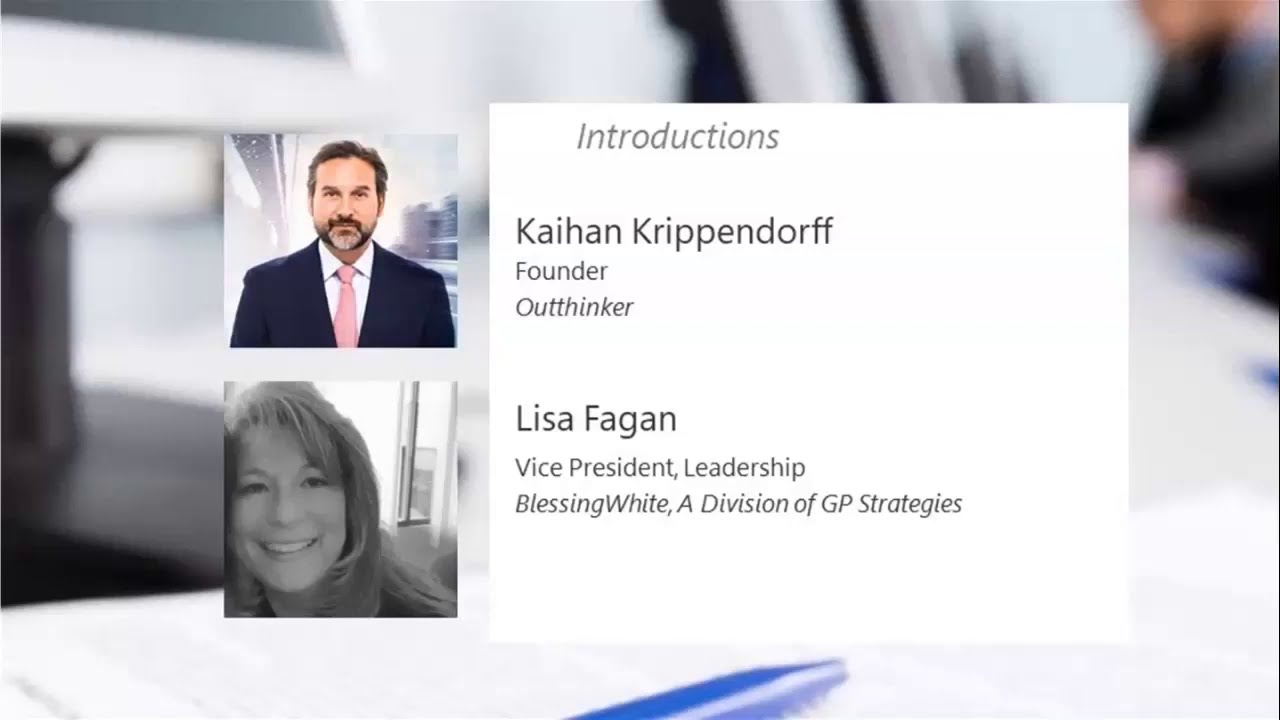
I'd now like to introduce you to today's presenters, Kaihan Krippendorff and Lisa Fagan. Lisa is an executive responsible for global leadership strategy and client engagement for GP Strategies. She brings more than 20 years of experience in the learning and development industry and as a leader of client engagement teams and advisor to clients seeking to achieve their workforce performance goals. Kaihan joins us as the founder of Outthinker, a former McKinsey& Co. consultant, and author of 5 business strategy books. Most recently, he's released Driving Innovation from Within, which I believe he'll be talking about today. He's also recognized by Thinkers50 as one of the top innovation thought leaders in the world today. He's focused on business growth strategy and innovation. Kaihan is also an active keynote speaker and advisor and leads the Outthinker Strategy Network, a global peer network of chief strategy officers from Fortune 500 companies. He's earned degrees from the University of Pennsylvania, Wharton, Columbia, London Business School, and holds a doctorate in management. He's also a very important and strategic partner with BlessingWhite, a division of GP Strategies, so we're very happy to have him here today, and through which we've brought his innovation approach to numerous clients throughout Learning Solutions. So, without further ado, Lisa, I believe you are going to take it away, so I'm going to give presenter rights to you.
Thanks, Kayla. Great to be here with everyone. Thank you so much for joining us here today, and it's wonderful to also be partnering with Kaihan, a great strategic partner of our organization. So as you can see here from our agenda, we're going to start by diving into the research results from GP Strategies, and then I'll be handing over to Kaihan. And we've got a lot to cover, so I won't spend time going through each bullet of the agenda. I'll just dive right into the research that we have done at GP Strategies and let that be a backdrop for Kaihan's presentation. sharing with you. So the last couple of years, there have been a lot of articles and a lot of buzz about the mindset shift that leaders need to make. The phrase that's been used is it takes a mind shift. And that's been peppered throughout leadership and business articles that we've been seeing. And that's been compounded by the digital disruption that we're seeing in the workplace. So when you couple the digital disruption with what we're seeing as normal business changes over time, We're really seeing a situation where it's clear that the business environment is calling on leaders to think differently today. With this backdrop, GP Strategies decided to conduct 2 research studies to provide today's leaders with an understanding of what they needed to be successful, not just today, but into the future. In the first study we did last year, we asked leaders what mindsets they needed to adopt in order to be successful. 4 key mindsets came out of that research that I'll share with you in just a moment, but these were considered critical to the success of a leader. This year we decided to go deeper. We did a second study, and our research focused on probing further around those mindsets and determining how leaders could embody those mindsets through behaviors. So for all the buzz that we're hearing about it taking a mindset shift, there really wasn't anything articulating what it meant in terms of behaviors. What did that mindset shift look like in terms of behaviors? And then we went one step further. We said we wanted to know what were the challenges that leaders were facing that prevented them from being successful and embracing these behaviors. What did good look like? And we want to share those behaviors with you along with the challenges and how we can best set you up for success. What I'll share with you now is just an overview of those findings. There's just so much information that could be shared, it would take more than the hour, so I'm going to really buzz through it. But what's important is how these mindsets and these behaviors set the stage for cultivating innovation in your organization. So let's dive in. Let's get a grounding for how we're defining mindset. We are defining mindset as a particular way of thinking. It's, it's what's shaped by your attitudes and opinions that guide and influence the actions you take. The behaviors are driven off of those mindsets. So essentially how you show up as a leader is coming from how you think. That's how we're defining mindset. In our research last year, 90% of our respondents indicated that growth, inclusive, agile, and enterprise mindsets were necessary to be successful as a leader. So these were the 4 Big 4, if you will, that we identified through our research that were required from the perspective of the leaders that we polled to be successful in business today. So if you start in the upper left-hand corner, growth here is being defined as how we're growing and developing our people. Inclusive being defined as how we're inviting others with differences to the table to have the conversation and work on projects. Agile being defined as the ability to fail fast, learn from those failures, and pivot in the face of change. And enterprise being defined as the ability to look across the business and be sure that you're anchoring whatever work that you're doing to overall business objectives. So let's look at these a little bit more closely. What the research told us was that— and what's really important to emphasize right now is that when these mindsets are present, And leaders perform the actions associated with, with these mindsets. They create an environment that pushes the boundaries of what's possible. It encourages people to seek diverse opinions and approaches, empowers employees to make decisions, and all of these fuel innovation in the business. But what they equally told us that gets in the way of their ability to adopt these mindsets is the constant pressure to produce. The pressure on time, your own sort of self-limiting beliefs about what your team can accomplish, the fear of taking risk, and your own lack of connection to an organization's strategy and goals. So in the face of these obstacles, people have a tendency to fall back on existing processes, things that they've usually done, kind of the what they're used to, a consensus. consensus mentality and going to the same people that they're used to going to instead of branching out. But if you can press past these obstacles, what we heard from leaders is that the results can be phenomenal and that employees will thrive. So let's look at these mindsets in a little bit more depth. So if we look at the growth mindset, you can equate the growth mindset to essentially developing your people. to coaching people. They're absolutely aligned. A leader who coaches instills confidence in their employees. They provide space for their employees to choose their own path to success. A coaching mindset or a growth mindset, they work hand in hand and they create a belief in the individuals that you're working with that they can be a resource for you and that they can— you can unleash their potential. and not tell your employees in a very prescriptive way what they should do, but allow them to find that for themselves. A leader with a growth mindset also needs to understand that their employees' strengths and weaknesses, what they are, so that they can coach to the appropriate contribution, and that that invites innovative thinking. We also know that it's equally important to understand your employees' values so that they can be coached to satisfaction. Having that dual focus really drives that level of development and that level of engagement from your employees. What gets in the way here again is the lack of time, taking the time to do those coachable moments, those in-the-moment conversations with employees where you can actually help them overcome some of the challenges that they're facing and get to that next level of understanding and confidence. But if you're able to find the time to take those coachable moments, do those coaching moments with your employees and really develop them, the payoff here can be really great. The payoff looks like this. You know it's working when your employees are proactively taking on challenges, when they're feeling empowered, when they're taking risks, when they're thinking out of the box. In the inclusive mindset, here what we're saying is that inclusive mindsets means that you're inviting feedback from people who think, look, or behave differently from you. So what gets in the way of your ability to think, to invite these folks to the table, is often your own personal bias, your own unconscious bias. About whether or not they're going to bring value. The fear of taking risk to invite differences to the table, people from different perspectives, and having confidence that they're going to be able to raise the level of the collective group. So, if you're able to overcome that bias, which is really the biggest challenge, it's really hard to overcome your own personal bias. But understanding that that can help to drive and bring— lift the thinking of the collective group. You'll know that it's really working and that you're adopting the inclusive mindset when you hear words from your team like they're speaking without fear, they're engaging in constructive and healthy debate, they're collaborating with one another, they're less dependent on you as a leader to give them all of the answers. The agile mindset is where we're talking about pivoting, as I mentioned earlier. It's the ability to sort of bob and weave when you're dealing with changes and your surroundings, your ability to embrace the changes that are happening either in the business or in the work world and making adjustments accordingly so you can still drive to success. The most important capabilities of an agile leader are the ability to adapt to that workplace dynamics and the obstacles and to rebound from challenges. 31% of our respondents identified adapting to workplace dynamics as the top skill of an agile leader. For an agile leader, it's the ability to overcome those obstacles and bounce back that is the most prized when you're looking at recruitment of leaders. Now, what gets in the way Is again time pressures, a structure that is dependent on a lot of approvals, stakeholders, and processes, getting into and falling into analysis paralysis. So if you're able to, as a leader, rise above, be fearless, be bold, what success can look like is teams that are empowered, that have sort of a we got this mentality. And that have a bias to action. They're about getting things done instead of waiting for people to tell them to go do something or to give them permission to take action. And finally, I'm going to skip that slide because I already covered it. And finally, on the enterprise mindset, what we're really talking about here is the ability to look across the business and to understand that it takes, you know, don't fall into silo thinking. That it takes the whole business to make the overall organization successful. This one was really probably the most surprising result that came out of our research. When we looked at the enterprise mindset and the fact that it called on the leaders to be engaged and connected to strategy, our feeling was sort of like, really, isn't this what leaders are supposed to do? Isn't that what their role is all about? But as we got deeper into the discussion with the leaders, the respondents of the survey, it really became clear that it was just because that they're supposed to take these actions doesn't mean that they're actually taking those actions. And what we heard was that when leaders are fundamentally able to help individuals link what they do to the work that the team does with company goals, then they're really adopting and embracing the enterprise mindset. It's really making that connection for them. Employees get caught up on the day-to-day activities, and sometimes that feels like they're disconnected from the larger group. And it's the job of the leaders to help them be focused and anchored. So the leaders really become the bridge between what the employees are obligated to do on a daily basis and what the strategy is for the business. So what gets in the way is the failure to make those personal connections to those corporate targets. And the day-to-day activities. The lack of knowledge of what the company really needs to get accomplished and tying that to what your daily tasks are. So what employees then, if you're able as a leader to make those connections for your employees, what success can look like at that point is employees are using their own language to define what company strategy is. They're not using corporate speak. They're using their own terminology. And they're articulating what success looks like relative to the whole group, to the whole business, to the whole team, rather than their own personal success. So just to summarize what you can do as a leader and what we've shared with you in terms of very quickly high-level overview of the mindsets and the behaviors that are needed to bring these mindsets to life, let me just quickly take you through this this chart here, if you will. When it comes to a growth mindset, what we say is that learning and growth are highly prized, that developing people are highly prized, but organizationally we then reward speed and accomplishment. So as an organization, try instead to create a coaching culture, one which leaders know how to coach others and do as a normal way of operating every day. They're having those coachable moments with people, and where you as a leader are finding those coachable moments. You don't need to sit down in meetings or formal type of settings to help really develop the people that are on your team. From an inclusive mindset, what we say is that we're seeking input from a range of perspectives. There's a lot of corporate speak around Hey, we want to make sure that we're engaging all of the differences and tapping into the potential of differences in the organization. But what we really do is we drive for consensus and we rely on our go-to people. So as an organization, we really need to try instead to ensure that our C-suite has a sense of ownership and connected to the importance of a diversity and inclusion strategy for the business. and they need to model it. As a leader, we can instead, as individual leaders, try to seek input until it becomes a habit and that it's not an extra thing to do, and we're overcoming that unconscious bias against bringing people to the table that we perhaps haven't worked with in the past. When it comes to an agile mindset, what we say is that we make decisions quickly. We want to fail fast. We want to rebound from the challenges around us. But we then get weighed down or bogged down with cumbersome processes, extensive analysis, and trying to get stakeholder buy-in. So instead, as an organization, why don't we try to evaluate the processes that we have that get in the way? Are they too cumbersome? Can we eliminate some steps? Can we minimize the number of people that are involved in decision-making? And as individual leaders, Can we try instead to empower people on our teams, help them to make the decisions, and not rely on us as the constant point of decision in every instance? And finally, as an enterprise mindset, we say that we make decisions that benefit the larger organization and their goals, but we fail to connect those decisions and day-to-day work to those goals. And that's the breakdown in enterprise mindset and thinking and behaving in terms of the whole enterprise. So instead, as an organization, it's so important to just be plain-spoken and move away from using lofty terms that just create that sort of glazed view of the business and just focusing in on your work. Well, out of love with complicated vision, mission, and values language, make it real for your employees. And as leaders, connect and reconnect employee conversations to organization goals. So make that a regular practice, a habit to show how the work that they're doing connects and drives what the overall mission and business objective is. So that's what I have to share with you in terms of mindsets. The most important thing, as I mentioned at the very beginning, and this slide, by the way, is just another way of saying what I just shared with you on the previous slide. But what I want to leave you with is the importance of these mindsets being the foundation for driving innovation. And if you think differently, you will act differently, and you'll drive growth and innovation for your organization. So I'm going to hand over to Kaihan now, who's going to take that one step further.
Great. Thank you, Lisa, for sharing this with me. Um, I have many more slides here than I planned to go through, so I'm going to jump around a little bit. You won't see that, but I want to just give you a little bit of a kind of unpacking of what I'm going to share. And then I'll ask for people's input through your questions or comments in the message, in our message board. And that'll kind of direct where I go. But let me tell you kind of what I have been interested in and what I've been working on. So I have for the last 10 years or a little bit less than that, to a great extent through a partnership with Blessing White, one of GP Strategies companies, been running workshops on innovative disruptive thinking. How do people generate very disruptive ideas? However, we found, although we conduct these programs through a great number of large organizations, we kind of expect that the ideas that are generated through the program won't turn into reality when they're introduced inside an established company. Sure, sometimes they do. But we believed, as so many people believe, that it is easier to innovate as an entrepreneur. And if we look at the most admired innovators in business, they all follow a surprisingly similar narrative. They are not employees. They get an idea, usually when they're pretty young, usually in college. They go to the West Coast and they step into the garage. Here's a picture of Hewlett-Packard's garage. And they build something, usually with a small team. the hipster, the hacker, the hustler, and they launch a technology or a product or a business that then disrupts the industry. And this idea that really it is entrepreneurs who have the freedom to innovate and take the primary role in innovating is so prevalent that there are very smart people who argue that it necessarily is this way. Clayton Christensen, for example, who is the Harvard professor that introduced the concept of disruptive innovation, he wrote, the very decision-making and resource allocation processes that are key to the success of established companies are the very processes that reject disruptive technologies. In other words, the way that established companies maintain their scale and advantages are precisely the practices that will reject something that is new. John Hagel and other innovation experts, they talk about corporate antibodies that emerge around a new idea that protect the mothership from the potentially damaging effects of this new idea. So one day we ran a workshop and about 3 years afterwards I was listening to a radio program, NPR, and I heard something that encouraged me to challenge this commonly accepted belief. I heard about an innovation that came out of one of our workshops that actually turned into something and was recognized by NPR, by CNN, by BBC, by many media authorities as a truly unique, a true departure from the norms of publishing. And so I went to interview the person who was at the workshop who came up with it and asked her what her path was, and that planted this question in my head. Is it the truth that entrepreneurs are the innovators, or do we tell the story of entrepreneurs as innovators because it's a more interesting story to tell? So I sort of reverse analyzed the sources of great innovations. I found a validated list of the 30 most transformative innovations over the last 3 decades. This is from a panel of professors based off of 2,000 submissions, and they debated and debated, and they came up with this list. And these are the big, big innovations. These are email, the internet, DNA sequencing, MRIs, you know, the big transformative innovations. And what I looked at was on the left column here, who conceived of the idea, and then the middle column, who then developed the solution, and in the right column, who then scaled the solution and brought it to market. And if you look at the blue area, that's pretty hard to see because we've got a lot of information here, but just look at the colors. The blue area are entrepreneurs. And if you see that entrepreneurs only conceived of 8 of the 30. And what that means is that over 70% of society's most transformative innovations were conceived of, we owe their existence to employee innovators. If it were not possible for employee innovators to innovate, you would not have a mobile phone to reach for. You would not have the internet to connect to this webinar. You would not be able to send an email. If you got sick, you couldn't get an MRI. You couldn't get a stent. The world would be a dramatically inferior world if it were not for employee innovators. Now, we all know that the way that we know what is possible is by hearing stories, right? We hear stories of someone doing something and we think, wow, we could do that too. And what this data, what it points to is that we're potentially, by celebrating entrepreneurs, to such a greater degree than we study and celebrate employee innovators, we risk communicating to employees that they are not meant to be the innovators and they might stop trying to be innovators. So I really believe that what we need to do is study not the entrepreneurial journey exclusively, and I love entrepreneurs. I'm an entrepreneur. Many of my friends are entrepreneurs. But what we need to do is we need to identify, study, explore, celebrate the narrative of the employee innovator. So I started doing that. I started looking at employee innovators. What was their story? And what I found is I thought that they would be working in the incubation lab or on the innovation team or maybe they'd be in R&D and they would follow a process. Companies invest over $300 billion a year in formal innovation programs. But what I found is the internal innovators rarely follow that program. They're never part, they're hardly, rarely part of that formal program. They usually find an opportunity to do something that they're passionate about, that will impact the world, and that will also impact their business. Heather Davis is a good example. She's a client of ours. She was until recently a very senior person at TIAA. She's behind many innovations. This one is one that I can tell you about because it's public. So TIAA, you might know them as a retirement fund manager. But what you don't perhaps know about them is that they also own a lot of agricultural real estate. They are the largest private owner of farmland in the United States. They own more wineries than anyone else. And they had a problem, which is they were having difficulty finding migrant workers for their orchards because there was a change in immigration law and they didn't feel comfortable hiring them without really doing the right thing. So Heather flew over to the West Coast and she went to see these orchards and she saw the kind of work that needed to be done there. Now she brings something else to the equation and this is something that I think is beautiful about employee innovators is they bring something unique to them to the problem. And what she brought was the fact that her that her child, her son, is also autistic. And she recognized that the kind of work that is done on a farm is ideal work for people with autism. So she created an innovation. She launched a program within TIAA called Fruits of Labor— excuse me, Fruits of Employment. And what it does is it helps people with autism find work on farms. Now, they don't just get to work on the farm. They get a driver's license. They learn to drive. They have their own money to spend. They get something on their resume. It is a way for them to step out of their house, living with their parents, and become productive, engaged members of society. And hundreds of people have gone through this program. I can show you story after story, but each time what you'll see is the entrepreneur sees an opportunity and even if they're not asked, they pursue that opportunity. And so it is not the entrepreneurial story and it is also not the kind of the story of the internal incubation team. It's something else and I think it's important that we get to it. Another way to think about why what they do is different is that if we look at how innovation is done, the right approach really depends on the scale of the entity in which you are seeking to innovate. When— if we look at the left-hand side of this chart, when a company begins, they are a startup, they're a disruptor, they're risk-taking, and so they can be more agile and act more innovatively. But as they scale, the level of entrepreneurship, that's the dark blue line, it decreases. And it decreases because companies introduce bureaucracy, they narrow tasks, they tightly monitor tasks, they become more risk-averse. And that kind of makes sense because when you have a business model that works, you want to start repeating the business model. But if you continue to scale, then 4 new things come into play that make it possible, and even preferable, to be entrepreneurial from inside an established company. But you need to do it differently. There are 4 things. The first is scale. You have scale that entrepreneurs can only dream of, that if you introduce something, if Heather Davis came up with that idea outside of TIAA, she wouldn't be able to immediately turn on and introduce it to many, many farms. You have multiple capabilities under one roof. You've got experts in all divisions of your company and functions. You have resources that you can invest in innovation, and you have the ability to absorb and diversify risk. Jeff Bezos said, if you have a 10-in-1 chance of a 100 times payoff, you should take that bet every time, but you have to be ready to lose 9 times out of 10. So my point is, it's not that large means Entrepreneurship or innovativeness decreases. What it means is that the way that you innovate is different. So I interviewed 150 internal innovators and I asked each one, what was your path? Because I'm trying to lay out the path of the internal innovator. What are the barriers that you faced? When did you face them? How did you overcome them? And if we take all of their responses and I kind of collated it 7 key steps and barriers pop up. And just to make it easy to remember, I put it into a framework called INNOVATE. So you can think of this framework as either if you were an internal innovator, what are the barriers that you were going to face? What's the path that you're going to follow and how do you overcome that? If you're a leader, you can think these are barriers that I and my organization are placing in front of our would-be internal innovators. Which ones are slowing down in the flow of innovation, and which ones can we address to unlock the flow? So I'm going to quickly go through this, and then I'm going to ask for your input, if you don't mind, if you don't mind typing into the Q&A dialog box if there is one that you are particularly interested in going deeper into. And if not, I have my 2 or 3 that I wanted to go into with you, but I want to customize this for you. So we're going to stop at the bottom left where you see intent and you see this fire, right? What this is, is this speaks to that— I'm just going to underscore over here if I can— what this speaks to is that— there we go, right here. So intent, it is activating the intent to innovate, that many would-be entrepreneurial internal entrepreneurs, they've been told so many times that they have given up trying. And when you don't have an intent, you don't take action. Indeed, you don't even see opportunities to take action. It's a little bit like when you buy a new car, when you want to buy a car, you start seeing that make of car around the city, right, because you have an intent that you're gonna get this car, you start seeing opportunities. So often when people don't have the intent, they actually don't even see the opportunities when they appear. And there are 3 primary barriers that you wanna look at to unlock intent. The next is need, and this really speaks to when Lisa was talking about the enterprise mindset, that many, People don't understand what the strategy is. Indeed, 55% of mid-level managers in large corporations cannot name more than 2 of their company's top strategic priorities. So we might activate their intention, they might start looking for innovations, but they might be looking in the wrong places because they don't understand what the market needs or doesn't understand what the organization needs. So thanks for typing in. We're going to go into some of these. We won't be able to go into all of them. The next is generating a portfolio of options. There's nothing more dangerous than an idea when it's the only idea you have. And sometimes a would-be internal innovator, a frustrated innovator, has that one idea and they are pushing that stone up the hill and they don't want to give up because they don't realize they have another 100 ideas behind it that they could pivot to. So there are techniques to generate a flow of options and manage a portfolio of options. The next one is value blockers, and to be honest with you, I really wanted to call this business model blockers, but I wanted to spell innovate, so I named it V. There are 8 potential value blockers. You introduce an idea and your idea has a certain natural business model around it. You're introducing it, if you were an entrepreneur, you could just introduce it in the market and you could design your business model, decide how you're going to price it or distribute it or organize your people to deliver it, it or market it or who your core customer is going to be. You could make all those decisions with a blank sheet of paper. But when you're doing it inside an established company, those boxes are already filled in. You're operating within an existing business model. And many internal innovators who grow frustrated, they will conclude that this idea just cannot be done from inside because it is being rejected. Just like when you transplant an organ, it could be rejected. But when you do transplant an organ, there are things that you do to adjust the situation in order to reduce the rejection. And there are clever things that internal innovators do to identify, predict what those value blockers will be, and neutralize them by making small adjustments to their idea. After that, they take action. And I think this speaks to the agile mindset. Being proactive, being willing to take action on an idea before it's proven. Many organizations are grown up to adopt a prove, plan, execute approach. So prove the idea, write a plan, then I'll give you funding and you can go execute it. However, when it's a truly innovative idea, it's hard to prove without first taking action. Usually you have to take action in order to prove the idea, run an experiment. So it is important that our people understand how to design and run business experiments, and that we have the space for them to do that. The next one's really interesting, which is team, and this speaks to the fact that your innovation is likely to be— depend on the support of people across the company. It's unlikely that the team that runs the experiment or starts working on the idea all reports to the same manager. Right, you're going to need someone from accounting, someone from product, someone from pricing, someone from marketing. You're going to need someone from operations, and they are all in different parts of the company. So how do you assemble this fast-moving cross-functional team when you cannot go to a leader other than maybe the CEO and say, hey, can you have Jim and Jane and Mark and Margaret come and work on this. No, you— what these internal innovators are really good at doing is rallying support by an informal agile team who do it out of hide because they're passionate about the idea. Very different form of team management. And then finally is the environment. So finding an island of freedom is how I like to think of it, is there's a certain combination of organizational environmental factors. Leadership, types of talent, organizational structures, and culture that create the freedom for people to innovate. If you're a leader, you want to look at all 4 of those drivers and see how you can adjust them to broadly make it easier for people to act innovatively. If you are not that leader, if you don't have influence over what the corporate culture is, What that means is you want to look within the organization where you can find the subculture, where you can find the pockets of the right combination in which you take the idea and you pursue the idea there. And often that place is not the obvious place where you wouldn't build the idea. So we can talk about each of these. We won't be able to talk about all of them. So if you would like to talk about one of them in particular, please type it in. I have a vote for the 3 barriers for intent. I have a vote for managing the environment. So why don't I jump into those 2? I'm going to do those in reverse. Let's talk about the environment. First, let me just show you some fun quotes here. I won't read all of these to you. Harry Warner of Warner Brothers Pictures first rejected the idea of talking movies saying, who the hell wants to hear actors talk? Before he was convinced otherwise and they released the first talking movie because at the time all movies were silent, right? Walt Disney, he was fired from a newspaper, fired by a newspaper editor for lacking creativity. On the right-hand side, I don't know if you know this, but there was an employee of Hewlett-Packard named Steve Wozniak. If you don't know Steve Wozniak, he is the co-founder of Apple with Steve Jobs. He proposed the design for what became the Apple computer 5 times and was rejected all 5 times. In 1920, David Sarnoff, he's an employee at RCA, he urged his company to invest in the radio. At the time, they were a telegraph company. And his managers responded, the wireless music box has no imaginable commercial value. Who would pay for a message sent to nobody in particular? So we kill off these opportunities that our employees bring us all the time, and it is done in subtle ways. So what I did is I wanted to see what were those ways, and I looked at, I scoured all of the research I could find. And I asked, where can I find a research study that shows a statistically significant correlation between an organizational driver and levels of internal innovation? So, only— there's a lot of kind of hearsay, there's a lot of kind of gut belief, there's a lot of mythology, but I only wanted to look at where I could find a study that said, we looked at 3,000 data points and we found an R-squared correlation that was sufficient. value that we can state with confidence that there's a correlation. And there's a lot of work, but you can summarize it all on one page here. We've got 4 sets of drivers. They're all interconnected. You've got leadership, talent, structure, and culture. I mean, you can have great leadership, but if they don't also have the right talent, innovation will go nowhere. You can have great leadership and great talent, but if you put them under a structure in which they have to operate that kills off innovation, they're not going to innovate. You can have all 3 of those. You can have great leadership and talent and structure, but if your culture doesn't also encourage innovation, then innovation will eventually dwindle off. So it's a bit of a wicked problem because they are all interconnected. But I think I'll just go through a couple parts of this because I think they relate to what Lisa and GP have been researching. So on the left-hand side, the question is, what kind of talent do we need? To drive innovation from within. A common place to look is an entrepreneur because those are the people that we typically consider to be innovators. So we look to find employees that look like entrepreneurs. In our training and development programs, we look to develop them in skills that are skills that entrepreneurs have and behaviors that entrepreneurs have. But half of the time that's a mistake. Because of the 6 attributes that are shown to correlate with people who are effective internal innovators, 3 of them make them look like entrepreneurs and 3 of them make them look very different. So the top 3 will make the talent look like an entrepreneur. So first, obviously they want to be innovative thinking. So we want to develop people who try new things, who think of new ways of doing things, who are creative, who are able to find Novel solutions, and we want to train people to do that. Second is autonomous action. In the agile mindset, Lisa talked about proactivity and being the kind of person that takes action. That's what we're looking for. We're looking for people who see an opportunity and without being asked or directed, maybe without asking permission if you're comfortable with that, which I think you should start getting comfortable with, Allowing them and having people that take action. And the third thing is strong market awareness. So understanding what the customer needs, understanding what the industry needs. They go to conferences, they spend time with customers, they have strong customer intimacy. Now those 3 things will make them look a lot like entrepreneurs because you could say entrepreneurs have those characteristics, but here are 3 things that will make them look different. And I think these are some of the reasons why entrepreneurs, when their businesses are acquired by established companies, that they often leave as soon as they can. The first is calculated risk. So they tend not to be risk seekers, but rather they kind of get a kick out of creating what I call risk asymmetry, a situation where they can bet a little in order to gain a lot. They're not betting with their money, they're betting with the company's money, so that's really important for them. The next is intrinsic motivation. I have not found any study that really shows conclusively that there is a financial incentive structure that will encourage internal innovation. The successful employee innovators are driven by the intrinsic value of innovating. That might be the sense of play in it. It might be the sense of accomplishment. It might be the sense of purpose. But there's some intrinsic motivation that has them innovate. When their innovation is successful and they could think, if I were doing this on my own, I'd have a million dollars or I'd have a billion dollars, but instead the company's benefiting instead of me, they think, well, I didn't have to eat ramen noodles or put my family's financial situation at risk in order to do this. They enjoy innovating. And the last one is strong political acumen. One of the key differences between successful and unsuccessful internal innovators is that successful internal innovators view the political challenge as part of the problem-solving process. So the implication here is this starts describing a character that we want to identify, we want to recruit, and characteristics that we want to develop in our people if we want to start opening up islands of freedom. Now Lisa talked a lot about risk. That came up especially in the growth mindset. And you see this in 3 different places here. If we look at structure, there are 4 structural elements that correlate with high levels of internal innovation. The first is you've got to have innovation resources. You've got to invest in innovation. That doesn't mean that you have to take 2% of your revenue and put it into innovation every year necessarily, but you have to make it easy for people to take money to innovate. Many of our clients like this idea of a 5-5-5 experiment. 5 people, $5,000, 5 weeks, 1 or 2 days a week. You gotta have a reward structure that allows for risk-taking and allows for innovative behavior. You gotta have structures that allow people to take risks and bounce back from them and learn from them. And you gotta have organizational freedom. You gotta have the ability, you know, I think this fits within the agile mindset that Lisa shared with us, the ability to pull together a team from different parts of the business. To go to your boss and say, hey, there is this project that has nothing to do with my role, but I'm passionate about it. Can I spend some time working on that or supporting that team? The culture components really fit very closely with the talent pieces. And, you know, leadership, we've talked a lot about leadership today. You really want to become aware of these things and do what you can to build the structures, talent, culture needed. So I can keep talking, but I really would love to make sure that I'm addressing any questions that you have. So if you have a question, please enter it into the— for Lisa or I, please enter it into the Q&A box.
Yes, and Kaihan, we've had a couple of questions come through. We've got about 12 minutes left that we've set aside scheduled for this. So go ahead and if you have a question for Kaihan or if you have a question for Lisa about the research, go ahead and put that in the chat panel or in the Q&A panel and we'll address those. Kaihan, if you wanted to go over anything else, we do have 1 or 2 minutes if you wanted to touch on anything.
Yes.
Otherwise, we can certainly jump into the Q&A and at that point I'll have you just hop to that last slide with your guys' contact info on it so that everyone on the call can see that.
Well, yeah, I have a bunch to— there's so many things I could talk about.
Yes, of course.
Being a new company and not having a full understanding of culture, how does one deal with value blockers? I think that if I were to pick one, that was the one I was going to talk about, value blockers. So maybe I'd just like to address that.
Perfect.
Okay, so value blockers are when your business model conflicts with an existing business model, and often it's in funny ways the existing business model comes up to bite you. So Frito-Lay is a good example of this. They're a division of Pepsi. They launched a cookie called Grandma's Cookies, and according to the marketing studies, this cookie was going to be the number one cookie in the market. The perfect taste, the perfect mix of crunchiness and softness. They then tested a whole bunch of names and discovered Grandma's Cookies had just the right associations, the packaging, you know, it would just test it off the, off the, you know, like be over the roof, through the roof. Now here's what happened. They launched this product, but they didn't think through the value blockers sufficiently. Because everything that they distribute— distribution is one of the elements, key elements of your business model— everything they distribute goes on to the snack aisle. And the truck drivers are used to going to the snack aisle. What they're not used to doing is going 2 aisles over into the cookie aisle. That's a different aisle than the snack aisle. And so in the critical weeks when they launched, the drivers were not consistently stocking and fixing the cookies, and so the displays didn't look that great, and so people stopped buying them, and then they lost shelf space, and this business was not nearly as successful as they thought it could be. Now, just contrast that with Xbox. Xbox is an innovation that probably shouldn't have worked. I mean, kind of cookies for Frito-Lay makes sense, but Xbox for Microsoft makes less sense. a company that doesn't really have a cool brand, and to have a gaming console, that has to be a cool brand. They've never made hardware before, and now they have to make hardware because no one's going to make hardware for them because that's like agreeing to manufacture the razors and not being able to sell the razor blades. Now, what they did that was really clever was they said, there are 2 customers that we need to make this successful. We need gamers, certainly, But we also need game developers. Without good games and therefore good game developers, we're not going to be able to attract gamers, and so the whole business will fall apart. So think of the business as really depending on getting great game developers to build games for this. Now, there are 2 different types of game developers. There are console game developers like EA Sports that invest millions of dollars in these high-end games, and then there are PC game developers which you could think of as, you know, a programmer in their dorm room designing Minecraft, right? Microsoft's primary game developers, because they're primarily on PCs, they were PC game developers. So they redesigned the console, reconceptualized it as the first gaming console for PC game developers. So the way that you developed a game The packages you used, the tools you used felt a lot like PC game developing. And that was a key simple decision that removed a value blocker. The way to think of it is like this. You have a bunch of decisions to make. You can either disrupt your competition or not. You can either disrupt your business or not. If you make decisions that don't disrupt you and don't disrupt your competition, that's business as usual. You're both doing this. If you do as too many companies do, if you disrupt your business without disrupting your competition, you're adopting a copycat strategy. You say, oh, Uber is doing it this way, let's do it the way Uber does it. That's kind of the gut of where people want to go. You could do something completely radical, completely new to you and to your competition. That's very risky, but the magic is this quadrant over here. How can you engineer choices that disrupt your competition without disrupting you. In other words, you do it your way. Your way is different than your competition, and that will significantly reduce the risk. I mean dramatically reduce the risk. I won't go into this chart in great detail here, but think of this as basically 2 dimensions. How new is my product? A little bit new, very new, completely new? How new is the customer that I'm serving? The same, adjacent, or new? And the further out you get, the higher the probability of failure, 75 to 95% probability of failure when you are innovating in this quadrant. If you can just make a few small decisions that bring it down and dramatically increase your risk, your likelihood of success. So I think that's one of the main differences that successful innovators, a mindset shift that they make to engineer the business model so it disrupts our competition without disrupting us. I'll leave it there.
So Kaihan, another question came in around, you know, you mentioned teaching employees to be innovative. How might one start doing that, especially as a leader of an organization?
Yeah, I think that there's a curriculum that you can follow, you can put together if we take those barriers and we look through them. What do you need? Intent, like self-motivation, self— sense of self-efficacy. The need is understanding, taking that enterprise mindset, training them in that enterprise mindset. What does the company need? Options is creative thinking. Act is agile methodologies and approaches. T is team building without formal power. And an environment is really political acumen. You can kind of put together curriculum and address all 7 of those.
And for those of you on the call, I know we went over a lot in the last 55 minutes. So before we wrap this up, I know there are several questions that still came in. Don't worry, we'll try to address them all. We might be able to go over a minute or 2, but I want to be mindful of everyone's time, so we'll make sure to follow up with any questions We don't get to. If you do have a question for Lisa or Kaihan, go ahead and put it in the chat panel or Q&A module. Also, I'd like to remind everyone quickly that the recording and slides and a copy of the research report mentioned today will be sent to the email address that you provided when you registered. So another question that came in— Lisa, I'm actually going to jump back to you for this one. Going back to the research mindsets, I know that was like a whole 30 minutes ago.
That's okay.
Do you have to have all 4 mindsets in order to drive innovation?
No, it's a good question. The answer to that question is no. I mean, in an ideal world, you would be able to get your leaders behaving in accordance with all 4 of the mindsets, and that's really going to cultivate this real innovative culture, if you will. But if you just think about the growth mindset all by itself and developing the people that are on your teams, that alone will start to ignite out-of-the-box thinking, as I mentioned earlier. So even if you can embrace or embody one of the growth mindsets, you're going to be moving more toward an innovative culture.
Great. I'm also going to stick to you with this one, this next question. How do you feel about gamification to facilitate engagement?
Is that to both Kaihan and me or to just me?
That's to you, Leisa. But Kaihan, feel free to jump in too with your thoughts.
Yeah, no, we're real excited about gamification and are incorporating it in our learning journeys today. And we have a program that we launched earlier this year called Leadership Essentials that incorporates gamification. It just gets better engagement and results out of the learning. So, you know, as long as you're doing multimodality, appealing to different learning preferences in your learning journeys, gamification can be really powerful. So we're fully endorsing gamification in our learning design.
And I would add, I think that, you know, that creating that intrinsic value, tapping the intrinsic motivation to innovate is really key, making it fun, getting the informal rewards, because so many companies have tried to just tie innovative behavior to financial rewards, and there's no evidence that Great.
And a lot of today's conversation, you know, we're addressing leadership, but a lot of the conversation is talking about individuals as innovators. But with that, and for any of the individual contributors too on the call, what is the best way to engage leadership? Is there a particular part of the framework, Kaihan, that you mentioned? or within the research that we've done that makes sense to lead with that will resonate with leadership? And what do you see as the optimum way to implement some of your ideas?
Yeah, I think you start by stepping back and assessing the organization across all the dimensions and see what is primarily holding us back. And of those things, what is the easiest for us to change? You start making these small tweaks, but it does unfortunately really depend on, on leadership and what is their mindset and how they react to ideas and people.
What I would add to that is, as individual contributors, when you can create a groundswell, you can just think about what you have the ability to influence and what's within your control. And just push on those walls a little bit, and that can have a positive upward ripple effect.
Wonderful. Well, we're coming up, you know, at the top of the hour, and I want to be mindful of everyone's time. The one question we didn't get to is around measurement. I feel like we could honestly have an entire webinar on that topic. So what I'll do is, you know, maybe we'll hold on that one. Kaihan and Lisa, I'll touch base with you afterwards and we can come up with a game plan for addressing the best way to look at measuring innovation. So with that, Lisa and Kaihan's information is up on the screen. Obviously, we've covered a lot today. We hope that you continue the conversation with both of our presenters. And with that, I'll go ahead and wrap things up. So thank you again to today's speakers.
Thank you.
speakers, and thanks to everyone who joined us today for your time and attention. We do hope that you will register for future webinars. Our registration page is available at gpstrategies.com. I wish everyone a wonderful and productive rest of your day. Thank you. Thanks, Kayla.
More from Kaihan
#856 (Video): CRMC Keynote Kaihan Krippendorff on making your brand a disruptor not disrupted