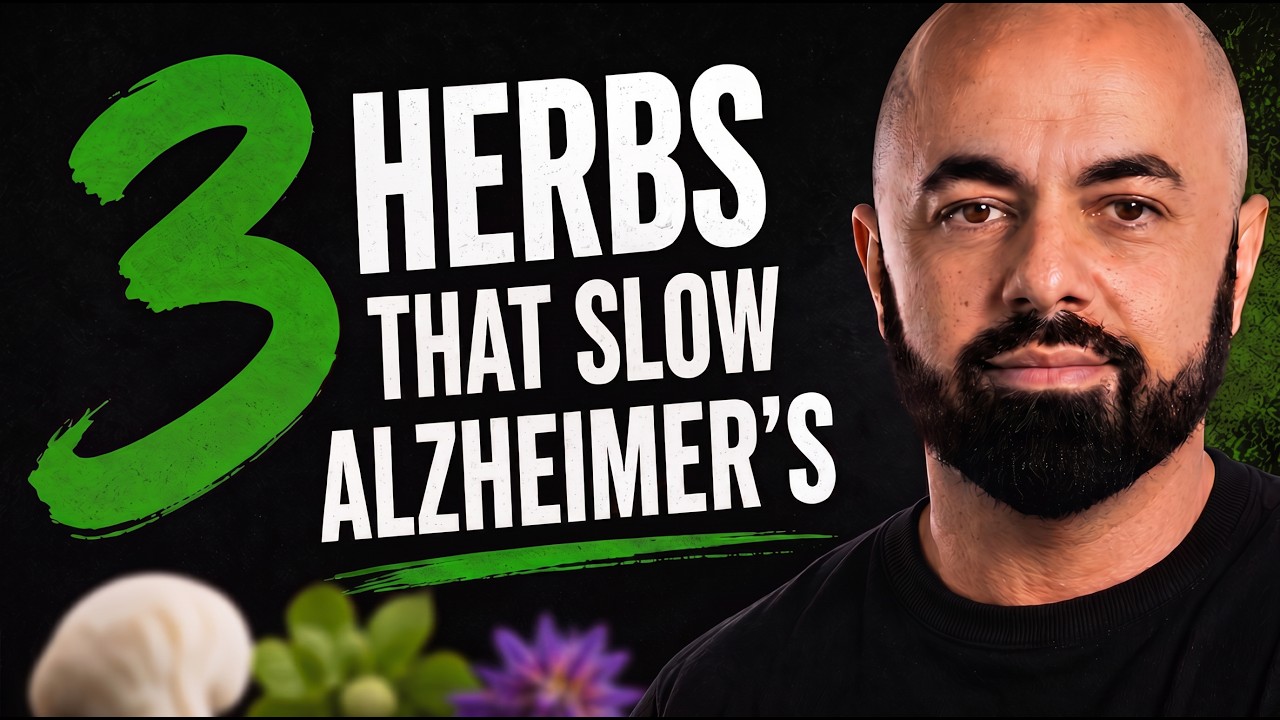
In this video, the speaker explains that Alzheimer's disease develops silently over years, with early memory lapses often dismissed as normal aging. By the time clinical symptoms appear, brain damage is already extensive and current prescription drugs only manage symptoms without altering the disease trajectory. The talk emphasizes the importance of early intervention and introduces three natural compounds—lion's mane mushroom, bacopa monnieri, and saffron—that have demonstrated clinically meaningful effects in human studies of cognitive decline. The speaker outlines the role of the APOE4 gene in elevating risk, noting that about 25% of people carry at least one copy, but that genetics interact with inflammation and lifestyle. Lion's mane is presented as a stimulator of nerve growth factor, supporting neuronal repair; bacopa is described as protecting acetylcholine pathways, mirroring the action of approved Alzheimer’s drugs; and saffron is highlighted for its anti‑inflammatory, antioxidant, and amyloid‑reducing properties, with trial data showing efficacy comparable to standard medication. The video cautions against taking all supplements at once, recommending a step‑wise approach—introducing one change, observing effects, and adjusting—so individuals can act before the disease fully manifests. The overall message is a call for awareness, early preventive action, and evidence‑based use of these herbs as adjuncts to conventional care.
Chapters
Most people don't realize they're developing Alzheimer's until it's already well underway. Not because it happens suddenly, but because it doesn't. It's slow, it's subtle, it's quiet. It starts years, sometimes decades before anyone notices. And in the beginning, it doesn't look like a disease. It looks like normal life. Forgetting where you put something, struggling to recall a name, walking into a room and forgetting why you're there. Small things, things people laugh off, things people normalize. But those small moments are not random. They're signals. And over time, those signals start to compound. Now, I've seen this happen in families, and maybe you have too. At first, it's easy to ignore. Then it becomes harder to explain, and eventually it becomes impossible to deny. And by that point, the biology has already changed. The damage has already progressed. And this is where it gets difficult, because the tools we have at that stage are limited. The medications available today don't stop Alzheimer's. They do not reverse it. They don't rebuild what's been lost. They manage symptoms temporarily. They slow the visible decline, but they don't change the trajectory underneath. And that's the part most people don't understand, because by the time symptoms show up, the process has already been running for years. So the real question is not, what do we do when it's diagnosed? The real question is, what is happening before that point and what can we do about it? Because that's where opportunity is. Now, here's where this conversation becomes important. There are compounds, natural compounds, that have been studied in humans not theory, not speculation, humans with cognitive decline that show measurable effects on brain function. And yet most people have never heard of them, not because they don't work, but because they don't fit into the system we rely on. And that's what we're going to unpack today, not from a hype perspective, not from a fix-everything angle, but from a grounded research-based understanding. Because if you understand this properly, you don't wait for something to go wrong. You start thinking differently now. Now let me ask you something. Do you know your genetic risk for Alzheimer's? Most people don't. There's a gene called APOE, and one version of that gene changes everything. It's called APOE4. If you carry one copy, your risk of Alzheimer's is about 3 times higher. If you carry 2 copies, that risk jumps dramatically— 8, 10, even 12 times higher. Now here's the part that matters: about 1 in 4 people carry at least one copy. So this is not a rare thing. This is not a niche group. This is a significant portion of the population. But here's where it gets more important. The gene alone doesn't determine your outcome. What matters is what happens around it. Because when ApoE4 is combined with inflammation, the risk increases dramatically, over 6 times. So now we're not just talking about genetics, we're talking about genetics plus environment, genetics plus lifestyle, genetics plus internal conditions. And this is where the conversation shifts, because now the question becomes, What influences those conditions? And this is where these compounds come in. Let's start with lion's mane. Now, most people see this as just another supplement, another mushroom, but it's not because what it does is very specific. Your brain has something called nerve growth factor. Think of it like maintenance and repair. It helps your brain maintain neurons, repair damage, support memory pathways. And here's the problem. As you age, nerve growth factors decline. And in Alzheimer's, declines even faster. So your brain's ability to repair itself gets weaker over time. Now here's where science has struggled. We know nerve growth factors matter, but we can't give it to the body. It doesn't reach the brain effectively. So researchers have been trying to solve the problem for years, and this is where lion's mane becomes interesting, because instead of trying to deliver it, it stimulates your body to produce its own. And that's a completely different approach. Now imagine this. Instead of trying to fix something externally, you're activating the system internally. Now, in studies, this has shown the ability to increase nerve growth factor activity, support memory centers, reduce plaque buildup. In human trials, we see something important. Not a cure, not a reversal, but improvement, stability, slowing of decline. And at this stage, that matters because once the system starts breaking down, even slowing that process is meaningful. Now, here's the nuance most people miss. This doesn't work the same for everyone. If you're young and healthy, you may not feel anything. But if there's a vulnerability, that's where it becomes relevant. And that's the difference between optimization and intervention. Now, bacopa works differently. This is not about repair. It's about protection, stability, reducing stress on the system. Your brain relies on chemical signals, neurotransmitters, and one of the most important is acetylcholine. This is directly tied to memory, and in Alzheimer's, it declines. Now, here's something interesting. One of the main drugs used in Alzheimer's works by protecting acetylcholine. Bacopa. It does the exact same thing. Different source. Same pathway. Now think about that. We're not talking about something random. We're talking about something interacting with the same biology. Now here's where it becomes more important. In advanced Alzheimer's, the results are mixed. But earlier, that's where it shows impact. Memory, focus, retention, which tells us something critical. This is not about fixing late-stage disease. This is about changing direction earlier. And most people miss that window because they're waiting for a problem instead of preventing one. Now, saffron changes the conversation completely because this is where the data becomes stronger, more consistent, more direct. Now, saffron doesn't just support the brain. It interacts with inflammation, oxidative stress, amyloid plaque buildup. And here's what makes it different. It's been tested directly against medication. Same patients, same timeline, same measurements, and the result comparable. Now let's pause there because that's significant. We're not comparing it to nothing. We're comparing it to standard care and seeing similar results. Now that doesn't mean it replaces medication, but it changes how we think because now it's not alternatives versus conventional. It's different tools interacting with the same biological systems. And that's a completely different conversation. And this is where everything comes together because Alzheimer's is not just one thing, it's multiple systems breaking down over time: inflammation, oxidative stress, neurotransmitters, repair mechanisms, all of it. So when we look at these compounds, we're not looking at isolated effects, we're looking at system-level interaction, and that's why this matters. So what you actually do with this information— this is where people go wrong— they try everything at once, they overload the system, and then they don't know what's working. And so instead, you simplify. One change at a time. Observe, adjust, because this is not about doing more, it's about doing what works. And here's the truth: Alzheimer's doesn't start when you're diagnosed, it starts long before. And by the time most people realize, the window has already narrowed, not closed. And that's the difference, because what you do earlier shapes what happens later. Now, this is not about fear, it's about awareness, because once you understand the system, you stop reacting and you start acting. So if this has helped you, share it because someone in your life is already thinking about this. They just don't have this information yet. If you want more like this, subscribe because this is what we do. No noise, no hype, just real information explained in a way that actually matters. I'll see you in the next video.