Cancer Alley (The 85-Mile Stretch of America Nobody Wants to Talk About)
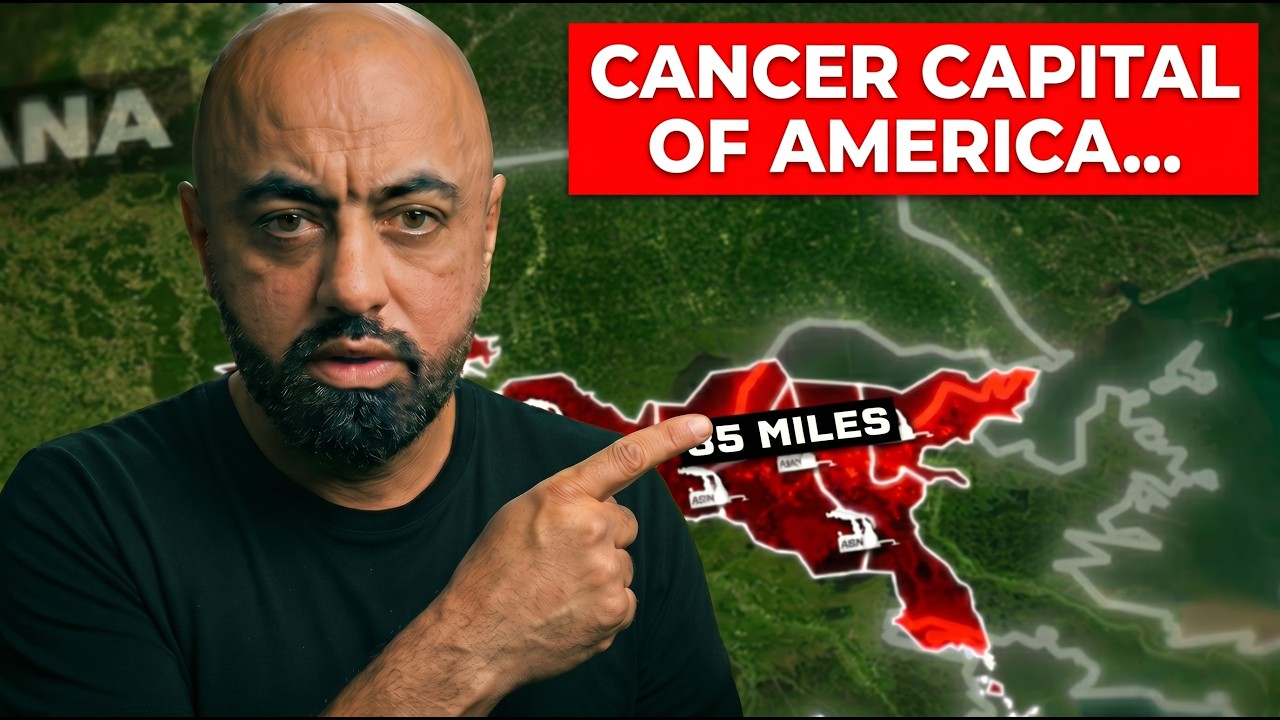
The documentary‑style narration walks the viewer through the 85‑mile stretch of the Mississippi River between Baton Rouge and New Orleans that has come to be known as “Cancer Alley.” It begins by describing the sheer density of more than 150 petrochemical plants and refineries that line the corridor and the juxtaposition of these industrial complexes with nearby residential neighborhoods. The speaker then traces the region’s history from ante‑bellum plantations, through post‑World‑War II industrial expansion, to the present‑day clustering of petrochemical facilities, emphasizing how cheap land, river transport, and political incentives guided plant siting. The narrative highlights that the communities most exposed to the plants are predominantly African‑American, low‑income, and often descendants of people who lived on the land for generations, framing the issue as one of environmental justice. The core of the piece explains the specific pollutants emitted—benzene, ethylene oxide, chloroprene—and how regulatory risk models translate measured or estimated emissions into projected cancer risk. It distinguishes between modeled risk (based on emissions and exposure assumptions) and observed health outcomes from cancer registries, noting the uncertainties and mismatches that fuel community concern. The speaker details how cumulative, mixed‑chemical exposure, proximity, wind patterns, and historical emissions create a complex exposure landscape that is difficult to quantify precisely. The documentary then shifts to the human response: community activism (e.g., Rise St. James and activist Sharon Levine), the economic importance of the petrochemical sector for Louisiana, and the tension between jobs/economic benefits and health/environmental burdens. It outlines policy mechanisms—zoning, tax incentives, permits, and evolving regulations—that have enabled the corridor’s growth while also providing a framework for emission limits. The narrative concludes by looking forward: ongoing proposals for new plants, global demand for petrochemicals, climate‑transition pressures, and the broader question of who decides what level of risk is acceptable. The speaker frames Cancer Alley as a case study of a universal dilemma—balancing industrial progress with health and equity—rather than an isolated anomaly.
Chapters
There's a stretch of land in the United States that most people have never heard of, but millions of people live near it, work around it, grow up inside it. And for decades, some of those people have believed something is wrong. They believe that where they live is making them sick. Not suddenly, not obviously, but slowly over time. Now, this place has a name— not an official one, a nickname— one that didn't come from scientists or regulators or corporations. It came from the people who live there. Cancer Alley. Now, if you look at it on a map, it doesn't look unusual. It follows the Mississippi River between Baton Rouge and New Orleans, about 85 miles, a stretch of land shaped by water, history, and industry. But what you don't see on that map is density, because along that stretch there are more than 150 petrochemical plants and refineries, one of the highest concentrations anywhere in the world. Facilities that produce plastics, chemicals, synthetic materials, fuel components— the backbone of modern industry. Now, if you drive through it, you see something different. Towering stacks, endless piping, flames burning off excess gas, the lights that never turn off day or night. The system is always running. Now, here's where contrast begins, because just beyond those facilities are neighborhoods, Homes, schools, churches— places where people live, raise families, build lives. Now, this is where the story starts to change, because for decades, residents in some of these communities have reported something unusual: higher rates of cancer, clusters of illnesses, patterns that don't feel random. Now, here's where we have to be precise. Cancer Alley is not one single place. It's not one uniform condition. Risk varies, Block by block, and not all studies agree on exact outcomes. Some estimates come from modeled environmental exposure, not direct cancer registries. Now that matters because this is not a simple story, but it is a persistent one because the name Cancer Alley didn't appear overnight. It emerged in the 1980s and 1990s as local activists began documenting what they were seeing— families, neighbors, communities. Noticing patterns, asking questions, and trying to connect what they were experiencing to what was actually happening around them. Now step back because this is where the story becomes bigger. This is not just about cancer, it's about proximity because where you live determines what you're exposed to— air, water, soil— and exposure over time is what defines risk. Now let's go deeper because to understand how this happened, you have to go back not decades, But centuries before petrochemical plants, before refineries, before pipelines, this land was something else. Plantations, sugar, cotton worked by enslaved people. Now, this is not a side note, it's the foundation, because the geography didn't change, the land didn't move, but what was built on it did. Now, after World War II, everything accelerated— industrial expansion, oil demand, chemical production. Now companies needed space Space, access to water, transportation routes, and this corridor offered all of it. The Mississippi River made it ideal— barges, shipping infrastructure. Now layer in something else: land— cheap, available, and often already occupied by communities with limited political power. Now plants were built one after another, expanding over time. Now step back again because this is where the pattern starts to become visible. A historically exploited region becoming an industrial corridor with communities already in place. Now ask a simple question: who lives closest to these facilities? Because proximity is not random. This is where the conversation shifts from environment to equity, because many of the communities most affected are predominantly African American, lower income, and historically marginalized. Now here's where the tension builds. Because this is not just about exposure, it's about who is exposed and why. Now we move forward because to understand the concern, you have to understand the science. What is actually being released into the environment? How is it behaving? How long-term exposure works? Because that's where this story becomes real, not in headlines, but in mechanisms. And once you understand that, the question changes from, is this place dangerous, to What is happening here over time? Who is living inside the system? Now step forward into the early 20th century. The world is industrializing, energy demand is increasing, oil becomes central to economic expansion, and now companies begin looking for locations not just anywhere but specific types of locations. They need access to water, transportation infrastructure, large tracts of land, and regulatory environments that allow expansion. Now, the Mississippi River corridor checks every box: barge transport, direct connection to global shipping routes, flat land, existing industrial pathways. Now layer in something else— cost. Because land along this corridor, especially land already shaped by plantation systems, was relatively inexpensive and often located near communities with limited political influence. Now, this is where decisions begin to stack. After World War II, industrial expansion accelerates. Rapidly, petrochemical companies begin building facilities along the river, one after another, not randomly, strategically. Now, this is important because clustering is not accidental. Industries cluster because it increases efficiency. Shared infrastructure, shared transportation, shared labor pools. Now, once one plant is built, it becomes easier for another to follow, and another, and another. And now this creates something known as industrial corridors. A concentrated zone of production. And once that corridor forms, this reinforces itself. Now here's where the system becomes more complex— zoning. Because zoning determines what can be built where. And in many parts of this region, industrial zoning expanded over time, sometimes overlapping with existing residential communities, not always displacing them, but surrounding them. Now ask a simple question: what happens when industrial zones expand into areas where people already live? Because that's where proximity becomes unavoidable. Now bring in policy, because this is where the system becomes structured. State and local governments often supported industrial expansion through tax incentives, land use approvals, infrastructure development. This was not hidden. It was economic strategy because petrochemical industries bring jobs, revenue, exports. This is where tension begins because economic development and environmental impact do not exist separately. They exist together. Now think about the timeline: 1950s, 1960s, 1970s. Facilities continue to expand. Regulations exist but are less comprehensive than they are today. Monitoring is limited. Understanding of long-term exposure is still developing. This is not negligence. It is the reality of evolving science. Now move forward into the 1980s and 1990s. This is when something changes, not in the system but in awareness. Residents begin to notice patterns— illnesses, cancer diagnoses, clusters within families, within neighborhoods. Now here's where the name emerges: Cancer Alley. Not from a study, from observation, from lived experience. Now that matters because lived experience often precedes formal investigation. Now bring in early activism. Community members begin asking questions, requesting data, demanding investigation. Now this is where science begins to engage. Environment monitoring increases. Studies are conducted. Now here's where nuance becomes critical because not all findings are uniform. Some areas show elevated risk and estimates, others do not. Some data is modeled based on emissions and exposure assumptions, not direct measurement of health outcomes. Now this creates complexity because perception is based on experience while science is based on data, and those two do not always align perfectly. Now bring in another layer, property, because this is where people become locked into place. Homes near industrial facilities often decrease in value. Now this creates a barrier. Leaving becomes difficult financially, logistically. Now this is where the system reinforces itself. Communities remain, industry expands. Now step back again because this is where the pattern becomes clear. Historical land use, industrial expansion, policy support, economic incentives, community proximity. Now connect those and you get a corridor, not by accident, but by accumulation. Now here's the critical insight. This was not a single decision. It was thousands of decisions over decades, each one rationale in isolation, but together creating a system. Now ask yourself something. At what point does a system become something people question? Because for decades, this was not a national story. It was local. Now bring in another factor, visibility, because industrial activity is visible. Stacks, smoke, flares. But exposure is not always visible. Air quality changes cannot always be seen. Long-term risk cannot be felt immediately. Now, this creates a disconnect because people see the industry but don't always understand the exposure. Now, combine that with economic dependence, limited mobility, incomplete information, and you get something very specific— normalization. Now, this is where the investigation becomes deeper because normalization does not mean absence of concern. It means concern exists within a system people cannot easily change. Now bring this forward because this is where everything connects. The corridor exists because it made economic sense, it was logistically efficient, it was politically supported, and it developed over time. Now here's the key point: none of those factors alone explain the outcome, but together they do. Now we move forward because understanding how this was built is only one part of the story. The next part is what matters. What is actually being released into the environment, how those substances behave, and what long-term exposure actually means. Because that's where this becomes more than history. That's where it becomes science. And once you understand that, the conversation changes again from how did this happen to what does this mean for the people living here today. We've looked at the place. We've looked at how it was built, and now we look at what actually matters most: what people are exposed to. Because this is where the story shifts from history to biology, from structure to consequence. Now, when people hear terms like petrochemical plants, it feels abstract, industrial, distant. But what matters is not the facility itself, it's what comes out of it. Because chemical production involves emissions. Some controlled, some regulated, some reduced over time, but not always eliminated. Now let's break this down properly because this is where precision matters. We are not talking about a single substance, we are talking about multiple compounds released at different levels over different time frames. Now let's start with one of the most well-known, benzene. Benzene is a volatile organic compound used in the production of plastics. Resins, synthetic fibers, and other industrial materials. It is also a known human carcinogen. Now, that classification matters because it is not based on assumption. It is based on decades of epidemiology and occupational research. Benzene exposure has been linked to blood-related cancers, including leukemia. Now, here's where context becomes important. Risk depends on exposure concentration, duration. Now, short-term exposure at low levels did not carry the same risk as long-term exposure. Now bring this into the environment. Facilities may release benzene in controlled amounts within regulatory limits, but those limits are based on models, average exposure assumptions, not what happens when your exposure is not average, when someone lives near a facility for years, for decades. Now layer in another compound, ethylene oxide, used in the production of antifreeze, plastics, and sterilizing agents. It is also classified as a carcinogen. Now here's where this becomes more specific. Long-term exposure to ethylene oxide has been associated with increased risk of certain cancers, particularly breast cancer and lymphoid cancers. Now again, dose matters and time matters. Let's move to another compound, chloroprene, used in the production of synthetic rubber. Now this is where the story becomes localized because chloroprene emissions have been a Major focus in one specific area, the place in St. John the Baptist Parish. This is not abstract. This is a real place, a real community. Now, in the late 2010s, environmental monitoring conducted by the US Environmental Protection Agency identified elevated levels of chloroprene in the air near a synthetic rubber facility. In some measurements, levels were significantly higher than what the EPA considers to correspond with acceptable long-term cancer risk. Now pause, because this is where language matters. Acceptable risk does not mean zero. It means a defined level of risk based on statistical modeling. Now, this is how environmental risk is assessed. Exposure is measured or estimated and then translated into risk levels, often expressed as one additional cancer case per number of people over a lifetime. Now, this is not a prediction. It is a model. Now here's where complexity enters because modeled risk is not the same as observed cases, and this is where confusion often begins. Now let's explain that clearly because modeled risk estimates what could happen based on exposure levels over time. Observed data measures what has actually happened through cancer registries and health records. Now those 2 do not always match perfectly because cancer is influenced by multiple factors. Genetics, lifestyle, healthcare access, environmental exposure. This is why different studies can produce different conclusions. So now let's take a step back because this is where people often misinterpret the data. When the EPA identifies an area as having elevated cancer risk from air pollution, it is based on a modeled exposure, not a direct count of diagnosed cases. Now, this does not invalidate the concern. It defines it a little differently. Residents in that area have reported strong chemical odors, headaches, respiratory irritation, concerns about long-term cancer risk. Now, those are lived experiences. Now, here's where we have to stay precise. Symptoms like headaches and irritation can be linked to air quality, but cancer risk is a long-term statistical outcome. Now, both exist in the same conversation, but they're not the same type of evidence. Now, step back again. Because this is where science becomes more important. Exposure. Because exposure is not a single event, it is cumulative. Now think about how exposure works. You breathe air every day, all day. Now if that air contains trace amounts of a compound, your exposure is continuous, not occasional. Now here's the key factor: duration. Living in an area for 1 year, different from 10 years, different from 30 years. Now layer in proximity. Closer to a facility, higher potential exposure. Farther away, lower. Now this creates variation even within the same parish. Now bring in another factor, wind patterns, because emissions do not stay in one place, they move. Now exposure is not fixed, it changes. Now this is why risk is difficult to quantify precisely, because the system is dynamic. Now let's go deeper, because this is where the real issue appears. Multiple exposures, Now individuals are not exposed to one compound. They're exposed to mixtures, multiple chemicals at low levels over time. Now this is called cumulative exposure, and this is where research becomes more complex because most studies evaluate individual compounds, not real life involving combinations. Now bring in regulatory context. Facilities operate under permits, emission limits, monitoring requirements, and over time emissions of many pollutants have decreased due to regulation. Now, that is an important point because this is not a static system. It has changed, but reduction does not mean elimination. Now, step back again because this is where the tension becomes clear. The system defines acceptable levels, but residents experience exposure directly. Now, those 2 perspectives do not always align. Now, bring in another layer— time— because many of these facilities have operated for decades. Now, cumulative exposure is not just about current emissions. It includes historical exposure. Now, this is difficult to reconstruct precisely, but it matters. Now connect everything. Multiple chemicals, long-term exposure, proximity, environmental variation. Now, this is no longer a simple equation. It is a system. Now ask the real question, not is there exposure? Because there is. The question is, what does that exposure mean over time? Now, this is where science continues to evolve because long-term environmental exposure is one of the most difficult areas to study. Now, bring it back to the people living there because this is where the data becomes real. For residents, this is not a model. It is their environment, their air, their daily life. Now, this creates something powerful, a difference between statistical risk and lived experience. Now, both matter, But they operate differently. Now here's the key insight. The concern in Cancer Alley is not based on a single number. It is based on a combination of scientific findings, environmental monitoring, community experience, and historical context. Now we move forward because once you understand the exposure, the next question becomes unavoidable. Not just what is happening, but who is affected and why certain communities are more exposed than others? Because that's where this becomes more than environmental. That's where it becomes about equity. And that's where this story goes next. At this point, we understand the place, we understand how it was built, we understand what is being released into the environment. Now the question becomes more specific. Who is living closest to that exposure and why? Because environmental risk is not evenly distributed. It never is. Now this is where the conversation shifts from chemistry to people, because exposure only matters when someone is exposed. Now if you look at the maps of this corridor, not just where the maps are but where people live around them, a pattern begins to emerge. Many of the communities located closest to the heavy industrial activity are predominantly African-American, often lower income, and in many cases descendants of families who have lived in the region for generations. Now, this is not a coincidence. It is a result of history, land use, economics, and policy decisions over time. Now, go back to what we established earlier. This land was once plantations. After emancipation, many formerly enslaved people remained in these areas, building communities on or near the land where they had worked. Now, fast forward to industrial expansion. Companies did not build in empty space. They built where land was available, where it was affordable, and where there was less resistance. Now, this is where proximity becomes structural, not random. Now let's make this real. St. James Parish, St. John the Baptist Parish— communities like a place. These are not just locations, they are neighborhoods, families, schools. Now bring in something else: zoning. Because zoning determines what is allowed to be built. And in many cases, industrial zoning expanded into areas already occupied by residential communities. Now, this creates overlap— people living near industry not because they choose to move next to it, but because it grew around them. And now, this is where the concept of environmental justice enters. Now, that term is often simplified or politicized, but at its core, it is about distribution— who experiences environmental burden and who does not. Now, let's define that clearly. Environmental justice examines whether certain populations are disproportionately exposed to environmental risks. Now, in Cancer Alley, activists and researchers have argued that this is the case, that historically marginalized communities have borne a disproportionate share of industrial exposure. Now, this argument is based on patterns— geographic, demographic, historical. Now step back because this is where nuance matters. Not every community is the same. Not every area has the same level of exposure, but patterns exist, and those patterns are what drive the conversation. Now bring in lived experience, because this is where statistics become human. Residents talk about family members diagnosed with cancer, multiple illnesses within small areas, concerns about air quality, concerns about long-term health. Now again, we stay precise. Individual cases do not establish causation. But patterns of experience drive questions. Now, this is where activism begins, because when people experience something repeatedly, they organize. Now, one of the most visible examples of this in St. James Parish, where proposed petrochemical projects have faced organized oppositions. Now bring in a name, Sharon Levine, a local activist, founder of Rise St. James, an organization that has challenged the construction of new petrochemical facilities in the area. Now, her work has drawn national and international attention because it represents something larger— not just opposition to a single plant, but a broader question: how much industrial development should we have concentrated in one area, and who decides? Now, here's where the tension becomes real, because this is not just a one-sided issue. Now, bring in the industry perspective, because this is critical. The petrochemical sector is a major part of Louisiana's economy. It provides tens of thousands of jobs directly and indirectly. It contributes to state revenue, exports, infrastructure. Now, for many families, these plants are not just part of the landscape; they are a source of income, stability, opportunity. Now, this creates a conflict because the same facilities that raise concerns about environmental exposure also provide economic support. Now, ask a difficult question: what happens when a community depends on the very industry it is concerned about? Because that is not a simple situation. Now, bring in the government perspective. State agencies often emphasize regulatory compliance, emission reductions over time, economic importance of the corridor, and now they point out that many emissions have decreased due to stricter regulations. Facilities operate within permitted limits. Risk is managed. Now, this is not incorrect, but it was one perspective. Now place it next to another. Residents who experience daily exposure, long-term uncertainty, limited ability to relocate. Now, these 2 perspectives do not cancel each other out. They coexist. Now step back again, because this is where the structure becomes clear. We have communities with historical roots in the region, industrial development layered over time, economic dependence on that development, environmental exposure associated with that development, and now connect that and you get tension. Not theoretical, real. Now here's another layer: mobility. Because leaving is not always an option, property values near industrial areas can decline, which makes selling difficult. Relocation is expensive. Now this creates something else. Entrapment, not in a dramatic sense, but in a structural sense. Now, this reinforces the system. People stay, industry remains. Now bring in generational perspective, because this is where the story deepens. Families that have lived in these communities for generations are now navigating a different environment, one shaped by industry. Now, this creates a sense of connection, history, and concern. This is not just an environmental issue. It is a social issue. It is an economic issue. It is a historical issue. Now connect this back to exposure because exposure is not just about chemistry. It is about proximity. And proximity is shaped by history. Now ask a final question for this section. If 2 communities exist, one near heavy industry, one far from it, and they experience different levels of exposure, what determines That difference, because the answer is not random, it is structural. Now we move forward, because once you understand who is affected and why, the final question becomes unavoidable: what happens next? Because this is not a static situation. New plans are proposed, policies are debated, communities continue to organize, and attention is increasing. Now the question is no longer just about what exists, it is about what will exist. And the future, and who will decide. The story is no longer about a name, not about Cancer Alley. It is about who builds, who benefits, and who lives with the consequences. It's about an industrial corridor, one that was built over time, expanded over decades, and now exists at a scale that makes it difficult to change. Now the question is no longer how did this happen, or even what is happening. The question is What happens next? Because this is not a finished story. It's ongoing. Now look at the present. New petrochemical and plastics facilities are still being proposed. Some approved, some delayed, some canceled after public opposition. Now this tells you something important. The system is not static. It is still evolving. Now layer in something else, global demand, because petrochemical products are not local. They are global. Plastic, synthetic materials, industrial chemicals— these are part of modern life. Now, this creates a feedback loop. Demand drives production, production requires infrastructure, infrastructure requires location, and this corridor is already built for it. Now, ask a difficult question: if demand continues, where does production go? Because relocation is not simple. Infrastructure is already here— pipelines, facilities, transportation networks. Now this creates inertia. Now bring in another layer, climate, because petrochemical production is tied to fossil fuels. Now as the world debates energy transition, carbon reduction, sustainability, this region becomes part of that conversation, not as a symbol, but as a reality, because reducing emissions globally has local implications. Now this creates another tension between economic continuity And environmental change. Now bring it back to the communities because this is where everything becomes real again. Residents are not debating abstract policy. They're living inside it. Now, some families choose to stay because this is their home, their history, their community. Now others choose to leave when they can, seeking distance from the industry. Now this creates a split, different responses to the same environment. Now bring in something else: buyout programs, relocation discussions. Now these are complex because moving a community is not just logistical, it is emotional, historical, economic. And now consider, what does it mean to leave a place your family has lived for generations? Because that question is no simple answer, because this is where the system becomes visible at its highest level. We have industry that supports economies, communities, that experience exposure, government that regulates within limits, activists pushing for change. Now connect all of that and you get a system under pressure, not collapsing but being questioned. Now here's the key insight: this is not just about one place because the structure we've seen here exists elsewhere also. Different industries, different regions, same pattern. And that's where this stops being about Cancer Alley from a place to a principle. Because the real issue is not Cancer Alley. It is how societies balance industry, health, and the communities caught between them. Now ask yourself something honestly: what level of risk is acceptable? And who decides? Because that decision is not purely scientific. It is economic, political, social. Now bring this back to regulation, because regulation defines acceptable limits. Not zero, acceptable. Now that word matters because acceptable to one group may not feel acceptable to another. Now think about how that plays out. A modeled risk, a regulatory threshold, a permitted emission level. Now place that next to a family, a home, a community. Now the numbers remain the same, but the meaning changes. Now this is where the conversation becomes difficult because there is no single solution. Reducing industry has economic consequences. Maintaining industry has environmental consequences. Now, this is not a problem that resolves cleanly. This is where everything connects. This corridor exists because it made economic sense. It was built over time. It was supported by policy, and it continues because of demand. Now, those forces are still present. Now, the difference is awareness, because what was once local is now national. And in some cases, global. Now ask the final question: what does awareness change? Because awareness alone does not shut down a plant, it does not rewrite policy, but it does something else. It changes how people think, how they question, how they evaluate trade-offs. Now bring it all the way back to the beginning— the river, the plants, the communities. Now look at it again, not as a single issue, but as a system. Because that's what it is. Now here's the final thought. Cancer Alley is not just about one place. It is about a question, one that every industrial society has to answer. How do you balance progress with consequence? And who carries the cost when those two don't align? Because that question does not stay here. It exists everywhere. You just don't always see it. And once you do, you start looking at everything differently. Not just this one place, all of it. Most people will never know this story. Cancer Alley is one example. There are dozens more. Now you know. Subscribe to this channel because the next story is already waiting.
More from Kashif

The Fat Loss Peptide Being Sold on a Lie About FDA Approval #KashKhan #Peptides #FatLoss

Why Does This Fat Loss Peptide Give You a Tan? Fat Loss Peptides Beyond Ozempic







He Spent $2 Million a Year on His Health. His Stomach Is Eating Itself. #KashKhan #Biohacking

