What They're REALLY Growing in Maui (And What They Don't Want You to See)
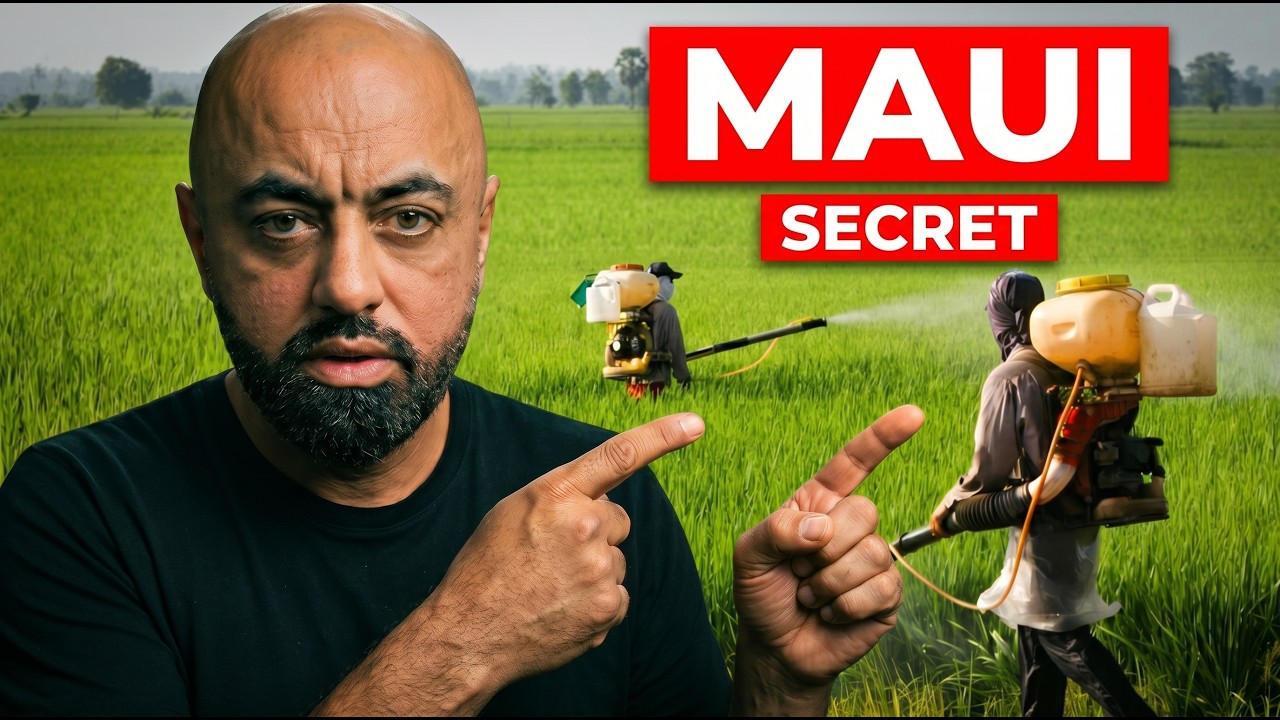
The video investigates large‑scale agricultural testing on Maui, focusing on documented legal violations by Monsanto (now Bayer) in Hawaii, the suite of highly toxic restricted‑use pesticides applied, and how the island’s climate enables continuous, accelerated crop‑testing cycles. It details the 2020 DOJ plea in which Monsanto admitted 30 misdemeanor pesticide violations, including illegal storage of methylparathion (PenCap‑N) and repeated breaches of restricted‑entry intervals, resulting in a $22 million penalty. The narrator outlines the specific chemicals used—paraquat, atrazine, chlorpyrifos, methylparathion—and their toxicity profiles, citing sales data from the Hawaii Department of Agriculture and USGS findings of these compounds in surface water. The video explains exposure pathways (air drift, water runoff, soil residues, dust) and presents three case studies: (1) workers forced back into fields before safe re‑entry, (2) documented school‑drift incidents causing acute symptoms, and (3) a Maui birth‑defect lawsuit alleging long‑term residential exposure. Throughout, the narrative stresses that while direct causal proof of health outcomes is lacking—due to the complexity of cumulative exposure and the high burden of proof—there is a clear pattern of repeated chemical use, environmental contamination, and regulatory enforcement that is reactive rather than preventive. The video concludes by questioning how much evidence is needed before policy action, highlighting the tension between known risks and scientific certainty, and urging continued scrutiny of such agro‑industrial systems.
Chapters
Close your eyes and picture Maui. Not the headlines, not the controversy, the version you've been shown your entire life. Water so clear it almost looks artificial. Air that feels lighter the moment you step off the plane. Palm trees moving slowly like time itself doesn't rush there. Maui is marketed as an escape from stress, from noise, from everything industrial. It's supposed to feel untouched, natural, clean. Now open your eyes because there's another Maui that you don't know about. And this one you won't see from the beach. You won't see it in a travel brochure. You won't see it unless you leave the coastline and drive inland, because just a few miles away, the landscape changes. The color changes. The feeling changes. Flat land, wide fields, former sugarcane plantations that didn't disappear. They transitioned. And what replaced them was not traditional farming. It was something else. Large-scale agricultural testing. Not just growing crops, but developing them, engineering them, testing how they respond to chemical stress and environmental pressure. And this is where the story shifts, because this isn't speculation, this isn't an opinion. In 2020, Monsanto, an American agrochemical company and agricultural biotechnology corporation, agreed to plead guilty to criminal violations tied to pesticide use in Hawaii. That statement comes directly from the United States Department of Justice. According to the DOJ, Monsanto pleaded guilty to 30 misdemeanor counts for using pesticides in a way that violated federal law. Specifically, the company used pesticides in a manner inconsistent with their labeling. Now, that sounds technical, but what it actually means is simple: they did not follow the safety rules required for those chemicals. And those rules exist for one reason— to prevent human exposure. The violations were tied to something called restricted entry intervals. This is the legally required amount of time that must pass before workers can safely re-enter a field after pesticides are applied. And it's not optional. It's not a suggestion. It's a federally enforced safety standard. And in one of the documented cases, workers were allowed back into treated fields after just 7 days. The required interval is significantly longer. That difference is not small. It's not just administrative. It directly affects exposure risk because those intervals are based on how long it takes for chemicals to dissipate to safer levels. If the time is shortened, the protection disappears. Now let's be clear about something. This is not an allegation. This is part of a federal plea agreement. Monsanto admitted to these violations. In addition to these 30 counts, Monsanto also pleaded guilty to 2 felony charges. These were tied to the illegal storage of a banned pesticide called PenCap-N. PenCap-N contains methylparathion, a chemical classified as highly toxic and already prohibited. The company admitted to storing it improperly. We'll return to methylparathion when we look at the full chemical picture. Again, this is not speculation, this is documented in federal court records. The total penalties reach approximately $22 million. This includes criminal fines and payments tied to environmental and community programs. The company was also placed on probation and required to implement compliance systems to prevent future violations. So before we go any further, We established this clearly. This story does not begin with suspicion. It begins with confirmed legal misconduct. Now pause for a second because this is where most people stop thinking. They hear guilty plea, they hear fine, and they assume the system worked. Violation, penalty, case closed. But that's not what actually happened because a penalty does not prevent exposure. It happens after the violation, after the risk, after the event. And that distinction matters because it tells you something about how the system functions. It reacts. It does not always prevent. Now zoom out, because one case doesn't explain Maui, but a pattern does. And this wasn't a single incident. The Department of Justice described Monsanto as a serial violator in Hawaii. That means repeated violations across multiple years, from 2013 through 2020. That's not a one-time failure. That's a pattern of behavior. And patterns reveal systems. Now ask the next question: why Maui? Why here? Because Maui isn't just a location, it's an advantage. Hawaii's climate allows crops to grow year-round, which means multiple growing cycles in a single year. And that changes everything because in most places agriculture is seasonal, but here it's continuous. And for companies developing genetically engineered seeds, that matters because they're not just growing crops, they're testing them, adjusting them, running repeated cycles to observe how they respond. And the faster you can run those cycles, the faster you can develop products. This has been acknowledged in federal court filings involving agricultural operations in Hawaii. The climate allows accelerated research and development, which makes locations like Maui strategically important, but it also changes the intensity of activity on the ground. Because when testing becomes continuous, so does everything that supports it, including pesticide use. And that's where the next layer begins. Because the legal violations tell us something already went wrong, but they don't tell us everything about what was happening right there in that spot. To understand that, you have to look at what was being used, how often it was being used, and what happens when those chemicals don't stay where they're applied. Because the legal violations tell us something important. They tell us rules were broken. They tell us safety protocols weren't followed, but they don't tell us everything. To understand the real risk, you have to ask a different question. What chemicals are we actually talking about? Because the word pesticides sounds simple, neutral, almost harmless, but pesticides are not just one thing. They are a category, and inside that category are substances with very different properties, very different levels of toxicity, very different impacts. Data from the Hawaii Department of Agriculture shows that Maui County has had sales of restricted-use pesticides, including Paraquat, atrazine, chlorpyrifos. These are not minor chemicals. They are widely studied and they each carry specific risks. Let's start with paraquat because this is one of the most important to understand. Paraquat is classified by the Environmental Protection Agency as highly toxic. Even a small ingestion can be fatal. There's no antidote. There's not an opinion. That is a regulatory classification. Paraquat is designed to kill plants quickly. But its toxicity is not limited to plants. It is also hazardous to humans if exposure occurs. Now here's where we need to be precise. We are not saying paraquat caused specific illnesses in Maui. That is not proven. But we are saying this clearly: paraquat is part of the chemical profile used in agricultural systems like the ones operating in Hawaii, and its toxicity is well documented. Looking back at methylparathion, the chemical inside PenCap-M, It's an organophosphate compound similar in class to chlorpyrifos. It was actually banned in the United States precisely because of the extreme toxicity to humans. Its illegal storage on active agricultural fields wasn't a paperwork issue, it was a federal crime. These weren't chemicals sitting in the wrong cabinet. This was a prohibited substance being kept on active agricultural land, land that workers were entering regularly. Now let's look at another chemical, chlorpyrifos. This is an organophosphate insecticide. It has been studied extensively for its potential effects on neurological development, particularly in children. Regulatory decisions around clopyrifos have changed over time. Some uses have been restricted, others debated, but the scientific concern has centered on its impact on the nervous system. Now again, we are not making a claim about a specific outcome in Maui. We are identifying the chemical profile because understanding the chemicals matter. Now, atrazine. Atrazine is one of the most widely used herbicides in the United States It has been studied for environmental persistence, meaning it can remain in soil and water, and it has been detected in water systems in agricultural regions. This is where the pattern begins to form. You have multiple chemicals, each with its own profile, each with its own risks, and they are not used once. They are used repeatedly, which brings us to frequency. Investigations and reporting have shown that pesticide applications in some Maui agricultural areas occurred As frequently as every 5 to 7 days. That's weekly. Now think about that in context. Not one exposure, not occasional exposure, repeated exposure potential. Now here's where we move from chemicals to environment, because chemicals don't stay where they're applied. They move through the air, through the soil, through the water. And that movement matters because once a chemical leaves the field, it is no longer confined to its intended use. This is where environmental data becomes critical. A study conducted by the United States Geological Survey examined pesticide presence in surface water across Hawaii. The study found that pesticides were detected in the water downstream of agricultural areas. This included chemicals like glyphosate and chlorpyrifos. Now let's be precise about what that means. Detection does not automatically equal harm, but it does confirm the presence. It confirms movement. It shows that these chemicals are not fully contained. They can enter water systems, and once they are in water systems, they can move beyond the original site of application. Now consider how exposure actually happens, because most people think exposure requires direct contact, but that's not always the case. Exposure can occur through multiple pathways. Air, when pesticides drift beyond the area they're applied. Water, when chemicals enter the surface or groundwater. Soil, when residues persist and become part of the environment, and even dust, when particles from the treated fields are carried by the wind. These are known exposure pathways in environmental health. Now combine that with proximity, because location matters. If agricultural testing is happening near residential areas, near schools, near communities, then those pathways become more relevant— not theoretical, but possible. Now add volume, because presence doesn't always tell the full story. Scale does. Data from the Hawaii Department of Agriculture shows significant volumes of restricted-use pesticides being sold in Maui County, including paraquat, atrazine, and chlorpyrifos. Restricted-use pesticides are not available for general public purchase. They require certified applicators because of their potential risks. So when we talk about These chemicals, we're not talking about minor exposures. We're talking about substances that are regulated specifically because of their potential impact. Now step back and look at the full picture. You have chemical use, you have frequency of application, you have environmental movement, and you have proximity to human populations. That combination creates a system, not a single event. Now here's where it becomes important to stay grounded. Because this is where narratives can easily become exaggerated. So we stay with what is supported. We know these chemicals are used. We know their toxicity profiles. We know they can move beyond application sites. We know they have been detected in environmental samples. What we don't know automatically is the exact level of exposure for any one individual or the direct causal impact on health outcomes. And that distinction matters because environmental health is not simple. It's not a one cause, one effect. It is cumulative. It is influenced by dose, by duration, by individual susceptibility. So now we come back to the central tension of the story. We have evidence of chemical use, evidence of movement, and known pathways of exposure, but proving direct causation in individuals is far more complex. And that gap between exposure and proof is where this story exists, because there's not a lack of information, it is a lack of certainty. And in the absence of certainty, decisions still have to be made. Now we move forward because understanding the chemicals and the environment is only one part of the story. The next question is, what happens when those systems intersect with real people, real communities, and real lives? And that's where the story becomes much harder to ignore. Now we move to the most difficult part of the story because this is where the systems stop being abstract. And becomes human. This is where we stop talking about chemicals and start talking about people. And this is also where we have to be the most careful, because this is where credibility matters the most. So we clearly separate what is proven, what is documented, and what is alleged. Case study number 1: the workers. The foundation of this entire story is the Department of Justice case, and at the center of that case were not policies, not theories, People, workers entering fields, fields that had already been treated with pesticides before it was considered safe. The restricted entry interval exists for one reason, to protect human health. It is based on how long it takes for chemical exposure risk to decrease after application. And in the cases outlined in the DOJ filing, that protection was not followed. Workers entered these fields earlier than allowed. That is confirmed. That is part of the guilty plea. Now think about what that means, because this is not indirect exposure. This is direct proximity inside the field, inside the environment where chemicals were actively present. And that exposure did not happen once. It happened across multiple violations, across multiple years. Now what we do not have is detailed public data on long-term health outcomes for those specific workers. And that matters because we do not assume outcomes that are not documented. But we do understand something clearly: the system designed to prevent exposure failed. Now we move to case study number 2, the schools, because this is where exposure moves beyond workers into communities. There have been documented incidents in Hawaii where schoolchildren were affected by what was described as pesticide drift. In one widely reported case, students began experiencing symptoms during the school day— headaches, nausea, respiratory irritation. Some were treated by emergency responders. Investigations were conducted. Now here's where we stay precise. The presence of symptoms consistent with pesticide exposure was documented, but establishing exactly which chemical caused those symptoms or confirming long-term effects is far more difficult. And in many cases, that level of certainty is not reached. But the event itself matters. Because it demonstrates something important. That exposure does not always stay contained. It can move through air, through drift, from fields into surrounding environments. And when that happens, the line between occupational exposure and community exposure disappears. Now let's move to case study number 3, the Maui birth defect lawsuit. This is where the story becomes even more complex because this is where long-term health outcomes are being alleged. Families living in a subdivision near agricultural test fields filed legal claims. The claim was that pesticide exposure contributed to developmental issues in their children. Multiple families, same geographic area, proximity to fields, downwind conditions, and similar health concerns being reported. These cases were covered by local media, including Hawaii News Now. Now again, We are precise. These are legal allegations. They are part of the public record, but they are not definitive proof of causation. And that distinction is critical because environmental health cases are extremely difficult to prove. They require long-term data. They require control comparisons. They require elimination of other variables. And that process takes time, often years, sometimes decades. But here's what matters: patterns Because even when causation is not proven, patterns can still be observed. And in that case, the pattern being described is consistent: geographic clustering, proximity to agricultural activity, repeated exposure potential, and similar reported outcomes. Now pause for a second because this is where most people go in the wrong direction. They either assume everything is proven or they dismiss everything entirely. Both are mistakes. Because the reality exists in between. We have documented violations, we have documented exposure events, we have documented environmental presence. Now we have reported health concerns. What we do not have is definitive causal proof linking those exposures to specific long-term outcomes in individuals, and that gap matters, but it doesn't erase what we know. Now step back and look at all 3 case studies together: workers, schools, families. 3 different contexts, 3 different types of exposure: occupational, acute community exposure, and long-term residential exposure concerns for all 3. And all of them connect back to the same system. Now add what we already established: chemical use frequency, environmental movement, and proximity, and you start to see something very clear. This is not a single incident. This is a system with multiple points of contact. Now here's the uncomfortable part, because this is where the story becomes difficult. Proving harm in this kind of system is one of the hardest things in science because exposure is not one event. It is cumulative. It is influenced by duration, by dose, by individual biology, and by combinations of factors that are difficult to isolate. So the absence of proof does not automatically mean The absence of risk, but it also does not confirm harm. And that is the tension. This is where this story lives, between what is known and between what is not yet proven. Now bring back the corporate position. It has to be part of this. The company maintains that its products are safe when used as directed, that its operations follow regulatory standards, and that there have been no confirmed adverse health effects directly linked to its activities in Hawaii. That is their position. It is important to include it because this is not a one-sided story. This is a conflict between perspectives, between data, between interpretations. But here's what cannot be ignored: the violations happened, the exposure events happened, the lawsuits exist, the reports exist, and the environment shows presence of these chemicals. So now the question changes. It's no longer about just whether harm can be proven. It's about how much evidence is required before concern becomes action. And that is not a scientific question alone. That is policy. That is a system question and ultimately a human right question, because the people living in these environmental zones are not waiting for perfect data. They're living inside The uncertainty. And that uncertainty is the reality of the story. So what do all these pieces actually add up to? Because everything we've looked at so far exists in pieces— legal violations, chemical profiles, environmental movement, human reports— but none of those pieces exist on their own. They are part of a system. And to understand this story, you have to understand how that system works. Because the question is not just what happened in Maui, The question is why systems like this are allowed to operate the way they do, starting with regulation. Because most people assume something simple: it is a chemical, it is approved, it must be safe. But approval does not mean absolute safety. It means approved under specific conditions, control conditions, defined exposure levels, defined usage patterns, defined assumptions. And real-world environments are rarely controlled. They involve variables like wind, water movement, repeated application, human proximity, and cumulative exposure over time. So when we talk about approval, we are talking about a framework, not a guarantee. Now bring back what we know. In Maui, pesticides were applied repeatedly, in some areas as frequently as every 5 to 7 days. We know those chemicals have known toxicity profiles. We know they can move through environmental pathways, and we know that there were violations in how they were used. Now ask a simple question: do real-world conditions always match regulatory assumptions? Because if they don't, then the system is operating outside its intended safety model. Now we move to enforcement, because this is where another assumption breaks. Most people believe that regulators prevent harm, but in many cases regulators respond after violations occur. The Monsanto case is an example of that. The violations happened, then enforcement followed. And that doesn't mean the system failed completely, but it does mean the system is reactive, not purely preventative. Now add another layer: burden of proof. Because this is where the system becomes difficult to navigate. In environmental health cases, proving harm requires a very high level of evidence. You need long-term studies, large sample sizes, control conditions, and the ability to isolate variables. That is extremely difficult, especially in real-world environments where multiple exposures exist at the same time. So what happens? The burden shifts not to the system creating the exposure, but to the people experiencing it. They are the ones who have to prove causation, and that process can take years. Now think about the timeline. Exposure happens first, then symptoms may appear, then investigation begins, then studies are conducted, then conclusions are debated, and by the time certainty is reached, the exposure has already happened. Now bring everything together We have confirmed legal violations. We have known chemical toxicity. We have environmental detection. We have documented exposure events, and we have reported health concerns. At the same time, we have no definitive causal proof linking those exposures to specific long-term outcomes. That is the reality. Not one side, not the other, but both at the same time. Now ask a deeper question. What does a system look like when risk exists but proof takes decades? Because that is where modern environmental health operates— in uncertainty, in probability and patterns, not in absolute conclusions. Now consider scale, because this is not just about Maui. The same agricultural model exists in multiple regions. The same chemicals are used globally. The same regulatory frameworks apply, and the same challenges exist in proving long-term impact. So Maui is not an isolated case, it's an example, a concentrated version of a larger system. Now return to the beginning, the image of Maui— clean, untouched, natural— and now place that image next to everything we've discussed: legal violations, chemical systems, environmental movement, human reports, and uncertainty. Now the image becomes more complicated, not false, but incomplete, because both things can exist at the same time— natural beauty and industrial systems. And the problem is not that one exists. The problem is when one is visible and the other is not, because visibility shapes perception and perception shapes trust. Now we come to the final question, and it's not simple. It's not comfortable, but it's necessary. How much evidence is required before concern becomes action? Because waiting for certainty means waiting for time, and this time is exactly what exposure does not wait for. It is a story about a system, a system where exposure can be documented but causation takes years to prove. A system where communities report concerns while companies maintain Compliance, and both realities exist at the same time. What responsibility does a system have when risk is known but certainty is not? Because the answer to that question defines everything that comes next. Maui is one example. There are dozens more, and we're just getting started. Subscribe to this channel because someone has to keep asking the questions they don't want answered. The next story is already waiting.
More from Kashif

The Fat Loss Peptide Being Sold on a Lie About FDA Approval #KashKhan #Peptides #FatLoss

Why Does This Fat Loss Peptide Give You a Tan? Fat Loss Peptides Beyond Ozempic







He Spent $2 Million a Year on His Health. His Stomach Is Eating Itself. #KashKhan #Biohacking

