185: How To Create Good Luck, and Expand Your Opportunities and Influence, with Christian Busch
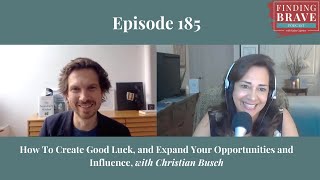
Christian Busch explains how to create good luck through what he calls a serendipity mindset. He breaks down blind luck versus smart luck, shares research on why some people find more opportunities, and offers concrete practices like keeping a serendipity journal and using the hook strategy to expand your influence.
Chapters
Hello everyone, this is Kathy Caprino and welcome to my podcast, Finding Brave. I've created this show for everyone who longs to create something bold and brave in their life, to rise up, speak up and stand up for who they are and to reach their highest and biggest visions. Each week I'll be speaking with inspiring guests from all walks of business, leadership, entertainment, the creative arts and the entrepreneurial world and they'll be sharing their intimate stories of Finding Brave and offer their best strategies for building your most rewarding, joyful and meaningful life, business and career. Speaking of that, I'm thrilled to share that my new digital course, the Most Powerful youl is available now. This transformative eight module training course is based on my top selling book, the Most Powerful you and is designed to help you close what my research has revealed are the seven most damaging power gaps that keep 98% of professional women from thriving at the highest level and reaching their most thrilling, rewarding potential. In the course, you'll be taught transformative action strategies and mindsets from me and from more than 30 of the nation's top experts that will help you experience dramatically more power, confidence, communication skill, leadership growth and authority over what transpires in your work. And you'll be guided on how to take the seven brave pathways to career bliss which are Brave Sight, Brave Speak Brave, Ask Brave Connection, Brave Challenge, Brave Service and Brave Healing. If you're finally ready to close your power gaps and rock your career, visit mostpowerful you.com and join the course today. And if you'd like to learn more about these seven gaps and how to close them, take my free webinar seven ways to rapidly elevate your career. You can find that@mostpowerful you.com elevateyourcareer thank you and I hope to see you there. Right hello everybody. Welcome to another episode of Finding Brave. I'm basically levitating today just to be able to talk to our guest, Christian Bush about something that I think is so important for us to understand, but I don't think the majority of us do. And that is how to create good luck or as you call a Christian serendipity. And I can't wait to hear what if there's a difference and how to expand your opportunities and your influence. That is what we're going to talk about. So Christian, first of all, you are such a busy person. Thank you for taking time. I so appreciate it.
Thank you so much for having me. So delight to be here.
All right people, we are going to be talking all about what is luck? What is the difference between blind luck and serendipity? And this is based on a lot of your research, Christian. And I know that you talk also about the biases we have that hold us back from experiencing more luck. So let us dive in. But without further ado, let me share what Christian's got going on here. Dr. Christian Bush directs the CGA Global Economy Program at the New York University I love NYU and also teaches at the London School of Economics. Previously he co directed LSE's innovation lab and co founded, excuse me, the Sandbox Network, as well as Leaders On Purpose. He's a member of the World Economic Forum's Expert Forum, Holy Crow. A fellow of the Royal Society of Arts and among diplomatic couriers top 99 influencers as well as the Thinkers50 radar list of 30 thinkers most likely to Shape the Future. Christian's best selling book, the Serendipity Mindset has been highlighted by many people and many lists as we were talking about. But Arianna Huffington nailed it when she said it's a wise, exciting and life changing book. So welcome to the show. I'm sorry that you don't have much going on, Christian. That's too bad. Meaning how do you get all this done? How does this all happen? You're just a very productive person, I guess.
Huh.
Well, it's fascinating. I'm a big fan of this maker versus manager schedule and trying to figure out how do we use, you know, high energy periods.
Let's say in my case it's in.
The morning, a couple of hours that I protect. So there's it's non negotiable like I would never schedule a meeting there.
And so it's you know, six to.
Eight or those kind of periods where that's the periods where I try to think, get things done and the rest of the day is much easier because you feel you already got the things done that you need to get down to the rest.
What is this list? Say it again. I don't know this list, this format, this technology.
Yeah, it's a great blog post, highly recommended by Paul Graham. It's called Maker vs. Manager Schedule and it really Manager. Yes. Yeah.
Oh we will. I need to check that out. I am, I think I'm as productive, I think I do the work of three people sometimes. But other times, you know, an email comes in and off I am over there, off I am on a text, off I am looking at slack. I need this. So it's really helped you. Thank you for that tip. So let Us jump in to the serendipity mindset. First of all, what led you to research this and explore it? I'd love to hear. We'd love to hear.
Yeah.
Well, the journey really started. You know, I used to be that kid.
I was kicked out of high school. I had to repeat a year. I channeled that you were too smart for it. I certainly always tried to push boundaries in some kind of way. And somehow, you know, I felt that the education system somehow boxed us into certain ways. And I transferred this lifestyle, you know, into my driving style. Probably help the inofficial world record of how many dustbins you can knock over on your way to school.
Where did you grow up, Christian? Where did you grow up?
In Heidelberg in Germany, in the south. Beautiful, romantic city. Highly recommended for those of you who, you know, have a. Want to go on a romantic trip and you know, I grew up there and then I, you know, was this kind of slightly reckless driver and one day I crashed into four parked cars. And I won't forget the policeman who came to the scene. You know, all cars were completely destroyed, including my own. And he was like, oh my God, he's still alive. And so, you know, it was this idea that I was supposed to be dead that stuck with me. And I asked myself all these weird questions, you know, if I would have died, who would have come to my funeral? Who would have actually cared? Was it all worth it? Did I do anything meaningful?
And how old were you when you were thinking these things?
15. Well, 18 and a half. Ish. 19 ish. And, and you know, I only had depressing answers at that point. And so it put me on this intense search for meaning. I started reading Viktor Frankl's Man's Search.
For Meaning, which was my favorite book in the world. It's the most life changing book.
Everyone was extremely life changing. And it was, what I loved about it was that idea that you can imbue meaning in every situation and that.
Matter what that situation looks like.
Exactly, exactly, exactly. And you know, it made me realize, hey, what I enjoy doing the most is connecting ideas, connecting people. And so, you know, I embarked on that journey and what I found fascinating is when I in my work as entrepreneurial and then later as academic, the most purpose driven, successful, inspiring people, they seem to have something in common which is that they intuitively cultivate serendipity. They somehow see something in the unexpected and then turn the deposit outcomes and.
So they see something unexpected. Is that what you said?
They see something in the unexpected. So they, you know, take the example. I don't know.
Take the example.
Let's say you're in a coffee shop, right? And if you have slightly erratic hand movements like I do, you spill coffee.
Over someone and you sense something, you.
Sense there might be something there with that person, you don't know what it is, you just sense there might be something there. And now you have two options, right? Option number one is you just say, I'm so sorry, here's a napkin. You walk outside and you think, ah, what could have happened had I spoken with a person? And then option number two, you start a conversation, that person turns out to become the love of your life, your next co founder, your investor, you name it. The point is the reaction to the unexpected moment. That is what created that serendipity, right? And, or, or you missed it because you didn't act in that moment. And so that's really what I'm fascinated about, that question of how do we imbue meaning in the unexpected? But also, and we'll probably talk more about this, how do we create more meaningful accidents? So how do we create more of this proactively in our lives?
I have questions. You said there were two options. You spilled the coffee. You could either walk out. I'm sorry. And realize, oh, I probably could have done something, or connected. I think there's a third option which is you don't even know that that's an opportunity. Like it doesn't even occur to you. So here's my question. I have so much. Let's make it a 10 part series. You know, in my, I kind of created a new life after age 41. I had been in a corporate world and it was a mess. I mean, I was successful, but internally I was a mess. And then after 9, 11, and I seized that moment like, you know, in a way, kind of what you're talking about. Life is too short, it's so fleeting, it's so make the most of it. And then I pursued a spiritual path and did a lot of learning. Viktor Frankl, et cetera. But I'm saying this because one thing that happened to me was some of my friends say, you know, a butterfly is sometimes. Kathy, A butterfly is just a butterfly, meaning. I now see meaning in everything, you know, a pigeon laying eggs or, you know, mourning dove on my deck laying eggs. But part of that is listening to yourself, part of that. And I want to understand if you think this is true. Part of it is cultivating a very intimate relationship with what you're hearing. And you're thinking and your intuition and your gut. I believe that part of that is why you would say, gosh, something's going on with that person here at Starbucks. I'm going to talk to them. Can you tell us about that? Do you think it's intuition or gut, which can be refined? Certainly. What do you think about that?
Yeah, it's such a great point. And I probably see two themes in there. The one is really, to your point, how do we develop an intuition that is quote, unquote, mature, right? Because we all, we all have fight or flight. We all have kind of intuition that might lead us into, like, the wrong direction, right? When I think about some of my worst decisions in life, they come from, like a fight or flight type. Oh, my God, I should retreat from a situation versus a. A more mature one that is, oh, what is this trying to tell me? Oh, let me try to understand this and then let me act on this. And so I feel there's this big piece. And I've gone through a similar journey. I think in terms of when I was younger, I had always had versus gut, right? So I was, I was very head, like, like, like brain driven. And I would always say, oh, the gut tells me this, but the brain, like, usually wins and so on. So I saw them as kind of a dichotomy. And then what I realized is, no, like, the gut is such a beautiful subconscious brain that probably knows a lot of times more than our consciousness. And so essentially, if we can listen into it and say, what is it trying to tell me? That meeting went really well, but I feel weird about it. Like, is there. Should I do more research about that person? Is there maybe something about that person that I should learn? And then you do that. And I feel that beautiful integration of both. It's almost like a Hegelian, you know, you need both to then arrive at a kind of synthesis that allows you to make sense of it. And so to your point, I feel there's this deep point around this in terms of how do we learn to listen to our guts and also learn when to listen and when not to listen. I think that's kind of the point where I'm very excited about. And then the second one is really that. That openness to the unexpected. And I think in your case also, right. Once you believe it's out there, you start to see it more. Because we all have the bias of underestimating how often the unexpected. You know, we think the unexpected doesn't happen, even though it's extremely likely. Right? It's a probability question. It's a probability question that a lot of people drop money in the street. A lot of people xyz. But if we don't believe it, we don't open our eyes to it. There's actually an amazing experiment that I'm a huge fan of where they took people who self identify as very lucky. So people who say good things always happen to me and da da da, and people who self identify as very unlucky. So I'm always in accidents, I always have bad luck and so on. We know people in our lives right on both ends of that spectrum. And so they tell them, walk down the street, go into a coffee shop, sit, sit down, order a coffee, and then we'll have our interview for the research. Now what they don't tell them is that there's hidden cameras along the street. And inside the coffee shop, in front of the coffee shop there's a five pound note. So money. And inside the coffee shop there's this one chair next to this extremely successful businessman that can make big ideas happen. Now the lucky person walks down the street, sees the five pound note, picks it up, goes inside the shop, orders a coffee, sits next to the businessman, they have a conversation, exchange business cards. Potentially an opportunity coming out of it. We don't know that part.
The businessman is well known. Like it's just. Or they're just talking to somebody, a random person.
Exactly, just the person. They sat next to it and they were waiting. So they were like, okay, I might as well start a conversation with that person. Now the unlucky person walks down the street, steps over the five pound note, so doesn't even see it, doesn't even see it, goes inside and orders the coffee, sits next to that businessman, ignores the businessman, and that's that. Now at the end of the day, they ask both people, how was your day today? And so the lucky person says, well, it was amazing. I found money in the street and made new friends and you know, potential opportunity coming out of it. The unlucky person just says, well, nothing really happened. And that's the point, right? Once we start seeing the unexpected, being that from silent sources, right, like, like closet introverts like myself, a lot of our luck happens from seeing something somewhere and then connecting dots and then, or if you're more extrovert, like with the businessman, you have some kind of extrovert kind of luck come out of this. But I think the beauty here is that either for both, like for both the introvert and the extrovert, there's something in here that can actually create your luck. And long story short, though, there's also a fascinating thing, this apophenia, which is seeing patterns that aren't there. Right. So I feel like people like us who see a lot, like sometimes we might also see a couple of patterns that might not necessarily be. They did all these pigeon experiments, right, where they dropped pellets for pigeons and then, you know, they dropped them completely random. But whenever the pigeon thought, oh, what I just did, like made them throw the food, they did it again, even though it had no correlation, no relationship with this kind of thing. So sometimes we might see patterns that are not necessarily there. But the point here is usually I think it happens that those patterns actually lead to more serendipity when we, when we.
It's so good you are a mind reader because as you were talking about the person that talked to the guy next door, I'm an extrovert, you can tell. But my son is an introvert and I've learned so much about introversion and introversion is different from shyness as we know. But if you're an introvert and you're shy, you're not going to talk to that business person. So I was thinking about saying, oh, wait a minute, are we saying that we've got to be an extrovert? I'm so glad you jumped in and said no. There's so many ways in life that are authentic to your approach that create the other thing I want to amplify. I always have said this and I am a trained therapist, so I learned a lot that I use in coaching and writing. But one thing I learned is any pattern that repeats in your life, you are co creating it in some way, otherwise it doesn't randomly really repeat. Would you agree with that? And I think the flip of it is if you have a pattern of I am going to see opportunity wherever it potentially exists, there's a pattern there of doing that and it's a mindset. Is that right?
Absolutely.
And that's actually one of the key pillars that I feel are behind developing a mindset for serendipity is the idea of framing. Right. And how do we make sure that at the end of the day, the way we look at the world predetermines a lot of. Exactly to your point, what we can see, but also what we can do. And I'm a big fan of there's this fascinating organization in the Cape Flats in Cape Town. So I do a lot of work in Sub Saharan Africa. In extremely resource constrained environments. And that organization, it's crime ridden context, absolutely no resources. And they developed a low cost education methodology, 10 steps to use social media to build your business, things like that. And what they do is they go into similarly resource constrained environments. And instead of asking what do you need? So putting people into the position of I need a budget or something, they ask what is already here and how can we make the best out of this? And so what that does is it reframes the situation away from resource constraints to maybe we can connect the dots differently. If we look at a former drug dealer, great, that person will have amazing social capital. They will be extremely creative if we can turn them into a teacher. And it is cool now again to be a teacher. If we look at an old garage and we see a potential training center, we start seeing the potentiality in material resources and so on. And so I'm actually, you know, when you think about serendipity, it's so much about potentiality, right? It's about seeing a little bit more in a situation than could be there. When I look at a kid, I don't only see like a 10 year old kid, I see like I see the potentiality of that person. I think that's where a lot of times serendipity then comes you.
Have you been trained in therapy as well?
A bit of psychology, but.
But not.
Certainly not to the degree that you were.
Well, it doesn't seem so, but you're right up there. But in marriage and family therapy, that genre of therapy, we do talk about the reframe and it is such a potent part in my work with people. They'll come for instance, Let me give an example. People. So you know what I mean? Gosh, I've been on 10 interviews and I haven't moved forward on one of them. So what? So my question is, what do you make of that? They say I'm a loser. And I say what if you're not supposed to have gotten those jobs? Do you want those jobs? Almost inevitably they don't want those jobs. They just think they have to. But they didn't even realize they didn't want the job. But the reframe is not lying, it's not embellishing. It's telling a story that fits the facts equally well but allows for more positivity and expansion. It's exactly what you're talking about. But you've taken it it a step further in a way you're looking at not what do you need, but what have you already Done. That we can expand on in a way you haven't envisioned. Is that right? Is that what you're talking about?
Absolutely.
And the fascinating thing, I will never forget the first time I went, like around 10 years ago, and I asked the founder, what is something I, as the white guy coming into your context, should never ask you? And he was like, never ask me what I need first. Because if you ask me what I need, you put me into the role of the victim, the beneficiary, someone who needs something from you, versus, if you ask me what's here, what can we do? Then we start peer to peer, and then we can still work out from there. If there's any reason.
Founder of this organization that you.
Yeah, one of the founders of the initiative.
How did he learn that? How did he learn?
I mean, he's extremely enlightened. Like, he would be a great guest, I think, also for your podcast, by the way. But it's fascinating because it's, you know, to exactly what you just mentioned, like, how do we frame a situation? Do I frame myself as being the victim in this situation of I'm a victim of resource constraints, I'm a victim of xyz, or do I say there's something I can still control? And I think that's why I found Viktor Frankl so fascinating. Because obviously Viktor Frankl said, look, I am in the toughest of situations one can imagine, right? In a concentration camp. Any potential power has been taken away from me. I'm literally being stripped everything in terms of agency, but I still have a little bit of agency. And I loved always his thing where he said, well, still every day I would talk with a fellow prisoner to make them feel better. And that gave me some kind of meaning, right? Because that was the agency I still had left. And so I think, especially at the moment, in terms of COVID right, where nobody picked that situation, I think it had a huge effect on any of us. I had Covid last year, severe form. It certainly wasn't pretty. And then I reread Viktor Frankl, and what I found fascinating is exactly this to say we cannot always pick the stimulus, but we can always, like, pick our response to that stimulus. And so how much agency do we give ourselves? And I think that's kind of the beauty of.
Of, of.
Of that, like, you have created some looking at. Honest to goodness. I have this quote in front of me, and I want to read it to you. All right, people, here it is. Oh, no. Where it is? Quick, quick. Here it is. Viktor Frankl. Everything can be taken from a man. But one thing, the last of the human. I can't even read it without crying. The last of the human freedoms. To choose one's attitude in any given circumstance, to choose one's own way. And there's another quote from the book. When we are no longer able to change a situation, we are challenged to change ourselves. I mean, what I don't think we don't. That's the guidebook for life. What did I want to ask you before that? Tell me the question that your, your colleague said. He said don't ask what I need ask. And how did you phrase it?
Ask what we can do together. So in a way, what is already here versus what is not here, what is lacking. Exactly.
Fantastic. So we're talking about reframing the situation. Tell us more about the pillars of how to. And you also talk about the difference between blind luck and smart luck, because I would say there is stuff that you just didn't shape. I mean we are not. We're human, we're not something else. We. We can't control everything. I think. Right. So what would you say the difference between blind and smart luck are?
That's what I find most interesting about serendipity. That if we see serendipity as smart luck as something where we have to see something in the moment and then connect the dots. It's about productivity towards a random event versus blind like is being born into a good family or something. It's the things we can't pick. Right.
It's passive.
It's purely passive. And I think in the blind like situation, there's a lot of societal inequality. Right. In terms of the ways I sit here in the West Village in New York, I have access to education, to networks. To me the potential level of serendipity is much higher than 2 Marlon in the Cape Flats in Cape Town, where he doesn't have that. And so we have very different starting positions. And I think at the same time as we work on mindset, of course we have to work also on, on those societal inequalities. And to your point, like what I found really fascinating is the question of for that smart luck, what is it about that smart? Like how can we build a muscle for that? And so broadly I feel it's in two domains. The one is really what is the deeper psychological layers here around self limiting beliefs? Right. If in the coffee shop, for example, you don't talk with that person because you think I'm not worthy, I'm not ready, I'm not xyz. Or you sit in a meeting and you hold back your idea that just popped up because you're like, oh, no, it's not mature yet. And so. And so. And then you walk outside and you think, I should have talked about it, but I didn't. I'm a big fan of really doing a serendipity journal and saying, what are the. What are the things that hold me back from acting on something, even if I see it in the moment? And what is the pattern behind this? Right? Is it xyz? And then really figuring this out and then working on this deeper psychological question. And then I think there's the tactical question, right? The tactical thing around how can I have more practices in my life and in my organization that make serendipity more likely? And so one of my favorites here is the hook strategy. So the hook strategy is all about saying, how do you create potential dots that other people can connect for you? So to give you an example, there's this amazing entrepreneur in London called Ollie Baritz. And if you would ask him, ollie, what do you do? He wouldn't just say, I'm a technology entrepreneur. He would say something like, I'm a technology entrepreneur, recently started reading into the philosophy of science. But what I'm really excited about is playing the piano. And so what he's doing here is he's giving you three hooks where you could be like, oh, my God, such a. Such a coincidence. I recently started playing the piano. You should come by at a martine or, oh my God, such a coincidence. My sister is teaching on the philosophy of science. You should become a guest lecturer. The point is that the more we can have those kind of dots that we seed into every interaction, every conversation a little bit, that's when other people create serendipity for us. And so I'm a big fan also in that serendipity journal to say, what are the key themes, interest areas that I'm excited about at the moment? And how can I bring that into a site sentence in a conversation if nobody picks it up? Okay, but a lot of times, actually unexpectedly, the uncle of the brother of the mother would say, oh, my God, such a coincidence. I didn't even know you work on this. I want to put you in touch with this person. That's how a lot of people get their clients. Right, but just seeding things into conversations in some way without pitching it on others.
I love it. I want to ask you this because. All right, speak, Kathy. You reached out, I think, to me after we both were on the Next Big Idea clubs list on. Was it on the new grads, how to help them make a dent in the universe, or was it on supercharge your productivity? There were two lists, but. But I think it was you that reached out on LinkedIn and said, Congratulations. Now, there were a number of people on those lists, and I tend to. Or maybe I. You tell me. Maybe I tagged you. That might have been what happened when I tweeted out that. But the point is, you reached out, and very generously, you said, congratulations. Well, we're busy people, right? So when something comes in like that, it makes us stop. Stop the crazy hamster wheel of our work. And I stopped. I looked at you on LinkedIn, I went, Holy crow. I looked at you elsewhere. That's how we got to meet. Now, serendipitously, we were both on that Next Big Idea list club list. But I think it was your generosity that got me to stop, because I probably like you. I'm pitched over 600 times a month, literally, by people that want something. Will you feature me in Forbes? Will you. Can I be on your podcast? Can I do this? Can I do that? So when you're used to getting pitched so much, you almost. I almost have a little bit of a wall. I have to. What gets through generosity. Do you think generosity of spirit fits into this at all?
It's such an interesting observation in general, I feel, in terms of. And I'm obviously also very grateful for our serendipitous connection, which is wonderful in itself. You know, it's interesting. I was thinking about this a couple of days ago. You know, I talked with an editor of a journal, right? Of, like, a management journal, and they said, whenever I'm sending a rejection email, people never write back. They just leave it. And so there was a person who wrote back to that editor and said, thank you so much for the feedback. I appreciate it. Looking forward to keeping in touch. And the editor was like, you know what? I really appreciate this. Let's keep in touch. I want to kind of, like, do something with you, because this is actually, to your point, generous, and it's something that is unexpected, and it's something that you're sticking out now because you were the only person who did this. And it was such a kind of natural thing for that person who reached out. But for the editor, it was such a beautiful wow moment to say, oh, okay, that's really interesting. And I think we do that. Not enough, right. That I see that a lot with students, for example, when you know, this idea, like, it gives, like it lets my heart bounce. When I read from a student after three years after they graduated, and they say, hey, thank you so much for XYZ session. Now, like, I see it really work out in this and this job. And you're like, oh my God, great. And then of course, I check out their LinkedIn, I'm like, oh my God, great that they do that. I want to put them in touch with someone else as well, you know, so it triggers, to exactly your point, it triggers exactly that thing of, hey, like, this is someone who did something beautiful there. And that actually like, puts us into a completely different, not necessarily relationship to each other, but like, it creates like an environment that is much nicer, to your point, than if he had just written, I need this reference letter now, and I need to do xyz. And so I think to your point, there's. I'm a big fan, actually, of writing a lot of thank you letters and just being generous in general because I think there's, you know, I'm always looking at it from. I think there's what you just mentioned, that there's beautiful serendipity coming out of it. But more importantly, I also feel, you know, when you think from a deathbed perspective, when you'll be on your deathbed with 80 or 90, I'm not sure, like, how many things of the things that we are pitching for, we will really be like, excited about, care about. I, you know, a lot of people who are on the deathbed said, I wished I had said XYZ to XYZ or I wished I had. And so I'm just very conscious also of like, being grateful to everyone who is part of our journey because there's only limited time that we can say thank you. And so we might as well do it now.
I adore that. I will say this as again, the former therapist. What I see is some people trying to be generous, but it's like a hoax. They're not, they're looking, they're. They've got their hand out, but they pretend they don't. I would ask everybody to embrace what it feels like to be a giving, caring, generous person. Not for looking at what you get in return. And listen, it's. I'm still struggling because when you're beleaguered a lot and working, you know, you want a return on what you invest in, including your time. But it's a happier life. It's a happier life when you are just coming from the heart, not bleeding Heart not, you know, I'll give everybody anything they want. You know, of course you've got to use your discernment, but do this because it makes life happier. And the other thing I would ask you to talk about is I am relentlessly positive. I always have been. It's just. And there, you know, there's pessimism and there's optimism and research shows that, you know, at age four, we can see children going in a direction, but it can be shaped. It's not set in stone, but I've always been relentlessly positive and I can't stay angry at anything. But what was my question? Not just to talk about myself, the positivity piece. A lot of people have said to me, yeah, well, that doesn't work for me. Meaning when something bad happens like the pandemic, I look at where the silver lining is, because there always is one. It doesn't mean we wanted to lose so many hundreds of thousands of people. Our own, my own 96 year old mother had it Covid and recovered. What it does mean is nothing is black and white. There are good things that come out of tragedies. So if I'm relentlessly looking at that, here's the end of the story here. People will say, yeah, sure, I don't believe that. But I'll say to them, well, how well is that working for you that you believe nothing good comes from most things? So do you see also that there are things people can do to be more positive? And is that part of creating luck?
Yeah, it's such a great question. It's also maybe briefly on the, on the last point also, which I found you beautifully articulated, that idea of how are you genuinely giving rather than instrumentally giving. Right. Because I feel that's the kind of most, the most slimy people I know are the ones who are like somehow, you know, this kind of virtual virtue signaling type, oh, let me kind of pretend to be nice so that I can get something out of it. And I think that's the kind of people who really need like, leave the really bad, like aftertaste. Right. And I've been a big fan actually of Adam Grant's work, like Give and take, because he had, you know, this beautiful thing that I've always struggled as someone who just, you know, I like, I get very excited when I can do something for someone. And so the problem of course of this is there's only so much, so much you can do. And so where do you like put the boundary? And I think one of the things that Grant has been working on so much and that I highly recommend everyone to dive in if that's something there. And it's really that question of how can you as a giver, like how can you as a giver thrive in a world of where people are taking, where a lot of people are taking. And how do you define that boundary of saying, okay, like this is as much as I can give, but also, hey, I need to replenish, I need to focus on my own things and so on, so on. And I think that is the fascinating balance, I guess that we all have to find in terms of how do you then also say no to things and learn that that's fine. And I think for me being honest that's sometimes been a challenge is like a harmony loving person. I don't like to say no, right. I don't like to say, oh, I'm sorry, I can't do xyz. But actually the more one like realizes, oh, actually that's the best thing for both me and the other person because I can't really help them if I'm anyways in the stressed kind of apparatus and so on. So I feel like there's. That's a beautiful conversation to be had probably also with Adam Grant around, you know how to, how to be a giver but also have boundaries around that.
I should reach out to him. I interviewed him in Forbes and it was incredible. And I took the survey, we'll link to it people. And you know what I found? I forget how we called it, but you seem to be the type that just gives generously. And where you might be more healthfully connected to people is to have more discernment. I was the kind of person that, how do you put it? Wants reciprocity. And I think that that can, that can backfire too. I've interviewed Lorna Byrne, who's an Irish best selling, five international best selling authors, best selling books. And she's dyslexic and illiterate and Christian. She sees angels. I'm not a religious person, but I've done a retreat with her, co hosted a retreat. And to sit with someone who literally sees things that others don't, it's amazing. But she told me the angels are saying to, to you, Kathy, give without expecting anything in return. And I was like, darn those angels. So I think, I think we can all shift a little in our natural way if it's beleaguering us or holding us back.
Yeah, that's fascinating, right? Because I feel we all have that Kind of feeling of if there's too much of a one way, then it always feels a little bit strange.
And also.
So, yeah, so Adam Grant's work on this has been super fascinating. But, but then to your second point, you know, it's interesting because I grew up in a culture, you know, in Germany, that is not necessarily known for the most kind of optimistic. And again, I don't even want to talk about in the context of culture, maybe more in the sense of the way I grew up. I think optimism was more like, great, if you have it, but actually like being rational is the way that, um, they're supposed to be. And, and what I found fascinating is, and that's one of the reasons why I found Viktor Frankl's work so fascinating. He had this beautiful sentence around, if you start as a realist, you end up as a depressionist, but if you start as an optimist, you end up as the real realist. And I think that's something I've seen a lot in my work, that I'm extremely optimistic. But I've also seen that, you know, in life people try to shoot you down. People like, there will always be stuff that in an ideal world, I wouldn't want it like politics and everything else, but it will happen. And so then being realistic about it and letting go of a little bit of the idealism, and then you kind of arrive a little bit on this kind of like, okay, like this is kind of like an optimistic realism now. And I actually think that optimistic realism practices that I found very useful is everything from, you know, gratefulness type, you know, sitting with a family and just reflecting on, hey, what are we grateful for today? Or doing a gratefulness journal? Reflecting on a couple of things just in terms of getting ourselves into this idea that despite that life is very harsh, objectively speaking, it is very harsh. There's in every moment also something to be grateful about.
Right.
And I think the more we remind ourselves and build that into our day to day practice, I think the easier than it is to say I'm not only kind of, you know, slightly non optimistic, but actually so I think like we can rewire our brain a little bit towards it by, by starting to see those kind of beautiful things also.
I love it. Is there anything. I gotta let you go. Darn it. Is there anything else? Any other pillars that we need to understand that we haven't talked about? About how do I have a more serendipitous life? How do I do it? Anything else?
Yeah, I'm a big Fan. You know, I think a lot of times we put pressure on ourselves that we have to have it all figured out and we have to know everything and so on. And then we realize, well, everyone's just winging it at some point and. And especially, you know, I'm becoming a father soon and so on. That's kind of the areas, right, where we know that in a way, the unexpected will happen all the time and we just have to wing a lot of it. Right? And I think one of the things why I'm so excited about this work is because I grew up in an environment where you want to plan everything for the next 50 years. You want to have a strategy for everything, and then life happens and you're like, oh, my God, like, there's so many unexpected things. And I feel like giving a vocabulary to the idea that actually, at the end of the day, serendipity and the unexpected doesn't have to be something that kind of, you know, is only anxiety enhancing, but actually it can be part of our plan. It can be part of our plan to cater with this. And, you know, I think especially for organizations, that's super interesting because, you know, a lot of my work is with senior executives, and they always want to portray complete control and authority and everything else, even though everyone knows that they don't have it all figured out. And so the question is, hey, can we reframe that away from its passive that unexpected things happen to?
No.
We created a culture that allowed for serendipity to evolve, that allows us to connect these unexpected events to our mission, our vision, and so on. And so I'm actually also a big fan of the question of how organizations can create a culture for serendipity that reframes the unexpected from a threat into an ally.
I can't wait. Will you come back on the show and talk about that piece? You know, I just want to say one more thing. My book is about, and I have a course coming out today as we record, tomorrow as we're recording, but it's about closing the seven damaging power gaps. And what's interesting is, in a way, I think it's a flip of what you're talking about, but they're both so connected that when we have these gaps, I don't recognize my talent or worth. I communicate from fear, not strength. I isolate instead of, you know, achieving support. All of those things are going to rob you from luck, all of those things. So I think not only do we need to race out and grab your book and enact These strategies. I would also ask you to think about what are your power gaps? And you know, you can find those. We're going to link to those. But. And there's a survey. But if you have these gaps in confidence and power, they truly block you from everything we're talking about. Like block you from being the leader who doesn't feel like he, he or she has to pretend that they have it all buttoned up, you know, or. Or that great thing that happened. Like, you know, I just. Going viral on Forbes. Yeah, it was a great post and it was a great interview. But there's luck there. You know, a lot of people pretend that going viral you can control.
Ha.
No, not so. So anyway, I think they go together. I really do. So where do we just devour all your work, Christian? Where do we go? Give us a few links. Tell us where to get your book. Where do we go?
Yeah. So on Twitter, I'm Chris Serendip.
The homepage is SerendipityMindset.com and yeah, I.
Think that's the two major.
That's it. I am so grateful to you. When is your new one coming? Your baby?
October 3rd. Hopefully, if everything goes according well, that'll.
Change your life for sure in ways that will be serendipitous and you're not going to know what hit you. How wonderful. Congratulations and thank you again for being here, everybody. Are you inspired? I am. I just can't wait to take these action steps and bring more good luck towards us and towards everyone else that we connect with. That's the goal, right? Because we're all really kind of just one, aren't we? Thank you. Thank you so much. All right, everybody, we want to hear from you. Wherever you see this, you know that we love comments. Share what you get out of Christian Book. Where are you still struggling? Not what do you need, but what can we leverage based on what you already have? Let's. Let's answer that question. Thanks again. Have a wonderful week and we will see you next time.
Thank you.
Thanks so much for joining us today. And please don't forget to check out findingbrave.org for more programs, resources and tips. And tune in next time for your weekly dose of finding brave.
More from Kathy


Elevate Yourself, Elevate Others, and Amplify Good | Chris Cooper | Finding Brave Ep. 334

Finding Brave Epis #333: How Leaders Can Harness AI Without Losing Their Humanity, w/Bennett Borden

Finding Brave Epis 332- How to Stay Brave, Valuable and Visible in the Age of AI, with Raman Rai

Finding Brave Epis 331 - The Power of Positive Disruption, with Dr. Patrick Leddin


Finding Brave Epis 330 - Being 40: Letting Go and Embracing Who You Are, with Stacey Lindsay

Disrupt Career Reinvention with Kathy Caprino - via The Disruption Lab Podcast w/Patrick Leddin

Creating Neurodiversity-Friendly Work Cultures: Simple Workplace Adjustments Matter

Finding Brave Epis 329 - How To Create a Neurodiversity-Friendly Workplace, with Kristen Pressner

Finding Brave Epis. 328: Reclaiming the Power to Trust Your Own Voice, with Dr. Cindy McGovern