186: How to Have Those Difficult But Crucial Conversations With Friends and Colleagues
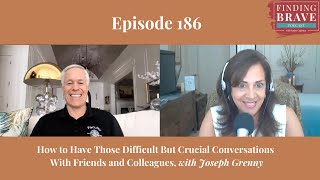
Joseph Grenny explains why heated conversations go wrong: we feel threatened and tell ourselves stories about being victims or helpless. He offers a framework starting with clarifying what you actually want, then sharing facts and perspectives to expand what you both understand together.
Questions this video answers
2002.
Third edition (referred to as "as of this fall").
cruciallearning.com.
Chapters
Hello everyone, this is Kathy Caprino and welcome to my podcast, Finding Brave. I've created this show for everyone who longs to create something bold and brave in their life. To rise up, speak up and stand up for who they are and to reach their highest and biggest visions. Each week I'll be speaking with inspiring guests from all walks of business, leadership, entertainment, the creative arts and the entrepreneurial world. And they'll be sharing their intimate stories of Finding Brave and offer their best strategies for building your most rewarding, joyful and meaningful life, business and career. Speaking of that, I'm thrilled to share that my new digital course, the Most Powerful youl is available now. This transformative eight module training course is based on my top selling book, the Most Powerful youl and is designed to help you close what my research has revealed are the seven most damaging power gaps that keep 98% of professional women from thriving at the highest level and reaching their most thrilling, rewarding potential. In the course, you'll be taught transformative action strategies and mindsets from me and from more than 30 of the nation's top experts that will help you experience dramatically more power, confidence, communication skill, leadership growth and authority over what transpires in your work. And you'll be guided on how to take the seven brave pathways to career bliss, which are Brave Sight, Brave Speak Brave Ask Brave Connection, Brave Challenge, Brave Service and Brave Healing. If you're finally ready to close your power gaps and rock your career, visit mostpowerful you.com and join the course today. And if you'd like to learn more about these seven gaps and how to close them, take my free webinar 7 Ways to Rapidly elevate your career. You can find that@mostpowerful you.com elevateyourcareer thank you and I hope to see you there. Hello everybody. Welcome to another episode of Finding Brave. Kathy Caprino here. Once again. I'm pinching myself at who I'm able to talk to in this show and today is no exception. I have the amazing Joseph Granny with us. Thank you for joining Joseph. I know how busy you are.
Thank you.
Can't wait. And we are talking about is it possible to tell the truth to your friend or colleague and keep them keep the relationship positive? I'm so in need of this conversation, really. And in fact just talking to a friend yesterday who was sharing all about how one of her family members was talking to a person and it got so heated and so you know, you can tell everyone's walking away feeling hurt, angry. We're not making this happen the way we need to. These crucial conversations that I know you're an expert on. So let's dive in. But before I do, you know, I do love to share with people what my guests mean to me or how I learned of them or, you know, how their work has impacted me. And I was just telling Joseph, we first connected when I interviewed you for you and David Maxfield for my Forbes blog, Career Bliss on gender bias is real. And people, I want to tell you, and I was telling Joseph this, but you have to. I have quoted this research countless times, but definitely in my TEDx talk and in my book the Most Powerful you in the course and you know, constantly in my other courses in coaching. Because your research really validated and confirmed and legitimized that women are experiencing gender bias. In a way, you actually put a number to it. Your research showed that a woman's perceived competence and worth dropped exponentially compared with men when they were deemed forceful. And, you know, I think probably every woman on the planet knew this to be true, but it wasn't being talked about. And when we did talk about it, it went very badly. So I'm ever grateful to you. Thank you again for that, for that research.
So glad that you're continuing to share that. It was an important finding and it really kind of gives us all the more reason to focus on the topic for today because only way norms get reset, the only way biases become apparent and addressable is through conversation. And so that's the only mechanism that gives us any hope.
Oh, I love it. All right, let me tell you about Joseph before I ask my questions, which I can't wait. Joseph Granny is a four time New York Times best selling author, dynamic keynote speaker, and leading social scientist for business performance and so much more. Joseph has spoken at some of the world's premier leadership conferences and his books have been translated into 28 languages. Amazing. And available in 36 countries and have generated results for 300 of the Fortune 500. Someday on another podcast, I've got to ask you how you got into this work. Or maybe we'll have time for that, but wow. And again, this is not just research. That is kind of nice to know. It's making huge changes, I think, in how we lead, how we communicate, how we engage. So grateful. All right, let's dig in. First of all, what compelled you in the beginning to look at this topic of, well, your book now did you say it's in the third edition? Crucial Conversations?
Yeah, as of this fall.
When did it Come out first time, 2002. Wow. That feels like 100 years ago, doesn't it?
We've been through so much, so much.
And how relevant it is today. So let's just talk about. Let's make it really relevant to maybe the past four years, five years, the pandemic. What do you find most compelling to explore and teach about this? Why are you drawn to this?
Well, there's two answers to that question. The first is that are consulting practice dragged us into the topic. I wouldn't have predicted, nor would I have selected to focus on communication in my career. What we were interested in is behaviors that make a disproportionate difference in organizational performance. That's where we began.
Wow.
Time and again, we found that companies with safety problems, companies with customer loyalty problems, companies that couldn't execute well, that underperformed their potential customers, with employee turnover. Time and again, we found that almost any area of pain within an organization, what kept those problems chronic, what turned them from an incident into a pattern, is people's inability to confront, discuss, and resolve them. That the fact that these issues became emotionally and politically charged are what caused people to either back away from them or engage in them in a way that was unproductive. And so we literally, if we wanted to improve organizational performance, had to find a way to help people get to dialogue when it mattered the most. So that was one strand that got us to where we are today.
All right, I do have to ask, you know, what was your training? What did you go to school for? Can I just ask all of us?
In varying ways, Al, Ron, Kerry, and myself came from the social sciences. So for me, it was organizational behavior, organization development. So the, you know, the question that we ask in the social sciences are the two questions that really are at the heart of all social science are, number one, why are people doing what they're doing? And how can you help them change? And so that really was our platform. And as we tried to understand why problems occurred in organizations and how to help people change, helping them learn to confront, discuss, and resolve emotionally politically risky things. And politically risky things really became the central challenge.
My goodness, I can't wait. Just another question here. When you were growing up, I know this is the therapist in me. I can't stop. When you were growing up. All right, let me. Let me tell you why I'm asking this. I remember at age 16, my dad was a scientist, a chemist, and the only thing he didn't ever get an A in it was psychology. And he'd be like, you're always trying to figure things out, Kathy. And it was kind of annoying to him, you know, and he'd always be like. If we were discussing, he'd be like, fact. What are the facts? I only want the facts. And I'd be like, I don't know, but this is what I think. So I grew up, for a lot of reasons, needing to understand why people do what they do. And thus therapy, you know, after corporate life, was a perfect. And coaching, too. As a child, were you interested in why people do what they do?
I think in some ways I was small, got picked on, had a lot of bullying experiences early on, and I wonder if that created a hypervigilance and alertness to the behavior of others and cues and signals about what was going on. It also gave me a sympathy for the powerless kind of an appreciation for how power is unevenly divided in the world and that that's at the heart of many of the social problems we have. And so, you know, I don't know. You're the therapist, but I think that explains it. My father was a psychologist, too, so I think.
Oh, there you see? I knew it. But I think you are a perfect example of what I talk about a lot, that you have connected all the dots of who you really are to make a difference. Oh, I love it. All right, now let's dive in. What do you think is going on here that makes so many of our conversations so volatile? Is it a difference of opinion or what is it?
Well, there are a couple of layers of that. One is just the way we're built as human beings doesn't work for social prosperity. Our bodies are designed for physical survival, and unfortunately, physical survival, I guess, probably back on the savannah, there was an advantage in us seeing danger when it didn't exist. So getting ourselves to a state of arousal, even when we did it 10 times more often than we needed to, it's better to be wrong nine times than wrong once.
You mean dead? Is that what you mean? Yeah. Right. Meaning we're constantly scanning for the threat. Right. And. Okay. And so we immediately. I'm just reading a book, Untangling The Mind, by Dr. Ted George, about the amygdala, the cerebral cortex, and how we're. We're always doing what you're saying. What's. What's a threat here? Right.
That's where the problem begins. So, you know, the sort of. The reptilian, the core brain, its job is to keep you alive. The executive function is to help you prosper. But the problem is when There's a contest between the two. The reptilian brain takes over. It wins. It trumps. Because survival is the number one goal. Most of what we do. When my wife comes in and says something that sounds to me like she's criticizing me, and I start to cringe inside, what's happening is executive function is shutting down. My capacity to be able to handle this in a way that leads to social success is diminished. And so all of us are really hardwired for failure around complex social dynamics. However, we have the software to learn. We have the capacity to rise above our thinking and our patterns and to create new ones. And so really, the research, Cathy, for crucial conversations came number one, when we saw how critical the topic was. But number two, when in the workplaces, we would ask, who is it here that finds a way to get the truth on the table but without rupturing relationships? Are there people here like that? Even in the most oppressive authoritarian environments, there were inevitably a couple of people that knew how to do that. And so all of the research that led to the book was from watching, observing, studying people who found a way to get the truth out in the open when it mattered the most. And what we found then is that those are transferable skills that the rest of us can learn how to do what they do. Wow.
You know what you're reminding me of, which is another thing I learned from you, and I teach in this article you'll have to read to people on gender bias. You did a video you enacted with a female and a male, an individual saying something forceful that nobody would like to hear. Right. And that's how audiences said, yeah, you know, he's. We don't like him that much either because he's forceful, but her. But then you tested mitigating statements that come before, and you taste tested a whole variety. But one of them was, and I realized when I read it that I think I do that. That coming from a place of a value statement, something like, listen, I really value honesty and transparency. So what I need to share here is I don't agree with the direction we're going here, that that mitigated the backlash. So is it stuff like that, how we present what is going to be inflammatory or how we mitigate what can sound incredible, incredibly challenging? And what came to my mind is, isn't it true, Joseph, nobody wants to be criticized in a meeting. Nobody wants to be told they're wrong. Nobody wants to look foolish. Nobody. So if some senior person or another person hates your idea, if they come at you like that. Well, sorry, Kathy, that, you know, that just misses the mark. That's a bad idea. We're gonna fight. We're gonna be mad, but I'm doing all the talking. Tell me. Is how you present the difficult idea. The key.
So there are two categories of keys. So the way the book is organized, at least the new edition that we just talked about, new chapters.
Two new chapters, right?
Yeah. The first part is called what to do before you open your mouth. And it turns out that about 80% of the problem is preverbal. 80% of the problem is what's happening inside of me, which no matter what kinds of diplomacy skills I might have mastered, they're not going to overcome the fact that, frankly, I just want to prove you wrong or that I feel defensive or that I want to be right or that I want to punish you. And so my motivational set really trumps any skill set that I might have in getting that right. First is the beginning of the solution.
Is that because I learned this in therapy and other things, you can't hide energy. Everything is energy.
I like that. Yeah.
Yeah. So if I'm sitting here disdaining what you're saying, I can be as sweet as possible and smile, you're gonna know.
Value statements. Who cares if you start with facts rather than accusations? And none of that matters because I can see the seething look on your face, and I'm picking that up. So literally, there are parts of our brain hardware that are dedicated to viewing expressions and reading expressions. They're significant parts of our cognitive real estate whose total job it is just to look at people's faces, because that has survival value. So again, the words that come out of your mouth will have a part of an effect. But if there's a contradiction between what I read from your face and what I hear from your mouth, I'll trust the face.
And so what do we do? I'm thinking immediately of myself in certain. I don't want to get political here and upset people, but certain things that are going on in our country that.
Heard of some of them.
That I literally can't remain calm about. So let's start here. Well, let's do this. The two keys are what you're feeling inside, and then the other is how you're articulating what you're feeling. Right.
Yeah. So the book is organized in what to do before you open your mouth and then how to open your mouth. So very simple.
So what do we do? Let's talk about those things that hijack us immediately. Let's even say, and we won't say what side we're on, but vaccinate or don't vaccinate. What do we have to do when we're, when we're feeling things internally? Is it mostly fear? Is that 90% of what gets us to have terrible conversations fear?
I think a synonym for that would be threat. So there's some sort of perceived threat and usually we amplify it so we make this some psychic battle when in fact it's just a difference of opinion. So even if you were a hardcore anti vaxxer and I was a hardcore pro vaxxer, even if there were that, let's face it, how this conversation goes is not going to cost me my life or you your life. In the immediate circumstances you might have beliefs about how things get carried out, but it's not however our brain treats it like that. It treats it as though the fact that you're calling me some insane lunatic because I'm willing to inject my six year old child with this vaccine, that that has some real significant psychic threat to me and it doesn't. So there's huge opportunity for us to de escalate our own emotions and if we recognize that this is just perceived threat, not real threat. So one way we do that, one of the skills we found from observing people who are really good in these moments is a skill called start with heart. Start with heart essentially means learning to notice when your motives are off track. When under threat, our motives become short term. It's about things like saving face, about being right, about winning, about punishing. It's all about dealing with immediate emotional threat and so understanding that. What we found from those who can talk themselves off that ledge is they tend to use a really potent therapeutic intervention of a single sentence. They just ask themselves the question, what do I really want? What do I really want here? Now there's two reasons that that simple question has such a, a powerful effect on our affect is that number one, it moves us from short term to long term. So the word really in that gets me out of I just want to win this argument or I just want to hurt you back because you hurt me. And I start thinking about what do I really want, it tends to push me a little longer term. The second thing is it's an abstract question and one of the things we know about physiology is that when my brain is dumbed down, when the executive functions are shut down because I'm in survival mode, if you present your brain with an abstract question, one that it's too dumb to answer. In its current toxicated state, intoxicated state, what happens is blood flow literally gets redirected. Blood flow starts to be restored to the executive functions. You start thinking differently. And so just pausing and asking myself, what do I really want? And then sometimes we encourage people to elaborate it. What do I really want for me? Well, what are my long term goals from this conversation? But what do I want for you? That one is a powerful antidote to the selfishness that comes from threat mode. We tend to only think about our own selves and our own survival. But when I think, what do I want for you? So if Kathy is an anti vaxxer and I'm thinking, you know what, I would really like for you to have a long and healthy and happy life. And I'd like that for your children too. Just thinking about that has a calming effect on me. And the third element is what do I really want for the relationship? And if you and I have an ongoing relationship, then just asking that question again causes me to show up and present myself in a little bit different way. So just getting the motivation right solves a huge percentage of the potential misbehavior that I might otherwise enact.
I got questions. So let's take the vaccine issue. I think that what's happened, and I think it's true of a lot of other issues, we don't just think it ends with you and me. So if you take a position that is against my values and against my beliefs, I think the threat, if we think about it, is not just you are doing that, but you represent millions like you. So if I can change, I don't, I don't know. I don't sit here and think about it like that, but I'm trying to here. If I can change you, then there's hope. So let me just ask this in another way. I think that when we really fight about stuff, there's also values how I value something that you are threatening. So if you support something that has no scientific merit, let's say, and I believe in science, you are a threat to not sitting in your living room, but to the very way I, for instance, might perceive the world should be. So I get it, that if we breathe and that gets our cortex, you know, connecting more and mitigating the amygdala. Right. We're going to see. Okay, Joseph's a great guy, but he's not impacting 10 million people. He's just one person with this view. But don't you believe that that's why there's so much rage that when I. When I see a person who represents millions, who I think are hurting the world, I can't contain it to just you and me. Tell me if I'm making sense.
Yeah, you completely are. What you're illustrating nicely is another aspect of a crucial conversation, and that is there's another chapter in the book called Master My Stories. The argument there is that our affect is not a function of what's happening. It's a function of the story I'm telling myself about what's happening. And so it isn't that you and I are talking about vaccines. It's how I'm representing the conversation about vaccines that's jacking up my emotions. And so, again, what you nicely illustrated is our tendency during these moments is to tell three kinds of stories that help justify us into moving to either silence or violence. So silence, meaning I withdraw violence, meaning I become aggressive or abusive or, you know, even physically so. But in most cases, it's not. It's just verbal violence. But still, still the same coercive kind of approach. The three stories we tend to tell ourselves are, first of all, a victim story. So I make myself out to be an innocent sufferer. I amplify my own virtues in my mind. I believe in science. I'm a good guy. I'm well informed. I draw conclusions based on careful research. That's the kind of human being I am. Then we tell villain stories. I characterize the other person as an obstinate, obnoxious, valueless, irrational human being. So obviously you aren't persuaded by science. You don't care about that. And furthermore, you don't care about the 10 million lives that you're probably gonna affect with your insane opinion. So if I can make myself out to be a victim and you to be a villain, the final story is the helpless story. Helpless stories justify us in moving to either silence or violence. So either saying nothing and just saying, well, I'll never convince them I'm not going to take a stand on anything or violence, meaning I've got to call you names. I need to try to bring you down. I need to let you know how stupid you are. So I justify behaving in ways that probably morally, I wouldn't really endorse. But in this moment, because you're a villain and I'm a victim, this is justifiable. So those three kinds of caricatures, those three ways of spinning up the world in our minds, are what justify our misbehavior during crucial conversations. And until we recognize that, until we start realizing I am fabricating reality in my mind in a way that is going to damage this conversation, until we do that, we're not ready to open our mouths. Ah.
So is it fair to say, gosh, so it's so rich. You are actually not you, your research, your. What you're espousing here is our strategies to put the relationship that you have higher than anything else. Is that it? Because let me just tell you why I'm asking that. There are many times that I choose to say this. You know, Joseph, I think nothing that I'm sharing here is really going to sway you in any way. And. And I think that in fact, me sharing my views upsets you, and I think that the opposite is true. So I would love to agree to disagree here because I. There's really nothing you're going to tell me about vaccines, climate change, whatever that is going to change how I feel. So could we preserve what we have here and not argue? Would you call that silence?
Yeah.
So you don't like it?
No, I wouldn't do that.
What do you do? What do you do?
So what you are doing there, that I think I would just play out a little bit differently that you're setting the table for the conversation. I think it's perfectly appropriate. So I'll give you an example. I was in a taxi cab. I got in at like one in the morning into London, 10, 15 years ago. This was at a time when America was taking military action in the Middle east. And my driver happened to be from the Middle East. It's one o' clock in the morning. I'm tired. I just want to get to my hotel. The taxi driver turns around, he says, are you an American?
Oh, no.
Really aggressive.
It'll be a long ride.
Yeah. Yes, I am. And he went on a rant about American foreign policy. And I'm not even saying whether I agreed or disagree. He didn't know. He just went on a rant. And I was there to lecture on crucial conversations in London. And I just thought, you know, I could just dodge this whole thing by faking sleep. But, you know, if there's hope for the world, I ought to be able to give a shot at this. Here's how I began the conversation. I had to interrupt him because he was on a tear. And I said, sir, I want to say something for a second. Can you just. Can you give me a second here? Finally he quieted down and I said, you know What? We've got 35 minutes until we get to downtown London, and I said, and I would be happy to have this conversation, but first we're going to have to agree on ground rules.
Good grief.
And he looked at me kind of a little uncomfortable, and I said, the ground rule is this. For 10 minutes, you get to say anything you want to say. And at the end of 10 minutes, I get to say anything I want to say. And if at any point in that 10 minutes either of us is having too hard a time hearing the other person out, then we get to just say, let's just sit in silence and get to the hotel. Can we agree on that? And he got this kind of sly smile on his face, and he said, you're a strange man, but this sounds good. And we did it. And we had this great conversation, just because we set aside the conversation, the topic for a moment and talked about some ground rules with each other about how we do this. Now, the part of what you said that was built into that was we said, hey, let's let the peace in our relationship be more important than the conversation. And if it looks like we can't do both, we'll agree to exit. But let's at least give it a try.
Holy crow. All right, question for you, then. What comes to my mind is, what is the point of a crucial conversation? So let me just ask this. You know, when you said that about London, I lived in London when John Lennon was killed. Oh, my God. It wasn't really safe to be an American in that. I mean, I cried just thinking about it. It was so bad. And what in that case, and what this guy was doing is you're an American, so you're this. And you know what? How do we even begin to address that? Not true. But here's my question to you. What are you hoping to accomplish when you do that with him? What's your goal? That he will listen and have a change of heart. That he will see Americans. What is your goal? Because what you're talking about, I adore. But you want the truth. I don't have the patience in the end, not the patience, the energy to do that with everyone with whom I disagree. Holy crow. I mean, can I just say, Joseph, I did a post on what is feminism and why so many men and women hate it. I can't tell you the vitriolic hate I got. It was scary. Like, shut up, you dumb C word. I'm not going to go there. Thank you. You know, so I do. I want you to help us to know, first of all, what are you trying to accomplish in this conversation with this guy and when do you walk away? Because it's, you're going to get hurt or it's going to go very badly. Can you answer those?
Yeah, yeah. And that's a beautiful and fundamental question. So thanks for giving me a chance to respond to it. So first of all, tell me what it's. Let me tell you what the intent is not. The goal of the conversation is not to convince. The goal of conversation is not to compel. The goal of the conversation is not to control. It's not to try to get the other person to think something different. As soon as we believe somebody is trying to control us in that kind of way, we resist. So the very effort to convince makes you less convincing. And so you literally have to dismiss that. Here's the goal. The goal is to expand the pool of shared meaning. That's it.
Say it again, say it again, say it again.
If you imagine a pool sits between the two of us and it's empty when we start this conversation, but if the conversation is productive, what happens is my experiences, my perspective, my conclusions, my judgment, my facts, all of that gets put into the pool. And you get to take a look at it. You get to look down in there and say, is there anything I like? And then when yours gets in there too, and I understand your background, your experiences, and then we stir it all up together, sometimes some interesting combinations result and some new connections, some new leaps of understanding. But it's just a pool that sits between us. The goal is to remove the defensiveness from the conversation such that there can be a free flow of meaning between the two of us. And now I have access to more information than I ever did before. So at the end of this 35 minute ride to downtown London, I didn't see the world incredibly differently, but I saw it a little bit differently. I knew what it felt like to live in the city that he was in and to have relatives whose lives were at risk when America took a certain stance on something. And that gave me a sensibility and appreciation that I didn't have before. And so me surrendering the need to convince made it so that both of us could persuade ourselves with information once it became mutually available. That's the goal of a healthy conversation.
You know what's making me tear up? I was coming from the place of. Nothing you can say will change me, change my mind. You're coming from the place I think I want to be changed, not change my mind. I want to be shaped, I want to Be open here. Open.
Yeah, that's it. Yeah. And if you happen to get the same benefit, hallelujah. But if not, I'm going to. So I'm going to invest in this. And that's what I wanted when we started the conversation in the taxi cab.
So good. Holy crow. So where are we? So I can see why your, your. Let me ask this. I can't even finish my own sentences because my mind's going so fast, you know, in. A friend was telling me that her daughter and this other person were really arguing vociferously about taking a knee when the American flag is shown. Here's the question. So you would go into organizations and you'd ask, no matter how autocratic, no matter how narcissistic the leaders were. I mean, there's another example when. Don't even take on the narcissist. I really, I mean, I've been hurt by narcissists who, if you challenge or give a perceived challenge, which could be as benign as they'll, you know, their hard wiring is a little messed up and they're going to obliterate you often anyway. How many people do you think if you, I'm sure you've done the study. If you take a normal scenario of a normal random gathering of human beings and you were able to be this way with every person, how many people do you think can respond in like, can calm the amygdala, can say, what's this guy doing here? You know, calm that. I just want to talk and I want to tell you. Wrong. How many people would be changed or shaped or open to doing it this way?
Yeah, the problem with the question is it's less about people than topic. So it's a combination of this person and this topic. So all of us have topics that probably would drive us to defensiveness and to a threat position differently than other people. And all of us, all of us are there. So all of us probably have somewhere where we're far less capable. What I can tell you is this, that my life experience from the past 35 years of studying this and just trying to work on myself is that if I'm in a good place, then 99.9% of the time I can at least be heard. Doesn't mean I'm convincing. It just means that I can reduce defensiveness and I can at least be heard and also hear them a little bit better. Now, there are conditions when things are so emotionally escalated and time bound and there's other threats in the environment that you'll Never get there with. With that person. But if it's just me and another person and we're controlling the variables between us, there's an enormous amount that we can do to get defensiveness out of the way and get to real healthy dialogue.
Oh, my gosh, it's so hopeful. You know, what comes to mind over the years of 16 years of coaching? And it happened a lot more in the beginning, but I've had clients who expected me to do all the work. So if they didn't get the job that they were hoping for, somehow I get lambasted. And there was one time, you know, right. One time I got an email really letting me have it. And I bring it up because there have been times when I wasn't confident in my work as much. So if someone said, you know, you didn't give me what I needed, I would be rocked much more. Now, I've been doing this a lot of years. I know my process works. I don't guarantee anything. I guarantee will coaching will get you a job, but I guarantee there's growth if you do what we're talking about. So I did something uncharacteristic, which is I wrote him back. I'll make this brief. I. Number one, I hear that you're very angry and you know, and I appreciate that. I can see that. I hear that. Number two, I have to disagree with several of your statements that I am responsible for you getting a job. That I promise, blah, blah, blah. And I can give you some of our emails if you want to see. But thirdly, I'm going to tell you this. I would love to get on the phone and discuss this with you, but I will never again receive an email like this from you. And if I do, we're done. And as you know, I don't give refunds, but I really would love to get on the phone. And then I said, which, you know, sometimes you just operate. You don't really know what you're doing. But this is what I fired off. And I would ask you to, when you read this, take three deep breaths and put yourself in my shoes. And how would you feel if you received an email like this from one of your customers? And that just let me know and let's have a talk. What do you think he did? You know, he wrote back an hour later. I'm so ashamed.
Yeah, there you go.
What do you think? What did you did any of that touch on anything that you talk about now? This wasn't a conversation. It was an email exchange. Does any of it hit.
So recall what I said a moment ago. For me to misbehave, for me to attack another human being or to be aggressive with them, I need to turn you into a villain, me into a victim, and then me helpless to do anything healthy. And so his email had him in that state. When you respond in a somewhat gracious way, acknowledging somebody else's feelings, when you behave in a way that's inconsistent with their story, you help them dismantle it. And so likely what happened was he was less capable of continuing to see you as a victim, as a villain, and he saw himself as being somewhat responsible, a little bit less of a victim in this relationship. And. And that brought him back to the decent human being he generally probably was. So nice. Nice work there.
Wow, look at you. All right, anything else we have to know? Anything else on Crucial Conversation?
Well, there's a ton we have to know, but, you know, your questions have really gotten us to some of the foundational issues. I think it's a great start.
Oh, thank you so much. So where do we learn? Where do we get the book? Where do we. I think you have trainings for us that we could take advantage of.
Yeah, we do. So the book is called Crucial Tools for Talking When Stakes Are High and it's available everywhere. And if you go to cruciallearning.com that's the name of the company, there's a lot of both online as well as classroom based learning opportunities.
Oh, thank you so much. It's so rich and so important and so immediately impactful. Thank you for your time, Joseph. Everyone, we want to hear, wherever you see this, please write us. How are these strategies helping you and where are you still struggling? Because we're all human and we will struggle with this probably till the day we're not on the planet. But thank you for joining and I do hope it was inspiring and have a wonderful week and we'll see you next time.
Thank you, Kathy.
Thank you, Joseph. Thanks so much for joining us today. And please don't forget to check out findingbrave.org for more programs, resources and tips. And tune in next time for your weekly dose of Finding Brave.
More from Kathy


Elevate Yourself, Elevate Others, and Amplify Good | Chris Cooper | Finding Brave Ep. 334

Finding Brave Epis #333: How Leaders Can Harness AI Without Losing Their Humanity, w/Bennett Borden

Finding Brave Epis 332- How to Stay Brave, Valuable and Visible in the Age of AI, with Raman Rai

Finding Brave Epis 331 - The Power of Positive Disruption, with Dr. Patrick Leddin


Finding Brave Epis 330 - Being 40: Letting Go and Embracing Who You Are, with Stacey Lindsay

Disrupt Career Reinvention with Kathy Caprino - via The Disruption Lab Podcast w/Patrick Leddin

Creating Neurodiversity-Friendly Work Cultures: Simple Workplace Adjustments Matter

Finding Brave Epis 329 - How To Create a Neurodiversity-Friendly Workplace, with Kristen Pressner

Finding Brave Epis. 328: Reclaiming the Power to Trust Your Own Voice, with Dr. Cindy McGovern