188: Listener Favorite Summer Pick: Top 5 Regrets of the Dying, with Bronnie Ware
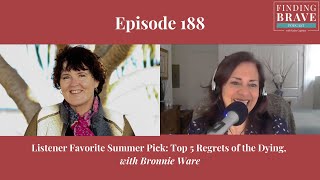
This is a Finding Brave podcast episode (host Kathy Caprino) featuring Bronnie Ware, author of the bestselling memoir The Top Five Regrets of the Dying. The conversation covers Bronnie's life transition from banking into palliative care, the origins and content of her viral work on end-of-life regrets, and practical reflections on how to live with less regret (courage to be true to oneself, setting boundaries, allowing happiness, prioritizing relationships). The episode mixes personal biography (childhood, caregiving, illness, becoming a parent) with actionable advice for listeners about courage, choices, and finding joy.
Chapters
Hello everyone, this is Kathy Caprino and welcome to my podcast, Finding Brave. I've created this show for everyone who longs to create something bold and brave in their life. To rise up, speak up and stand up for who they are and to reach their highest and biggest visions. Each week I'll be speaking with inspiring guests from all walks of business, leadership, entertainment, the creative arts and the entrepreneurial world. And they'll be sharing their intimate stories of Finding Brave and offer their best strategies for building your most rewarding, joyful and meaningful life, business and career. Speaking of that, I'm thrilled to share that my new digital course, the Most Powerful youl, is available now. This transformative eight module training course is based on my top selling book, the Most Powerful youl, and is designed to help you close what my research has revealed are the seven most damaging power gaps that keep 98% of professional women from thriving at the highest level and reaching their most thrilling, rewarding potential. In the course, you'll be taught transformative action strategies and mindsets from me and from more than 30 of the nation's top experts that will help you experience dramatically more power, confidence, communication, skill, leadership growth and authority over what transpires in your work. And you'll be guided on how to take the seven Brave pathways to career bliss, which are Brave Sight, Brave Speak Brave, Ask Brave Connection, Brave Challenge, Brave Service, and Brave Healing. If you're finally ready to close your power gaps and rock your career, visit mostpowerful you.com and join the course today. And if you'd like to learn more about these seven gaps and how to close them, take my free webinar, 7 Ways to Rapidly Elevate youe Career. You can find that@mostpowerful you.com elevateyourcareer. Thank you and I hope to see you there. Hello, everybody. Kathy Caprino here and welcome to Finding Brave this week. I gotta tell you, what's the expression? The cup runneth over. I'm pinching myself. I'm having such an incredible time with this podcast and I really feel so blessed and grateful to be speaking to people like my guest today, Bronnie Ware, right in the middle of a crashingly busy period, the holidays and you being booked Ronnie, for months. I'm so grateful for your time. And you're calling from Australia right now, right?
Yeah, I am. It's. It's the morning. It's the morning in front of. In front of you. Yes.
16 hours. So I'm grateful you hopped up early in the morning too. Thank you. Everybody, if you haven't heard of Bronnie, you will now. And I know you're just going to dive into Bronnie's messages like, and you know, I just interviewed Ronnie in my Forbes blog. And, and I mean this with all my heart. I talk to a lot of people. I read so much material. And yet some of it, only some of it really, whatever way you want to call it, smacks you across the face, cosmic two by four or hits you in your heart, not hits you, but hugs you up in your heart that makes you sit up and say, it's time. I have to make a change, a big change or a small change or whatever it is. That's what's happened to me when I read Ronnie's work every time. So let me. We are talking today about the five regrets of the dying. But much more than that. It's about what's involved in living a life that fills your heart, that makes you live with joy and not regret. And Bronnie, it's a lot longer than one podcast explaining it all, isn't it? It's a big thing. It's a journey for a lifetime, isn't it?
Yes, it is. It becomes a path in its own way. Yes.
Right. Yeah. Which is not a predictable path, is it? If you're really on, if you're really on the path, it's. It's knocking you and loving you all over the place. But anyway, folks, let me tell you about Ronnie just a little bit. Ronnie Ware is the best known. Is best known as the author of the international best selling memoir the Top five Regrets of the Dying, read by over a million people in 32 languages. Women with a movie in the pipeline. Cannot wait to hear about that. I'm jealous. Bonnie is inspirational speaker. She lives in northern New South Wales, Australia, and is a passionate advocate for simplicity and leaving space to breathe, which we were just talking about. So hard to do right now, but we so need it. Bronnie, let's dive in. Can we? I was talking earlier about reading about your story that you were in banking and it was a good job and it was secure and then something happened to you. I would love to hear. Can you share it with us?
Sure. I loved certain aspects of banking, Cathy, and mostly the customer service. But banking was changing and it was all becoming about sales. And I also didn't understand how some people could be out and about on days off when I was at work, Monday to Friday night to 5 and I think, what are they doing? How are they outside and in casual Clothes and obviously not working from, you know, the hours that I'm working. And so I just started really questioning that existence because it didn't fit me. I used to be under the fluorescent lights and longing just for lunchtime to go out and sit in a park or by a river or anything that didn't involve air conditioning and fluorescent lights. And I changed jobs a lot in the banking industry, and because of this restlessness, and I did move around Australia a lot as well. But what that meant was I actually had an accelerated career path because I'd done so many different jobs that when I'd arrive in a new town, I'd go for whatever banking job was available. And I said, sure, yeah, I could do that. I could do that. And then all of a sudden, I was in management at a really young age and not enjoying it because it was so much about sales. And a turning point came when this couple came in and they wanted a mortgage or they wanted a loan to start a flower farm. And I believed in it so fully. And I did everything I could to prove on paper that they could afford it, because I could see that they had the commitment and the passion and the vision, and I couldn't prove on paper that they could afford it. And I had to decline their loan. And it just. It destroyed me. I just thought, if I can't help people like that who I know, they would have found a way to make it happen. But obviously I had. You know, the banks have their own criteria. They can't just lend to every visionary out there. And it just started me on a whole different direction. And so I quit the banking and I went and washed dishes on a tropical island for a couple of years. And that gave me the difference of not working 9 to 5. But it also started me really searching for work with heart. And then I did what a lot of Aussies do. I went on my backpacking holiday over to England and Europe, became a companion for the elderly people over there. And that eventually led me into palliative care when I returned to Australia. And I didn't see it coming, but my prayer. So work that didn't involve the criteria. My prayer was no stockings, no high heels, no makeup, and where I could be myself and work from the heart. And that eventually led me into looking after an elderly lady again as a companion. But she became terminally ill, and the agency I was working with said I handled it really well. Would I like to do more of palliative care?
Wow.
And through some tears and a lot of prayers for this for strength to do. So I said, yeah, okay, let's give it a try.
And for eight years, right?
Eight years, yes.
Yeah.
Yeah. It just changed my life completely, as you can imagine, it would.
Now I have questions. Bonnie, can I ask? They're probably different from what, I don't know. We'll see. But, you know, my work is career coaching, which, to me, we were talking about this. It's everything. It's spiritual coaching. It's personal growth. It's what is your heart asking? And how do we get to that? And how do we get the boundaries and the strength to get to that? But when I'm reading your story, what I'm. I know that you're also a musician and a composer. Right. And you're a poet, I think, obviously. So one thing I think these listeners. My listeners. Our listeners would be interested in. Did you have an inkling? Let me stop. Go back. When you say that you felt so hemmed in. That's how I hear it. You would go to banking every day in the fluorescent lights, and that's how I would feel in corporate life. And I stayed 18 years. But I didn't understand what it was. I thought, what's the matter with you? Why do you feel so hemmed in? Dad was with GE for 30 years. Why can't you? I didn't get it. And when I look back now and connect all the dots of who I've always been but didn't recognize it, this is the work I want to be doing and that my heart wants to be doing. So the question is, when you look back on. When you were a little girl, is the work that you're doing now what you dreamed you could be but maybe didn't believe it? Or was it even an inkling? Was it a. What do they call it, you know, a little glint in your eye, or you had no idea as a child?
Cathy. I didn't really dream that big. It was quite a traumatic childhood. My. My dad was. Was very cruel verbally, and. And he was broken. And I was the most sensitive of all the children, and I triggered a lot of his. He was a sensitive, broken man, and so I triggered a lot of that, and so I copped. Copped his brokenness. So as a child, I really didn't dream that much. I was really just doing my best to stay quiet and stay out of the way, and. And it wasn't until I walked on hot coals at a Tony Robbins event in my 20s that I dared to think, oh, okay, maybe I can actually be bigger than I think I can be. My dreams can be bigger than I've allowed them to. To be. But as a child, I had pen friends all over the world. And I used to put on. My father was an accountant and a songwriter. Guitarist. Songwriter. My mother was a nutritionist and a singer and.
What a mix.
Yeah. And so we had this, like, really creative life when all the. The musicians would be in town and then they would disappear. And then it was just this straight, you know, corporate sort of life again. And so there was a part of me and I think any child would be happy to like. I loved the creative times when the. All the really big musicians in country music in Australia in the 70s, when they would come to visit, it was so exciting. It was. It was like, you know, a mini Woodstock. It was for a few months every year. They'd all be. Because in those days, they used to take their caravans right around the country and then they'd stop for a few months, write new songs and off they'd go again. And so they would use our farm for that few months. And so it was really an amazing time. And I had this creativity and I would write songs and I would write letters to friends and all of those sort of things. But then they would disappear and dad would just straighten out again and. And be his other self and the house would be really different. And then I went into banking and so I followed his accounting footsteps. But when I think back, I always loved writing. I just loved expressing myself through Word. And I didn't dream that I could be an author. It didn't even cross my mind. But I was so happy writing and expressing myself through Word. So it was there. I just wasn't really brave enough as a little girl to dare to imagine, you know, I was gonna do what my father said because I was too scared not to. Yeah. So I went straight out of school into a banking job. Like, I had the banking job set up before I even left school. Yeah.
Isn't this. So, folks, I want you all to listen to the themes of this because I think they are so universal. First of all, it was interesting. Did you say you copped his brokenness? Is that how you put it?
Yes. Yeah.
Meaning you were the lightning rod for it. You were the.
Yes. Yeah. I was the one. The vent. Yeah.
You know, I wonder if you would agree with this statement. I think so. In this upcoming book, the Most Powerful youl, the first chapter is, you are what your childhood taught you to be, unless you've healed it or.
Yeah.
Would you agree with that?
Absolutely, Kathy, and that's so wise of you to say that. Absolutely. And. But we can heal it. And before my dad died, we had a completely different relationship, and he. He was a man with a lot of regrets, and he was still broken in his own ways, but I had healed the need for his love, and only at that point did I actually get his love. And for me, at that point, it was like, well, I'm glad for you. I was happy for him that he had reached a point where he could love in that way more than me feeling like, oh, great, I've got Dad's love. It's like, well, I love myself enough now. That. That's great, dad. Thanks a lot. But whatever.
Did your journey help him?
Yes. Reciprocal.
He learned from you?
Yes, he did. He did, but he wasn't able to express that. So when he read my first book, the Top 5 Regrets of the Dying, it took him years to read it, and he only read it in his last few months. And so it had already been out at least four or five years by then. And when my mum told me he was reading it, he didn't acknowledge it to me. And so I confronted him about it and made him deal with it. And I said, and. Or I tried, and I just said, oh, dad, Mum told me that you read my book. And he just said, yeah, yeah, it was interesting, love. It was interesting. And that was all he could tell me. But in the meantime, my mum's told me he's on the phone to all his mates saying, you got to read Bronnie's book. He can't believe the stuff she's done in her life and what she's done. Get a hold of it. Buy this damn book. You'll love it. And he's telling the neighbor over. He's telling everyone. That's what I mean, admit it.
But that was okay for you?
Yeah. Oh, yes.
Another interesting theme, I think, is the duality that he had you. And I'm guessing he went back after his friends and the musicians left. He went back to that flat life that was stimul, not stimulating and crushing to him. And. And interestingly, that you had that duality, it's like you absorbed that, too, until you broke away, right?
Yes.
You said, I'm going to honor what I really want to do here.
And he's like a lot of your listeners and a lot of what you and I were as well, he was doing, living the life expected of him. He had a stack of kids to feed. He was trying his best to feed us all and to keep the farm through floods and droughts and everything else. And he was out of his league. He was just doing the life expected of him. And that's probably why he was so miserable most of the time, because he didn't have the coping mechanisms, and he was living in a world that wasn't true to his sensitive, creative heart.
We can relate to that, I think, can't we, folks? I want to read to you the five top regrets of the dying. But we're going to talk about other things. And, you know, the source material is Bronnie's book, her viral post. It's all there. And the memoir is amazing. But just. Just so you have a frame of reference, or would you like to share them? Bronnie, what would you like?
No, go on. You do it. I love hearing your voice. You've got such a. Such a lovely voice for podcast.
Thank you, my dear. And you know, I'm a singer on the side, so I can so relate to music feeding us so much. Number one, I wish I'd had the courage to live a life true to myself, not the life others expected of me. Number two, I wish I hadn't worked so hard. Number three, I wish I'd had the courage to express my feelings. Number four, I wish I'd stayed in touch with my friends. And number five, I wish I'd let myself be happier. Oh, all right. Could you? The one that speaks to me right in this moment, which I feel is complex, it's not readily apparent how to do this well, is number five, I wish I'd let myself be happier. Can you just riff on that, Bronnie? What do we have to do? What are we not doing?
Well, we have to realize we're allowed to be happy and that we're worthy of happiness. That's a really big thing for a lot of people. But also understanding that contrast is a part of life. We're not going to be happy all the time. We can't realize our potential without the challenges and the struggle to realize our strength and to break through all of the conditioning that's actually holding us back and to break through the resistance to our potential, the fear of our potential. And so we have to have those struggles and the contrast and the challenges because they are the things that make us step into our best self, to really step up and own who we can be. So it's not about not being, not accepting those times. It is about choosing how long you're going to stay in those times. And so even within, if you're in a whole chapter of growth and challenge, even within that, it is possible to stop for two minutes and watch a cloud go over, or listen to a bird sing, or see a smile from a stranger, or take a few deep breaths and realize your own beauty. So choosing happiness isn't denying sadness and anger and challenges. It's saying, okay, I have all of that, but I am not going to give any more power to that than is absolutely necessary. So I'm in a sad time. For example, I'm in a sad time right now, but I can see a bird singing out, you know, flitting out from tree to tree out my window. Or a shopkeeper today wished me a nice day and they may have been having a really lousy time and might be struggling to feed their kid, or may have had had to walk two miles to get to work, but they still wish me a nice day and they still turned up and we interacted and they smiled at me. So. So happiness is a choice on a such a tiny level in so many ways, and yet all of those small choices to focus on something beautiful or something positive is one choice away from the anger and the sadness and one choice closer to happiness.
Boy, that's so beautiful. And you make it so doable. I love it.
It's so doable.
Can I offer something that helps me and see if you've come across this, which I'm sure you have.
Sure.
When I've come to the point where, and I did, I was about as far away from this approach to life as you could be. When I was in my 18 year old, miserable corporate career and chronically ill and trying, you know, toxic bosses, narcissistic colleagues, it was a mess. No work life balance, no meaning in the work. But when something seemingly bad, seemingly negative happens in with my kids, with me, with my health now, what I try to do in every moment I can is say, wow, okay, what can I learn from this? What is. And I'll say it five different ways. What is it that will make me say when I'm on the other side of this? That this was the best thing that ever happened to me because I experienced that getting laid off in a way that just killed me. And you know, sitting in the therapist office and he says, I know this looks like the worst crisis you've ever faced, but from where I sit, it's the first moment you can choose who you want to be. And you know, that's in my book. I say that every place I go because I don't know, it was as if it was a miracle being delivered to me that I could actually say, who do I want to be? And of course I couldn't say it fully baked because when you're so far away from yourself, you can't.
Right.
But I do say when I'm getting rocked, I'll say, all right, what, what can I get from this that I would say later? Oh, thank you. Does this resonate with you, Ronnie?
Sure does. I deeply believe without a doubt that our lessons are given to us from a place of love to bring us into our best self. Without a doubt. I've had my share of lessons for sure, but I was. My biggest lesson, I think has been I was very blessed to conceive naturally and quickly. At 44, I became a first time mom at 45. Yeah, amazing. And I have a gorgeous, sweet little girl now. But during the pregnancy I ended up leaving the relationship and, you know, I don't need to sort of go into that, but I just realized it was going to be. It was bittersweet because it was, it was the best move for my daughter and for myself. But as soon as she was born, I was diagnosed with rheumatoid arthritis. And so I went into a massive healing journey with that. And I can't play my guitar anymore. I don't, you know, I've had had a lot of grief around that, but being sick and a solo mum and it's also. So three things happen at the same time. My daughter was born. Within 24 hours of that, I was offered an international publishing deal with Hay House for my book. It had been rejected by 25 publishers. This same book that is now all of that that you've mentioned before. And I was diagnosed with RA Rheumatoid arthritis. So I've never really known any of the three without each other, but. But I'm now almost eight years along from that point. And I wouldn't be as at peace and grounded in myself and have the very strong boundaries around my professional life if it hadn't been for the disease. Because it taught me not only boundaries, but also the blessings of leaving space and the, the magic and the shortcuts that giving yourself space can bring to your professional and personal life. And so I would have been like, perhaps maybe not because I learned a lot through the dying, but to some degree I wouldn't have had such strong boundaries because I would have been caught up in other people's expectations or their beliefs on how a business should be run. Whereas through the challenges I'VE I was blessed with. I know that that doesn't actually work for me. I've tried all sorts of nonsense that other people thought and it doesn't work. But by becoming so ill to the point that my 2 year old was dressing me and not knowing how I was going to support, you know, I was supporting us financially through my work. But, but supporting her like cook for her and everything else physically, yes. Yeah. And you don't realize how much of it is physical and, but I wouldn't have if I hadn't had those challenges, Kathy. I wouldn't be confident to own the life that I have now and to step out and say, well, this is actually how I do business. It supports me. I bring my best self to the world by managing my business with these strict boundaries. And, and yeah, I wouldn't be that person. And so yes, absolutely, without a doubt, those challenges, when the carpet is pulled out from underneath us, it's actually a blessing of love gifted to us to say the way you're going is not working. Try a whole new direction. Because if I don't pull it, I believe that life just says if I don't pull the whole carpet out, you're going to keep one foot on the other side and keep trying to get back to that instead of finding a whole new direction. Direction.
Oh, I so agree and I love it. I have questions. More questions can I throw at you? I'm taking notes. I absolutely needed this conversation today. So when I think in some ways you and I are the same person. I mean, not literally, of course, you know what I mean. But people like to tell us. So I run a small business and you know, in some ways there's been great success, in some ways it's been heartbreaking challenge. But everyone's got an idea about how you should run a business, don't they? Often if not most of the time, these top gurus that tell me what to do, it all feels wrong. It just feels wrong. And I won't go into how. But you are pointing to so many things. One, make yourself right, not wrong. And what I say all the time, when something feels wrong, it's wrong for you. Now sometimes we feel a little afraid it might be right, the move, but we're scared to death so we make ourselves wrong for wanting it. But I think our intuition is so strong. But I'm really interested to know, is there something that pops up in your mind about what people are trying to tell you in terms of how you should run this business that really has felt Wrong to you?
Well, I list on my website some of my favorite insights and one of those is that the only system that works is your own. And yeah, I've been caught up in all that as well to a degree and then just thought, whoa, hang on a sec. This isn't your heart talking. This is too much time paying attention to what other people are doing. And it doesn't mean we can't learn from other people and we can not make so many mistakes if we're learning by their systems. But they are their systems. And so our own systems have. It can be a blend of a thousand people's systems, but they have to be aligned with our heart. And so yeah, I do think there's a lot of people out there making a lot of money selling systems to people that just do not work. And I know that it's been said by many people, and Tony Robbins especially that we do more to avoid pain than we do to gain pleasure. And so there is so much sold on igniting fear in people and it's a primal instinct to avoid fear rather than gain pleasure. So it actually works. But I just have, I do like, like what you've just explained. I question the integrity of a lot of people with that so called success that I think there are some really good people out there hugely successful with their heart in it and trying to do great work. But I do also think there's a lot of people out there creating, selling to people their own systems with who have become completely disconnected from their heart and are driven solely by the dollar and have lost sight of integrity and the fact that numbers are actually individual people with hearts and feelings.
Oh, Bonnie, I couldn't agree more in every possible way. It's heartbreaking to see and it's a bit uncomfortable when you're in the middle of that. I'm in the middle of that. You know, I'm a career coach and talk to all sorts of women about how to reach your highest potential. And around me is swirling approaches that I feel are unethical at best. You know I know. Yes, well, we do, we do. We hang tight with to what we know is right in our heart. Here's a question for you. So when you wrote this and it went viral and that's quite a situation, isn't it? To see something of yours just start. It's a wild feeling, isn't it? But here's my question. We talked earlier. You're very well boundaried now. Did you ever experience what many people in the caregiving field and I was a marriage and family therapist after corporate and I felt this all the time. I'm better now, but not perfect. That when you're in a helping service profession, it's very hard to say no because when you're saying no or when you're saying yes to yourself, it might feel like you're saying no to helping someone. How do you handle that? I mean, you're in so deep in these messages that are saving people's lives. How do you say no?
Well, it took time and through disease I had to say no because I had to get clear about my priorities and my well being and my daughter and my two highest priorities. So what? Well, for me, what I actually did was I've created an online course and I know everyone has an online course, but I actually did it with the intention of, okay, here are the tools that work, that worked for me. They can like, if you do what I say, they're most likely to work for you if you resonate with my work. And so what led to that is I did some private mentoring. I ran a membership and everything else, but I found that I don't want to hold that. It's not healthy for me to hold the space all the time for other people. Some people are brilliant at it. You're a coach, it's what you're called to do. I'm called to give the message, to give the tools and hand it over back to the person to say, this is what I can offer you to support your life. These tools worked for me. If you resonate with my work, they will work for you. But I cannot hold your hand every step along the way. You have the power within yourself and all of us do. And we all learn from other people, we all benefit from mentors and coaches and that sort of thing. But at the end of the day, it is our heart that will guide us. And I always come back to that Buddhist quote that the mind knows no answers, the heart knows no questions. And it may be the other way around. I always get it mixed up. It might be.
I think it sounds right to me.
Yeah. So it may be, but it may be the heart knows no questions, the mind knows no answers. I don't know which one is said first, but that's what I always come back to. And when I've done mentoring, and I still do some high end mentoring occasionally, but what I always come back to is, you know, the answer is within yourself. I can help you find it, but I cannot, I am not going to give you the answers and that is really scary for a lot of people. And that's where a great coach like yourself comes in, where you can help them find that courage to find their answers and remove a lot of the obstacles that are blocking people from seeing that. But I really do believe that, that through all of this, that what I do is I give people the tools. How they choose to use the tools is up to them. That's beautiful.
And you're fortunate that that's the way it goes. You know, truthfully speaking, one of my challenges is I give them the tools. But when we are broken in some way, and I don't mean our spirit is broken, I don't mean we're broken in that way. I mean something ins.
Gapped.
And that's what the book is about. Seven Damaging Power Gaps. We can't often. Well, Einstein said you can't solve a problem on the level of consciousness that created it. And I just, I believe that. So my role right now is shifting consciousness and I kind of have to be present to do that. But I'm, I'm praying and offering it up. Let me do that without being physically present because then it's one to many, not one to one. That's my goal. But I'm struggling. I'm struggling. Can I ask you this? You said that there's a. I heard you say there's a reluctance to happiness in a lot of people, a reluctance to be happy. What do you think that's about? Where did we get that?
I think it's an exhaustion, just tiredness that happiness isn't prioritized anymore. And so it takes effort to be happy, it takes commitment to be happy rather than it just being a natural state because we have so many distractions and things calling for our time and attention, that happiness isn't just a simple state anymore. There's not enough space just to be present and to allow happiness to flow in. So happiness takes work and that's where the reluctance is. Because people are tired and they may have given it a go a few times and then slipped back into other states and it's like, oh yeah, I tried that. Yeah, yeah.
And do you think, you know, again, I work with perfectionistic over functioners doing more than is healthy, necessary and appropriate and trying to get an A and all of that. And we don't come out of the chute like that. We're trained, we're culturally trained. And I do see that so many of our families, well meaning parents, or maybe even not well meaning, but parents that give conditional love, I'M only going to love you if you get A's. And it's not conscious. It's just the message that we got, you know, that you need to be this, this, and this for me to love you. I think what it does is set up a feeling of guilt around prioritizing those things that will bring us joy. We feel guilty and we feel afraid. Do you see that in the work you do?
Yes, but guilt is just toxic. I mean, I wrote about that in the top five Regrets of the Dying. And guilt is their projection and expectation. What we need to remember, and this is where finding brave comes in, that you do have to find courage and be brave, is that if we dare to create some space to honor the things that light us up, even if they're not at all linked with our professional life, they will lift our happiness, our confidence, our presence, our joy to a point that we bring, then bring more efficiency to our work. We also bring more clarity to life. And as a result of all of that, we then are bringing our best self, an improved version of ourself, to the world. And that benefits everyone. It may not benefit the person trying to put you on the guilt train. It may not benefit them, but what I have found is the more I've let go of that, the more those people have either dropped away or they've secretly admired me, or they've outright admired me and said, wow, you're so gutsy to have done that and then developed a whole new respect. The relationship has moved to a whole new level of respect. And so guilt is about the other person. It takes a lot to let go of it and say, okay, if I'm not pleasing you here, I'm going to feel a bit guilty. But that's only because we've set up these dynamics of your expectations and me meeting your expectations. But I have a better version of me in mind, and it doesn't actually align with your version of me right now. So hopefully we'll meet, you know, our energies will. Our expectations or lifestyles will link up along the way again. But I'm actually going to focus on bringing my best version of myself to the world because not only does it improve the lives of others, it actually gives you more joy. And the greatest appreciation we can show for our life is to enjoy it as fully as possible.
Holy cow. That is just so perfectly beautifully said. You know, as you're talking, it's like a video is running through my mind of my own life, but I want to just support that in every possible way as I said I'm a singer on the side and without. I've, you know, made a little money, been on records, a few records, sung in Carnegie hall, blah, blah, blah. But I never wanted to.
Excuse me. Sung in Carnegie hall, blah blah, blah. Not as a song. It doesn't matter, people. Yeah, yeah, and good for you, good for you. I own it. There's no blah, blah, blah allowed after that sentence ever again.
All right, yeah, you got it. Take it back. But I bring it up because while I never wanted to do it for a living, it. I levitate after singing. So I had a three night concert series with my little singing group in my community just last weekend and literally it's exactly what you're talking about. I feel so full, so joyful. I'm pinching myself and I notice that I'm different everywhere. I'm different in my work, I'm different when I'm playing tennis because of that experience that lit me up from the inside. So I think some of that guilt is also almost internally derived that this feels crazy to be this happy. I think there's another thing going on when the world can be so unhappy. I mean, you don't live in the US but we're going through one heck of a time, you know, with our government and the rage and the hatred and the world around you can feel so unhappy that when you feel happy you almost feel out of sync with other people. Does this make sense?
It does, it does. And then I understand then you can feel a bit guilty because everyone else is so miserable. We need people like we need happy people to reconnect us with who we really are, to say all of this is going on, but we can still choose happiness in amongst this. Let's find something on a really minuscule basis to focus on all. It's not denying all of that yucky stuff on the national basis or international basis, but let's look at something great. He like, I was just singing and it was fantastic and it's just made me so much happier. Why don't you come along and sing with me? Or why don't you do something that's going to light you up? And even if you can't do it in a sense to benefit the whole world, do it in a sense to carry you, like to, to diminish the guilt. Think, okay, I do this so it can be a boy to float me around, you know, river boy or an ocean boy, Not a girl boy, you.
Know, boy, I guess.
Yeah. To carry me through those hard times. Let the joyful moments actually carry me because goodness knows there's enough weighing me down the rest of the time.
Oh, Bonnie, what a gift you are to all of us. I can't thank you enough. Where is there anything else you want to leave us with that you don't get to talk enough about that we need to know?
Oh, thank you. I think just let yourself be surprised that sometimes we put so much energy into trying to work out, especially as career people, that trying to work out how every single step is going to work out. But if you can dare to be courageous enough to think, okay, maybe I don't need to know every step of the way here and just deal with the step in front of me, then life will breathe a sigh of relief and say, ah, okay, maybe I can help out here now. So just, you know, the more courageous we can become to let ourselves be surprised, the more blessings and opportunities, career opportunities as well as personal, can come our way. And I know from my own experience that that has been the case, that sometimes I'm trying so hard to make one direction work and my heart's not in it, but I've been trying to make it work. And then I just sort of step back and think, maybe there's something better waiting for me. And then this really obscure opportunity will come along that is so delightful, will make me more money than what I have made. Pushing this other thing for the last few months or whatever will make me more money in two weeks than what I've made in three months. You know, something like that. And so I guess the thing I'd like to say is just let yourself be surprised that we don't need to know all of the answers. We just need to be brave enough to open ourselves to hearing them.
Oh, it's so beautiful. I keep wishing you would live next door and you could come over for.
A cup of tea and I could.
Just soak it in. I can't thank you enough, money. I swear I'm gonna listen to. To this many, many times in the next few weeks because it speaks to me so deeply, so clearly. I need these messages. Thank you so much for taking the time. I can't tell you how much I appreciate it.
It's been a pleasure, Kathy, and thank you for reaching out and for the work you're doing. It is genuinely a delight to discover the good that you are bringing into the world as well. So please keep doing what you're doing.
Thank you, my dear. I'm taking that in. Thank you. All right, everyone, if you weren't inspired by this. I don't know what to say but let us hear from you now. Bronnie's taking some time off. We have to respect that. But you know, wherever you see this, whether it's on LinkedIn or Facebook or Instagram, we would love to hear what you got from it and everyone's going to have a different take. I just would love to hear how did this move you? What did you hear that you were really ready to hear and you're ready to do something different? Thank you again, Bronnie. Come back again soon. I hope and hope I meet you in Australia soon. Next summer maybe.
Sounds like a good plan.
Happy holidays and I will see you next week, my friends. Be brave. Bye now. Thanks so much for joining us today and please don't forget to check out findingbrave. Org for more programs, resources and tips. And tune in next time for your weekly dose of finding brave.
More from Kathy


Elevate Yourself, Elevate Others, and Amplify Good | Chris Cooper | Finding Brave Ep. 334

Finding Brave Epis #333: How Leaders Can Harness AI Without Losing Their Humanity, w/Bennett Borden

Finding Brave Epis 332- How to Stay Brave, Valuable and Visible in the Age of AI, with Raman Rai

Finding Brave Epis 331 - The Power of Positive Disruption, with Dr. Patrick Leddin


Finding Brave Epis 330 - Being 40: Letting Go and Embracing Who You Are, with Stacey Lindsay

Disrupt Career Reinvention with Kathy Caprino - via The Disruption Lab Podcast w/Patrick Leddin

Creating Neurodiversity-Friendly Work Cultures: Simple Workplace Adjustments Matter

Finding Brave Epis 329 - How To Create a Neurodiversity-Friendly Workplace, with Kristen Pressner

Finding Brave Epis. 328: Reclaiming the Power to Trust Your Own Voice, with Dr. Cindy McGovern