193: Using a "Flux" Mindset To Better Navigate The Future, with April Rinne
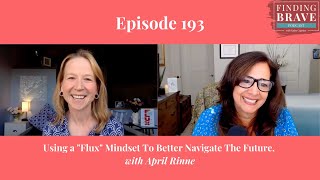
April Rinne discusses her "Flux" mindset for thriving amid constant change, rooted in early loss of her parents. She outlines practices from her book including "see what's invisible" and "let go of the future," and argues organizations need to shift from traditional change management toward building flux-ready cultures.
Chapters
Hello everyone, this is Kathy Caprino and welcome to my podcast, Finding Brave. I've created this show for everyone who longs to create something bold and brave in their life. To rise up, speak up and stand up for who they are and to reach their highest and biggest visions. Each week I'll be speaking with inspiring guests from all walks of business, leadership, entertainment, the creative arts and the entrepreneurial world and they'll be sharing their intimate stories of Finding Brave and offer their best strategies for building your most rewarding, joyful and meaningful life, business and career. Speaking of that, I'm thrilled to share that my new digital course, the Most Powerful youl is available now. This transformative eight module training course is based on my top selling book, the Most Powerful you and is designed to help you close what my research has revealed are the seven most damaging power gaps that keep 98% of professional women from thriving at the highest level and reaching their most thrilling, rewarding potential. In the course, you'll be taught transformative action strategies and mindsets from me and from more than 30 of the nation's top experts that will help you experience dramatically more power, confidence, communication, skill, leadership growth and authority over what transpires in your work. And you'll be guided on how to take the seven brave pathways to career bliss which are Brave Sight, Brave Speak Brave Ask Brave Connection, Brave Challenge, Brave Service and Brave Healing. If you're finally ready to close your power gaps and rock your career, visit mostpowerful you.com and join the course today. And if you'd like to learn more about these seven gaps and how to close them, take my free webinar seven ways to rapidly elevate your career. You can find that@mostpowerful you.com elevateyourcareer thank you and I hope to see you there. Hello everybody. Welcome to another episode of Finding Brave. How are you this week? It is when this is coming to you. It's mid September. I hope, I hope September's starting off with a bang. I happen to love September. It's so great, the new season. And I am beyond excited to welcome our beautiful, brilliant guest today about a topic that is so. And as every day goes on, we see how more critical it is. So, April Rinny, thank you for taking the time in the middle of your book launch, which is smashingly successful. Thank you for being here. Thank you.
Thank you so much, Kathy. I am just thrilled to be here as well.
We were both laughing about the technological issues of pulling interviews and podcasts together. From the lighting to you're seeing the beautiful light streaming in here.
We.
What the heck, people? We're just letting it flow the way it needs to. So if you have a fire alarm, April, like you did the other day, we'll forgive you. And you guys will forgive me for anything that goes on here. All right, people, we are talking about today using a Flux mindset to better navigate the future. And April is absolutely the. The expert on this in your own life. And how you turned what you've learned in your own life into messages for. Well, you'll find out. Let me tell you About April. Ranked one of the world's 50 leading female futurists by Forbes, April Renney is a change navigator. She helps individuals and organizations rethink and reshape their relationship with change, uncertainty, and a world in flux. My goodness. I mean, what else can we say? We're in such that world today, right? A World Economic Forum young global leader. She is a trusted advisor to organizations ranging from Airbnb, Nike, Intuit, the World bank, the Inter American Development bank, nesta. I don't even know how to pronounce this. Is it trove. I'm not even going to say the rest of the. I can't breathe. They're all over the world and unsettled. As well as governments spanning Singapore to South Africa, Canada to Colombia, Italy to India. April is the author of the new book Eight Superpowers for Thriving in Constant Change, which came out August 24. There is so much more about April, but I'm going to read this because I find this fascinating. A graduate of Harvard Law School, April is a futurist advisor, global development executive, microfinance lawyer.
Really?
Investor, mental health advocate, social certified yoga teacher, Globetrotter, 100 plus countries. It goes on. But I want you to know she also harnesses her very personal experiences with Flux. And you're going to tell us about that. But, you know, first of all, I feel like, what am I doing with my life? How do you have all these incredible professional accomplishments? It's so inspiring. But I do want to start with what you've written about the Flux mindset. We can see it behind you. And can you tell us? You know, I'm spilling the beans here, but I have such a personal affinity with people who turn their. What I call turn their mess into a message. Not that you ever had a mess, but people who've turned what they've been through in life that other people would say, I don't understand how you survived that. And then bring all that learning forward to help Others, I find that so inspirational. So could we start there, April? Tell us.
Absolutely. Thank you so much. What a beautiful and generous opening. I am just like, so excited.
I am, too.
Yeah, let's. This whole concept of flux and a world in flux, I do always like to remind people that, Yes, I think 2020 and the COVID pandemic, and, you know, I tell people, is your world in flux? That's my life. It's a moment in time that we're all grappling with. But the message I bring is not one about 2020 per se, or a pandemic per se. It's about the fact that moving forward, we actually are facing a future with more uncertainty, more change, more flux, and that I didn't write the book about 2020 either. I'd been working on it for three. Been writing it for about three years, but it's really more like three decades in. So if we go back to that kind of origin story or the genesis of flux, and before you do that.
Can you define flux for us since that's what we're going to be saying 5,000.
I love this. I love this because flux is both a noun and a verb. Oh, wow. And a lot of people, they like to say. It's a fun word to say, right?
I'm in flux, but exactly.
So as a noun, which is how most people know it, it means constant change or movement or fluctuation. But the world is in flux. Constant change. Not one change that you react or respond to, but like never ending change, but also as a verb, the verb to flux means to learn, to become fluid. And I love this concept because the world is in flux and we all need to learn how to flux, to change and shift and strengthen our mindsets to be fit for a future influx full of uncertainty, etc. So it's fun because, again, lots of riffs on it.
I love it. Let me just ask this, and then we've got to get to the origin story. Do you feel, has the world always been in flux? And we just didn't know it? Because we, you know, my kids who are 24 and 27, they're saying, My daughter in particular, it's a tough, tough time in so many ways right now. And they said to me, you know, has it always been like that? And I think it always has. It's just that we are now bombarded with a billion bytes of information per second. You know, photos and images. Tell me what you think. Has the world been influxed?
So on the one hand, I mean, change Is has been around for all of human history. I like to say, like the only reason you and I are here is because of change. Some things changed and we came into being. But at the same time it's not just how many things are changing. And there's a separate conversation we could have about the role of technology and how technology tends to accelerate, accelerate, accelerate. How much is changing, but not just how much is changing on any given day, which includes how much information people expect us to be able to consume, digest, distill and do something about. But it's also the pace of change and the way that I like to put it. And I think your kids would probably resonate with this. The pace of change has never been faster than it is today. But here's the hook. It is likely to never again be this slow.
Oh good grief.
When you think about that, I mean, because if you look back all the way, you know, Industrial revolution, so to speak, right? The first industrial revolution, it took about 100 years for the effects of it to be fully felt. Now that was a lot of change compressed in, but it was compressed into effectively five generations given life lifetimes at that time. Today we're in the so called fourth industrial revolution, you know, big picture. And no one knows exactly how long it's going to take, but you know, the bets are pretty good. It's between 10 and 20 years in which we see, and again, this is everything from smartphones, artificial intelligence, all of this is happening in basically less than one generation. And the human mind isn't really designed to cope like that. So part of me, and this is where I bring in the futurist lens, the global lens, where I'm sort of saying hold on, there's a kind of inner reset that needs to happen individually also the organizationally and societally. Because if the pace of change is ever faster, ever faster, ever faster, and we already feel like we don't have enough time to keep up, or we're overwhelmed, we're not able to show up fully, then we need a big reset. Because the future does not play out well. If we continue to buy into not just what society says, but what this piece of change is doing.
You know, while you're talking, I'm getting choked up. And whenever that happens, it means I'm living what, what the very message that you're saying. So I just want to say this, you know, as, as someone who has a small business and let's face it, I mean, I don't BS on my shows here, you know, I want to remain relevant. And it's amazing what being relevant and useful and reaching a lot of people requires today. Like, I'm about to get on or by the time you see this people, I'm. I'm going to be on TikTok giving sound bites, you know, yikes. At a time where slowing down may seem really interesting for me because I'm in that stage of life, having worked more than 40 years, it's not slowing down at all, it's speeding up. So all I want to tell you why I'm saying this is, it really speaks to my heart what you're saying, that I think if we don't take a conscious approach to change, we're going to just, you know, it's going to exhaust us and our mental health is going to go down the toilet. But anyway, we'll talk about that in a minute. Tell us how. Yeah, do you have a follow up on that comment?
Sure. Well, just going to say. And we'll circle back to this with the run slower. But, but as I like to say, I mean, this is. You are providing such gifts, such service, such benefit to humanity, but in order to keep doing that and to do so in the ways that you're best at, you can't. And this isn't you per se. I mean, this is everyone in their own way, can't keep running ever faster. And what we find. And again, we'll, we'll circle back to this. So the superpowers are counterintuitive in these wonderful, wonderful ways because they go against what society tells us, but they're actually not just much more fit for a world in flux, but much more suited to help you show up fully in the world. And it's not just about doing more, more, more, it's about being very selective about what you're doing and doing that full throttle. But, you know, anyway. Yeah, love it.
All right, now start from the beginning. Give me that origin.
We've already teed it up quite nicely because as I like to say, there are kind of three main lenses that I bring to change. Right. The first and most recent one is that of a futurist helping figure out where are we heading. The next one is this global lens. Given my travels and work and living in many different places and how much we can from different people around the world about how we think about and relate to change. But then if I go back deeper in my history and like, when did my journey to flux begin? And if I peel back the layers of the onion of my interest around how do we Deal with change. And also, I think, maybe relevant in particular for this audience. Like, what do you do when you don't know what to do? And you have that sense of, like, I know there's something better, something different. That for me, my entry into flux happened almost 30 years ago when I was in college and both of my parents died in a car accident. And in a moment, my world flips upside down, right? And 20 is a really interesting age because I was old enough. I was at college, I was able to take care of myself day to day, but I was young enough to not really know how the world worked or my role in it. And so, you know, this was, how do I rebuild my family? How do I take care of myself?
Right?
I had to grow up really fast. What does this mean for my career? Because I really didn't have a template for that. And at that time, it's funny, I mean, I can now say in many years later, the questions I started asking, which I think are so germane to your mission as well, which I love, makes me so happy to be here, this sense of what really matters. And if I were to die tomorrow, because I've just learned firsthand how fragile and unexpected life is, what would the world need me to do today?
What would the world need me to do today?
Not me. That's important. It wasn't about, this is about me. This is like, what do I need if I were to die tomorrow? What should I do today? What does society think I need to do today? There was definite. It was all about service to others. It was like, what does the world mean?
You went to that immediately? I mean, after grieving, of course, it.
Was a long side. There was an enormous amount of the trauma and the mental health and the anxiety and the grief and all of that, which candidly took years to unpack. And in fairness, as, you know, like, it doesn't ever stop.
No, it continues to.
But you work your way through that. You walk through that initial fire, and then you get to the other side going, okay, life is forever changed. But how do I make sense of what's happened? How do I, you know, take a mess and make it a message? It was very messy back then, and I like to think of it, too, as how did I look at a challenge and turn it into just an enormous, enormous opportunity for growth?
Can I ask you this? I can't lobotomize the part of myself that was a therapist. You know, I was a therapist. What do you. How do I ask this? What do you think contributed To. I mean, that's a selfless thought. Although there's. There's selfishness in the most beautiful way in serving. When you serve others, you get so much. But, I mean, I talk to a lot of people, April, and. And a lot of illustrious people, and a lot of them are not asking that question in that way. What does the world need me to do? Where you were raised in a spiritual. Yeah. Was it spiritual?
This does go back. And it brings me great joy because I know. I've just. I always joke when I talk about my parents. It's sort of like I'm. I'm dropping a hand grenade into the conversation, right? Of like, oh, now what do we do? And I'm like, no, no, no, no, no. It is such a joy for me to talk about this because I'm able to learn and better understand myself, but also how. How this message. It's my experience, but so many people in the world are trying to unpack their own puzzle of life. So in my case, I can say I'm very, very lucky. My childhood was not easy, but it was, as I like to say, I think all parents fall into this category. Like, my parents did the best they could with what they had, which wasn't a lot, and it wasn't a guidebook to parenting, but my dad was my best friend. I can be really candid with this as well. It's in the book and everything. My mom suffered from depression. We now know that she was borderline bipolar. My mom suffered a lot. My mom did the best she could. My dad was my best friend. Both my parents were teachers. And so education was a huge piece of our family. And we didn't have a lot in terms of money or material things, but the two things we were allowed to spend money on were education and travel. And my dad was a cultural geographer, meaning he studied the migratory patterns of people and plants and animals and, like, what makes the world diverse.
That's what he taught. And for a living, which was very cool.
Didn't make a lot of money doing it, but loved it and cares as a kid. No, that's what I mean. It was, like, worth it. Like, I'm so grateful because he's who taught me everything from that. The more different someone is from you, the more interesting they are to get.
To know and you can learn. Right.
Why do you want to hang out with people who look like you and talk like, you know, he's like, the world is a big, beautiful place. Like, go out and explore it. But another thing that he Would teach me. And where this, this question, the way I frame, the question comes from is that he would remind me pretty much every day that as a girl, the fact that I got to go to school as a girl in the world made me so lucky. There was a very clear sense that the world was full of inequalities, full of systemic inequities, and that I was lucky to be a girl. Getting to go to school, getting an education, celebrate that. And he celebrated it every day. But what he said to me was, and both my parents, in fairness, said this, but my dad was the one that we had these conversations almost daily. He was like, because you've been so lucky to get to go to school, you have a duty, a kind of responsibility to give back. Now he would say, there are lots of ways you can give back. You can be a doctor, you can be a teacher, you can be an environmentalist. We're not going to tell you what you have to do, but you can never think that your career is about you. You have to think about how you can serve others. Now, I bring this up because I was like 6, 7, 8 years old hearing this.
He would be talking about that then.
Yeah. Oh, yeah, yeah, yeah. We had some, I mean, in high school as well. But I remember it really, really young, and I thought that's what all kids were taught. Right. It wasn't until much later that I realized, whoa, that was kind of an interesting perspective. But I bring that up because even losing my parents, and one of the things I bring up in flux, too, is like, what makes you you, Even when everything else changes, like, what are those values that you have instilled in you that you do believe, make you who you are, authentic, unique, et cetera? And that sense of service, it was never a question for me because what I had learned also, he also taught me early on that when you give to people, when you serve others, you get so much back. And this might sound a little selfish, too, right? But that sense of when I am of service to others, I don't think I've ever felt more alive forever, more capable.
I totally agree. And having lived a life, you didn't have to experience this, thank goodness, but I had 18 years in corporate life of the opposite of that. So lost, sick, chronic illness, sexual harassment. What am I doing? Why is this so meaningless? But doing what I thought society wanted of me, you know? Oh, good. But there was a piece that I wanted to be a strong woman, you know? Yeah. I wanted to be a role model for other women. Ha. I mean, no, I wasn't. I was following. Whatever, who cares? But the point is, I know what it is to live the opposite of what you just described. And it's hell. It's a living hell. So, people, I hope if any of this resonates either side of the coin, you will do something here. What do you think, April?
Yeah. And if I can pick up on this. So back. And you are, you are, I actually think your ability to serve now and in many other ways throughout your life. But having that experience brings a power that sort of been there, done walk that talk, and now can really talk with authority about what that whole spectrum looks like right now. In my case, what's interesting, back to the age of 20. So I start asking these questions and I can actually say now. I mean, I would never have imagined back then that I would write a book about change, nor would I have imagined that today I would look back on that time and go like, wow, what I actually went through. The way I like to frame it sometimes is that I experience not knowing, not knowingly, not, not, not consenting, so to speak. But I had the equivalent of like a midlife crisis when I was 20, because the.
Without the benefit of the age and wisdom, really.
Right. But the questions I was asking were very similar to the kinds of questions that I hear. People who are having some kind of crisis, big transition later in life. But here's the hook. I hadn't yet started my career, so I was looking around going like, okay, clearly I have to have a career was always important to me. I had to take care of myself. That was very clear. Like, I didn't have a backstop. I needed to come up with a career of meaning, be self sufficient, you know, all of that. But I was looking around going, okay, if I were to die tomorrow, what would the world need me to do? And it was interesting because right after graduation as well, where I had mentors and mentors and professors and, you know, folks saying that, you know, with your credentials, you should go work at a consulting firm or an investment bank. And I have immense respect for consulting firms and investment banks. Do not get me wrong, please. But I was looking at this going, wait, I'm going to die tomorrow, I think. And I did have this rational, totally irrational fear for many years that I didn't have long to live, which makes sense when you realize what I've gone through. But I had this whole, like, that is not what I need to do. Like, no, no. And I had this almost allergic reaction to following the straight path that society had set out for me. And so I society, go left, go left, go left. I was going right. Or you know, go right and I was going left. I was just veering. But I had this sense, and I had people throughout say to me, your resume makes no sense. You look like an, you look like you're escaping something. What are you going to do? And I was like, I don't know exactly how all of these pieces fit together, but I do know that there is a different way of creating my career, a different way of adding value. And I was always interested, not in specific disciplines like being a lawyer or a doctor. I was interested in what was in between. I was interested in the interdisciplinary. What if I took a law degree and then went in all these other places and applied those skills in ways that are novel, unique, that serve in new ways, and that ended up serving me really well. Although I would say it took me a bit longer than my peers that climbed straight up the corporate ladder. But then what I found is many of them, not that far after, were quite miserable. They wanted off the ladder. The ladder wasn't working for them. So when I look back now and kind of try to make sense of what I was experiencing then and the perspective I have now, I see that I kind of had the equivalent of a midlife crisis when I was 20. Now, I never would have called it that back then, nor would I have ever imagined that I'd write a book about change. But the questions I started asking at 20 are the kinds of questions that I see people who are going through some kind of transition crisis, perhaps a really difficult time later in life. And the fact that I did that when I was 20 was really interesting because I didn't have a career at that point, point in time. So I was, I knew I needed one because all of a sudden I was self sufficient. I had to take care of myself. I really needed to figure things out. But I also had this sense of, as I was saying, like, if I were to die tomorrow, because I now see how easily, easily that could happen, even though I hope it doesn't. What would the world need me to do today? It was interesting because at the time I had mentors and professors telling me to, you know, with my credentials, I should go work at an investment bank or a consulting company. And again, with all due respect to investment banks and consulting firms, I'm looking at this going like, wait a minute, I might die tomorrow. That is not what I need to do. That is not what the world needs me to do right. The world needs me to go and figure out how I can serve others in new ways. It needs me to go and better understand how cultures actually relate to one another. Tolerance, diversity, meaning, impact, sustainability, all these different things. And so what that meant was that I pursued very atypical things for a 20 something society. Was saying turn right. I was like, nope, I'm going to turn left. And again it was saying turn right. I was going turn left. So instead of working, for example, instead of working at a Wall street firm, I guided and led hiking and biking trips around the world. I worked in Patagonia and in Vietnam and in Italy. And like, okay, now I was earning much less money. I was earning enough to care for myself, not enough to pay a mortgage or raise a family. But I was seeing the world and better understanding how it worked and how I fit into it. And that in turn exposed me to a lot of the different inequalities and inequities. And you know, alongside that I did figure out, okay, I'm really interested in how empowering a law degree can be, but not to go and necessarily litigate or spend time in courtrooms. I actually had to do that as part of my parents death and taught me I never wanted to be near a courtroom because it was a car accident and you have to have these things by law. But that I was interested in a law degree is really empowering for other people. How can I actually apply the law to different sectors in different ways? How can I take one set of, one way of seeing the world and leverage it into other places that haven't seen that perspective before? And so it led me down a very interesting career path that in fairness took me longer. Right. I mean my friends who wanted to climb the corporate ladder and pursue the straight line, they did so, they did so well. But I found that most of them pretty quickly were unhappy, even miserable. And so I share this because I like to say I have, I have built more of what is called a portfolio career than a career path, which shows up in the book and we can talk more about. But I realize now that I long, long, long want, long ago wanted that, but it didn't have a name. And that now there are so many different ways everyone can think about and build and curate their career. And so I want to bring that to others.
Well, I so love it. And I want to amplify two things that I really have to talk about. Flux mindset in your book in a way, I mean, not in any way to diminish what you went through losing your parents, but there was a freedom and an urgency to choose who you were going to be in the world and not let anything stop you. And, you know, people, if there's any message here that I would hope you would get is, no matter what our life situation, we can begin doing that now. I don't care if you're 61, 40, 20, ask these questions. And yes, there's a lot of unpacking of a lot of pressure that we get from our parents and our families and society. But look, you did it, and we can do it. You know, you're everything that you are. That's why you're so successful and joyful in your work, I think, April.
Yeah, well. And when you lose something, when you go through difficulty, how much more grateful that makes you feel for what you've got, as well as you start realizing, wow, there is abundance all around us. I just didn't see it before. There is. There are things I can do all around me. I didn't see it before because, again, I think, and I'm a little bit. I'm a little bit biased here, but I think society puts a lot of blinders on what we're supposed to do and not supposed to do it, etc.
And that is. That's a segue. Can we talk about. You talk about seeing what is invisible.
Yeah. And can you.
So let's. Let's walk us through your book. You know, in 15 minutes. We are missing so much. What? What, why is that happening? Why? Why? And why do we have to see what is invisible? Make visible the invisible? Tell us.
So see, what's invisible is one of the eight flux superpowers. And it is this sense of, I suppose, more broadly, just a quick backdrop. Every single one of us on the planet has what I call a script. And our script, these are the norms and narratives and stories that we're told as we grow up, as we enter the world about the world we're expected to live in and our role in it. And so you have a script and I have a script, and everyone has a script, and everyone's script is different. And I'm not going to say that any one script is better or worse or good or bad. None of that. Everyone has a script. They all have strengths, they all have weaknesses. But many of them, I would even argue most of them, are not that fit for a world in flux. So think about your script and what you've been told to do. And from the lens that my book is focused on, when change hits Right. When change hits, we're typically told, focus on what's straight ahead. Focus on what you can see. Go after what's in your comfort zone, like. Like, you know, pursue what you know. And I'm looking at this going like, no. I think actually that that perspective is what gets us in a lot of trouble. Often that learning how. When change hits or the future seems blurry or uncertain, rather than focusing on what's straight in front of you, we need to be focusing on what's invisible writ large, what's on the periphery, what we've been trained, oftentimes unintentionally, but sometimes very overtly, to not see. And here we can talk about. There's so many different riffs on this. I love it. There's invisible value, there's invisible talent. Today, I think we focus a lot on who's at the table. I'm always looking at who's not at the table, whose voices are not being heard right now. That is what's invisible. But what's interesting is each and every one of us. And again, I'm exhibit A. This was me for most of my life, too. But always, again, trying to peel back the layer of that onion of what don't I know? What am I not seeing? That I think, you know, many of us were taught to see certain things, but also to not see them. And that includes what we're told that we're never going to be enough. We're told that we're never going to have enough or earn enough or, you know, our career needs to be a straight path. I mean, the list goes on and on. And when you start realizing, wow, it's not that I don't want these things. It's not that I don't care about them. It's not that I don't think they're valuable. I was told that they just don't matter. And what we're finding is that the things that are invisible and here, you know, we can put everything from. A favorite of mine is trust. Trust will get you farther to navigate change than anything else, but it's kind of invisible and largely because we don't put it in dollars and cents. So, again, many of us have been trained to see value only when we can put a monetary value on it. We don't see the innate value of humanity, for example. So let me pause there. I mean, I can. This gets really deep, really fast. But that's what we're looking at.
So, you know, having been a therapist and knowing about unconscious bias so much that motivates us is unconscious. So what you're kind of saying is bring the unconscious to consciousness. Like, I want to give a very quick example. And I'm being really transparent. I've spent so much time working with women who've been discriminated against, you know, and. And I am a feminist, you know, which means equal rights for all. That's what I mean by that. But I realized there's been so much of focus on that that there's. I'm missing so much of how men have been discriminated against and hurt by the patriarchal world. And now that my eyes have been open, thanks to this podcast and reading so much, all of a sudden I'm seeing so much of the other side. But if you asked me a year ago, five years ago, what are you missing? I don't think I could tell you that. So how do we move forward fast seeing. How do we bring the unconscious to consciousness?
Yeah. I love this. Oh, my goodness. Kathy, I want to add, it relates directly to what you're talking about. It's not the. It's not a silver bullet kind of answer.
Yeah.
But one of the things that comes up again and again for me is that actually we think about privilege as a really good, you know, privilege gives you more options. Privilege. And keep in mind lots of different kinds of privilege. People can be privileged financially. The privilege of growing up in an emotionally healthy household is enormous. Privilege. Right. We can look at privilege of age or wisdom. I mean, many different metrics there. And privilege. Privilege should be appreciated for all that it is. But what I'm seeing again and again is that privilege actually blinds us.
Yeah.
Privilege keeps us from seeing what could actually help us the most. And here, in the context of change as well, those people who are most privileged under the current system, however you want to define that system.
Right.
Are the ones who perceive that they have the most to lose from that system changing. So change hits and they're the ones who go into fear and anxiety and no, no, no, you can't do this yet. If they could actually let down their guard a little bit. See, their privilege is keeping them from seeing some things that could be really helpful to them. When you can do that, it's actually really empowering. Wow. And so I bring this up because it does show up in certain gender dynamics. It shows up in how you build your career. It shows up in the value place in money versus other kinds of social capital and otherwise. It shows up in a lot of places. But I like to tee up too, though. The many different kinds of privilege. So one easy step that I think most people can take, because even if you don't see yourself as privileged on certain metrics, I can guarantee you that every person on the planet has certain kinds of privilege that keep us alive, but also may feel discriminated against.
Whatever.
Get clear on what your privileges are and what that's keeping you from seeing.
Oh my gosh, I love it. And I want to, I want to do the flip and see if this, this resonates with you. I. I won't go into this because it's. People are going to go, oh, she's so woo woo. But I'm reading a book, Journey of Souls, about life between lives. There you go, people. But I read something and literally stopped in my tracks. That the reason we incarnate or come to this planet, and if you believe in many times I do, it is to address and resolve your fears. Fear. And I think another way to look at this. Tell me if maybe it's not in your book, but tell me. I think if I spent a day, a year, 10 years thinking about what am I most afraid of? I mean, it would fill journals. What am I most afraid of losing? It would be reputation. It would be love it. When we go on and on and on and on. Could it also that also be a way of showing what. What we're not seeing?
Absolutely. What you've actually just cued for me, though, is another superpower. It's the last one. What is that?
We need to know the eight. Oh my gosh.
Well, yeah, and we can go through the eight, but this one is about our relationship to control. And the superpower is let go of the future. And a lot of people go, wait a minute, you're a futurist. You can't say that. What are you saying? To be clear, when I say we need to learn how to let go of the future, I am not saying give up. I am not saying failure. I'm not saying throw in the white towel and doomsday. I'm not saying that at all. I'm saying we are so caught up in needing to control the future as we want it to play out that we actually miss all the different possibilities that may exactly play out and how you might contribute to one of those. So riffing a little bit here, but I want to come back because this fear, and fear in particular of change, it is at the heart of flux. And I tee it up. I mean, what's lovely is that change is messy. It's complicated. Humans love Certain kinds of changes, changes typically that we opt into, the kinds of changes that we resist, they unravel us. We really, you know, they just make us crazy. Are typically those changes we can't control.
That are foisted on us often. Yeah, right.
And, or they blinds. I mean, losing my parents, blindsided, like. Right. It was, it was definitely forced upon me, but it wasn't the same. There's a different kind of change that's forced upon you. Like you're going to do XYZ in your, in your job, but it's those changes that blindside you. It's those changes that go against your expectations. They challenge your script. They, you know, they're the kinds of things that don't, your plans aren't going to work out like you wanted them to. And so that's where I come back and it's this through thread of the book, which is when change happens, particularly changes that are unexpected, unwelcome, you didn't want them, you're inclined to fear them or feel anxious about them or resist them. How do you, right then and there, flip the switch, flip the script and turn that challenge or the worst thing that could possibly happen because of that change into the best thing that could possibly happen. Because again, it happens every time there's an opportunity we're faced with multiple times every day to put this to use in small ways, but then also for life in bigger ways. So you've really hit on something and it is this fear and anxiety. And you know, I think, I love that you're, that you're a therapist, that you have that background. And what's interesting is, yeah, I'm a certified yoga teacher, but I'm also, I'm a lawyer and an investor. And, and what I'm doing is bridging these worlds. I'm bringing, I love that you bring up these different ways of seeing ourselves one another because I'm trying to kind of translate those, those, those conversations as well. And we need more of that journey and kind of language that you were discussing subscribing to show up in more places.
I, I love it and I, I'm aware of our time, but I do want to talk about organizational mindset. But before I do, can I, I, I, I feel so, I guess the word is excited when I speak to an expert like you who is, you know, in a very different world professionally, but yet we're saying much of the same thing. And, and here's what I mean. I now know when a crisis happens instead of what happened, you Know, after I lost my job after 9, 11, and I was crushed beyond belief and, you know, almost lost our house, blah, blah, blah. Now I say, maybe not that minute, but soon. I say, huh, I'm going to look at this as, okay, it's not the worst thing that ever happened. What could happen to me that in five years I could look back or what could I create that in five years? I look back and say, that is the best thing that ever happened to me. And a lot of people say, oh, what a bunch of nonsense. And I think it's because they're talking kind of about their human aspect that that script got blown up. And I think we're asking that you take a different approach from that, that you realize that, you know, what do they say? Man plans, God lasts. I mean, that the idea that you had, that it had to look like that, that it had to be, that is really just our small mind trying to be in control.
Yeah. What we're after, it's not actual control. It's just the illusion of it.
It's so right. It's so true.
All right, now let's.
Can we talk about organizational how flux in an organization? What do we as managers, leaders, what do we need to do differently here?
Yeah. So I think at the very basic sort of starting point is to keep in mind that organizations are groups of individuals. Right. Now, fast forward a little bit. I firmly believe that a flux mindset at the organizational level, it is going to become an essential element of thriving organizational cultures in a world in flux. We're not there yet, so there's a lot of work to do. But it begins by, so what we're trying to do with the book on A1. On one level is really help you understand what is your relationship to change, how does it need to improve? And here are the superpowers, how to strengthen the muscles that you need to thrive in a world in flux. So you start there, but already it's lovely. I'm thrilled with how organizations are already taking up the book and saying, whoa, this has everything to do with teamwork and collaboration and how we show up for one another and how we think about how the organization will thrive in world influx. But it does tend to boil down to or come back to, how do individual members of our team, like, do we actually understand one another's relationships to change? Because what I love is back to the whole change is messy and complicated. Like, a change that's easy for me may be really hard for you. A change that's really easy for you might be really hard for me. You might love a kind of change that I absolutely detest or resist or feel very anxious about, and vice versa. And what's interesting is organizations today, they focus so much on change management, and that's what I've heard a lot. Oh, you wrote a book about change management. I'm like, no, no, I did not. With all due respect to change management, which is helpful for strategy and so forth, it's incomplete, absolutely incomplete, because mindset, drive strategy, not the other way around. And so rarely do we take the time to understand our relationships, to change, much less our colleagues. Yet we're all showing up, I could say figuratively, to the table or to the zoom room with baggage around change. Certain things delight us, certain things trigger us. We don't actually know what does for ourselves or for one another. And so you want to level set there and then it turns into, though not just how to improve your organizational culture, but we're really looking at, these are skills for you professionally, personally. This is for you not just in the office or at work, but in your family, with your friendships and all the way, you know, all through life. Because there is a kind of life cycle of change as well.
So in a way, can you answer this for me? And again, not to cast aspersion on change management, it's a whole discipline, for goodness sake. But when I hear it, compared to the spirit of what you're talking about, change management is trying to manage, control, shape it.
Precisely.
Forget it.
Precisely. Well, and I say this because I ended up writing the book because I was seeing as a, and as a futurist, where I'm invited into organizations to help them, you know, forecast the future, plan their strategy around it. And that's why I have immense respect for it as a discipline, just like I have immense respect for vuca. Right. Volatile, uncertain, complex, ambiguous. Absolutely. But I'm looking at these systems, these, these mechanisms of thought and processes and so forth, and I'm going, where's the human element? Where is like our humanity? It's, it's incomplete. So again, really clear, these are helpful tools, but they're insufficient. And when change hits, that's when the really human again, the fears, the anxieties, those get churned up at that time. And if you're, if you haven't dealt with them already, then, or incorporated, integrated them in some way, you're going to be in a world of hurt. And your change management book, plan, manual, whatever, throw it, throw it out.
Get it?
Yeah, yeah.
I have to ask you One more question that I've got to let you go. I'm doubting other people might ask you this a lot, but I'm fascinated on how we become a futurist. What is it that you study? What is it that allows you to come into an organization and speak for hundreds of CEOs about the future? What is it that you have to study and talk about to be a futurist? Can I ask you?
Oh, I love this question. Absolutely. Because my answer is quite interesting that 10 years ago this term barely existed. Today you can get a masters in futures thinking. There are lots of. You can not. They're not common, but they do exist at select one.
Yeah.
And it's really what it's teaching you how to do is how to, for example, forecast or another tool. And we talk about this in the book what does it mean to scenario plan or scenario map? And this again shows up in chapter eight, let go of the future. Rather than trying to control and predict and like, I'm going to know the future and if that future doesn't go our way, you know, we don't know what we're going to do. You're mapping out a bunch of different scenarios, future scenarios that could happen. Now, the lovely thing is very rarely, if ever, do any of these scenarios play out exactly as you'd forecast them. But usually what happens is some aspect of them, of various scenarios comes to play and you're like, oh, we thought about what if that happened, we thought about what that happened and you're weaving this fabric together. But the nice thing is because none of this is hitting you like out of left field, you've thought about these things before. You may not have everything in place, but you're a little bit more prepared. So in my case, what's interesting, it became over time other people really calling me a futurist, where they were like, you're seeing where we're going as a society far before most people and we need to follow what you're doing more. So I've done a lot of work with Institute for the Future iftf, which a wonderful think tank based in the Bay Area. But for me, it does go back. I would not be able to be a futurist like I am right now if I had done a kind of singular career path. If I had just done, let's say, marketing or just tourism sector, whatever it was, because I was cross pollinating. But as I was cross pollinating and leveraging skills in very different and unique ways that all of a sudden every day I was getting a new kind of expertise, a new kind of wisdom, and then I was able to kind of transfer back and connect the dots back, sort of reverse engineer, if you will, what was going on. And it does. So it requires a certain amount of deliberation and like discipline to develop this kind of career. There are many more tools now available than there were when I started out doing this.
I love it.
But yeah, I mean, I like to say we do need people thinking, well, actually this is just a fun footnote. I tend to look when I'm working on futurist related engagements, perhaps five or 10 years out, 20 is getting already pretty tough for me personally because, you know, as a generation and so many things might change now. And then there are futurists though who are also doing the 50 to 100 years out. Oh, that's super. So you can even specialize within a study from them.
And here's my final question. When you go into organizations to help them see the future, okay, how do I ask this? Do they have the answers to those questions and you're just asking different questions.
I love that you ask this. I actually have two answers to that. So one, and they, they both relate to the superpowers as well. So one is that in fact, and what, what a lot of organizations have told me over the years is they're like you're busy thinking about all those things that we kind of sense are important. We've like heard they're important, but we're too busy with the day to day just keeping the trains running on time. We don't know where to look, we don't know what those are. We need you as a kind of insider, outsider. Right. So I can also say kind of. But on the flip side, what I. The more essential message I think is that when it comes to improving our relationships to change and being able to let go of the future and being able to strengthen our flux superpowers, for each and every one of those, I can say unequivocally, we have what we need to do this inside ourselves right now. We do not need technology that we don't have, we don't need money that we may or may not have, everything we need to actually create, develop, open a flux mindset. It's fundamental human wisdom. So this sense of coming full circle or this sense of what we've always known, we've had this wisdom forever. But what's happened is over the past several decades and few centuries, I might add, is that we've kind of buried them. We've buried them. Society's given us again this script. And when society gives you the script, they're like, just forget about what your inner voice might be telling you. And I'm saying we need to unearth and unleash that inner voice, that inner wisdom and write a new script again.
That'S fit for world. It's so beautiful. I mean to me it's spiritual. Not religious, spiritual. But I would, I would say that what we also need is the space to focus on this. I mean, do we need a futurist in. In every major organization, a person. My system is binging and binging. I'm sorry people, if you're hearing a beep, do we need that? Do we need creating the priority in the space to think this way?
Oh my goodness, I feel like you're reading inside my mind. I just finished an op ed on this kind of thing, which is not. There are a few organizations that actually do have in house futurists, large organizations that are like intel. I know that intel they have. And not. There's a sort of futurist, anthropologist, really interesting role. But it's not that everyone would need one full time. I think every organization needs to get much better at not trying to do strategic planning but trying to do scenarios, forecasting. I think, and I love what you're talking about too, this sense of. And hopefully we touched upon it in different ways. This sense of whatever we're going to do in the outside world comes from who we are on the inside. So this sort of professional development through personal growth, we have to think about this inside out. And so I think that's the kind of thinking, that's the kind of vision that every organization needs to have and that needs to be messaged, I think from leadership and all the way out and all the way down and all the way. All the directions and to have a role. I think about it a lot in terms of organizations have a chief change officer often or not often. Some do. But when they do have a chief change officer it's typically the person tasked with handling digital transformation. And I'm like, no, we need a chief change navigator that is much more about the human experience of change that is nested within or amongst different functions in an organization.
Oh, April, it's so I could keep you for 10 hours and I know you have another interview coming. Where I am, my head is exploding. I know it's going to change what I do. I know it is. And how I think and how I help others. But where do we learn more about you. Where do we go? Where do we get the book? Where do we hire you to speak? Where do we get your. Where. Where do we go?
Thank you so much. So if you want to learn more about flux and all things flux and the book, the website is fluxmindset.com so lots to learn there. And I've tried to make a lot of the information just, just easy to digest and, and publicly available right there. And then if you want to know more about me and, you know, my background and that sort of thing, it's aprilrenny.com so just my name.
All right. I. I'm so grateful. What, you know, I speak to a lot of people, but I know that I've had a lot of change happening because I have to go take a nap. That's how it feels like there's a lot going on that is reshifting, shifting things. And I'm so grateful to you. Thank you for coming on. So great.
Thank you so much, Kathy. My pleasure.
I know your book is going to be a smashing success. People, we want to hear from you. Wherever you see this, Instagram, TikTok, wherever it is, LinkedIn. What we want to know is how is this hitting you? What do you have questions on how is it shaking you up? Where do you have to go take a nap? Please let us know because that's how we understand if we're delivering any value here. And also we want to help. So please, wherever you see this, give us a comment we'd love to hear. And I hope you're inspired to understand what change is and embrace it and you know and do a lot of things like address. Let go, let go, let go. Have a wonderful week. Thank you again, April, and we will see you next time. Bye. Thanks so much for joining us today. And please don't forget to check out findingbrave.org for more programs, resources, and tips. And tune in next time for your weekly dose of finding brave.
More from Kathy


Elevate Yourself, Elevate Others, and Amplify Good | Chris Cooper | Finding Brave Ep. 334

Finding Brave Epis #333: How Leaders Can Harness AI Without Losing Their Humanity, w/Bennett Borden

Finding Brave Epis 332- How to Stay Brave, Valuable and Visible in the Age of AI, with Raman Rai

Finding Brave Epis 331 - The Power of Positive Disruption, with Dr. Patrick Leddin


Finding Brave Epis 330 - Being 40: Letting Go and Embracing Who You Are, with Stacey Lindsay

Disrupt Career Reinvention with Kathy Caprino - via The Disruption Lab Podcast w/Patrick Leddin

Creating Neurodiversity-Friendly Work Cultures: Simple Workplace Adjustments Matter

Finding Brave Epis 329 - How To Create a Neurodiversity-Friendly Workplace, with Kristen Pressner

Finding Brave Epis. 328: Reclaiming the Power to Trust Your Own Voice, with Dr. Cindy McGovern